
Troubleshoot the system before you change the inputs.
Symptoms
- Leaves roll downward, stay green and firm, and look normal when gently unrolled.
- New growth at the tip is wrinkled, narrow, bronzed or twisted, and the plant is stunted.
- Leaves curl together with mosaic mottling of light and dark green.
Possible causes
- Heat, drought or waterlogged soil is causing physiological leaf roll, which is harmless.
- Broad mites, thrips or aphids are feeding on the growing tip and distorting leaves as they expand.
- A virus, often spread by aphids, has infected the plant.
- Growth-regulator herbicide drift or vapour has reached the plant.
Quick fixes
- Unroll one leaf, then check the soil moisture and the afternoon temperature at the pot.
- Examine the newest leaves and the underside of curled ones with a hand lens.
- Pull up a plant that shows mosaic mottling, curl and stunting together.
Pepper leaf curl: what each cause looks like
| Cause | Where it shows | Other clues | What to do |
|---|---|---|---|
| Heat or water stress (leaf roll) | Whole plant, leaves roll downward | Leaves stay green, firm and unstunted | Fix watering, shade the hottest hours, wait |
| Broad mites | Youngest leaves and growing tip | Wrinkled, elongated, bronzed, stunted | Hand lens, then a label-approved treatment |
| Thrips | New leaves and flowers | Curl and pucker, dark specks of frass | Shake over white paper, then treat |
| Aphids | Tips and undersides | Clusters, shed skins, sticky honeydew | Rinse off, repeat, watch new growth |
| Virus | Often the whole plant | Light and dark green mosaic, stunting | Pull the plant |
| Herbicide drift | New growth, one side or all plants | Cupped, strap-like, twisted leaves | Ask about nearby spraying |
Pepper leaves usually curl for one of two reasons: the weather is stressing the plant, which is harmless, or something is feeding on the growing tip, which is not. The quickest way to tell them apart is to look at the newest leaves. Rolled but otherwise normal leaves point to heat or water. Wrinkled, bronzed, twisted or stunted new growth points to mites, thrips, aphids or a virus.
UC IPM calls physiological leaf roll very common, so rule it out first. If the plant curling is a tomato, see tomato leaves curling, and if it is an herb, herb leaf curl has its own checklist.
Start by unrolling a leaf
Pick one curled leaf from the middle of the plant and ease it flat. Look at the shape, the colour and the leaf texture, then look at the very top of the plant.
Washington State University describes physiological leaf roll in pepper and eggplant as leaves that “roll downward” while the plants “remain green and are not stunted or deformed”. UC IPM gives the same direction and adds that the leaves are not infected: “This is not caused by a pathogen.” If that matches what you see, the next two sections are your answer. If the growing tip is distorted, jump to the pest section.
Heat and water: leaf roll
Washington State University links leaf roll to “drought, high soil moisture, or high temperatures”. Both extremes belong on that list, so the leaf cannot tell you which way the watering has gone wrong. Push a finger into the mix, or lift the pot, before you decide. The overwatered or underwatered guide has the full test.
Washington State and UC IPM both say no treatment is needed. WSU reports that the condition “causes no damage to the plants and does not seem to affect yield”, and UC IPM’s advice is “No action is needed.”
Heat matters in a second way. The University of Maryland Extension lists night temperatures below 60 °F and above 75 °F, or day temperatures above 95 °F, as causes of pepper flower drop. A pepper that rolls its leaves and also sheds flowers in the same hot week is reacting to the heat; why pepper flowers drop covers the temperature thresholds in full. Maryland suggests wetting the foliage during hot, dry spells and giving plants late-afternoon shade. On a balcony, that means moving the pot away from the hot wall in the afternoon.
Mites, thrips and aphids: distorted new growth
Feeding damage looks different. It starts at the tip and the youngest leaves, and the plant is often stunted.
Broad mites are the pepper-specific suspect. UF/IFAS describes adult females as about 0.2 mm long, and lists “downward leaf curling, bronzing, and malformed terminals” as the damage. UC IPM says feeding causes “leaf elongation, a wrinkled surface and downward curling”, and tells growers to inspect such leaves with a hand lens. Because broad mites cause the same downward curl as heat, a plant with a wrinkled, bronzed growing tip and no heat or water explanation is the case to suspect them. UF/IFAS adds that feeding “distorts young leaves and buds, stunts growth, and discolors or drops fruit.”
Thrips curl and pucker foliage too, according to UC IPM. They are slender, less than 1/20 inch long, and UC IPM names the distinguishing sign: dark specks of excrement on the leaf. Shake a shoot over white paper to see them. The thrips guide covers identification and control.
Aphids have a pair of tube-like cornicles at the rear of the body, which no other common pest has, and Clemson puts indoor aphids at roughly 1/16 to 1/8 inch. UC IPM notes that some species inject a toxin that makes leaves curl, and that curl remains after the aphids are gone. Look for clusters on the tips and undersides, shed skins, and sticky honeydew. Follow the aphid control guide for isolating and rinsing.
Spider mites, according to UC IPM, stipple leaves with fine pale dots, sometimes with a bronze cast, and webbing is the clear sign once numbers are high. Stippling and webbing, not wrinkled new growth, are their signature, so if you see those instead, use the spider mite guide.
Two points hold for all of these. First, old damage is not active damage: leaves that have already curled stay curled, so judge control by the leaves that grow next. Second, treatment on a pepper you will eat is a label question. Check that the product lists pepper before you spray, and read what the label decides and how to choose a treatment for edible plants first. UF/IFAS advises delaying spraying for broad mites until new growth appears, so that the new leaves are what you are protecting.
A pepper that spent winter indoors can carry pests into spring, so a plant from the overwintering guide deserves a hand-lens check at the tip before it goes outside.
Virus: curl with mottling and stunting
UC IPM lists “mosaic patterns (alternating light and dark green coloring) on leaves, leaf curling, fruit distortion” as the signs of virus in peppers and eggplants, and says plants can be stunted or die. Many of these viruses are spread by aphids, and some can pass on hands or tools.
There is no spray for the virus. UC IPM says insecticides are generally not a practical way to control aphid-borne viruses, and its advice for affected plants is: “Pull up plants showing symptoms; they will be unproductive and may allow disease to spread to nearby healthy plants.” If virus returns year after year, choose resistant varieties where available.
Herbicide drift
Growth-regulator herbicides such as 2,4-D “primarily cause symptoms on new growth”, according to Washington State University, which makes them easy to mistake for mites. The damage shows as cupped or strap-like leaves and twisted growth, and it can come from “drift of the pesticide or pesticide vapors”. If several unrelated plants nearby show the same twisted tips, ask who has sprayed a lawn or verge recently.
Common mistakes
- Spraying for pests before looking at the growing tip with a magnifier.
- Treating a harmless leaf roll as a mite problem.
- Judging recovery by the old curled leaves rather than the new ones.
- Keeping a plant with mosaic mottling and stunting in the hope it improves.
Sources
- UF/IFAS Extension St. Lucie County: Pepper problem, broad mite
- UC IPM: Peppers pest management guidelines, general pests
- Washington State University HortSense: Pepper, eggplant physiological leaf roll
- UC IPM: Physiological leaf roll in vegetables
- UC IPM: Pepper and eggplant viruses
- Washington State University HortSense: Herbicide damage, 2,4-D and triclopyr
- University of Maryland Extension: Poor blossom and fruit set in vegetables
- UC IPM Pest Notes: Aphids
- UC IPM Pest Notes: Thrips
- UC IPM Pest Notes: Spider Mites
- Clemson HGIC: Common Houseplant Insects & Related Pests
Pests behind the curl
Identification and control for the insects and mites that distort pepper leaves.
Common questions
Why are my pepper leaves curling downward?
Downward curl has two common explanations. Washington State University and UC IPM describe physiological leaf roll in peppers as a downward roll linked to drought, high soil moisture or high temperatures, harmless and needing no action. UC IPM also lists broad mite feeding as causing downward curling, together with a wrinkled surface and leaf elongation on new growth. Check the youngest leaves with a hand lens to tell them apart.
Will curled pepper leaves flatten out again?
The sources do not say whether rolled pepper leaves flatten again. Washington State University says leaf roll "causes no damage to the plants" and does not seem to affect yield, so the thing to watch is new growth: leaves that open flat after the watering or heat is corrected are a good sign. Leaves distorted by feeding or by a virus stay deformed.
Can I eat peppers from a plant with curled leaves?
Heat-related leaf roll does not appear to affect yield, according to Washington State University. A plant with virus symptoms is unproductive and the fruit may be distorted, according to UC IPM. If you sprayed anything, the product label for pepper decides the waiting time before harvest.
Is curling a sign of too much water?
It can be. Washington State University links leaf roll to drought, high soil moisture or high temperatures, so the leaf alone does not say which way the watering is off. Check the pot with a finger or by lifting it before you water.
Related guides
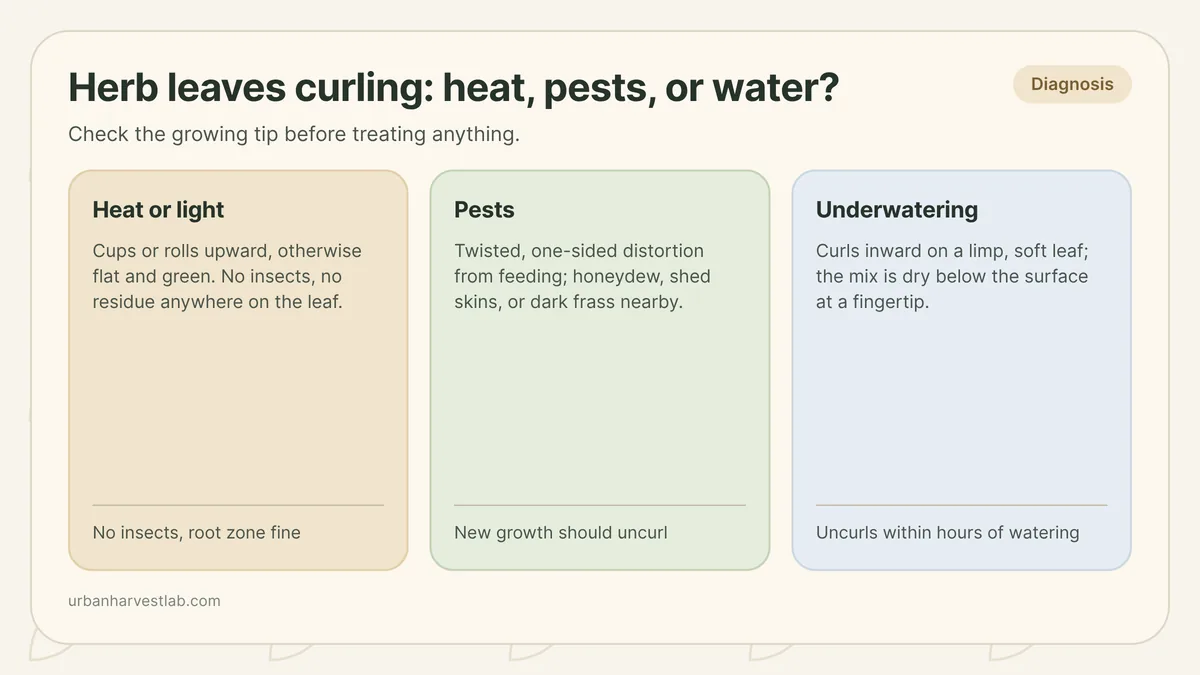
Herb leaves curling: heat, pests, or water
Curling herb leaves usually mean one of three things: heat or bright light, a pest on the growing tip, or a root zone that has gone too dry.
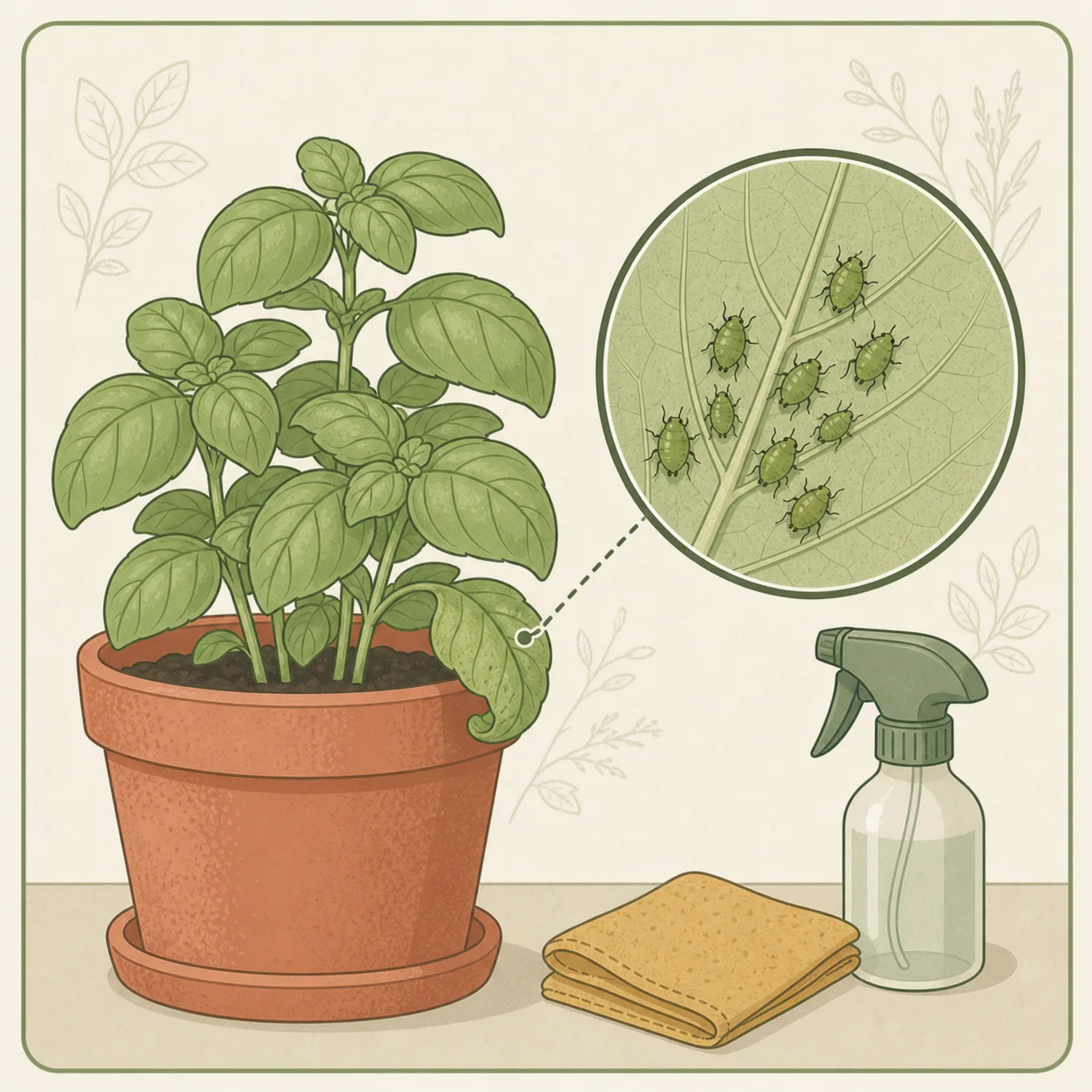
Aphids on indoor herbs: identify, isolate, and control them
Aphids are manageable when you find the colony, isolate the plant, remove most insects physically, and repeat inspections through the next generation.
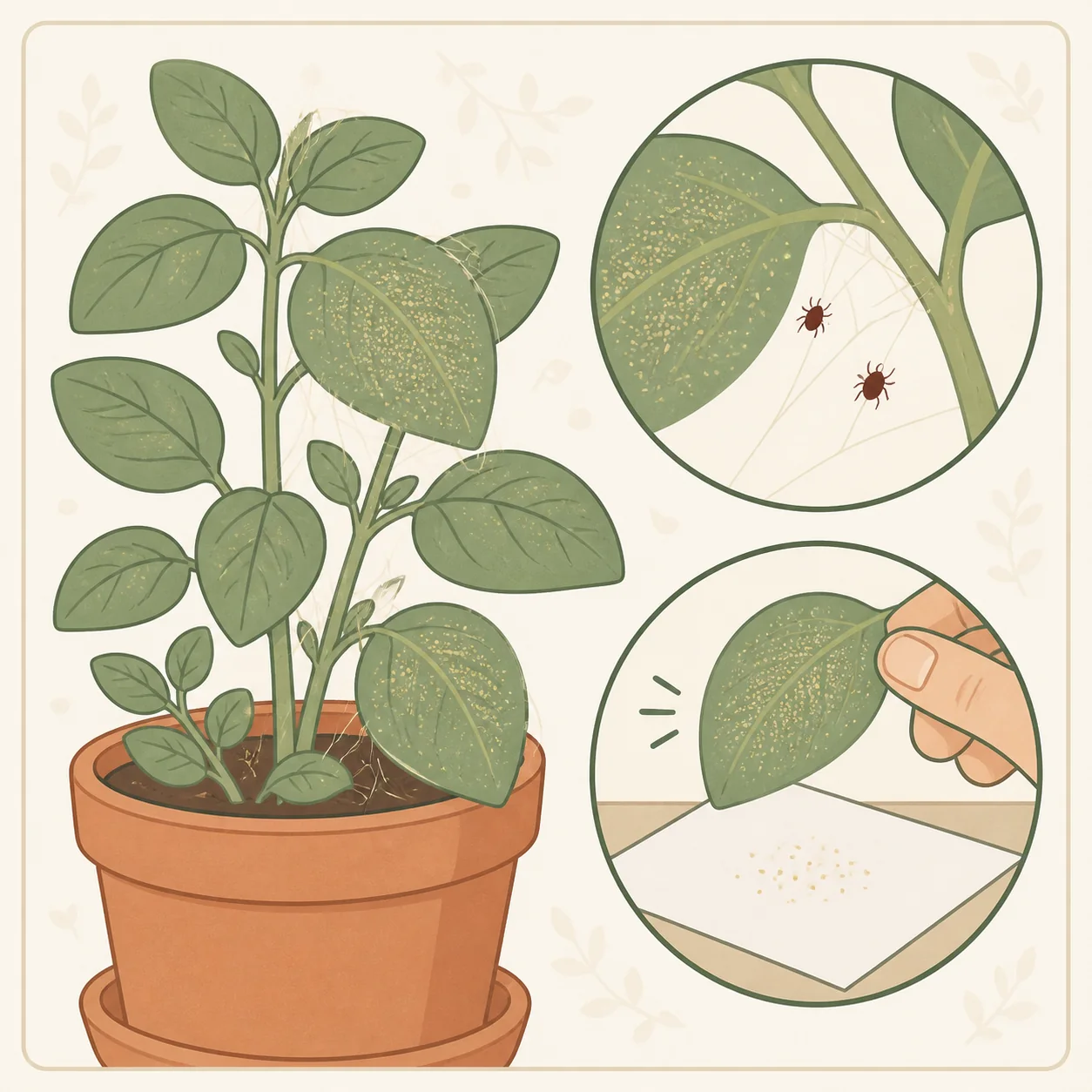
Spider mites on indoor herbs: signs, paper test, and control
Spider mites are easiest to control before webbing is obvious. Look for fine pale stippling and confirm moving specks over white paper.