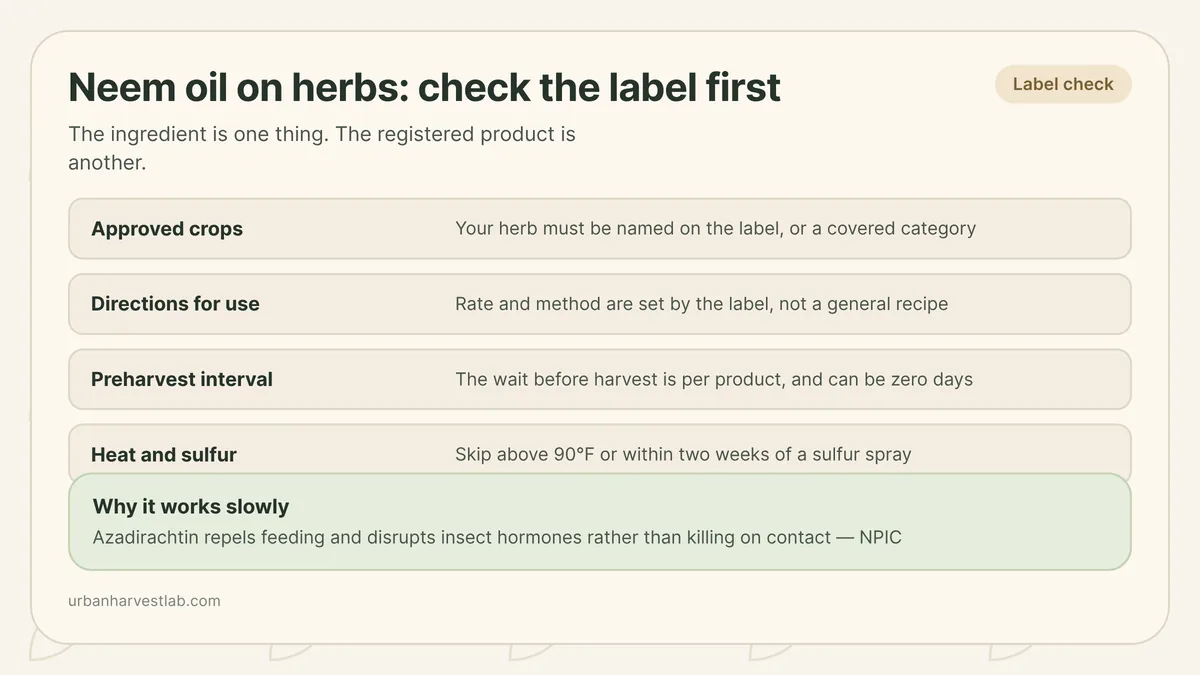
Whether neem oil is safe to spray on a herb depends on the product in your hand, not on neem oil as an ingredient. Check that your herb, or a category that covers it, appears on that specific label, then follow its rate and its wait time before harvest exactly as printed. Neem oil is not one product with one rule: the National Pesticide Information Center notes it is used in more than 100 different registered pesticide products, and each carries its own approved crops, application rates, and preharvest waits.
If you already know you are dealing with aphids, spider mites, or thrips, the label questions below are what stands between that diagnosis and a legal spray. If you have not confirmed which pest you are dealing with yet, the common potted herb problems guide and the pest identification chart are worth a look first — the label questions only matter once you know what you are treating.
What neem oil actually is
Neem oil is a naturally occurring pesticide pressed from the seeds of the neem tree. It is yellow to brown, with a bitter taste and a garlic-and-sulfur smell, according to the National Pesticide Information Center. The component that does the work is azadirachtin, which the agency describes as the most active part of the oil for repelling and killing pests. Azadirachtin reduces insect feeding and acts as a repellent, and it interferes with insect hormone systems, making it harder for insects to grow and lay eggs.
That mechanism is why neem oil is a slow product rather than a fast one. It is not primarily a contact killer that drops insects on the spot; it disrupts development and appetite over the following days. If a grower expects the same immediate knockdown as a contact spray and does not see it, that is the product working as designed, not failing.
The label decides what you can spray on food
The ingredient is one thing; the registered product is another, and it is the product’s label, not the plant’s common name for the oil, that carries legal weight. The US Environmental Protection Agency states plainly that pesticide labels are legally enforceable, and every one carries the statement that using the product in a manner inconsistent with its labeling is a violation of federal law. The label is where the agency’s review turns into a specific set of conditions: who may use the product, and where, how, how much, and how often it may be applied.
The National Pesticide Information Center puts the practical version of that rule directly: do not use a pesticide in any way other than what is specifically listed on the label, because doing so is against the law. Before buying, the agency recommends reading the label and confirming the product is intended for your specific use.
The sentence that actually decides most herb questions comes from the same source: if your fruit or vegetable is not listed on the label, you cannot apply the product to it. A neem product registered for ornamentals, and not for herbs or a named edible crop, may not lawfully be sprayed on the basil or mint you intend to eat, no matter how mild the ingredient sounds. UC IPM applies the same rule in its own aphid guidance, annotating acephate as “nonfood crops only” — a product can be recommended for a pest and still be off-limits on a plant you intend to eat.
There is no single wait before harvest for neem — check the label instead
A preharvest interval is the wait time between a pesticide application and when the crop can be harvested, and the label states how long the plant must remain in the garden after spraying. For neem, that number is not a property of the ingredient. The National Pesticide Information Center is explicit that wait times for the same fruit or vegetable can differ between products, because the EPA sets residue tolerances for every pesticide on each crop individually.
A zero-day wait is a real and common outcome, not a red flag: for products that can be applied up to the day of harvest, the label may print “0” or list no wait time at all. So the number worth finding is whichever one is printed on your container for your crop — not a rule of thumb carried over from a different bottle, a different herb, or a forum comment.
Skip the DIY recipe — use your product’s own directions
The concentration that is safe and effective depends on the specific formulation, so the rate to mix is the one in the “directions for use” section of your label, not a home recipe or a rate copied from a different product’s instructions for a different pest. The same section tells you how the product is applied and how much counts as too much. Beyond the crop list and the rate, a full label also carries first-aid information, the EPA registration number, and storage and disposal instructions — all worth reading once, before the first spray.
Application conditions that affect the result
Degradation is fast, which is part of why coverage and timing matter more than a single heavy dose. Oregon State University’s National Pesticide Information Center gives neem oil’s half-life as 3 to 44 days in soil, 48 minutes to 4 days in water, and 1 to 2.5 days on plant leaves.
Neem is grouped with the other plant-based contact oils in UC IPM guidance, and that group shares an application ceiling: apply with a high volume of water, and skip treatment on drought-stressed plants or when the temperature is above 90°F, per UC IPM. UC IPM describes horticultural oil sprays as a 1 to 2% oil solution applied in a high volume of water; the rate printed on your own product’s label is still the one that governs. UC IPM’s rule is not to apply an oil within two weeks of a sulfur application, or it may injure the plant.
What neem controls well, and where it falls short
UC Integrated Pest Management lists neem oil among the plant-based oils used against spider mites, among contact sprays for thrips, and alongside insecticidal soaps and horticultural oils applied directly to mealybugs. It also appears as one option for eradicating an active powdery mildew infection rather than only preventing one — a use case covered in more depth on the powdery mildew page for anyone dealing with that instead of an insect.
Because azadirachtin works through feeding disruption and hormone interference rather than a fast kill, it fits a repeat-and-observe pattern better than a single decisive spray. That also means coverage matters: undersides of leaves and growing tips, where soft-bodied pests cluster, need to be wetted directly.
Human, pet, and pollinator safety
Neem oil itself can be slightly irritating to the eyes and skin, according to the National Pesticide Information Center, which is a reason to avoid contact during mixing and application rather than a reason to avoid the product outright. The remaining components, once azadirachtin is extracted, are generally recognized as safe by the US Food and Drug Administration. The National Pesticide Information Center describes neem oil as practically non-toxic to birds, mammals, bees, and plants, and states that bees and other pollinators are not likely to be harmed by it. None of that substitutes for reading your own label’s precautions, but it is the baseline NPIC publishes.
Before you spray: what to check on the label
| Label section | What it tells you | Why it matters for herbs |
|---|---|---|
| Approved crops or use sites | Whether your specific herb, or a covered category, is listed | An unlisted crop cannot legally be treated, whatever the ingredient |
| Directions for use | The mixing rate, application method, and how often to repeat | Concentration is set per formulation, not per ingredient |
| Preharvest interval | The wait time in days before you can harvest that crop | This can be zero, and it differs by product, not just by plant |
| Temperature and condition notes | Limits such as a heat ceiling or a gap after a sulfur spray | Applying outside those conditions risks injuring the plant |
| EPA registration number, first aid, storage | Identification, exposure response, and safe handling | Needed if you ever have to identify the product to a poison control line |
Common mistakes
- Buying a product labeled for ornamentals and using it on a herb because “it’s just neem oil.”
- Assuming a wait-before-harvest number from one product or one crop applies to a different bottle or plant.
- Mixing a stronger solution than the label states because the first application “didn’t seem to do much.”
- Spraying during a heat wave or right after using a sulfur product on the same plant.
- Expecting a fast knockdown and concluding the product failed within a day or two.
- Skipping the label entirely because the ingredient sounds natural and therefore harmless.
Sources
- National Pesticide Information Center, “Neem Oil General Fact Sheet”
- National Pesticide Information Center, “Preharvest Interval”
- National Pesticide Information Center, “Reading Pesticide Labels”
- US EPA, “Introduction to Pesticide Labels”
- UC Statewide IPM Program, Pest Notes 7405, “Spider Mites”
- UC Statewide IPM Program, Pest Notes 7429, “Thrips”
- UC Statewide IPM Program, Pest Notes 74174, “Mealybugs”
- UC Statewide IPM Program, Pest Notes 7493, “Powdery Mildew on Ornamentals”
- UC Statewide IPM Program, Pest Notes 7404, “Aphids”
Diagnose the pest before you spray
Coverage and timing depend on what you are actually treating, so confirm the insect first.
Common questions
Is neem oil safe to use on herbs I plan to eat?
It depends on the product in your hand. Neem oil is sold in more than 100 registered pesticide products, and only one whose label names your herb, or a category that covers it, can legally be applied to that plant.
What is the pre-harvest interval for neem oil?
There is no single number for neem oil as an ingredient. Preharvest intervals are set per product per crop, so the label on your container states the wait time, which can be zero days.
How much neem oil should I mix for herbs?
Use the dilution and application rate printed in the directions for use on your product's own label rather than a general recipe, since concentration and formulation differ between products.
Why is neem oil not killing the insects right away?
Its active component, azadirachtin, mainly repels feeding and disrupts insect hormone systems rather than killing on contact, so results build over days rather than appearing immediately.
Related guides
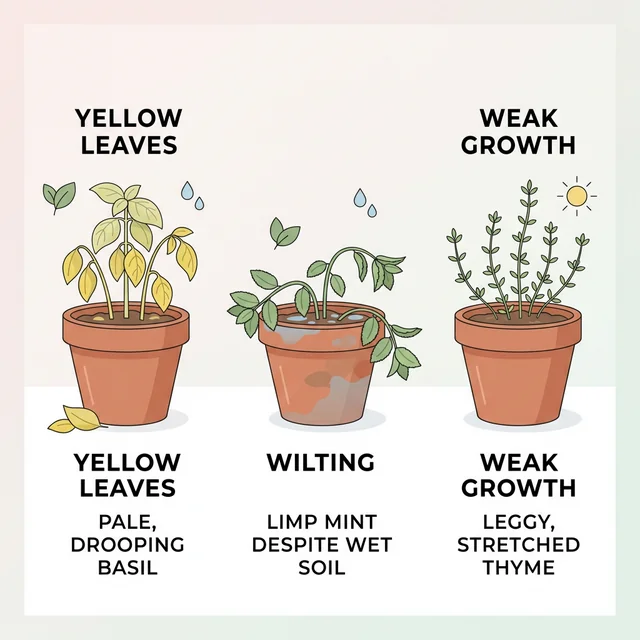
Common potted herb problems: yellow leaves, wilting, and weak growth
Common potted herb problems usually show up as yellow leaves, wilting, or weak growth, but the useful diagnosis starts with light, drainage, and root stress.
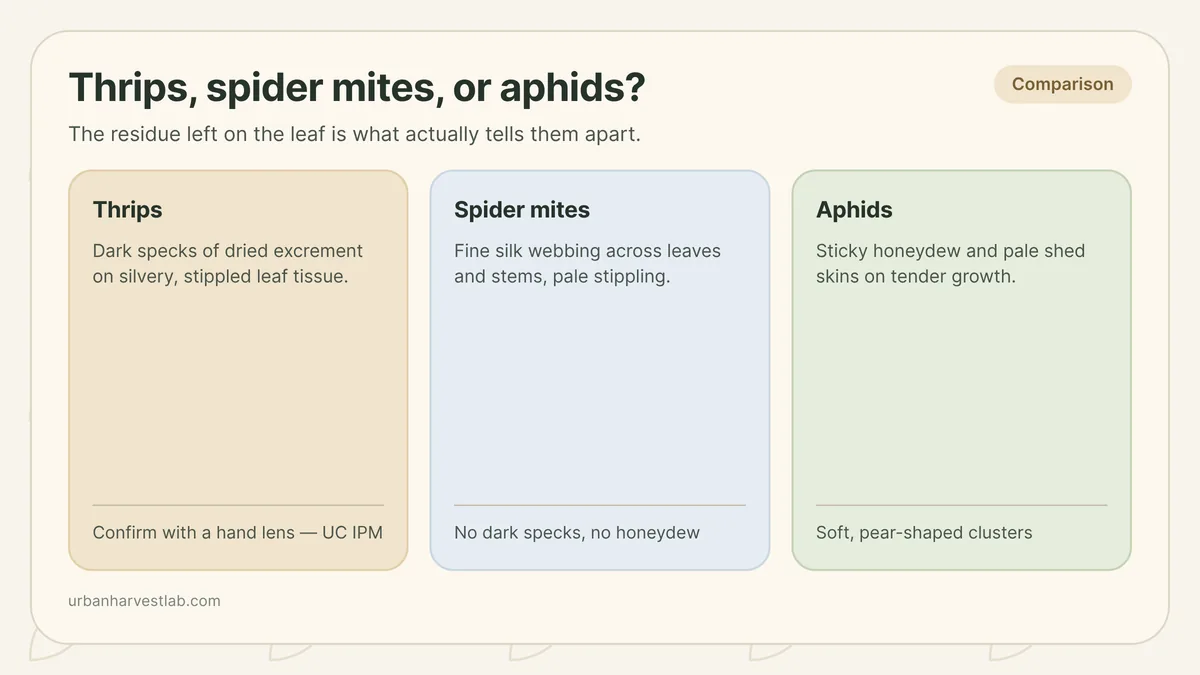
Thrips on herbs: identify the damage and stop it
Thrips leave silvery, stippled leaves and dark specks of excrement rather than webbing or honeydew, and confirming the insect matters more than guessing from the damage alone.
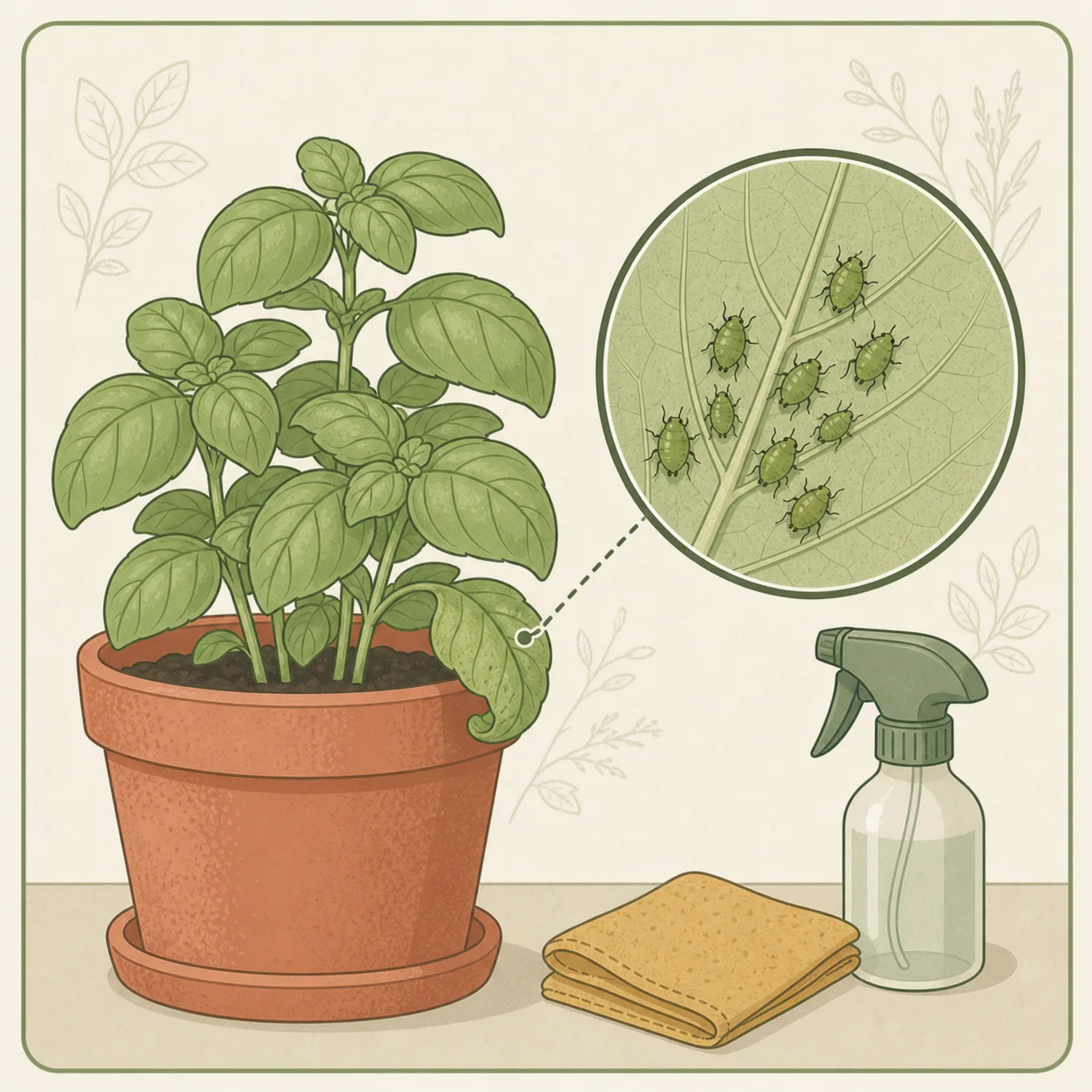
Aphids on indoor herbs: identify, isolate, and control them
Aphids are manageable when you find the colony, isolate the plant, remove most insects physically, and repeat inspections through the next generation.