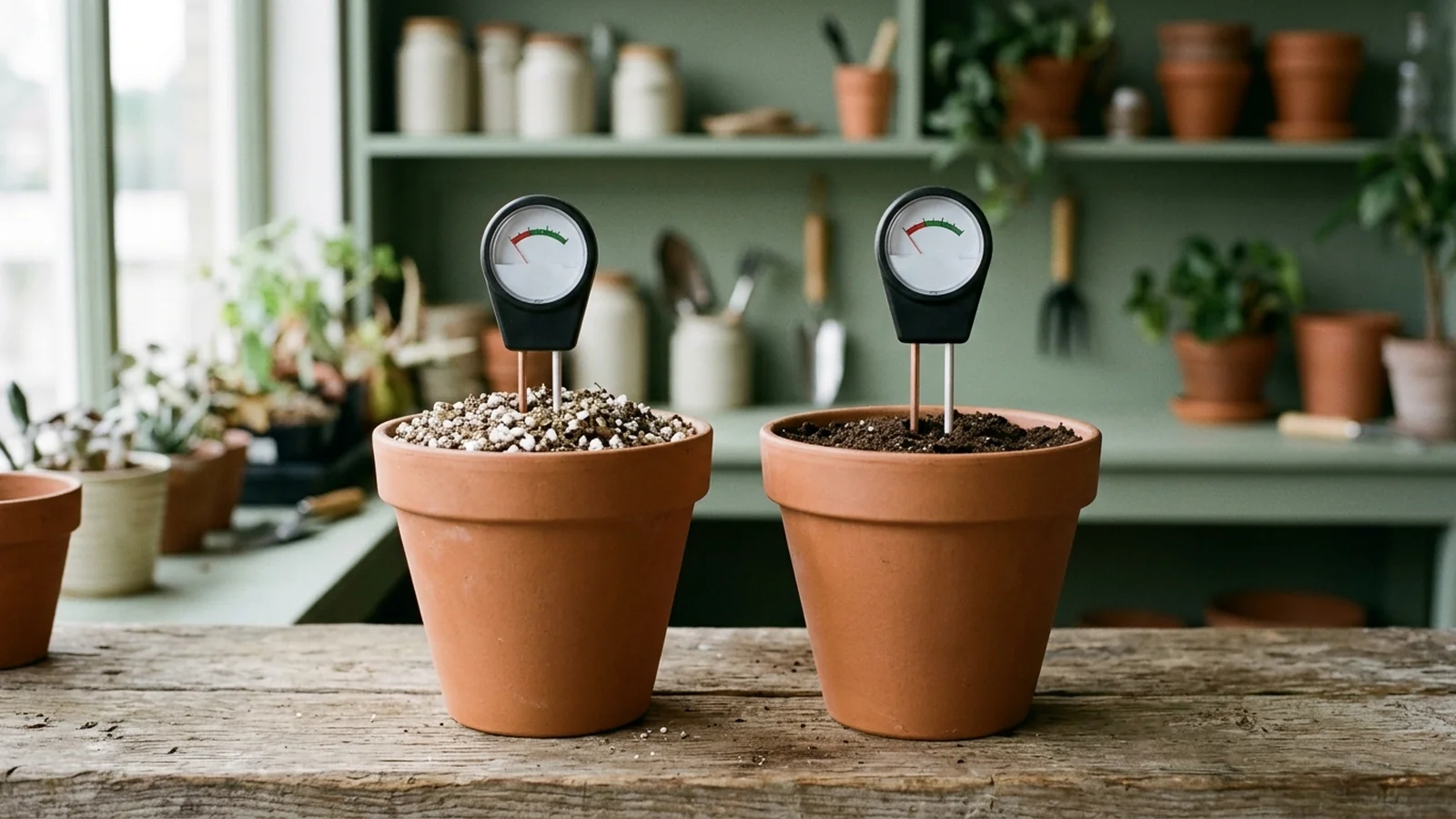
A cheap two-prong soil moisture meter does not measure water. It measures electrical resistance between its two metal tips and translates that into a position on a “dry / moist / wet” dial. Water usually lowers that resistance, which is why the needle tends to move the right direction — but salts, how well the prongs contact the mix, and how deep they were pushed all change the reading independently of how much water is actually there. Once you know what the dial is really responding to, the confusing readings stop being confusing. For a full read on whether a plant itself is over- or underwatered, overwatered vs underwatered covers the diagnosis directly; the rest of what follows here is about the instrument, not the plant.
What the probe is actually reading
The principle behind a supermarket moisture probe is the same one described in professional irrigation equipment: two electrodes are inserted into a medium, and the amount of electrical current that passes between them is converted into a reading. Oregon State University Extension Service’s guide to soil moisture monitoring describes it plainly for the resistance-block sensors used in commercial irrigation scheduling — “electrical conductivity increases with moisture content,” so a wet medium produces low resistance and a dry one produces higher resistance. A cheap analog dial works on that same underlying physics, scaled down to a hobby price point and without the calibration tables a professional sensor relies on to convert the raw signal into a real number.
That distinction between the raw electrical signal and an actual water measurement is the whole story. The signal is real. What it means is not fixed.
Why salts move the needle without the water changing
Dissolved salts conduct electricity more readily than plain water does, and both extension sources that document resistance-based moisture sensing name salinity as a direct source of error. Iowa State University Extension and Outreach’s guide to evaluating field soil moisture states it about gypsum resistance blocks, the same electrical principle at work in a consumer probe: “accuracy is limited under saline and dry conditions.” Oregon State’s soil moisture guide gives the mechanism: “because salts increase electrical conductivity, highly saline soils can cause inaccurate readings.”
For a potted plant, that shows up in two opposite situations that both produce the same misleading result. A mix that was fertilized recently carries a fresh load of dissolved salts, so a probe pushed in shortly afterward tends to read wetter than the actual moisture level justifies. A mix that has gone a long stretch without being flushed accumulates its own salt buildup from repeated feeding, and that older, saltier mix can likewise read wetter than a chemically cleaner mix at the identical moisture level. Neither situation means the meter is broken. It means the meter cannot separate “more water” from “more dissolved salt,” because both lower resistance the same way.
Why contact matters as much as moisture
The second failure mode has nothing to do with chemistry and everything to do with physical touch. A resistance reading depends on the tips making solid contact with damp material, and a loose, peaty, or heavily perlite-cut mix does not always give them that. Oregon State’s guide states the requirement directly for granular matrix sensors, which rely on the same contact-dependent physics: they “require soil contact for accuracy.” The same publication flags the equivalent problem for capacitance-type sensors, noting they are “sensitive to air gaps around the probe” and that their accuracy “depends on proper soil contact and installation.”
In a container, that means a mix built for drainage — chunky bark, a heavy perlite cut, coarse peat — can leave air pockets around the prongs even when there is plenty of water sitting nearby in the pores just out of contact. The dial then drops toward “dry” for a reason that has nothing to do with the plant’s actual water supply. Pushing the probe in at a slightly different spot, or angling it to seat both tips against solid mix, often changes the reading by itself, which is a useful test in its own right: if the number jumps around depending on exactly where you push, contact is the variable in play, not moisture.
The reading is only as deep as the tips
A probe reports the condition at the depth it reached, not the condition of the pot as a whole, and container soil does not hold moisture evenly from top to bottom. An Oregon State University Extension archive on container growing media, written by University of Illinois plant physiologist L. Art Spomer, lays out the physical reason: “a perched water table forms at the container soil bottom (drainage level), even though it has free drainage,” and “water content decreases with height above the water table.” In practice, that means the surface inches of a pot can be genuinely dry while the base sits in a saturated layer that does not fully drain — the same layer implicated in root rot when it persists too long. How much of that bottom band a given pot carries also depends on the drainage holes themselves and what sits below them; pot drainage holes explained covers the container side of the same physics. Spomer’s explanation adds the container-size detail that makes this matter for pot choice: “the deeper the container soil, the lesser its surface and average water content following watering and drainage,” so a shallow pot holds proportionally more of its total volume inside that saturated bottom band than a deep one does.
A probe inserted only an inch or two into the surface misses that bottom layer entirely. It can read confidently dry while the roots sit in standing water below — which is precisely the situation that damages roots, because it hides the one condition a grower most needs to catch early.
Three technologies, three different accuracies
Not every moisture sensor works the way a cheap dial probe does, and the differences matter if you are choosing between instruments rather than just reading one you already own. Oregon State’s guide documents three distinct approaches used across home and commercial settings, each with its own strengths and failure points.
| Technology | How it responds to water | What the guide says about accuracy | Where it struggles |
|---|---|---|---|
| Electrical resistance (the principle behind a cheap two-prong dial) | Resistance drops as the surrounding material gets wetter | No calibrated accuracy figure given for consumer versions; professional gypsum and granular-matrix versions are read against manufacturer tables | Salinity, poor soil contact, no volumetric calibration |
| Capacitance / frequency-domain | Resonant frequency of an electrical circuit shifts as the medium’s dielectric properties change with water content | Lower cost than time-domain reflectometry (TDR); needs calibration for different soil textures | ”More sensitive to salinity and temperature effects” and “sensitive to air gaps around the probe” |
| Time-domain reflectometry (TDR) | An electromagnetic pulse travels more slowly through wetter material, and the sensor times that delay | ”Generally very accurate (±2%–3% volumetric water content under proper calibration)“ | Calibration may still be soil-specific “for soils high in clay or organic matter”; costs more than the other two |
The pattern across all three: nothing on this list eliminates the need for calibration, and every technology has a documented weak point. A cheap analog dial is simply the least calibrated version of the same underlying idea, with the fewest safeguards against the failure modes the table above names.
The free, no-battery alternative: weight
For a pot small enough to lift, weight sidesteps the salt problem and the contact problem at the same time, because it responds only to how much water mass the container is actually holding. Clemson Cooperative Extension’s Home & Garden Information Center states the underlying fact plainly: “as potting mixtures become dry, a definite loss in weight can be observed.”
The method is simple enough to do without any tool. Water thoroughly, let the pot finish draining, and lift it once to register that saturated baseline weight. Lift it again a day or two later, and the difference between the two tells you more about real water loss than a single dial reading ever will, because it is not vulnerable to fertilizer salts and it does not care whether the mix happens to make good contact with a metal tip. It will not tell you where the water sits inside the pot the way a deep probe can, but for a container you can pick up, it answers the question that actually matters — has this pot lost real water since it was watered — without any of the confounds above. If a plant is already showing yellowing or wilting rather than just prompting a routine check, the yellow leaves cause finder sorts through the wider set of causes moisture readings alone cannot separate.
When a meter earns its place
None of this makes an electrical probe pointless. It means the reading has to be matched to the situation. Weight stops being practical once a container is too large or too heavy to lift comfortably, and a finger can only confirm the top few inches of a deep pot, exactly the layer the perched-water-table pattern above says is least informative. A large, deep container that a hand cannot reach into, or a mix that reliably looks dry on top while staying wet lower down, is where a probe long enough to reach past the surface layer earns a place in the routine — provided the salt and contact caveats above are read alongside the number, not instead of it.
For everything else — a windowsill herb pot, a small container you can lift one-handed — weight and a finger cost nothing, need no calibration, and are not fooled by last week’s fertilizer. A watering schedule tool or a container-vegetable watering routine is a reasonable starting point for how often to check in the first place — the probe or the finger then decides whether that day’s check actually needs a watering can.
Common mistakes
- Trusting a single reading from one insertion point instead of checking whether the number changes when the probe is repositioned.
- Reading a “wet” result right after fertilizing as proof the pot does not need water yet, when the salts, not the water, moved the needle.
- Pushing the probe only into the top few inches and assuming that reading describes the whole pot, including the base where water actually collects.
- Buying a longer probe for a large container without accounting for the same contact and salinity limits that affect a short one.
- Ignoring pot weight because a meter is sitting right there, when weight is the cheaper and more direct check for anything liftable.
FAQ
Do cheap soil moisture meters actually work?
They respond to something real, an electrical signal between two metal tips, but that signal is not the same thing as water content. It reflects resistance in whatever is touching the tips, and salts, contact, and depth all move it independently of how much water is actually in the mix. Read it as a rough indicator, not a measurement, and confirm a surprising reading with a finger or by lifting the pot.
Why does my meter read wet right after I fertilize?
Fertilizer adds dissolved salts to the mix, and salts carry electrical current more easily than plain water does. A resistance-type probe cannot tell the difference between “more water” and “more dissolved salt,” so a freshly fed pot commonly reads wetter on the dial than it actually is.
Why does the meter read dry when the bottom of the pot is soaked?
The reading only reflects conditions at the depth the prongs reached, usually a few inches. Water tends to collect near the base of any container, a pattern extension research on container media describes as a perched water table, so a probe pushed only into the top layer can read dry while the root zone lower down is saturated.
Is checking pot weight more reliable than a meter?
For a pot small enough to lift, weight avoids the salt and contact problems entirely, because it responds only to how much water mass is actually in the container. Lift the pot right after a thorough watering to feel the wet baseline, then lift it again a day or two later; the difference is a more honest signal than a single dial reading, especially in a mix loose enough to give the prongs poor contact.
Sources
- Oregon State University Extension Service: Soil Moisture Monitoring to Support Irrigation Scheduling (EM 9868)
- Iowa State University Extension and Outreach: How to Evaluate Soil Moisture in the Field
- Oregon State University Extension archive (Ornamentals Northwest): Container Soils Are Different
- Clemson Cooperative Extension HGIC: Indoor Plants – Watering
Read the pot itself, not just the dial
These guides cover the diagnosis a meter cannot make on its own, plus the drainage and routine questions that decide whether a reading means anything.
Common questions
Do cheap soil moisture meters actually work?
They respond to something real, an electrical signal between two metal tips, but that signal is not the same thing as water content. It reflects resistance in whatever is touching the tips, and salts, contact, and depth all move it independently of how much water is actually in the mix. Read it as a rough indicator, not a measurement, and confirm a surprising reading with a finger or by lifting the pot.
Why does my meter read wet right after I fertilize?
Fertilizer adds dissolved salts to the mix, and salts carry electrical current more easily than plain water does. A resistance-type probe cannot tell the difference between "more water" and "more dissolved salt," so a freshly fed pot commonly reads wetter on the dial than it actually is.
Why does the meter read dry when the bottom of the pot is soaked?
The reading only reflects conditions at the depth the prongs reached, usually a few inches. Water tends to collect near the base of any container, a pattern extension research on container media describes as a perched water table, so a probe pushed only into the top layer can read dry while the root zone lower down is saturated.
Is checking pot weight more reliable than a meter?
For a pot small enough to lift, weight avoids the salt and contact problems entirely, because it responds only to how much water mass is actually in the container. Lift the pot right after a thorough watering to feel the wet baseline, then lift it again a day or two later; the difference is a more honest signal than a single dial reading, especially in a mix loose enough to give the prongs poor contact.
Related guides
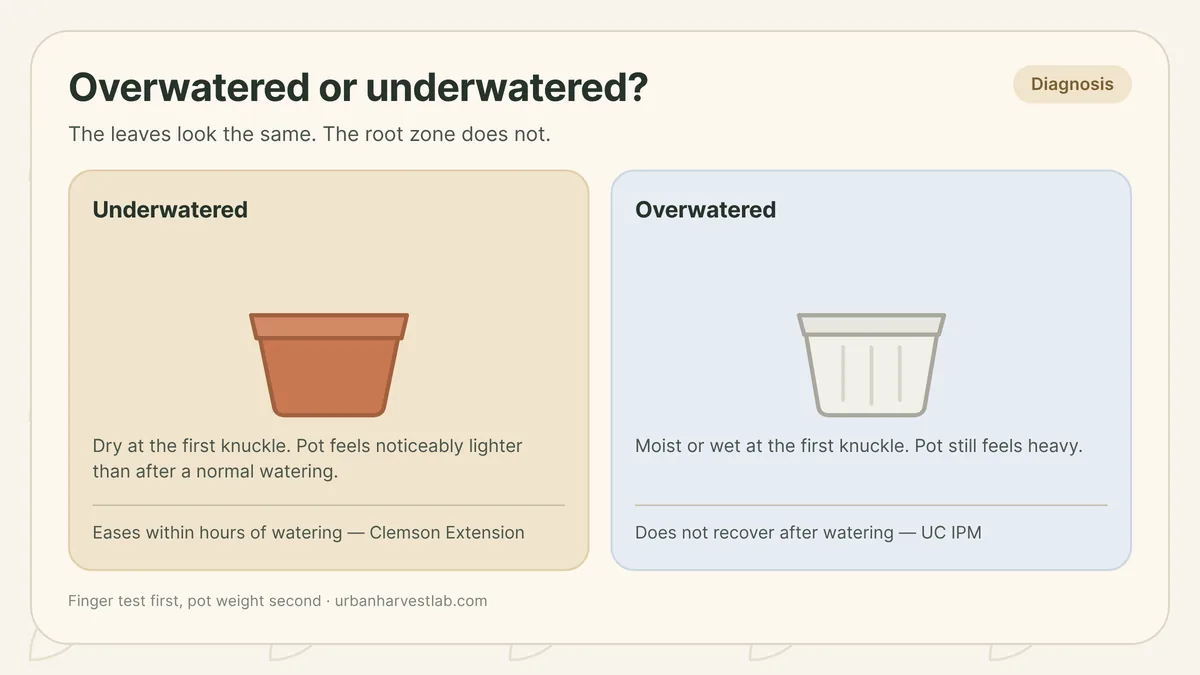
Overwatered vs underwatered: how to tell which one you have
Reading the root zone directly, with a finger test, pot weight, and how the plant responds to being watered, settles what the leaves alone cannot.
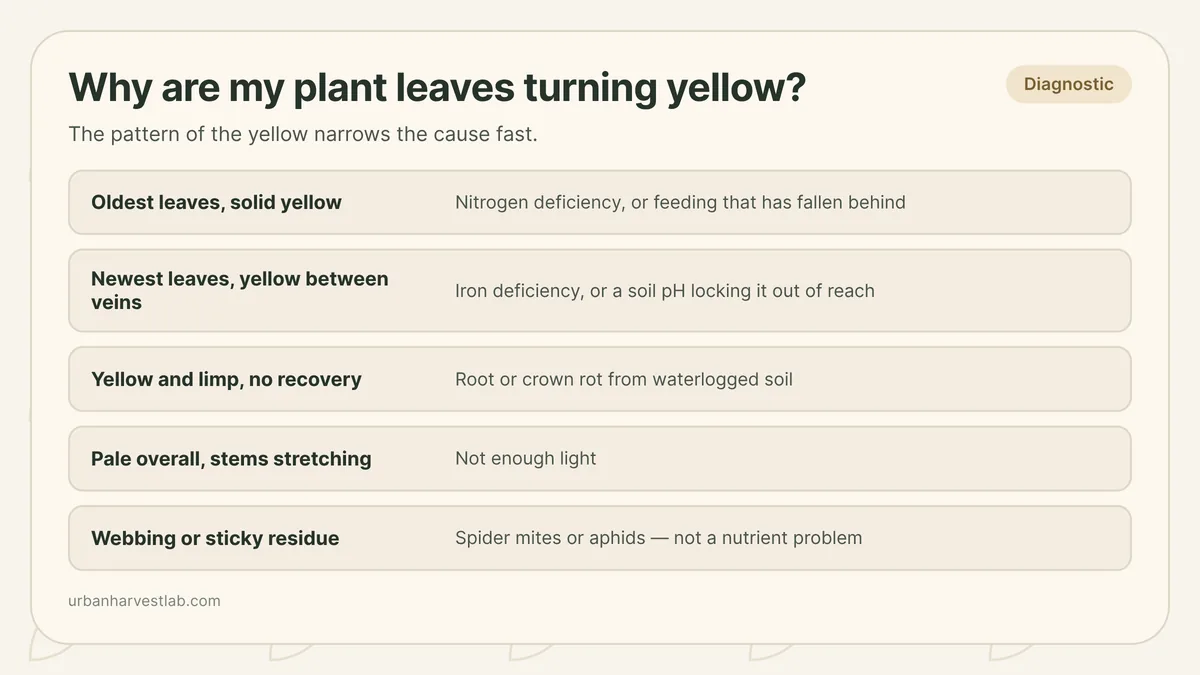
Why are my plant leaves turning yellow? Find the likely cause
Yellow leaves have a short list of real causes, and the pattern of the yellowing narrows it fast, once you know what to look for.
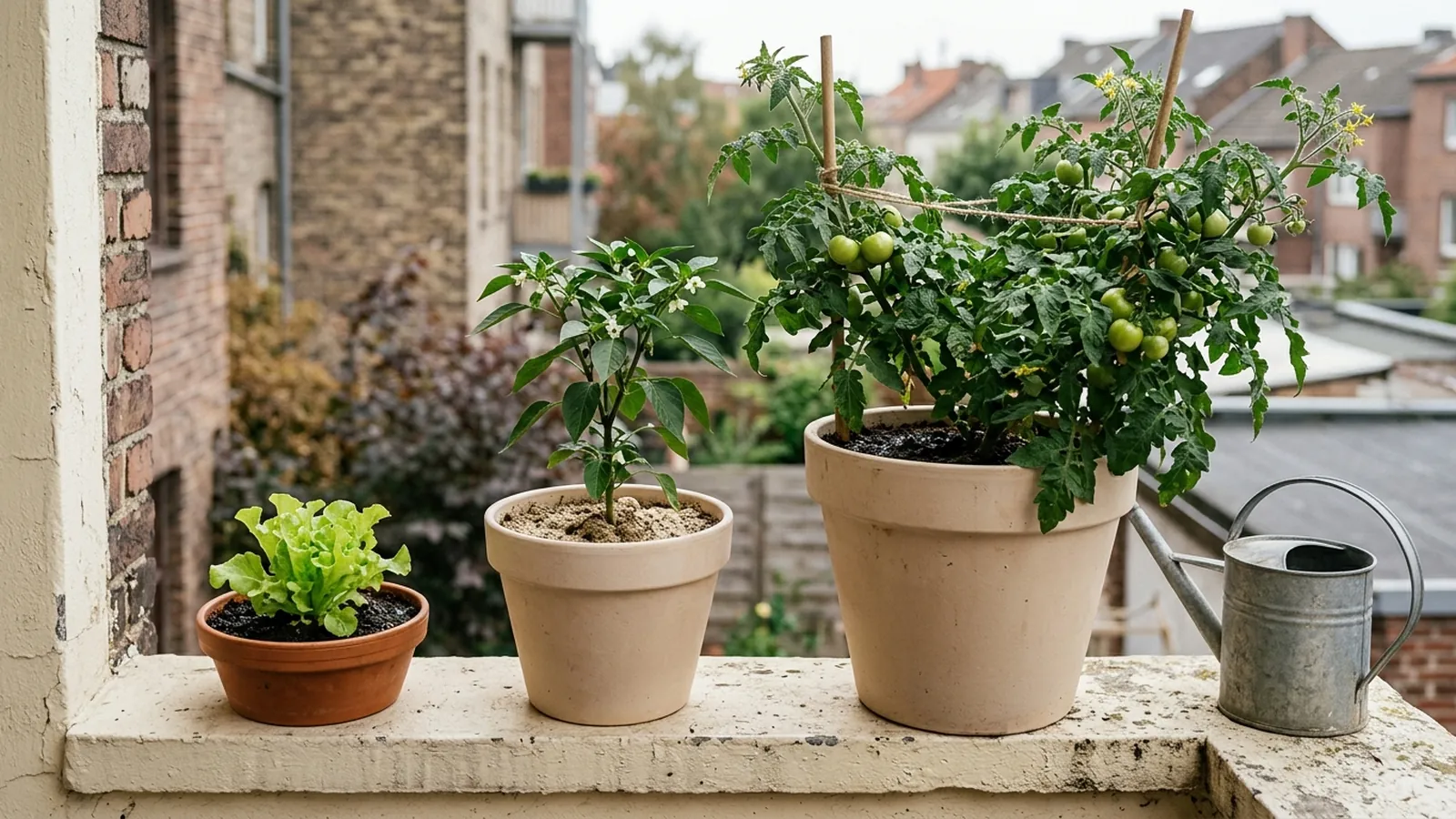
How often to water container vegetables: volume and crop stage set the interval
A pepper in a 2-gallon pot in May and the same pepper in the same pot in August are two different watering problems. Once you can see why, the question stops being how often and becomes how much mix you gave the plant, and what it is carrying right now.