Enter a herb group, a pot size, a material, a season, and a location, and the generator below returns how often to check the pot for dryness — not how often to water it. That distinction is the entire point: a container’s water need swings too widely with pot size, material, heat, and wind for a fixed calendar to hold, which is exactly why how often to water potted herbs answers “how often” with a physical test rather than a day count. The generator turns that same test into a personal reminder schedule, then leaves the real decision — water, or wait — to the finger pressed into the mix at each check.
Clemson Cooperative Extension makes the reason a fixed calendar falls short explicit: “the symptoms of over-watering and underwatering are similar,” so a schedule that assumes a pot is dry and waters it anyway can make root health worse rather than better. Checking first is not an extra step bolted onto watering. It is what keeps a calendar from acting on a day it does not actually describe.
Why the schedule is a check, not a watering
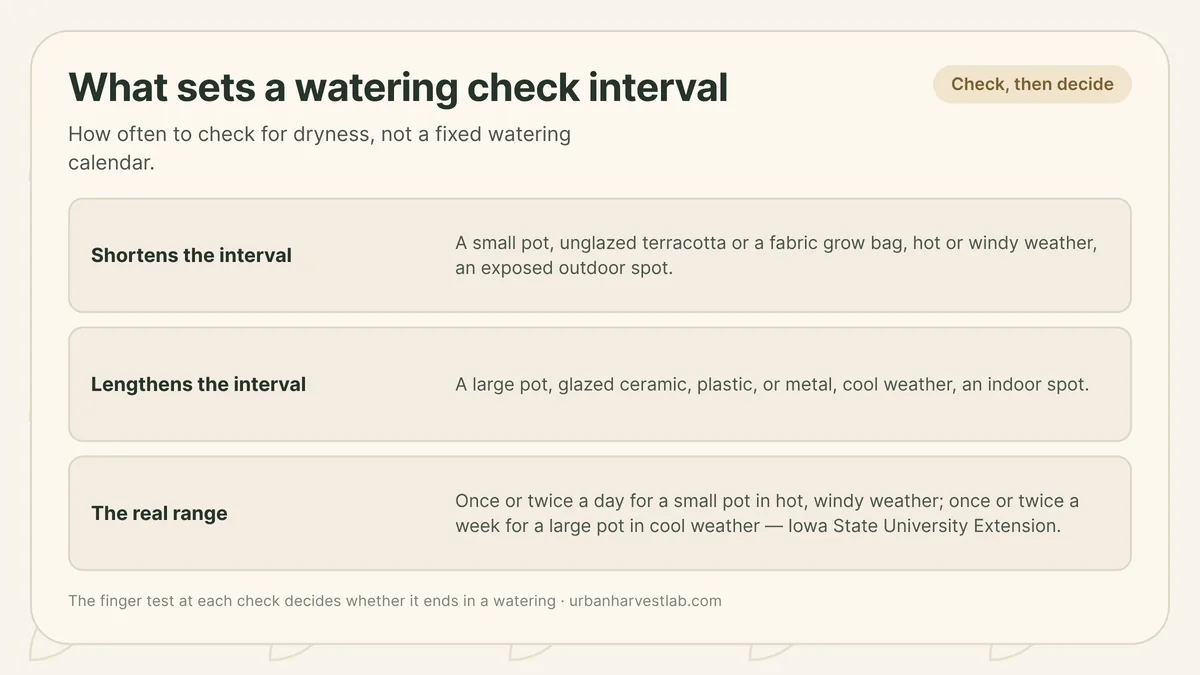
How fast a container dries is set by physics a calendar cannot see: how much surface area is exposed relative to the volume of mix inside, whether the container wall itself loses water, how much heat and wind pull moisture out, and whether the pot sits somewhere sheltered or exposed. Iowa State University Extension’s own range names the two ends of that swing: water “when the potting mix is dry at a depth of 1 to 2 inches,” with frequency running from “once or twice a day (small container, hot, windy weather) to once or twice a week (large container, cool weather).” A single fixed number cannot sit honestly inside a range that wide. What can be scheduled reliably is when to go check — and that is what the fields below compute.
Herb still matters to that interval, even though it is not setting the watering day itself. Mint and lemon balm carry soft, wide leaves that lose water quickly under heat and light, so a missed check costs them more than it costs rosemary or thyme, which tolerate a longer stretch between soakings by design. The generator shortens the check interval for the moisture-loving group and lengthens it for the Mediterranean group for that reason — not because their calendar differs, but because the cost of checking late is not the same. That grouping is about how fast a leaf canopy loses water, not a claim that mint needs watering more often than basil in absolute terms; the herb watering chart is where basil and mint sit in the same broader moisture group.
Generate your check schedule
Choose how thirsty the herb group runs, describe the pot in front of you, and set the season and location around it — the schedule below updates immediately.
Live schedule
This sets how often to go check the pot, not how often to water it. Confirm every result with a finger pressed into the mix before deciding to water.
Suggested check interval
—
Enter a pot diameter to start
- Pot size bucket
- —
- Dryness score
- —
- At each check
- Finger-depth test, 1–2 in
Enter a pot diameter to see the math.
The result is a reminder, not a permit. A “check every 2-3 days” result means go press a finger into the mix every 2-3 days — it does not mean water on that day regardless of what the mix feels like.
Score your own pot by hand
The arithmetic behind the generator is a simple point tally: add a value for pot size, material, season, location, and herb group, then match the total to an interval band. By diameter: up to 6 in scores 3 points, 7-10 in scores 2, 11-14 in scores 1, over 14 in scores 0. By material: unglazed terracotta adds 2, a fabric grow bag adds 1.5, metal adds 0.5, and plastic or glazed ceramic add nothing. By season: cool adds 0, warm adds 1.5, hot and windy adds 3. By location: indoors adds 0, outdoors adds 1.5. By herb group: Mediterranean or woody adds 0, leafy or soft adds 1, mint or lemon balm adds 2. The bands: 8.5 or more checks twice a day, 6.5 to 8.4 checks once a day, 4.5 to 6.4 checks every 2-3 days, 2.5 to 4.4 checks every 3-4 days, and under 2.5 checks about once a week.
| Pot size (diameter) | Material | Season / location | Herb group | Check interval |
|---|---|---|---|---|
| Small, up to 6 in | Terracotta | Hot and windy, outdoors | Mint / lemon balm | Twice a day |
| Small to medium, 7-10 in | Terracotta | Warm, outdoors | Leafy (basil, parsley) | Once a day |
| Small to medium, 7-10 in | Plastic | Warm, outdoors | Leafy (basil, parsley) | Every 2-3 days |
| Large, 11-14 in | Plastic | Warm, indoors | Leafy (basil, parsley) | Every 3-4 days |
| Extra-large, over 14 in | Glazed ceramic | Cool, indoors | Mediterranean (rosemary, thyme) | About once a week |
A small terracotta pot of mint on a hot, exposed balcony and a large glazed pot of rosemary indoors on a cool day are the two ends of the same range Iowa State University Extension describes — daily or twice-daily checking at one end, weekly at the other. Most container setups land somewhere between those rows, not at either extreme.
What each input is actually changing
Pot size
A small pot holds less mix relative to its exposed surface, so the same drying conditions pull a larger share of its total water out faster. A large tub holds a deeper reserve behind the same surface area, which is why Iowa State’s range puts “large container” at the slow end and “small container” at the fast end.
Material
University of Illinois Extension is the source behind this distinction: unglazed terracotta and fabric grow bags are porous, so water moves through the container wall by evaporation as well as off the soil surface, and an unglazed clay pot dries faster than an identical plastic or glazed pot standing in the same spot. Metal containers are not porous the same way, but a dark, thin-walled metal pot can heat up quickly in direct sun and warm the mix from the outside, which speeds drying by a different route.
Season and conditions
Heat and wind both pull moisture out of the mix and off the leaf surface faster than still, mild air does. This is the same pair of conditions Iowa State names at the fast end of its range — a small pot in a hot, windy spot is the setup most likely to need checking twice in one day.
Indoor vs. outdoor
An indoor pot is buffered from wind entirely and usually from direct sun as well, so its drying rate stays fairly steady day to day. An outdoor pot on a balcony or patio can swing from a mild morning to a hot, gusty afternoon within the same day, which is the main reason outdoor containers need checking more often than an indoor pot of the same size and material.
Do the check itself
Push a finger into the mix to the depth Iowa State University Extension uses as its trigger point: about 1 to 2 inches. If it feels cool and damp and clings to your skin, wait and check again at the next interval. If it feels dry and falls away, that is the point to water — not the calendar date, the finger. If the mix has pulled away from the pot’s sides and water runs straight through instead of soaking in, that is a different problem than an ordinary dry check — Iowa State University Extension’s fix is to stand the whole container in a tub of water for 20 to 30 minutes to remoisten it; protecting container plants during a heatwave covers that case in full.
Do not diagnose from the leaves alone. Clemson Cooperative Extension’s caution applies directly here: over-watering and underwatering produce similar symptoms, and both damage root health if they continue. A wilted, dull, or yellowing herb can be signalling either problem, so treat leaf appearance as a reason to go check the mix, not as a substitute for checking it.
Read the printable sheet
A useful watering card needs four things on it: the herb group, the pot description, the check interval, and a one-line reminder of the finger-depth test itself — a card that only shows the interval tells nobody what to actually check for. The Print this schedule button captures the current result as exactly that, through the browser’s normal print dialogue. The point table and bands further up work the same way on paper if the widget itself does not load. If the away period is longer than a few days, the interval alone is not a plan — how to water potted herbs while on vacation covers the actual coverage methods, from a neighbor working from the printed card to a wicking system that removes the need for a visit at all.
A heatwave changes the numbers on the sheet, not just the reader’s patience with checking. Re-run the fields with “Hot and windy” selected before a forecast heat spell, and pair the result with how often to water herbs in summer for what else moves during that stretch — shade, grouping pots, and where a saucer helps rather than causes standing water.
Update the schedule as the pot, plant, or season changes
A schedule generated once is not permanent. Moving a herb from a 6-inch starter pot into a 12-inch container changes the pot-size input outright, and usually lengthens the interval by a full band. Best containers for herbs covers sizing and material choice together, since both feed directly into the fields above.
Switching to a reservoir-fed pot changes the question rather than just the interval. Best self-watering pots for herbs covers which setups actually hold moisture evenly enough to make a daily check unnecessary, and which still need the same finger-depth confirmation the generator assumes here.
Re-run the fields whenever the season turns, a plant moves between indoors and a balcony, or a pot gets repotted — each of those is exactly the input the generator asks for, and potted herb care covers the wider routine of watering, feeding, and pruning that the check-schedule sits inside.
Where the actual watering rhythm comes from
Everything above sets when to go check a pot. How many days a given herb can actually go between waterings is answered herb by herb below: how often to water potted herbs and the herb watering chart group herbs by moisture need and give the rhythm for each group, and guides like how often to water basil and how often to water rosemary go herb by herb from there. Use the generator to know when to go check a pot; use that family of pages to judge what the check actually means once you get there.
Sources
Where the per-herb numbers come from
The interval below only says when to test the soil. These pages give the watering rhythm itself, herb by herb.
Common questions
Does this tell me how often to water my herbs?
No. It works out how often to check the pot for dryness, using pot size, material, season, and location. Whether a given check actually ends in a watering, and how that varies by herb, is answered by testing the mix at each check — the how-often-to-water-potted-herbs chart and its per-herb guides cover the watering rhythm itself once the check is done.
Why does pot material change the check interval?
Unglazed terracotta and fabric grow bags are porous, so water moves out through the container wall as well as the soil surface, and a pot like that dries faster than an identical one in plastic, glazed ceramic, or metal. A porous material shortens the interval; a sealed one lengthens it.
What do I actually do at each check?
Push a finger into the mix. Iowa State University Extension's trigger point is potting mix that is dry one to two inches down; if it still feels cool and damp at that depth, wait and check again at the next interval instead of watering on a fixed day.
Why does the generator suggest checking twice a day for some setups?
Iowa State University Extension notes that a small container in hot, windy weather can need checking once or twice a day, while a large container in cool weather may only need checking once or twice a week. A small terracotta pot on an exposed summer balcony sits at the fast end of that range, which is why the top of the interval reaches twice daily.
Related guides
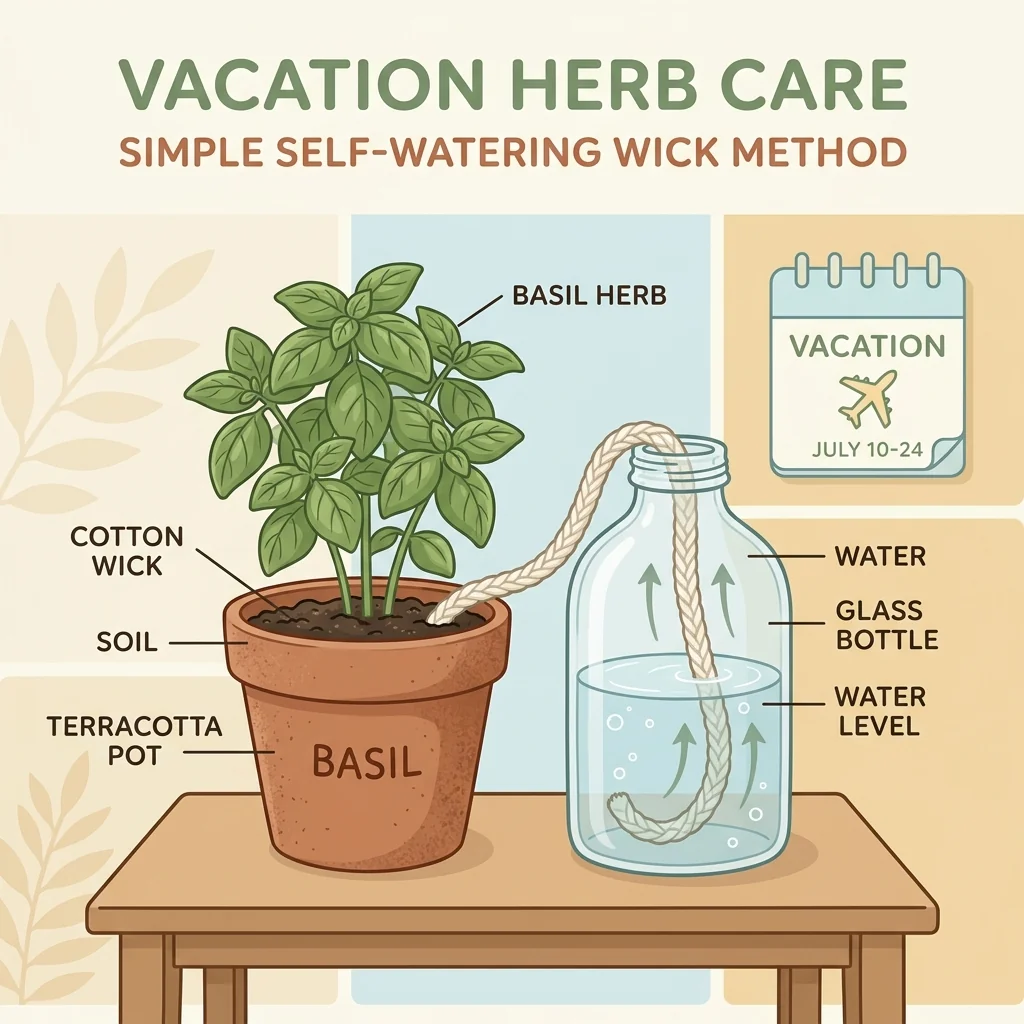
How to water potted herbs while on vacation: 5 foolproof methods
Potted herbs are notoriously sensitive to drying out. If you leave your apartment for a week without a plan, you will return to a graveyard of crispy, brown basil and dead mint. Here are five simple, passive self-watering systems you can build in minutes.
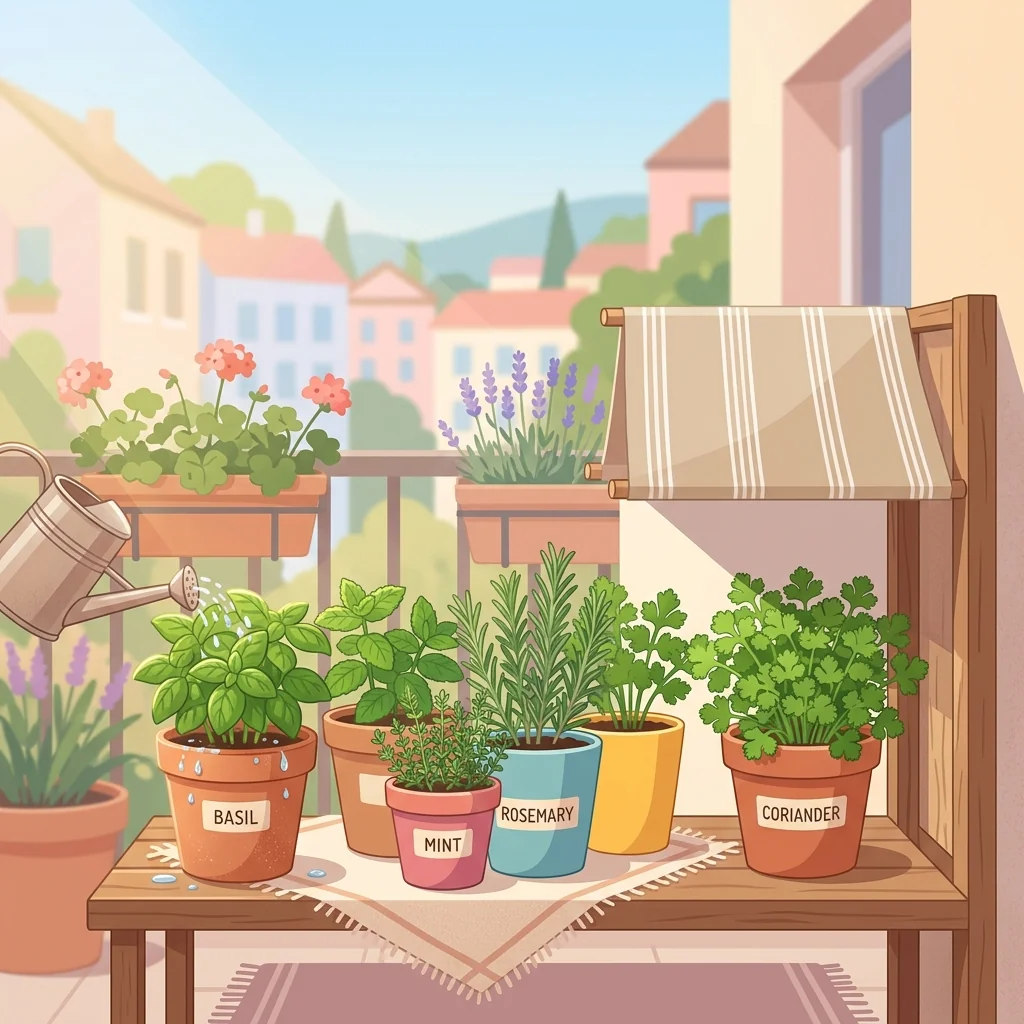
How often to water herbs in summer (heat-proof guide)
Summer heat can double how fast pots dry out. Here is how often to water each herb in hot weather, plus the shading and mulching tricks that keep pots alive in a heat wave.
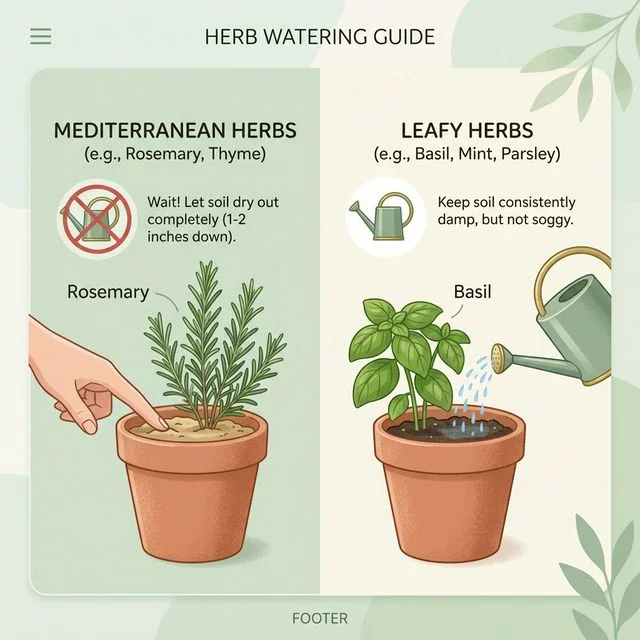
How often to water potted herbs: a by-herb chart
Most potted herbs should be checked often but watered only when the root zone is actually drying. Judge the pot instead of following a rigid calendar.