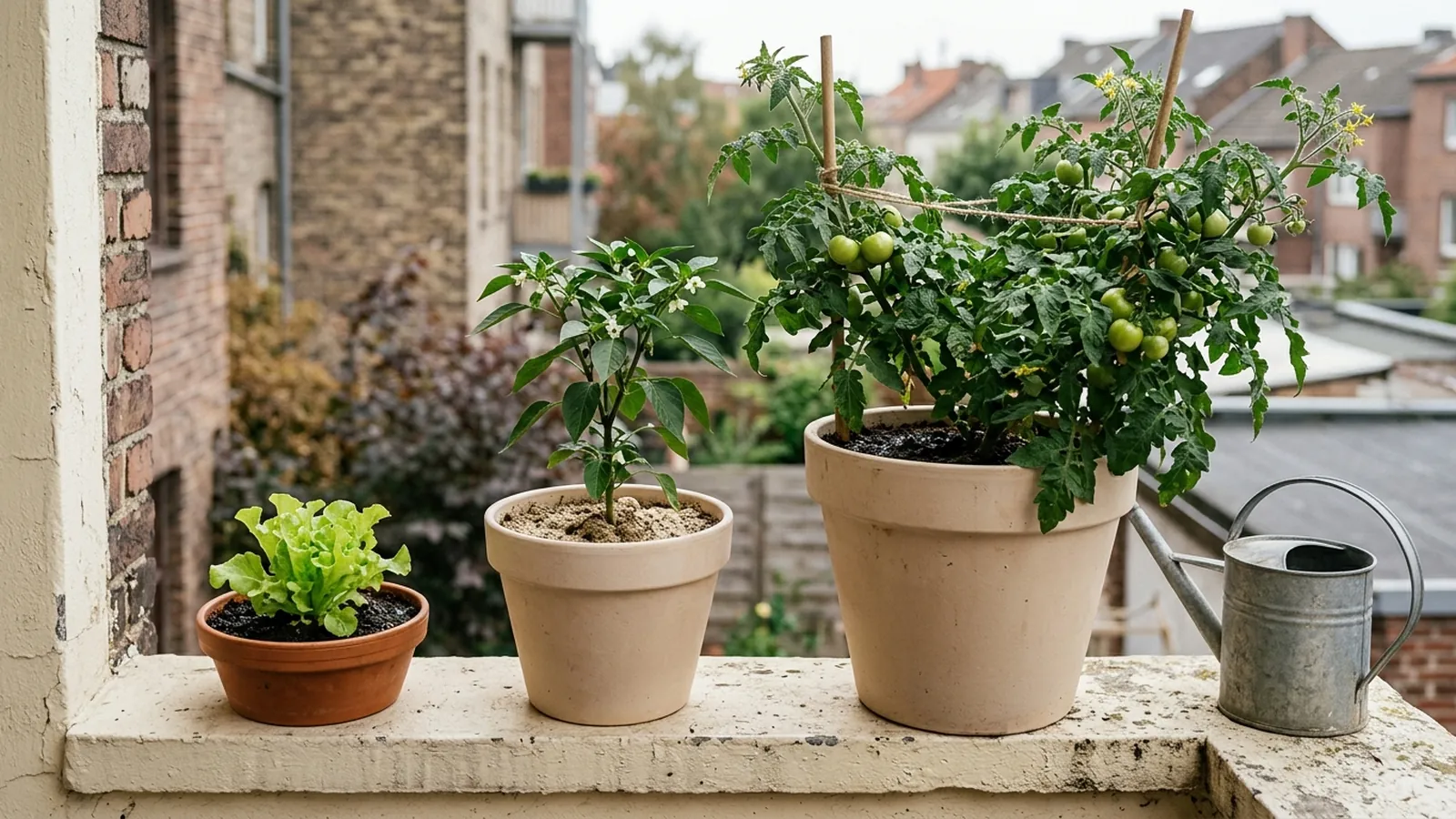
Minimum container size and the signal to water, by crop
| Crop | Minimum container size | When demand peaks | What tells you it needs water |
|---|---|---|---|
| Tomato | 12 in deep, 2-5 gal per plant | First fruit set through harvest | Pot lifts light; mix dry 2 in down by mid-morning |
| Pepper | 8 in deep, 2-5 gal per plant | Flowering through fruit fill | Mix dry at a finger's depth; dull leaf colour before any droop |
| Eggplant | 8 in deep, 4-5 gal per plant | Fruit fill in peak heat | Clear weight drop between a morning and an evening check |
| Cucumber | 8 in deep, 3+ gal per plant | Once vines run and fruit sets | Midday leaf flagging that recovers by evening |
| Summer squash (zucchini) | 8 in deep, 5 gal per plant | From the first pickable fruit onward | Big leaves flag early and often; judge by the mix, not the leaves |
| Bush beans | 8 in deep, in a box 12 in wide | Blossoming | Dropped blossoms are the late signal; dry mix 2 in down is the early one |
| Broccoli, cabbage, kale | 10 in deep, 5 gal per plant | Head and leaf formation | Mix dry at a finger's depth; flavour turns strong after dry spells |
| Carrot | 12 in deep | Root sizing | Surface dries long before the depth does; check low in the pot |
| Leaf lettuce | 8 in deep | The whole short season | Shallow mix, so surface drying matters here; check daily in heat |
| Chard, spinach, beets, radish | 8 in deep | The fast growth phase | Mix dry at a finger's depth |
Container vegetables have no single watering frequency, because two variables set the interval and both of them move: how much potting mix the pot holds, and how much leaf and fruit the plant is carrying right now. A pepper in a 2-gallon pot in May and the same pepper in the same pot in August are two different watering problems, and no schedule written in May survives August.
That is why the useful answer is a method rather than a number. Work out roughly what your container can hold, notice what stage the plant is in, and check the root zone before you water. The interval falls out of those three things, and it will change three or four times over a season.
Start with volume, because it is the one you set once and live with. If you have not sized the pot yet, container depth for tomatoes, peppers and herbs is the decision that determines how forgiving the rest of your summer is.
The four factors, in order of how much they move the answer
Container volume. A large pot holds more water and buffers more error. NC State Extension’s container handbook puts it directly: larger containers are beneficial because they do not dry out as quickly and require less frequent watering. Volume is also the only factor on this list you can change with a purchase rather than a habit.
Crop stage. A transplant with six leaves and a root ball that has not reached the pot wall draws a fraction of what the same plant draws with a full canopy and fruit on it. University of Maryland Extension states the rule in one line: plants need more water as they get larger and as temperatures get hotter.
Weather. Heat, wind and direct sun all raise transpiration and evaporation at the same time. Wind is the one people underestimate on a balcony, and it works on the plant and the pot surface together.
The container itself. NC State Extension notes that dark-coloured containers absorb more heat than light-coloured ones, which causes the potting media to dry out faster, and that the growing medium in outdoor pots fluctuates in temperature by as much as 30°F between day and night. A thin black nursery pot on a south-facing concrete balcony is a different environment from a thick light-coloured one two feet away.
Iowa State University Extension has published the spread those four factors produce, and it is worth reading as a range rather than a recommendation: watering frequency runs from once or twice a day for a small container in hot, windy weather, down to once or twice a week for a large container in cool weather. That is a sevenfold difference driven mostly by pot size and conditions, not by species.
Why the same plant needs far more water in August than in June
A fruiting vegetable’s water use scales with leaf area and with fruit load, and both climb steeply through the season.
In late spring, a newly planted tomato is a small canopy over a root ball that occupies part of the pot. The mix around it dries slowly, and overwatering at this stage is a realistic risk. By midsummer the same plant has filled the container with roots, carries several square feet of leaf transpiring through every sunny hour, and is pushing water and sugars into fruit. The pot has not changed. The demand has multiplied.
This is the part that a fixed schedule cannot survive. A twice-weekly routine that suited a June transplant will leave an August plant in drought stress, and drought stress in a fruiting crop shows up as lost yield rather than a dead plant. Colorado State University Extension records the specific consequences crop by crop: beans have a high water requirement during blossoming and drop their blossoms in dry soil or excessive wind, and blossom end rot on tomatoes — the black sunken area on the bottom of the fruit — is a symptom of inconsistent watering or a soil that does not have enough water storage.
Read that second one carefully, because it names the real failure. Blossom end rot in a container is usually not a calcium deficiency in the mix; it is the swing between a saturated pot and a bone-dry one, which interrupts calcium delivery to the fruit. A bigger container narrows that swing. So does checking more often in the weeks when fruit is filling.
Cool-season and leafy crops behave differently but have their own stage effect. Colorado State University Extension notes that lettuce becomes strong flavoured if the soil becomes dry, during hot weather and with crowded plants, that carrots crack and turn strong flavoured after dry spells, and that broccoli and its relatives develop a strong flavour if the soil gets dry. With these crops the penalty for an inconsistent supply is eating quality rather than a lost harvest.
Container volume outranks the crop, which is why drought-tolerant lists mislead
Search for drought-tolerant vegetables and you will get a list. Those lists are derived from open ground, and in open ground tolerance is mostly a statement about root depth. The University of California’s small farms programme groups vegetables exactly this way: shallow-rooted crops including lettuce, cabbage, onion and radish reach roughly 1.5 to 2 feet; moderately deep-rooted crops including beans, carrot, cucumber, eggplant, pepper and summer squash reach 3 to 4 feet; deep-rooted crops including pumpkin, winter squash and seeded tomato go over 4 feet.
Now put all of them in pots. Colorado State University Extension’s deepest container minimum for any of these crops is 12 inches, and a 12-inch-deep container gives a tomato 12 inches of root run exactly as it gives a radish 12 inches. The trait that separated them in a garden bed — the ability to follow moisture down — has been removed by the container wall. What is left is litres of mix and how much water that mix holds, which is a property of the pot, not of the species.
That has a practical consequence. Two plants of different crops in identically sized pots, at similar stages, in the same weather, will want water on a broadly similar rhythm. Two plants of the same crop in a 2-gallon and a 10-gallon pot will not. When someone reports that their tomato needs water twice a day and yours is fine on alternate days, the pot is the first thing to compare.
This is also why container sizing is a watering decision rather than a separate topic. The volume figures for the crops people most often undersize are worth checking against what you actually have: tomato pot size, pepper pot size, zucchini container size and lettuce container size.
NC State Extension supplies the diagnostic that closes the loop: when the leaves of a potted plant wilt frequently yet rehydrate after watering, the roots are not getting enough water, often because the plant is in too small a pot. A plant that wilts every afternoon no matter how attentive you are is not asking for a better schedule.
Minimum container size and the signal to water, by crop
Colorado State University Extension’s CMG GardenNotes #724 publishes minimum container sizes for container vegetables, and they are minimums — its own footnote says larger container sizes make the crop easier to care for by providing a bigger supply of water and nutrients. In watering terms, the difference between the minimum and something larger is how much margin you have on a hot day.
The stage column below is where to concentrate attention, and the last column is the signal that is worth acting on for that crop.
| Crop | Minimum container size (Colorado State) | When demand peaks | What tells you it needs water |
|---|---|---|---|
| Tomato | 12 in deep, 2-5 gal per plant | First fruit set through harvest | Pot lifts light; mix dry 2 in down by mid-morning |
| Pepper | 8 in deep, 2-5 gal per plant | Flowering through fruit fill | Mix dry at a finger’s depth; dull leaf colour before any droop |
| Eggplant | 8 in deep, 4-5 gal per plant | Fruit fill in peak heat | Clear weight drop between a morning and an evening check |
| Cucumber | 8 in deep, 3+ gal per plant | Once vines run and fruit sets | Midday leaf flagging that recovers by evening |
| Summer squash (zucchini) | 8 in deep, 5 gal per plant | From the first pickable fruit onward | Big leaves flag early and often; judge by the mix, not the leaves |
| Bush beans | 8 in deep, in a box 12 in wide | Blossoming | Dropped blossoms are the late signal; dry mix 2 in down is the early one |
| Broccoli, cabbage, kale | 10 in deep, 5 gal per plant | Head and leaf formation | Mix dry at a finger’s depth; flavour turns strong after dry spells |
| Carrot | 12 in deep | Root sizing | Surface dries long before the depth does; check low in the pot |
| Leaf lettuce | 8 in deep | The whole short season | Shallow mix, so surface drying matters here; check daily in heat |
| Chard, spinach, beets, radish | 8 in deep | The fast growth phase | Mix dry at a finger’s depth |
Penn State Extension’s own container sizing runs larger than the CSU minimums for the two crops people most often crowd: a single tomato plant needs at least a 20-inch-wide pot, while peppers and eggplants can thrive in a 14-inch pot. The two sets of figures are not in conflict so much as answering different questions — Colorado State gives the floor below which the crop struggles, Penn State gives a width that makes the season comfortable. If you are choosing a pot now, buy nearer the Penn State figure and you will water less often all summer.
Potted herbs sit outside this table because their demand is steadier and their pots are smaller; the per-herb intervals live in the herb watering chart, and the watering schedule generator turns herb, pot size and season into a check interval.
The physical checks that replace a schedule
Three checks, in ascending order of reliability.
The finger test. University of Maryland Extension’s instruction is to check the soil by pressing a finger into it. NC State Extension puts a depth on the same test: push a finger 2 to 3 inches into the potting mix, and water if the mix is dry at that depth. Iowa State University Extension uses a slightly shallower trigger, watering the container when the potting mix is dry at a depth of 1 to 2 inches. Anywhere in that 1-to-3-inch band is a reasonable place to judge from, and the exact depth matters less than doing it at depth rather than on the surface.
Pot weight. Lift or tilt the container. A freshly watered pot is heavy and a dry one is startlingly light, and the difference is far larger than anything you can see. This is the check that scales best once you have several pots, because you learn each one’s watered weight in about a week and can then triage a whole balcony by hand in under a minute.
What the surface looks like. Least reliable, and the most commonly used. The top half-inch of a container dries within an hour in sun and wind while the root zone stays wet. Surface colour is worth something for a shallow crop like leaf lettuce in an 8-inch-deep box, and close to worthless for a tomato in a 10-gallon pot.
When you do water, water properly. University of Maryland Extension’s guidance is to water containers until water starts to run out of the drainage holes, and it is explicit about the alternative: several shallow waterings are not nearly as effective as one single long water application. NC State Extension gives the same instruction — water pots until the water starts to come out the bottom.
If a container has dried out completely, a normal watering will run straight down the gap between the shrunken mix and the pot wall without wetting much of anything. Iowa State University Extension’s fix is to place the container in a tub of water for 20 to 30 minutes to remoisten the potting mix.
Time of day
Iowa State University Extension puts the best window at 5:00 to 9:00 am for any method that wets the foliage, because the leaves dry quickly afterwards and little water is lost to evaporation; midday watering is less efficient because of rapid evaporation, and evening overhead watering leaves foliage wet overnight, which raises disease risk. Drip and soaker systems keep water off the leaves and work well at either end of the day.
University of Maryland Extension adds the point that matters more for containers than for beds: water at about the same time each day. Water in the morning one day and the evening of the next, and the plant goes through two full days of sun and heat on a single watering.
What changes in a heatwave
Everything gets faster, and the margin the pot gave you shrinks.
Penn State Extension’s baseline is that most container vegetable gardens need watering at least once a day during hot summer months. Under a genuine heat event, a mature fruiting plant in a container near its minimum size can move to Iowa State University Extension’s upper bound of twice a day — a morning watering and an evening check. That is a regime no herb pot on the same balcony will need, and it is driven by the combination of full canopy, fruit load and a small volume of mix.
Two things buy back margin without asking you to stand there with a can. NC State Extension notes that a top dressing of mulch over the potting mix surface significantly reduces moisture loss; the materials and depths that work in a pot differ from garden-bed practice, and mulch for potted plants covers those. The second is grouping and shading pots so they shelter each other, which belongs to the wider heatwave response for container plants along with the emergency soak.
One caution during heat: a plant wilting at 3pm in full sun and standing upright again by 8pm has not necessarily run out of water. It may be transpiring faster than its roots can supply for a few hours, which is a normal response in a heat event. Check the mix before responding, because the same afternoon wilt in an already-saturated pot means something very different.
Where container watering routines go wrong
The saucer kept permanently full. A saucer that holds standing water keeps the bottom of the root ball waterlogged. NC State Extension’s instruction is to remove the water from the saucer after watering the plant, to prevent root rot; University of Maryland Extension says the same and suggests pot feet to raise containers for better drainage. Empty it after watering and after rain.
Frequent shallow watering. A splash that wets the top two inches trains roots to stay shallow and leaves the bottom of the pot dry, which is where most of the water storage was. University of Maryland Extension’s single long application beats several short ones.
Watering by the look of the surface. Covered above, and it is the single most common reason a pot that gets attention every day is still in drought stress.
Reading wilt as thirst. Clemson Cooperative Extension states the problem cleanly: the symptoms of over-watering and underwatering are similar, and both lead to poor root health, root decline and possibly death of the plant. A wilting container plant tells you the roots are failing to supply the leaves. It does not tell you whether that is because the mix is dry or because it is waterlogged and the roots are damaged. The root zone answers it; the foliage does not.
Treating an undersized pot as a discipline problem. If the pot is too small for the plant, more frequent watering manages the symptom for the rest of the season and the crop stays stressed. The fix is more volume next season, and in the meantime, mulch and afternoon shade.
Watering every pot on the same rhythm. A 2-gallon pepper, a 10-gallon tomato and a shallow lettuce box on one balcony are three different intervals. Check them individually, and you will find the small pots in the heat setting the pace for how often you need to be out there at all.
Sources
- Colorado State University Extension, CMG GardenNotes #724: Vegetable Gardening in Containers
- Penn State Extension, Container Vegetable Gardening: Four Keys to Success
- University of Maryland Extension, Maintaining Container Grown Vegetables
- NC State Extension Gardener Handbook, Chapter 18: Plants Grown in Containers
- Iowa State University Extension, How to Care for Plants Growing in Containers
- Iowa State University Extension, When is the best time to water the garden?
- University of California Small Farms Network, Tips on Irrigating Vegetables
- Clemson Cooperative Extension HGIC, Indoor Plants – Watering
Size the container before you worry about the schedule
Volume is the variable you set once and live with all season. These cover the sizing decisions and the two jobs that buy a container the most margin in heat.
Common questions
How often should I water container vegetables?
There is no fixed frequency that holds across pots and seasons. Iowa State University Extension gives the working spread: once or twice a day for a small container in hot, windy weather, down to once or twice a week for a large container in cool weather. Penn State Extension notes that most container vegetable gardens need watering at least once a day during hot summer months, which is a reasonable summer baseline for a fruiting crop in a modest pot. Confirm it by checking the mix rather than the calendar - Iowa State waters when the potting mix is dry at a depth of 1 to 2 inches.
Why does my tomato need more water in August than it did in June?
Because it is a bigger plant carrying fruit. University of Maryland Extension states it plainly: plants need more water as they get larger and as temperatures get hotter. A June transplant has a few leaves and a root system that has not filled the pot; an August plant has a full canopy transpiring all day and fruit drawing on it. Same pot, same crop, several times the demand.
Are some container vegetables drought tolerant?
Less than the lists suggest. Drought tolerance in open ground is largely a function of root depth - the University of California small farms programme groups vegetables by rooting depth, from shallow-rooted crops such as lettuce and onion at roughly 1.5 to 2 feet up to deep-rooted crops including pumpkin, winter squash and seeded tomato at over 4 feet. A container gives every crop the same depth, whatever you bought, so those rankings do not carry over. Volume of mix is the variable that matters in a pot.
The soil surface looks dry an hour after watering. Did I underwater?
Probably not. The top half-inch of a container dries first and fastest, especially in sun and wind, and it tells you almost nothing about the root zone underneath. NC State Extension advises pushing a finger 2 to 3 inches into the potting mix and watering if the mix is dry at that depth. Pot weight is the other reliable check: a watered container is heavy, and it gets noticeably lighter as the mix gives up water.
Related guides
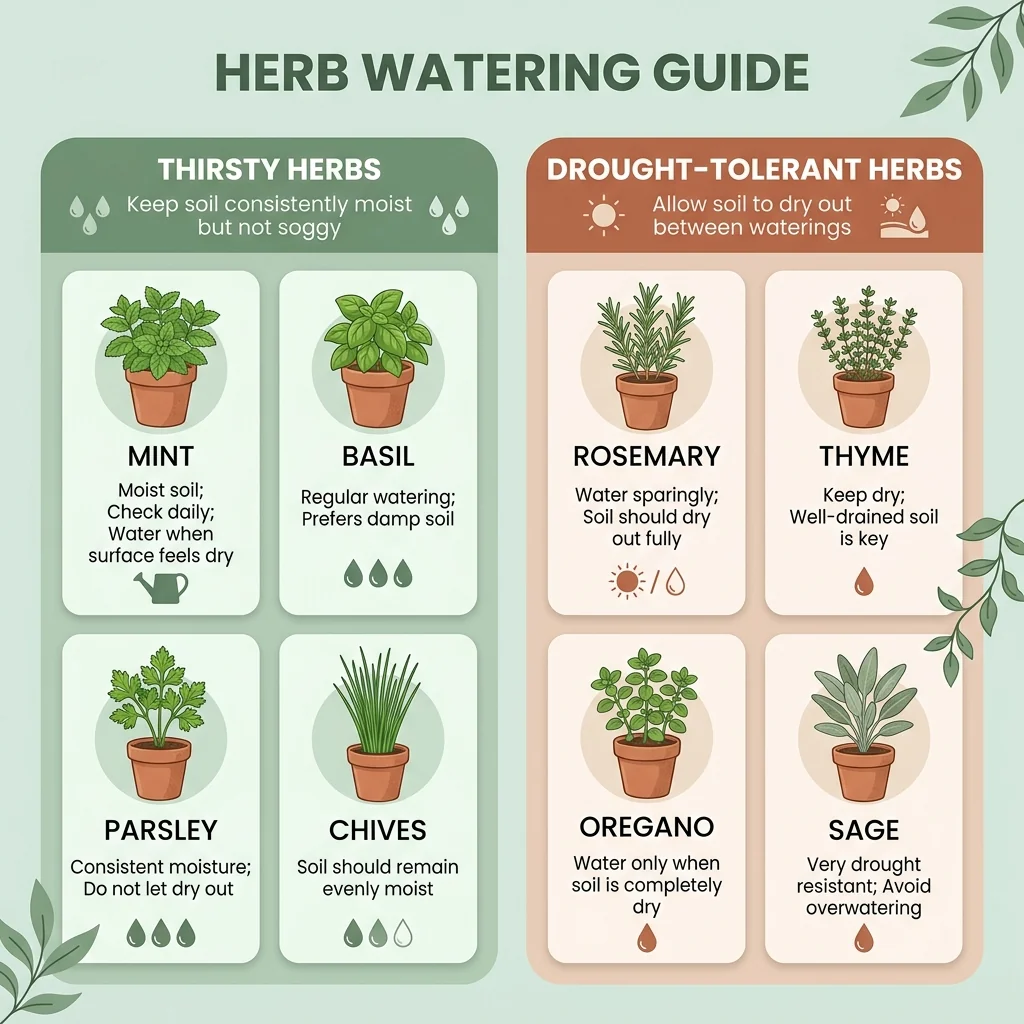
Herb watering chart: how often to water each herb
One simple chart for how often to water the most common herbs, split into thirsty herbs and drought-tolerant herbs, with links to a full guide for each.
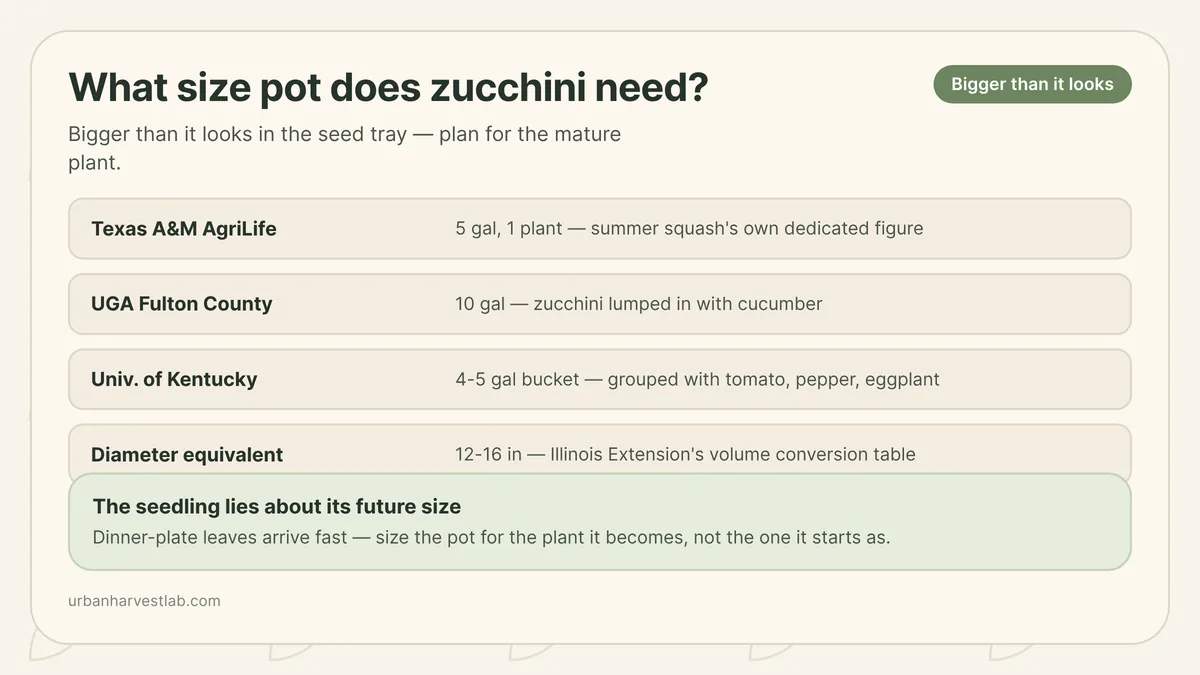
What size pot does zucchini need? Bigger than it looks in a seed tray
A zucchini seedling looks modest for weeks, then fills a pot almost overnight. The container has to be sized for the plant it becomes, not the one it starts as.
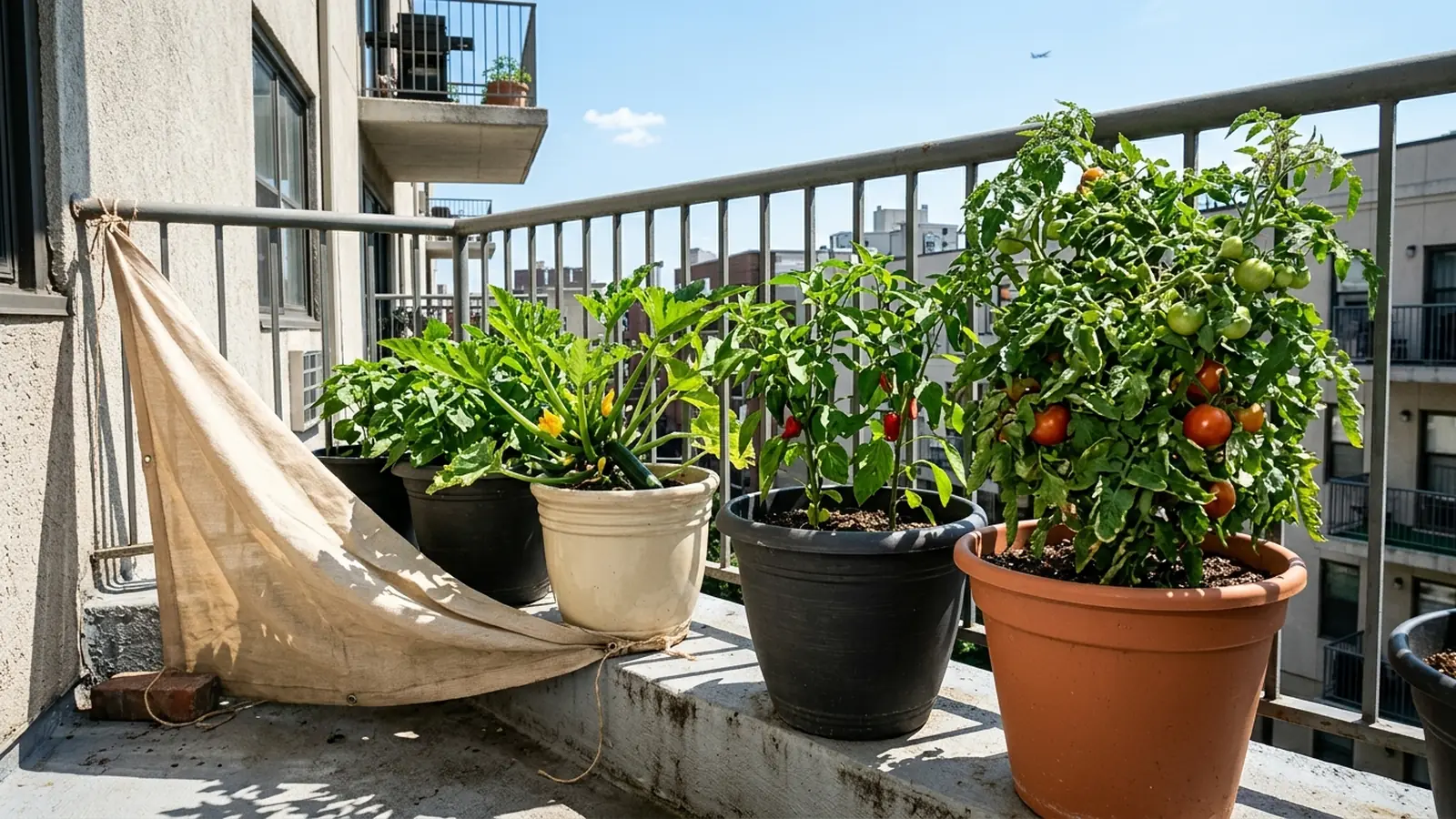
Best vegetables for a full-sun balcony: what to grow in 6 or more hours of direct light
A balcony that tracks 6 or more hours of direct sun can carry the fruiting crops every shadier balcony has to skip. The trade is a container that heats up far faster than garden soil, and managing that trade is the real work.