Troubleshoot the system before you change the inputs.
Symptoms
- The bottom of the fruit is puckered, folded or marked with deep crevices.
- Brown scars sit at the blossom end and sometimes run up the sides.
- The fruit was already misshapen while small and green, and the first trusses are worst.
Possible causes
- Cool nights while the flowers were forming, often after planting out early.
- A large-fruited or older heirloom variety, which is more prone than cherry types.
- Less often, 2,4-D herbicide exposure or heavy pruning of an indeterminate plant.
Quick fixes
- Pick off badly deformed fruit so the plant puts its effort into better ones.
- Cut away the scars on fruit that is otherwise sound and eat it.
- Cover plants on cold nights and plant out later next season.
Catfacing or something else?
| Sign | Catfacing | Look-alike |
|---|---|---|
| Where the damage sits | Blossom end: puckering, deep crevices, brown scars that can run up the sides | Blossom end only, a flat dark sunken patch with no crevices: blossom end rot |
| Shape of the fruit | Lumpy, folded or distorted from the start | Normal shape that splits in rings or lines later: cracking |
| Surface of the skin | Scarred but intact tissue underneath | Whitish or golden spots on the skin, spongy and white under the peel: stink bug cloudy spot |
| Which fruit | First trusses, large round fruit | Cloudy spot is most common from late July or August in Maryland's reports |
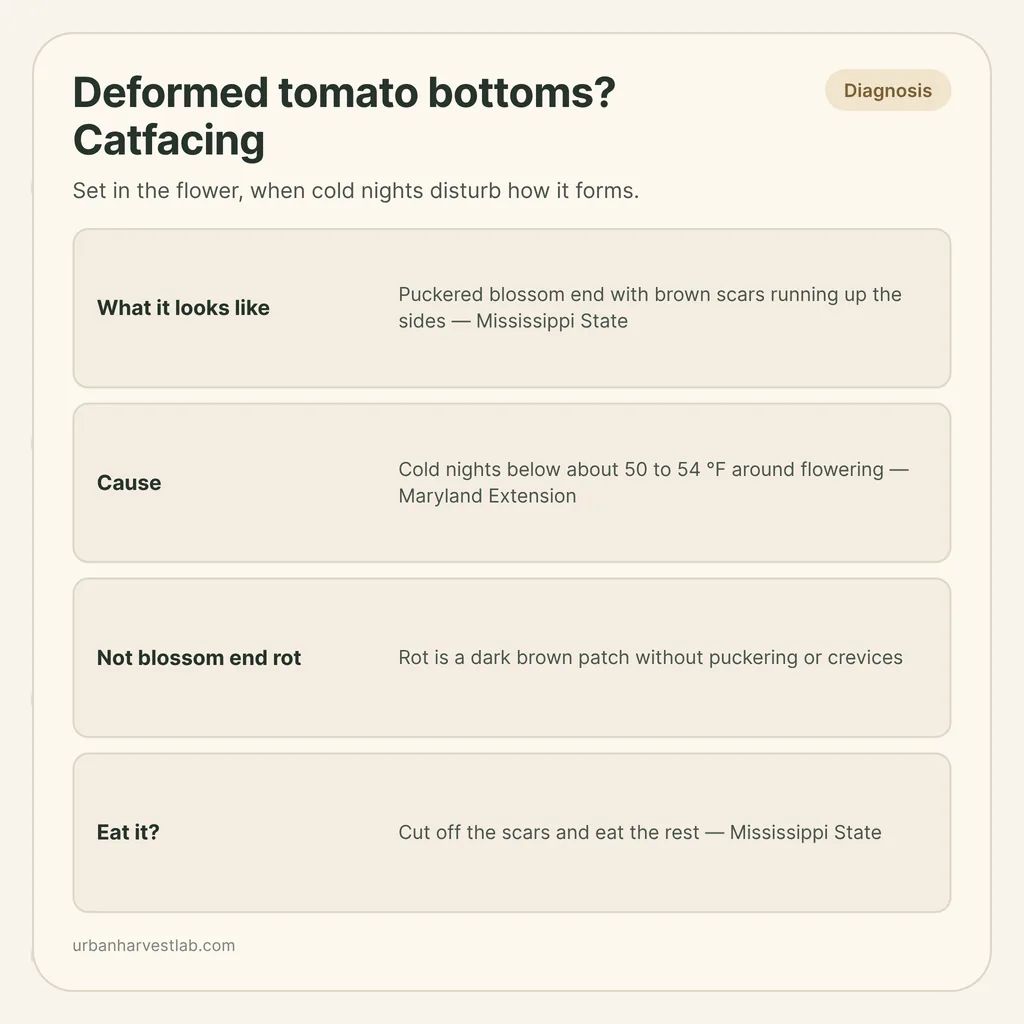
Tomatoes that are lumpy, folded or puckered at the bottom, with brown scars running up the sides, have catfacing. It starts in the flower, when cold nights disturb how the blossom forms, so the damage is set while the flower is still forming. Nothing you do now will straighten a deformed fruit, but it is a cosmetic problem and the tomato is usually fine to eat.
How to recognise catfacing
Mississippi State University Extension describes it as malformed or irregular fruit, often with brown scars at the blossom end that sometimes run up the sides, and a blossom end that is often puckered with deep crevices. In the most severe form the bottom of the fruit looks turned inside out, so the seed cavity shows on the outside. University of Maryland Extension’s home garden team adds holes to that list: misshapen fruit “often with deep crevices or holes.”
The shape is wrong from early on. If a tomato grew normally and then split, you are looking at the water-swing problem covered in why tomatoes crack, not this.
What causes it
The leading cause is cold during flowering. University of Maryland Extension’s gardening pages tie it to temperatures below 50 °F after transplanting. A Maryland vegetable specialist, Jerry Brust, gives a slightly higher line for nights: tomato flowers do not develop or pollinate properly below 52-54 °F, and daytime heat in the 80s does not make up for it. Mississippi State says tomatoes keep their best shape when temperatures stay above the mid-60s.
The two Maryland pages give different numbers, so Maryland Extension’s own figures run from 50 to 54 °F. Treat that as a zone to worry about rather than a single switch.
Cold is not the only suspect. Brust lists these, with the caveat that there is little information on the exact cause:
- Large, round fruit. The rounder and larger the fruit, the greater the chance. In the same field, plum types had less and cherries and grapes much less, if any. Mississippi State names large beefsteak types and many older heirlooms as commonly misshapen.
- Herbicide drift. Exposure to 2,4-D is another possible cause. A pattern is the clue: heavier damage on the side of the planting facing the source, tapering away from it.
- Heavy pruning. On indeterminate plants it may increase catfacing, which Brust links to reduced auxins in the plant.
- Jointless varieties and older cultivars. Brust finds jointless types more prone than jointed ones, and older cultivars more susceptible.
The delay matters too. University of Maryland Extension’s Brust traced damage he was seeing in Maryland fields back to cool nights 20 to 30 days earlier, which is why a balcony tomato can look deformed long after the cold snap you have forgotten about. Check what the nights were doing when the flowers opened.
Is it catfacing, blossom end rot, or insects?
Three problems get mistaken for it at the bottom of the fruit.
Blossom end rot. Mississippi State separates the two directly: blossom end rot shows as dark brown areas on the bottom without puckering or crevices. Catfacing distorts the shape; rot leaves a sunken dark patch on a fruit that is otherwise the right shape. Water and calcium handling in pots is covered in blossom end rot in container tomatoes.
Stink bug cloudy spot. University of Maryland Extension describes feeding damage as whitish areas with indistinct borders on green fruit and golden yellow spots on ripe fruit, with white, shiny, spongy tissue under the peeled skin. It shows up on the surface of a fruit with a normal outline, and Maryland reports it most commonly from late July or early August to the end of the season. Catfacing is a deformity present from the first weeks.
Cracks. Rings or lines in the skin of a fruit that otherwise grew round point to uneven water. The page on tomato cracking tells radial from concentric splits.
Flower drop is a separate cold-night symptom. If your blossoms are falling rather than setting deformed fruit, see tomato flowers falling off.
What to do with catfaced fruit
Eat it if it is sound. Mississippi State says catfacing does not affect edibility and that the scars can be cut off and the rest of the tomato eaten. Discard fruit that is rotting or has an off smell.
Remove the worst of it from the plant. University of Maryland Extension’s home garden advice is to take off catfaced fruit immediately, because it will not ripen uniformly and diverts the plant’s resources from developing fruit. Brust makes the same point: the fruit keeps draining nutrients from the plant.
Do not expect the whole crop to be affected. Mississippi State says it usually hits only the earliest fruit set and later fruit are generally not affected. Maryland growers saw it carry through second, third and sometimes fourth sets after a long run of cool nights, so later trusses depend on the nights warming up.
Preventing it next season
Brust writes that there is little that can be done to control catfacing except choosing varieties that are not prone to it. Mississippi State’s list is short: plant later, use resistant varieties, and use plastic or spun-bonded row covers to raise temperatures on cool days and nights. For a pot on a balcony, that translates into three habits.
- Wait for warmth. University of Maryland Extension’s advice is to set transplants out 1-2 weeks after the last expected spring frost, and to warm both soil and air. Work out your date with the frost date guide for balconies and acclimatise seedlings first with hardening off.
- Cover on cold nights. Throw a cover over the pot or bring it against the wall when nights approach the 50s °F. The cold snap protection steps show how.
- Pick smaller fruit. If early cold is normal where you live, cherry and grape types were much less affected in Maryland’s observations. The compact variety guide helps you choose a plant that suits a pot.
Skip heavy pruning of indeterminate plants while they are flowering in cool weather, and keep weed-killer sprays well away from the pots.
Sources
Get tomato fruit off to a clean start
Timing, cold protection and variety choice for pot tomatoes.
Common questions
What causes catfacing on tomatoes?
Cool temperatures while the flower is forming and being pollinated. University of Maryland Extension names temperatures below 50 °F after transplanting in one article and below 52-54 °F at night in another. Its specialist adds that the exact cause is poorly understood, and that 2,4-D herbicide exposure and heavy pruning of indeterminate plants may also contribute.
Are catfaced tomatoes safe to eat?
Mississippi State Extension says catfacing does not affect edibility and that the scars can be cut off and the rest of the tomato eaten. Skip fruit that is rotting or smells sour.
Will the next tomatoes also be deformed?
Often not. Mississippi State says it usually affects only the earliest fruit set and that later fruit are generally not affected. Maryland reports that after a long cool spell, several successive sets can be hit, so the answer follows your weather.
How do I prevent catfacing in pots?
Set plants out later, 1-2 weeks after the last expected spring frost per University of Maryland Extension, cover plants on cold nights with plastic or spun-bonded row cover as Mississippi State suggests, and favour smaller-fruited varieties.
Related guides

Why are my tomatoes cracking? Radial vs concentric splits
Cracked tomatoes are almost always a water-swing problem. Learn which split you have, whether the fruit is safe to eat, and how to stop it in pots.

Blossom end rot on tomatoes in pots: why it happens and what fixes it
Potted tomatoes swing between soggy and bone dry faster than garden ones, and that swing is what starves the fruit of calcium. Steady watering fixes most cases.

Tomato flowers falling off: heat, cold nights, and stress
Flowers that yellow and fall without setting fruit are usually reacting to temperature or stress, not disease. Work out which, then change the one thing that applies.