Troubleshoot the system before you change the inputs.
Symptoms
- The plant is green, leafy and growing, but no flower buds or yellow flowers have appeared on any truss.
- The stems are thick and the foliage is very dark green or oversized for the pot.
- The plant went into the pot recently, or has been growing slowly since a cold spell.
Possible causes
- Too much nitrogen from fertilizer or a rich mix, which pushes leaf growth at the expense of flowers.
- Fewer than six hours of full sun a day.
- A plant that is simply young, or one that stalled after being planted out into cold weather.
Quick fixes
- Stop feeding with a high-nitrogen fertilizer and check the label of what you have been using.
- Move the pot to the sunniest spot you have and time how many hours of direct sun it gets.
- Give a young or cold-stalled plant warmth and time before changing anything else.
A tomato plant that is green and growing but has no flowers is usually getting too much nitrogen, too little sun, or too little time and warmth. Work through those in order. They are quick to check, and each one has a different fix.
If buds do appear and then yellow and drop, you have a different problem, and tomato flowers falling off covers it. Everything below is about a plant that has not produced flowers at all.
Check the plant’s age and recent history first
Before blaming anything, work out how long the plant has really been growing in its final pot.
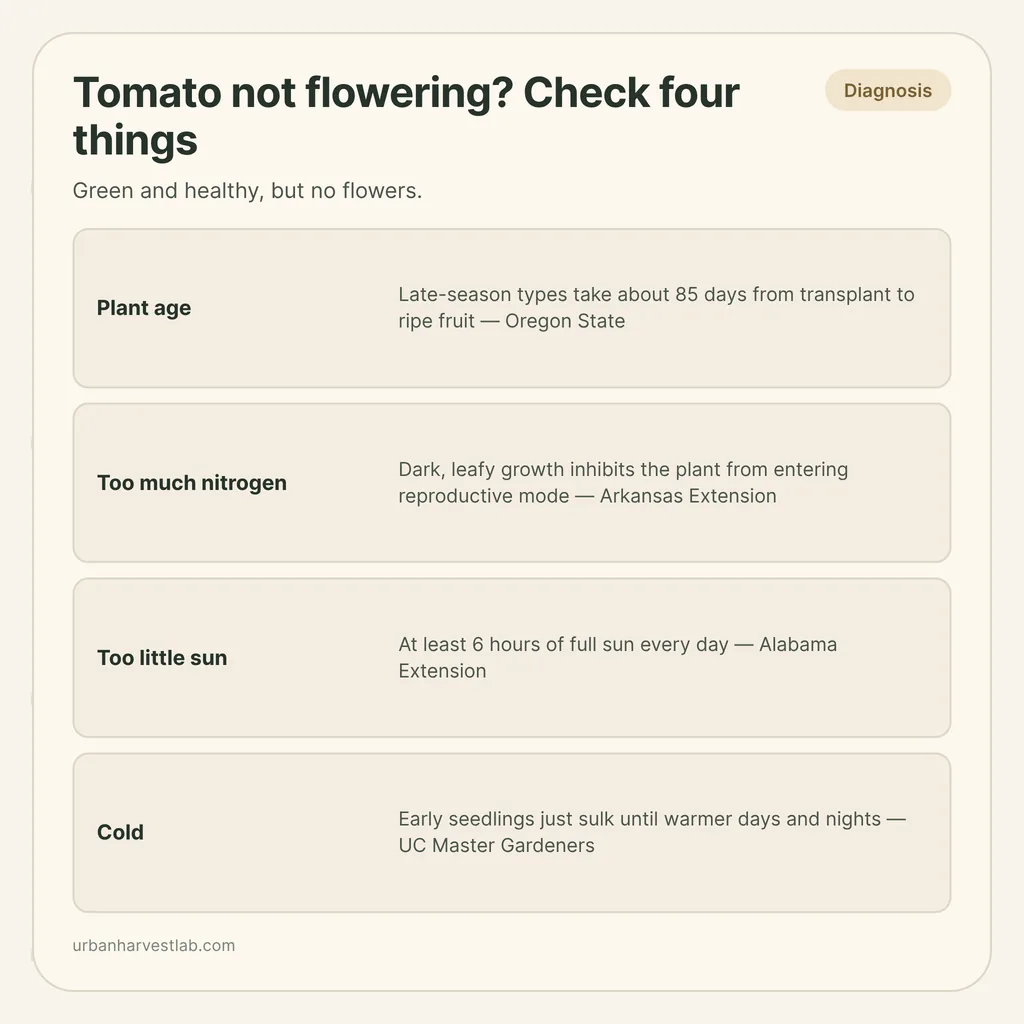
Oregon State Extension says it takes 5 to 8 weeks to grow good plants from seed, depending on temperature. It then lists time to maturity from transplants as commonly 50 days for early cherry types, 60 days for early full-size fruit types, 75 days for mid-season cultivars and 85 days for later, full-season ones. Flowers come well before that first ripe fruit, but the range shows how much variety matters: a late-season beefsteak planted a few weeks ago has a long way to go, and a cherry type should be quicker.
A cold start matters as much as age. UC Master Gardeners in Contra Costa County note that seedlings planted too early in spring are often inhibited by cold and “just sulk”, and that consistent warmer weather and nights should get them growing. If your plant has barely changed since it went outdoors and nights are still cool, waiting for warmth beats any intervention. Emergency cold snap protection for balcony container plants is useful if cold nights are still in the forecast.
Too much nitrogen: big, dark, leafy, no flowers
This is the single most recognisable cause. University of Arkansas Extension says it hears nearly every year from someone describing the most beautiful tomato plants they have ever had, with no tomatoes on them. Its explanation: too much nitrogen fertilizer causes excessive vegetative growth, which inhibits the plant from entering reproductive mode and reduces the number of flowers formed. UC Master Gardeners describe the same pattern as lots of healthy green leaves and stem growth, but few flowers or fruit. Alabama Extension adds that too much nitrogen can delay flower development.
What it looks like in a pot: thick stems, big dark leaves, fast growth, and trusses missing from where you expected them.
What to change:
- Stop the high-nitrogen feeds. Look at the first number of the N-P-K ratio on whatever you have been using.
- Follow a fruiting schedule. Arkansas Extension advises fertilizing before planting and then not again until the first fruit sets. Oregon State gives one nitrogen top-up around fruit set and recommends against more, since extra nitrogen promotes excessive vine growth and delays fruit maturation. Our container vegetable fertilizer schedule shows how to space feeds in pots.
- Watch the salts. Alabama Extension notes that too much of any fertilizer can raise salt levels around plants.
Not enough sun: leafy, stretched, late
Alabama Extension says to make sure tomato plants get at least 6 hours of full sun every day. UC Master Gardeners give a minimum of six hours of sun to produce fruit. Oregon State suggests as much direct sunlight as possible, 7 or more hours a day.
Balconies are the usual trap. A south-facing spot may get all of those hours, while a corner shaded by the building across the way can fall well short even though it feels bright. Do not guess. Track a clear day using how to measure balcony sunlight, then move the pot to the best-lit spot if it comes up short. If no spot reaches six hours, a compact variety suited to less light is a better bet than any amount of feeding; dwarf tomatoes in pots is a place to start.
Cold: a plant that will not start
Cold is the first thing to rule out on a plant that will not start. UC Master Gardeners note that early-planted seedlings are inhibited by cold and just sulk, so growth, and with it flowering, waits for warmer days and nights. Virginia Tech gives 70 to 81 °F by day as the preferred range for vegetative growth. Heat is a different problem, because it mostly hits flowers that have already formed; tomato flowers falling off covers it.
Next steps
Do not rush to a bloom-booster product as a substitute for finding the cause: none of the extension sources above recommends one, and a fertilizer cannot make up for six hours of missing sun. The cause they name for a leafy, flowerless plant is excess nitrogen.
Once flowers do open, pollinating balcony tomatoes and peppers explains how to help them set fruit. If the pot itself is cramped, tomato pot size is the next thing to check.
Sources
- Blossom Drop in Tomato (ANR-2717), Alabama Cooperative Extension System
- Three reasons your tomatoes aren’t producing, University of Arkansas Cooperative Extension Service
- Tomatoes Not Producing, UC Master Gardener Program of Contra Costa County (UC ANR)
- Grow your own tomatoes and tomatillos (EC 1333), Oregon State University Extension
- Basic Tomato Physiology and Morphology (SPES-508), Virginia Cooperative Extension
Get a tomato from leaves to fruit
Light, feeding and pollination are the three things a balcony tomato most often needs adjusted.
Common questions
Why is my tomato plant healthy but not flowering?
The usual reasons are too much nitrogen, too little sun, a plant that is still young, or cold that stalled growth after planting out. Arkansas Extension describes nitrogen-fed plants as the biggest and most beautiful the gardener has had, with no tomatoes on them, because nitrogen reduces the number of flowers formed.
How much sun does a tomato need to flower?
Alabama Extension says at least 6 hours of full sun every day, and UC Master Gardeners say a minimum of six hours to produce fruit. Oregon State suggests as much direct sun as possible, 7 or more hours.
Should I keep feeding a tomato that is not flowering?
Check for excess nitrogen first, since Arkansas Extension says it reduces the number of flowers formed. Arkansas advises fertilizing before planting and not again until the first fruit sets, and Oregon State does not recommend repeated nitrogen applications after the one at fruit set.
How long should I wait for a new tomato plant to flower?
Oregon State lists time to maturity from transplants at roughly 50 days for early cherry types up to 85 for full-season types, and flowers come well before ripe fruit. A plant that went out only a few weeks ago, or sulked in the cold, may just need warm weather.
Related guides

Tomato flowers falling off: heat, cold nights, and stress
Flowers that yellow and fall without setting fruit are usually reacting to temperature or stress, not disease. Work out which, then change the one thing that applies.
What size pot for tomatoes? Volume by growth habit
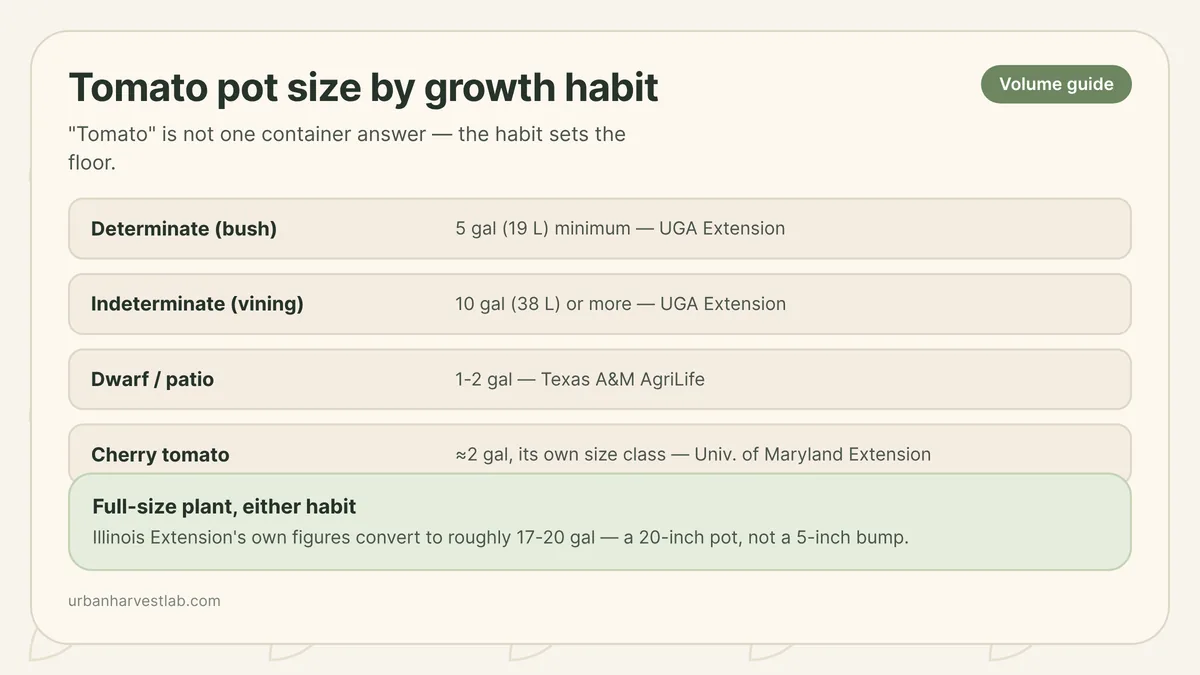
The right container for a tomato depends less on the fruit than on how the plant grows: determinate, indeterminate, or dwarf. Extension figures for the same word vary by more than three times.

Brown spots on tomato leaves: early blight, septoria or bacterial spot
Three common diseases cause brown spots on tomato leaves, and each leaves a different mark. Read the spot, then pick the response that fits.