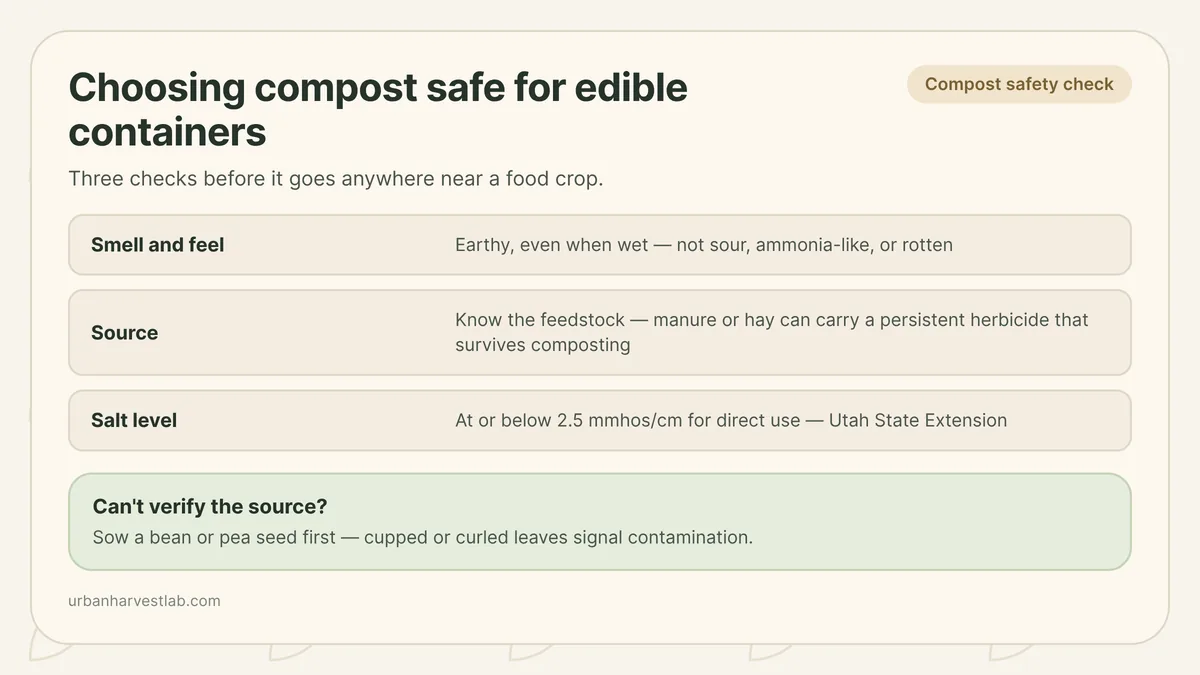
Checks before compost goes into an edible container
| Check | What you want | Hold off if |
|---|---|---|
| Smell and feel | Earthy smell even when wet, cool to the touch, no recognizable scraps | Sour, ammonia-like, or rotten smell |
| Source | Known feedstock, or a supplier who can answer about herbicide use | Manure, hay, or grass clippings from an unknown or unconfirmed source |
| Salt level | Electrical conductivity at or below 2.5 mmhos/cm for direct use in a seed bed or mix | No test available and the compost is manure-heavy or from a commercial blend with no spec sheet |
| Bioassay | Bean, pea, or another fast seed germinates normally with straight, unfolded leaves | Cupping, curling, stunting, or failed germination in the test seedlings |
Safe compost for a container growing food comes down to three checks: is it actually finished, do you know what went into it, and is its salt level low enough for a small volume of soil. Miss any one of those and a pile or a bag that looks fine can still stunt seedlings, curl leaves for a whole season, or carry an herbicide that outlasts the crop.
How much compost to add once it passes those checks is a separate question, covered in how much compost should you add to potting mix. This is about whether the compost itself belongs in a pot that is going to grow something you eat.
Confirm it is actually finished
Unfinished compost is still actively decomposing, and that process can release compounds that injure young plants. Utah State University Extension gives a simple sensory test: finished compost should “look and smell earthy — even when wet.” Penn State Extension’s independent marker is a sweet smell in finished material, against sour, ammonia-like, or rotten odors in anything still working through decomposition.
Pair the smell test with touch and sight. Finished compost has cooled from its active heating phase and looks reasonably uniform, without whole leaves, wood chips, or food scraps still recognizable. None of this catches a hidden contaminant or a salt problem on its own, but it will reject the batches that are obviously not ready, which is most of what goes wrong with compost people made themselves.
Know the source before you know the percentage
The bigger risk for an edible container is not usually the compost’s own maturity — it is what went into it before it reached your pile or your bag. Persistent herbicides used on pasture, hay fields, and some lawns, including clopyralid, aminopyralid, and picloram, pass through a grazing animal’s digestive tract unchanged, according to the National Pesticide Information Center. That means manure from livestock fed treated hay, and compost made with that manure or with treated grass clippings and straw, can carry active herbicide residue long after the composting process is otherwise complete.
The persistence is the part that catches gardeners off guard. The National Pesticide Information Center notes that clopyralid “may last for months to years in soil,” with faster breakdown in soil that is biologically active. A bag of compost that smells earthy and looks perfectly finished can still be carrying enough of one of these compounds to distort a crop planted the same season.
The crops named as sensitive cover most of what a container garden grows for the table: peas, beans, lettuce, tomatoes, potatoes, and peppers, per the National Pesticide Information Center. Symptoms show up as cupped or curled foliage, stunted growth, and germination that fails outright rather than as anything subtle. If a whole row of a container’s seedlings comes up twisted while everything else on the balcony looks normal, contaminated compost or manure is a more likely explanation than a nutrient problem.
The practical response is to ask before you buy in bulk or accept a free load: what fed the compost, and was that feed treated with a broadleaf herbicide. A supplier who cannot answer, or an unlabeled pile from an unknown source, is exactly the material worth testing before it goes anywhere near a container you plan to harvest from.
This risk is not evenly spread across every way a gardener gets compost. What varies between sources is how answerable the feedstock question is, not how likely contamination is. A supplier who can tell you what fed the compost lets you skip the guesswork; an unlabelled pile from an unknown source does not, and that difference in traceability, not the compost’s appearance, is what the bioassay is for.
Check the salt level too
Compost carries its own dissolved mineral load, separate from anything you add later with fertilizer, and a container has far less soil volume to dilute it than open ground does. Utah State University Extension gives a working threshold: straight compost should not go into a seed bed or potting mix without dilution once its electrical conductivity passes 2.5 mmhos/cm. For soil amendment use more broadly, the same source keeps soluble salt concentration below 20 mmhos/cm.
Most home gardeners will not have a conductivity meter on hand, which is another reason source matters: compost made mostly from manure or heavily fertilized feedstock tends to run saltier than a mixed yard-waste pile. If you can get a lab report from a bulk supplier, check it against that 2.5 mmhos/cm figure before using the material undiluted in a small pot. What to do if salt builds up after the fact — from this or from feeding — is its own topic, covered in salt buildup in herb pots; this is about the compost’s starting salt load, not what accumulates afterward.
Run a bioassay when you cannot verify either one
When you cannot confirm a compost’s feedstock or get a salt reading, the National Pesticide Information Center’s own recommendation is a simple test: sow a fast, herbicide-sensitive seed, such as bean or pea, directly in a sample of the compost, and watch it through germination and the first true leaves. Cupped, curled, or twisted growth, stunting, or seeds that fail to come up point to contamination. Straight, unfolded leaves and normal germination are a reasonable green light.
Run the test in a small pot alongside a known-good potting mix as a control, so you have something to compare against rather than judging the compost sample in isolation. Watch it through germination and the first true leaves rather than judging it in the first few days, since distortion in a bean or pea seedling shows up as the plant expands — cupped or curled leaves, a twisted stem, stunted growth against the control pot — not as it first breaks the surface. Label both pots. Colorado State University Extension gives 40-60% organic matter by dry weight as a quality baseline for compost, which a bulk supplier’s spec sheet should show alongside its conductivity reading.
Fit it into a mix you are already feeding
A compost-amended mix arrives with a head start on nutrition, and that changes what comes next. Utah State University Extension notes there is enough nitrogen, phosphorus, and potassium in a fresh compost-amended mix to cover a plant’s needs for the first two to three weeks, and specifically advises against adding liquid fertilizer during that window. Feeding on top of that starter charge does not make the container safer; it mostly raises the same salt risk covered above, sooner than expected.
If the container is a refresh between crops rather than a first planting, whether to reuse last season’s mix or start over with a fresh compost-amended batch is a separate decision, covered in can you reuse potting soil and refreshing old potting soil. The safety checks here apply either way: a reused mix that gets topped up with unverified compost carries the same source and salt questions as a brand-new batch.
Sources
Before you plant in a compost-amended container
These cover how much compost to add, what to do if salt already built up, and whether to reuse an old batch of mix instead.
Common questions
Is homemade compost safe for vegetable containers?
Usually, if it is finished and you know what went into it. Check for an earthy smell rather than a sour or ammonia one, and be cautious with any batch that included manure, hay, or grass clippings from a source you cannot ask about, since those can carry an herbicide that survives composting.
How do you know if compost is safe for tomatoes and peppers?
Tomatoes and peppers are named among the crops most sensitive to persistent herbicide residue in compost, along with peas, beans, lettuce, and potatoes. If the compost's source or feedstock is unclear, sow a bean or pea seed in a sample first and watch for cupped or curled leaves before planting your actual crop.
Can compost be too salty for a container?
Yes. Utah State University Extension sets 2.5 mmhos/cm electrical conductivity as the point past which straight compost should not go into a seed bed or potting mix without dilution, and a container concentrates salt faster than open ground because there is less soil to buffer it.
What if I do not know where my compost came from?
Ask the supplier what fed the compost and whether that material was treated with a broadleaf herbicide. If you cannot get a clear answer, run a small bioassay before committing a container of edibles to it.
Related guides
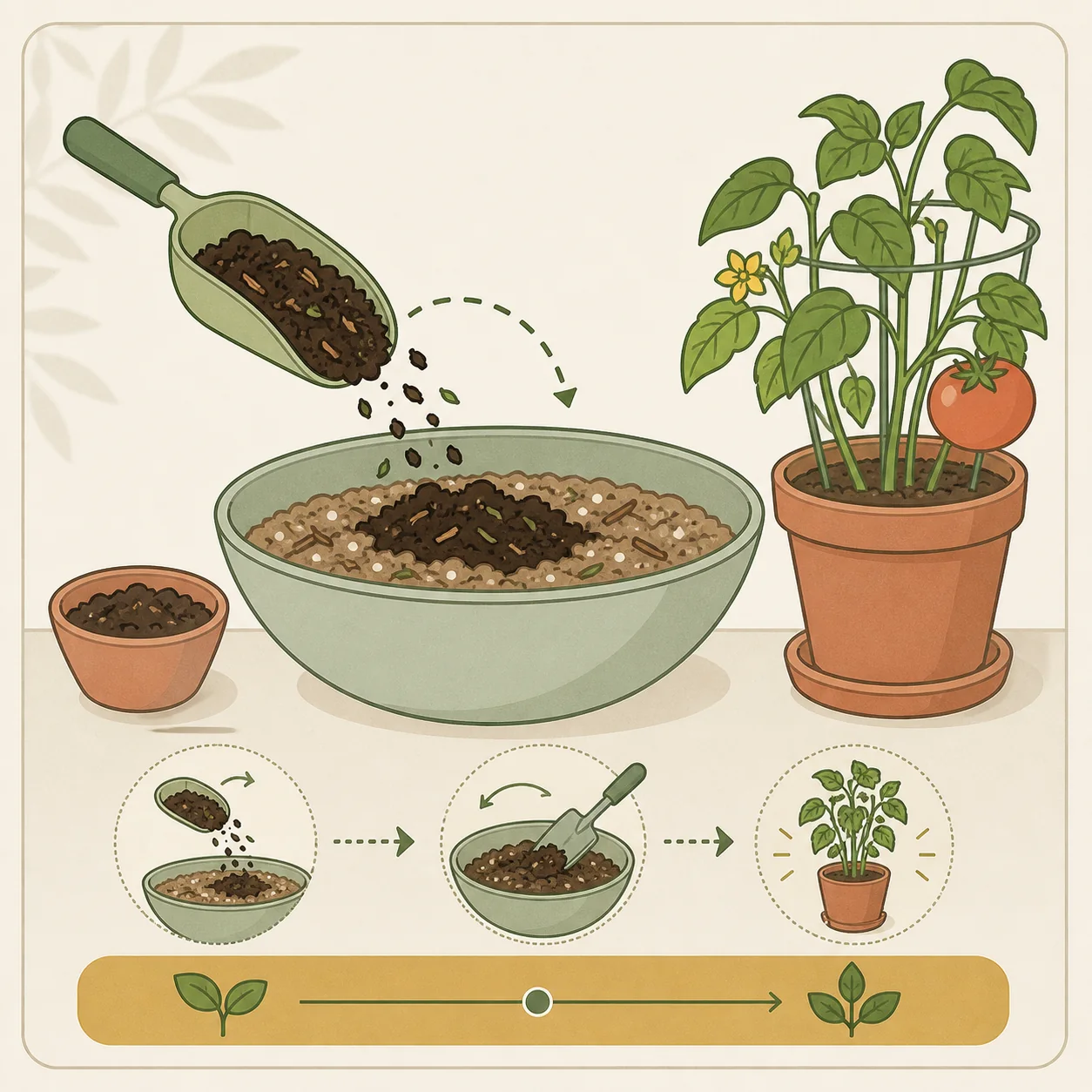
How much compost should you add to potting mix?
More compost is not automatically better. In a container, compost must share limited space with the coarse particles that preserve air around roots.
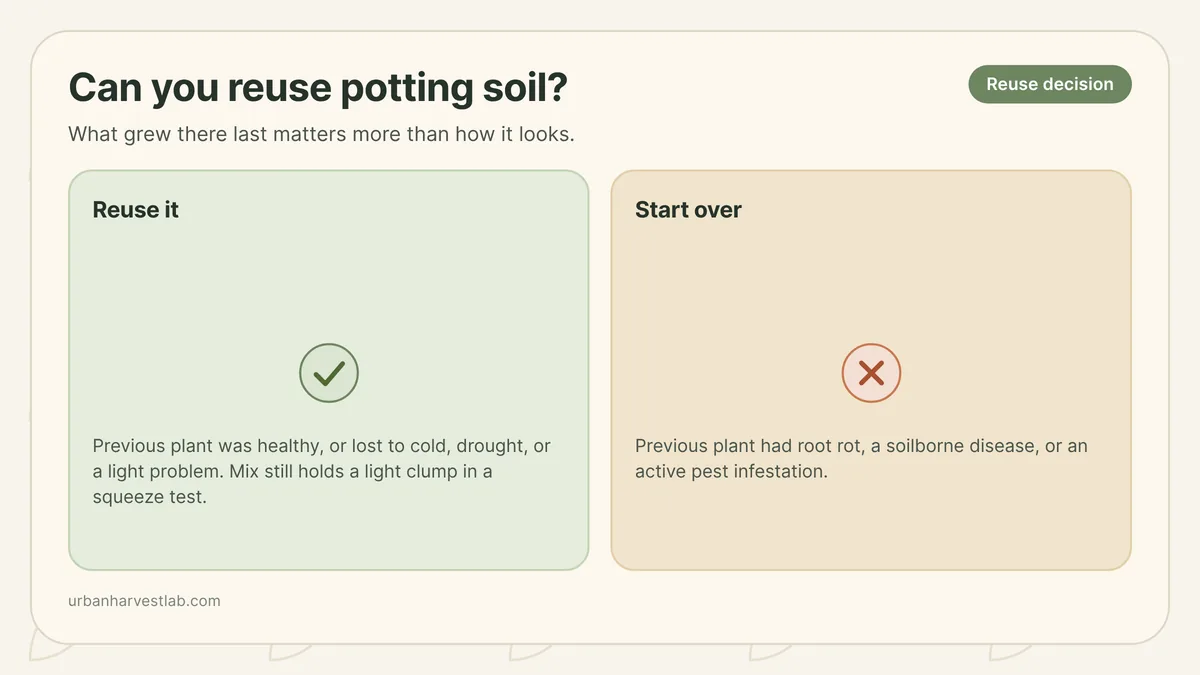
Can you reuse potting soil? When it's safe and when not to
Whether last season's mix belongs back in a pot depends less on how it looks than on what grew in it and why that plant left.
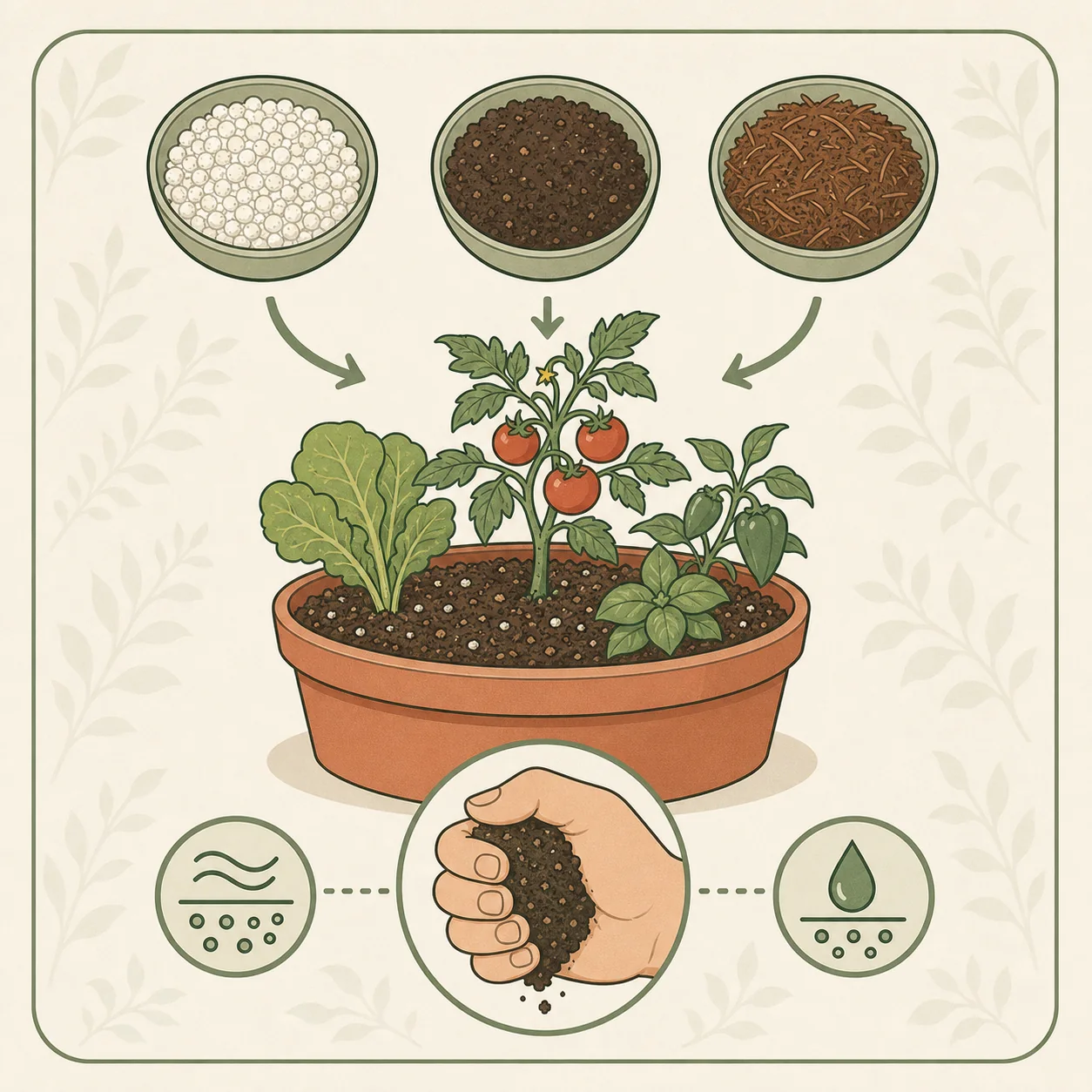
How to make potting mix for container vegetables
A useful potting mix recipe describes the job of each ingredient and gives you a way to correct the result. The goal is stable air and moisture, not a magic ratio.