
What cinnamon has been tested on, and what protects a seed tray
| Question | What the sources show | What to do |
|---|---|---|
| Does cinnamon slow fungi in a dish? | A 2019 tomato study measured 54.4% and 81.4% less Botrytis mycelium growth at 0.5% and 1% cinnamon filtrate | Treat it as a lab result for one fungus |
| Does it protect tomato plants? | Sprayed filtrate reduced grey mould symptoms on infected tomatoes in greenhouse tests | Not a method for seed trays or potted herbs |
| Does dusting soil prevent damping-off? | Not shown in the sources checked here; Utah State and UC IPM list sanitation and watering as the controls | Do not rely on it |
| What does prevent damping-off? | Clean trays, sterile mix, well-drained medium, thin sowing, no overwatering | Start with these, whatever else you add |
Cinnamon slows some fungi in laboratory tests, but the evidence does not show that dusting it on soil prevents damping-off or clears mold in a pot. The plant study we found tested a sprayed liquid on tomato leaves against grey mould, which is a different fungus, a different method and a different place on the plant. Seedlings are protected by clean trays, sterile mix and a surface that dries.
If you grow herbs in small spaces and want the full set-up that keeps trays healthy, the small-space herb gardening guide puts the pieces together.
Why a kitchen spice ended up on seed trays
The logic is easy to follow. Cinnamon bark is rich in compounds that inhibit fungi in a dish, it is already in the kitchen, and a brown dusting on a tray looks like a gentle, edible alternative to a fungicide. Gardening blogs repeat it, and each repeat makes it feel more established.
The step that goes missing is the one between the dish and the tray. A fungus growing on agar with cinnamon extract mixed in is exposed to the extract directly and continuously. A fungus in damp potting mix is sitting among organic matter, water films and a crowded community of other microbes, with a powder resting on the top few millimetres.
What the 2019 tomato study actually tested
A 2019 paper in the European Journal of Plant Pathology evaluated commercially available cinnamon bark powder against Botrytis cinerea on tomato. The authors made water filtrates at 0.5 and 1 percent and measured fungal growth in a dish. After six days, mycelium growth was lower by 54.4 percent at 0.5 percent and by 81.4 percent at 1 percent. In greenhouse tests, grey mould symptoms decreased on infected tomato plants that were sprayed. A field trial sprayed the plants six times with a 0.5 percent filtrate at four to five day intervals; the sources checked here do not report a disease result from that trial, so the grey mould reduction rests on the greenhouse tests.
Read that against the kitchen habit and the differences stack up:
- Different fungus. Botrytis causes grey mould on leaves, stems and fruit. It is not one of the organisms Utah State and UC IPM name as causes of damping-off.
- Different method. The material was a filtrate made from the powder, applied as a spray, repeatedly. Powder sprinkled once on soil is not that.
- Different stage. The plants were tomatoes in greenhouse and field trials, not germinating seedlings in a tray.
The authors note that very few reports on commercially available powdered cinnamon exist in the literature, which is why they ran the study. It is a promising early result for one crop and one disease, and that is how far it goes.
What damping-off is, and what stops it
Utah State University Extension lists the causes as soilborne fungi including Pythium, Rhizoctonia, Fusarium and Phytophthora, and its quick-facts box says the disease can easily be prevented by good sanitation and good cultural practices. UC IPM adds that the pathogens are present in virtually all soils and survive on dead organic matter, which is why a dusting on the surface is a poor match: the organism is already in the mix and in the water film around the seed.
The controls both sources describe are about conditions:
- Clean equipment. Utah State says reused trays should be scrubbed free of soil, soaked for one hour in a 10 percent bleach solution and rinsed well. University of Minnesota Extension gives 30 minutes in the same 10 percent solution, so either protocol is a sourced one; what matters is that the soil is washed off first. If you are weighing whether an old mix is safe, reusing potting soil covers the call.
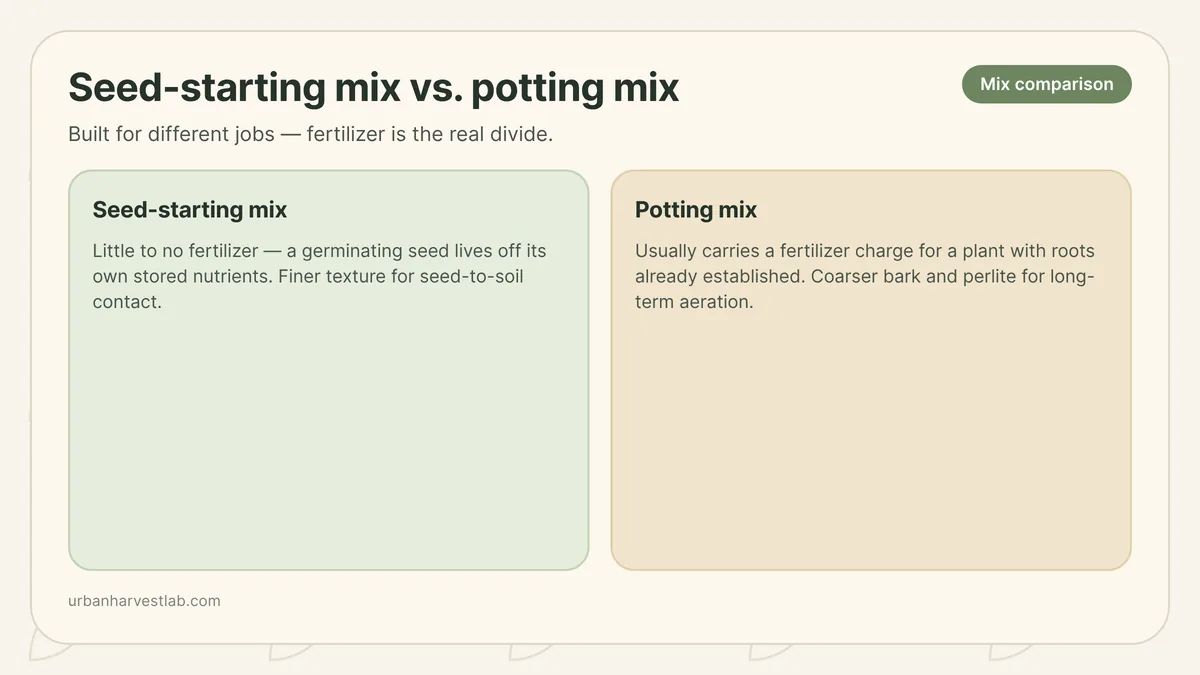
- Sterile, well-drained mix. Utah State says the potting mix used for seedlings should be sterile and that a well-drained mix reduces the chance of overwatering. A bag made for germination is built for this; seed-starting mix vs potting mix explains the difference.
- Less water. Utah State says an outbreak becomes more likely when seedlings are kept very wet. UC IPM advises misting seedlings instead of soaking the soil.
- Fast, thin growth. UC IPM points to planting when soil is 65-70 °F for most seeds and to thinning seedlings after they emerge for air circulation. It also notes that seedlings become less susceptible as they grow into established plants.
- Mature compost only. UC IPM warns that immature compost can support some damping-off pathogens and raise disease incidence.
Cinnamon appears nowhere in either list. If a tray collapses, the stem-base symptoms and what to do with the tray are in damping-off in microgreens.
Cinnamon on moldy potting soil
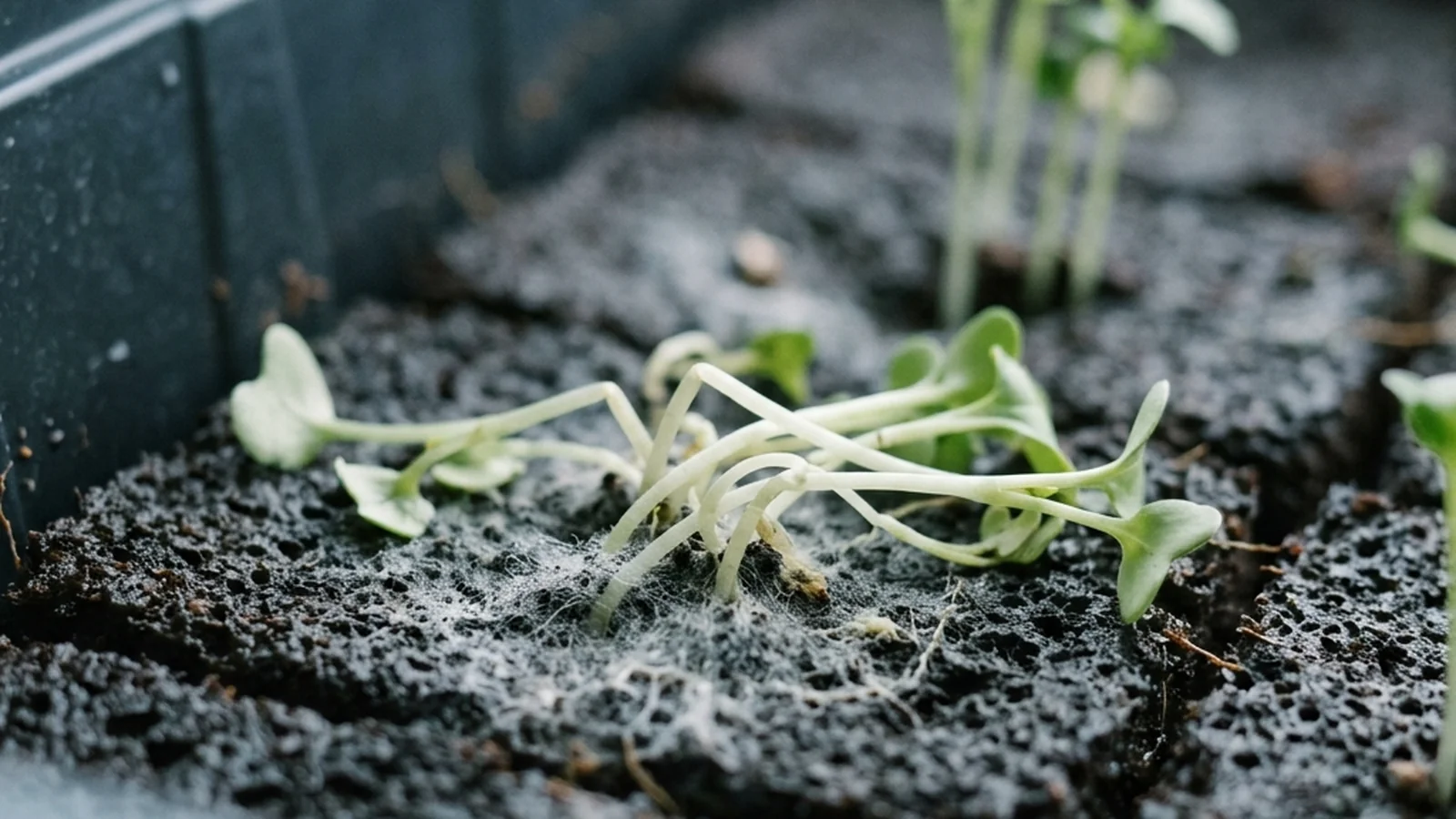
The fuzzy white or yellow patch on the surface of an established pot is a separate problem. Clemson Cooperative Extension describes that mold-like growth as saprophytic soil fungi, which feed on dead organic matter rather than on the living plant. That makes it a sign of a damp, still surface. In a seed tray, white cottony growth on seedlings that are collapsing can be damping-off itself, which Penn State and RHS describe; check the stem base for a pinched, water-soaked section before treating it as surface mould. A dusting may sit on the patch and look as if it worked, but the cause is still there.
The fix that matches the cause is drier top soil, more airflow and scraping the growth off. White mold on plant soil walks through telling it from salt crust and from real disease.
A dusting on the tray: harmless, untested, not a substitute
A thin dusting on the surface is a low-risk habit, and none of the sources checked report harm from it. The sources give no dose, no interval and no result to expect, so there is nothing to measure it against. Do not skip any of the controls above because cinnamon is in the tray, and do not thicken the layer if the tray stays wet. Clemson’s description of surface fungi living on dead organic matter suggests a thick layer of an organic powder on a damp surface is not a help.
Hydrogen peroxide is another popular kitchen remedy for fungal worries in pots, covered in hydrogen peroxide for plants.
Sources
- European Journal of Plant Pathology (2019), “Cinnamon powder: an in vitro and in vivo evaluation of antifungal and plant growth promoting activity”
- Utah State University Extension, “Damping-off”
- UC IPM Pest Notes 74132, “Damping-Off Diseases in the Garden”
- Clemson Cooperative Extension HGIC, “Houseplant Diseases & Disorders”
- University of Minnesota Extension, “How to prevent seedling damping off”
- Penn State Extension, “Safeguard Your Seedlings from Damping-Off”
- RHS, “Damping off: Causes, Symptoms & Control”
Related soil and seedling guides
Cinnamon is one of several kitchen remedies that promise to fix a damp tray. These pages cover what actually changes the outcome.
Common questions
Does cinnamon stop damping-off?
There is no trial among the sources checked that shows cinnamon powder preventing damping-off in a seed tray. What is documented is cinnamon slowing a different fungus, Botrytis, in a dish and as a foliar spray on tomatoes. Utah State Extension says damping-off is prevented by good sanitation and good cultural practices.
Is cinnamon a natural fungicide for houseplants and herbs?
Cinnamon has antifungal activity in laboratory conditions, and a 2019 tomato study in the European Journal of Plant Pathology found a 0.5 to 1 percent cinnamon water filtrate reduced grey mould. That is a sprayed liquid on one crop against one fungus, so it does not translate into a tested dose or method for potted herbs.
Will cinnamon on the soil hurt seedlings?
None of the extension sources checked here report cinnamon dusting harming or helping seedlings, so there is no documented dose to follow. A thin dusting is a low-stakes habit, but Clemson describes surface fungi as living on dead organic matter, which suggests a thick layer of an organic powder on wet soil is not a help.
What should I use instead of cinnamon on moldy potting soil?
Let the surface dry between waterings, add airflow, and scrape off the growth. Clemson Extension describes white or yellow mold-like growth on potting soil as saprophytic fungi, which live on dead organic matter and are not attacking the plant.
Related guides

Hydrogen peroxide for plants: what the evidence supports and where it backfires
Pouring pharmacy peroxide on roots is a popular rescue for overwatered plants. Here is what USDA and a controlled root-dip trial actually show, and why the oxygen claim falls short.
Seed-starting mix vs. potting mix: why your seedlings need a different bag
Potting mix is built to feed an established plant; seed-starting mix is built to stay out of a germinating seed's way. The difference is fertilizer content and particle size, and it matters before the first true leaf appears.
Damping-off in microgreens: symptoms and control
Damping-off attacks the seedling itself, not the tray surface. Here is how to recognize pre- and post-emergence stages and control outbreaks with sanitation, not fungicide.