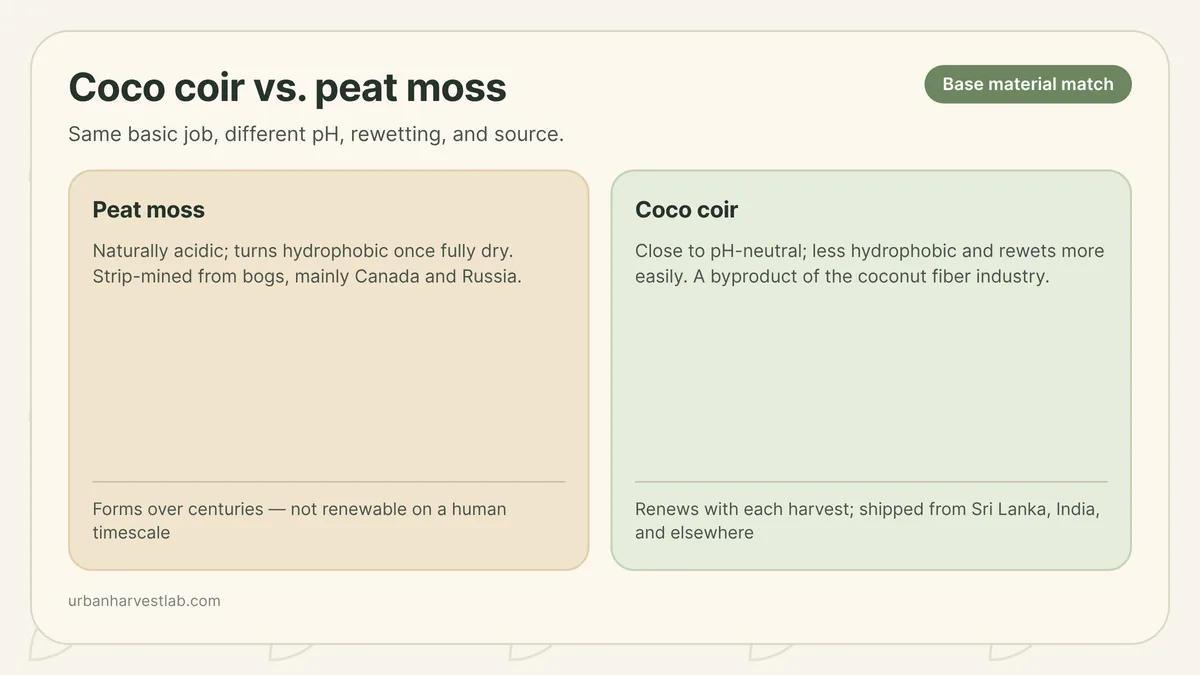
Coco coir vs. peat moss at a glance
| Property | Peat moss | Coco coir |
|---|---|---|
| Water retention | Holds water well but turns hydrophobic once fully dry | Similar retention; less hydrophobic and rewets more readily |
| pH | Naturally acidic | Close to pH-neutral |
| Salt content | Not listed as a drawback in WSUs comparison | Historically high; current processing has resolved it |
| Source | Strip-mined from bogs, mainly Canada and Russia | Byproduct of the coconut fiber industry, mainly South and Southeast Asia and Central America |
| Renewability | Forms over centuries; not renewable on a human timescale | Byproduct of an existing food and fiber crop; renews with each harvest |
Coco coir and peat moss do the same basic job in a potting mix — they hold water and add bulk around the roots — but they part ways on pH, on how they behave once they dry out, and on where they actually come from. Peat moss is naturally acidic and strip-mined from ancient bogs. Coco coir sits close to pH-neutral and comes from a coconut-processing byproduct. Swapping one for the other in a recipe changes more than the ingredient list.
A decomposed bog and a coconut husk
Peat moss is partially decomposed sphagnum moss that has built up in a cool, low-oxygen bog over hundreds to thousands of years, mostly in Canada and Russia, according to North Dakota State University Extension. Coco coir comes from the husks of coconuts grown for food, oil, and other fiber products — a byproduct of an existing crop rather than a raw material mined specifically for gardening, per Washington State University Extension’s Kittitas County Master Gardener Program.
Iowa State University Extension treats the two as interchangeable in function: both are listed as the traditional water-holding base of a soilless mix, alongside separate aeration components like perlite or bark that do a different job. Neither one is a complete potting mix on its own — either anchors a base layer that still needs structure and a nutrient-bearing fraction built around it, and neither should be confused with the mineral garden soil that does not belong in a container at all.
Water retention and rewetting
Both materials share the same underlying limitation. Iowa State University Extension groups peat moss and coco coir together as the mix’s water-holding base and warns that both go hydrophobic once they dry out completely, needing a pre-soak days ahead of planting rather than a quick splash right before you use them.
Where the two diverge is degree. Washington State University Extension’s side-by-side comparison credits coir with promoting moisture holding using less water than peat, and describes it as easier to rewet once it has fully dried, calling peat “hydrophobic: once dry, is very hard to rewet.” The same source lists coir’s cation exchange capacity as higher than peat’s, meaning a coir-based mix holds onto more nutrient ions between waterings rather than losing them straight to drainage.
Neither difference changes the basic habit a container needs: water on a schedule that keeps the base from ever fully drying out, because recovering a bone-dry batch of either material takes more than one watering to finish.
pH and the salt question
Washington State University Extension’s comparison is direct about pH: coco coir tests close to pH-neutral, while peat moss runs “more acidic than most garden plants prefer.” That gap matters less than it sounds for a bagged commercial mix, because manufacturers correct for it regardless of which base they use. Penn State Extension’s own greenhouse-grade standard for soilless mix targets pH 5.5 to 6.5, and UConn Extension’s Home Garden Education Office gives a slightly tighter 5.5 to 6.0 range for soilless blends specifically — both figures apply to the finished product, after lime has been worked in to correct a naturally acidic peat base or left out of a naturally neutral coir base.
Coir carries a documented history worth knowing before you buy in bulk. Washington State University Extension notes that coir “used to have high salt content,” a legacy of earlier processing methods, and states that current processing has resolved the issue. A fresh brick from a reputable supplier should not need special treatment, but rinsing it once before use is a reasonable habit if you are working with an unfamiliar import or a large batch. If a mix — coir-, peat-, or soil-based — later develops a white crust on the surface from fertilizer or tap-water minerals, that is a separate, ongoing problem to flush and manage on its own terms, not something either base material solves by itself.
Sustainability: a mined bog versus a processing byproduct
The two materials part ways most sharply here. Peatlands hold roughly 30 percent of the earth’s soil carbon and form over centuries in cool, low-oxygen bogs, according to University of Maryland Extension’s Maryland Grows program; stripping a bog for peat releases that stored carbon as carbon dioxide. Washington State University Extension is blunter about the extraction itself, describing bog strip-mining as a source of “massive environmental and cultural resource damage.” Most sphagnum peat sold in the US comes from Canada, and Maryland Grows notes that while the UK has set timelines to phase peat out as a growing medium for gardeners and commercial growers, Canada’s peat industry has given no indication of following.
Coco coir’s environmental case rests on being a byproduct rather than a target crop. It comes from husks left over after a coconut is harvested for food, oil, and fiber, so using it for potting mix keeps material out of landfills instead of drawing down a slow-forming ecosystem. Its real tradeoff is distance: Maryland Grows lists Sri Lanka, the Philippines, Mexico, India, and Costa Rica as the main producing countries, and flags the resulting shipping distance and cost as the honest cost of choosing coir over a Canadian peat bale, not its renewability. Washington State University Extension’s own comparison reaches a similar conclusion from the shipping side alone: sea freight uses less fuel than trucking, so the two options end up costing about the same to move despite coir traveling farther.
How much coir a mix can carry
Most commercial mixes do not force the choice. University of Maryland Extension cites research getting good results across a range of species with coir at 35 to 80 percent of total mix volume, and suggests coir-and-compost blends at 3:1, 2:1, or 1:1 as a starting point. That range gives room to lean toward coir for its rewetting behavior and neutral pH, or toward peat for its wider availability, without needing a pure batch of either.
Which blend actually suits a given pot depends more on the crop and the container than on the base material alone. Matching a potting mix to potted herbs walks through how moisture-retention needs shift between thirsty basil and drought-tolerant rosemary, and figuring out how much compost to add covers the nutrient-bearing fraction that neither coir nor peat supplies on its own.
Which one to reach for
If a bag of mix is already limed to its target pH, the coir-versus-peat choice mostly comes down to rewetting habits and sourcing priorities rather than plant performance. Coir suits a grower who has let a pot dry out before and wants a base that forgives it, or who is weighing the bog-extraction question directly. Peat suits a grower prioritizing easy availability over the sourcing question, and who waters on a schedule reliable enough that full dry-out is rare. Either one, blended into a real potting mix rather than used alone, does the job.
Sources
- Washington State University Extension, Kittitas County: Coconut Coir vs Peat Moss
- University of Maryland Extension, Maryland Grows: Peat-free potting mixes
- North Dakota State University Extension, Dakota Gardener: For Peat Moss Sake
- Iowa State University Extension, Yard and Garden: Potting Media — Components and Handling
- Penn State Extension: Potting Media and Plant Propagation
- UConn Extension, Home Garden Education Office: Potting Media
Build the rest of the mix
Once you have picked a base, these guides cover what goes around it in the pot.
Common questions
What is the main difference between coco coir and peat moss?
Coco coir sits close to pH-neutral while peat moss runs more acidic. Iowa State University Extension notes that both go hydrophobic once fully dry and need pre-wetting days ahead; Washington State University Extension's comparison puts coir as the less hydrophobic of the two and easier to rewet.
Is coco coir more sustainable than peat moss?
Coco coir is a byproduct of the coconut fiber industry rather than a material extracted specifically for horticulture, and it does not draw down a carbon-storing bog the way peat mining does. Its tradeoff is the shipping distance from producing countries such as Sri Lanka, the Philippines, Mexico, India, and Costa Rica.
Does coco coir still have a salt problem?
Coir used to carry a high salt content that could injure roots, but extension sources describe that issue as resolved by current processing methods. Rinsing a fresh brick before use is still a reasonable precaution.
Can coco coir and peat moss be mixed together?
Yes. University of Maryland Extension cites research getting good results with coir at 35 to 80 percent of total mix volume, and suggests coir-and-compost blends at 3:1, 2:1, or 1:1.
Related guides
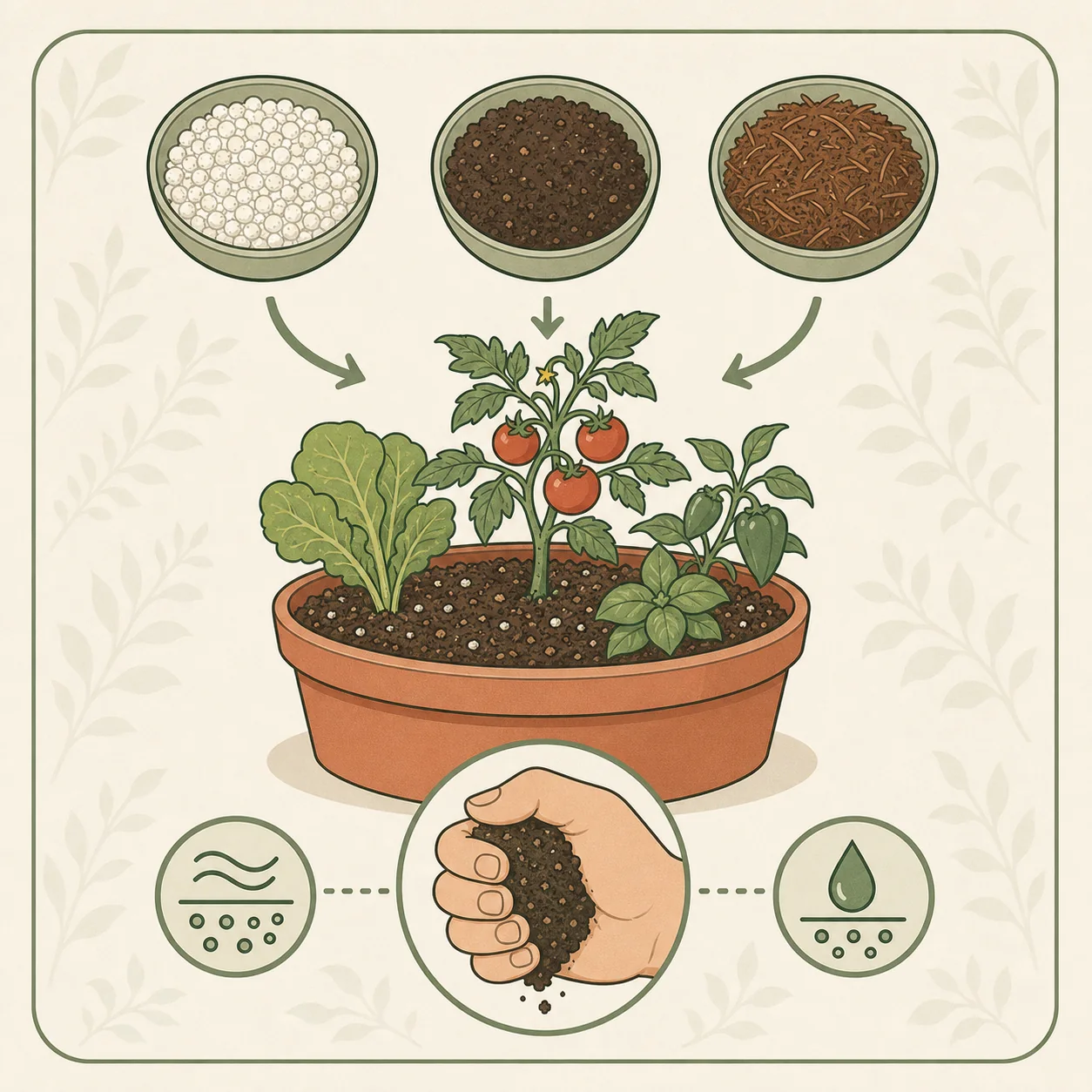
How to make potting mix for container vegetables
A useful potting mix recipe describes the job of each ingredient and gives you a way to correct the result. The goal is stable air and moisture, not a magic ratio.
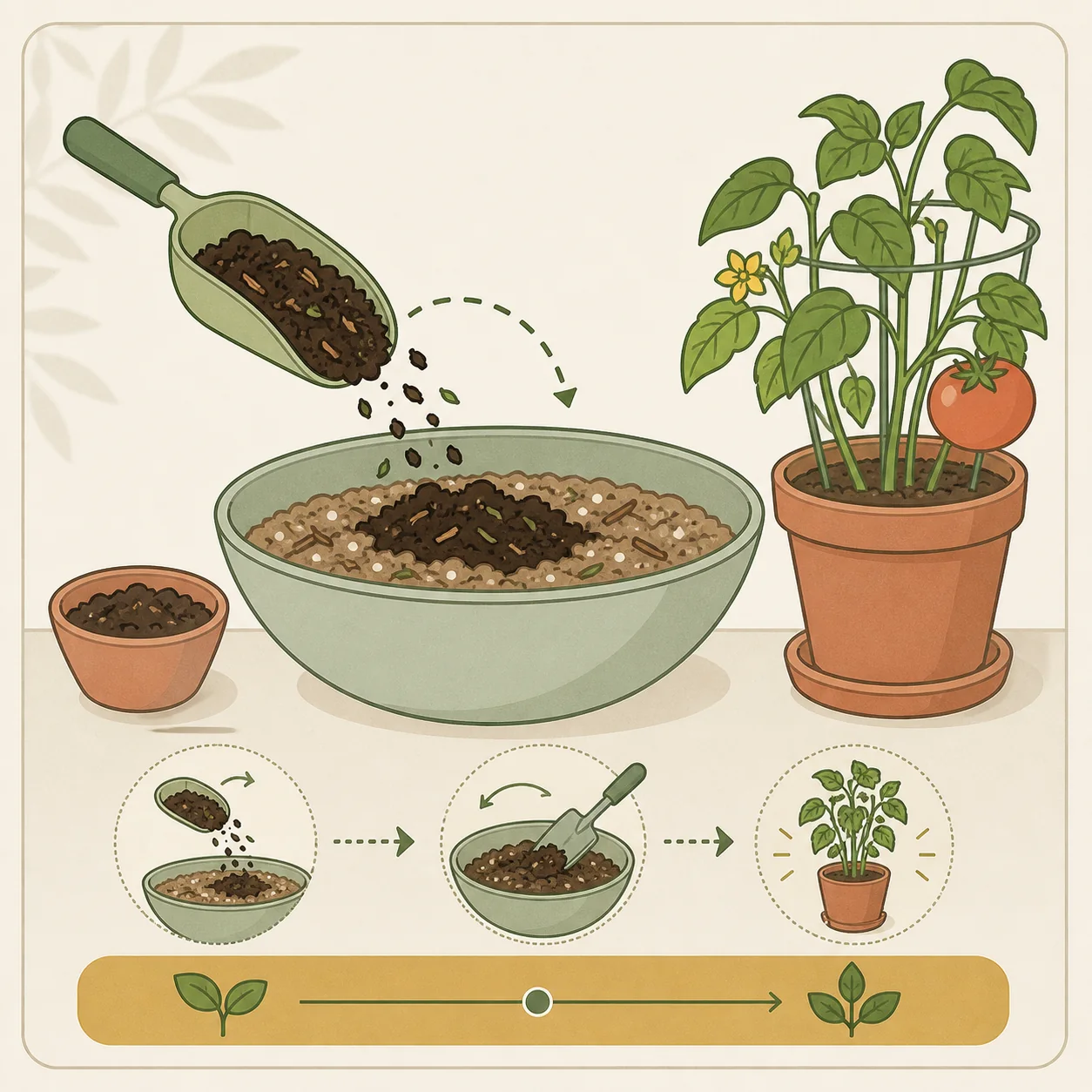
How much compost should you add to potting mix?
More compost is not automatically better. In a container, compost must share limited space with the coarse particles that preserve air around roots.
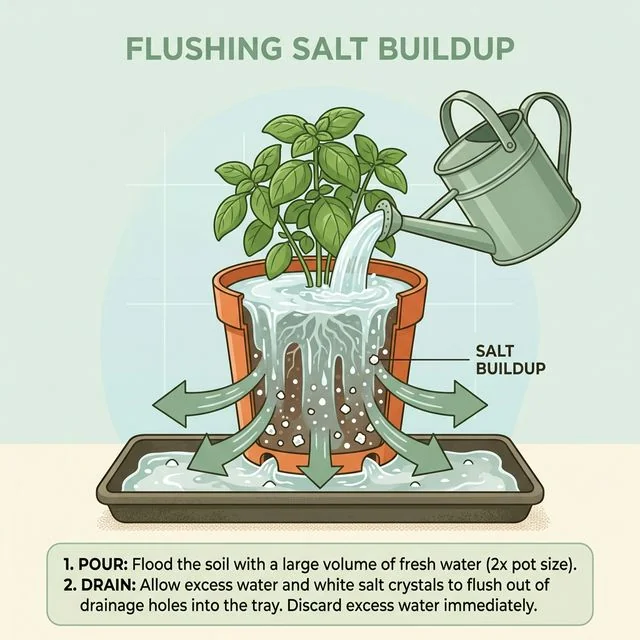
Salt buildup in herb pots: when to flush and when to repot
Every time you water your plants with liquid fertilizer, you are leaving heavy chemical salts behind. If you don't periodically wash them out, your herbs will suffer from chemical burn and nutrient lockout.