Nutrient lockout happens when soil pH pushes a nutrient into a chemical form roots cannot absorb — it is a pH problem, not something fertilizer salt causes by building up in the mix. The nutrient can still be sitting in the pot. A mix can hold a full dose of iron and the plant growing in it can still show iron deficiency, because the pH of that mix has converted the iron into a form roots cannot transport across the root membrane. Illinois Extension notes that high calcium, zinc, manganese, phosphorus, or copper can also tie up iron on their own, and poor drainage or damaged roots can produce the same look without any pH problem at all. Testing and correcting the mix’s pH addresses the cause; feeding harder does not.
What “lockout” actually means
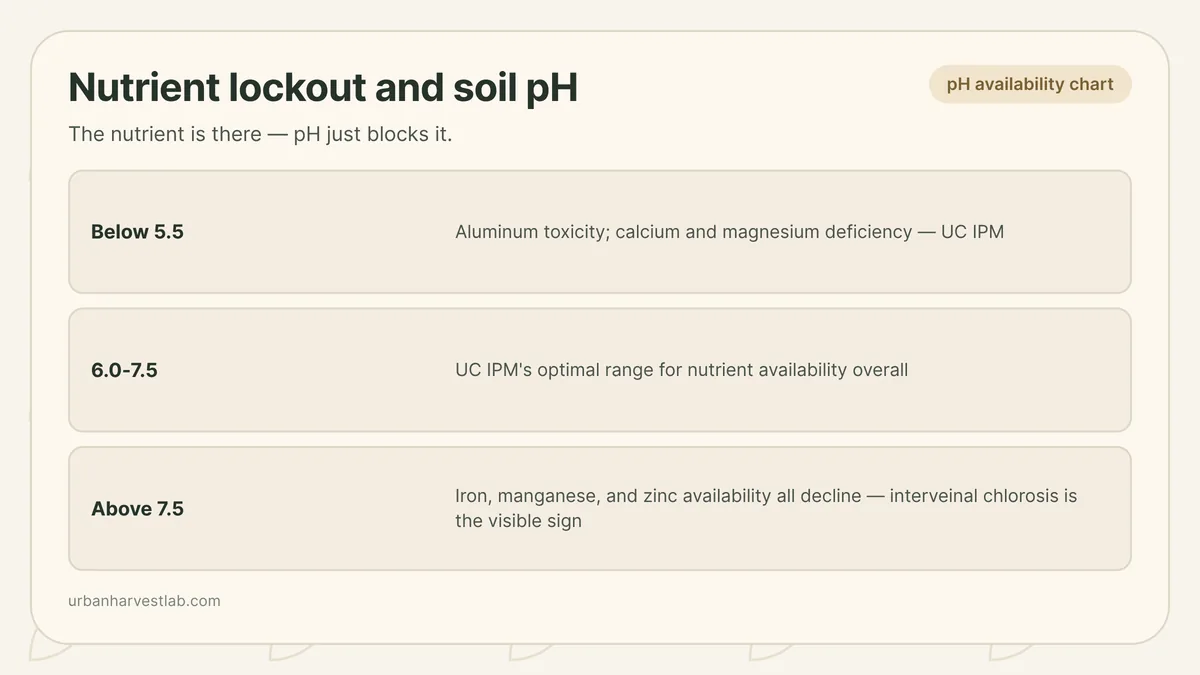
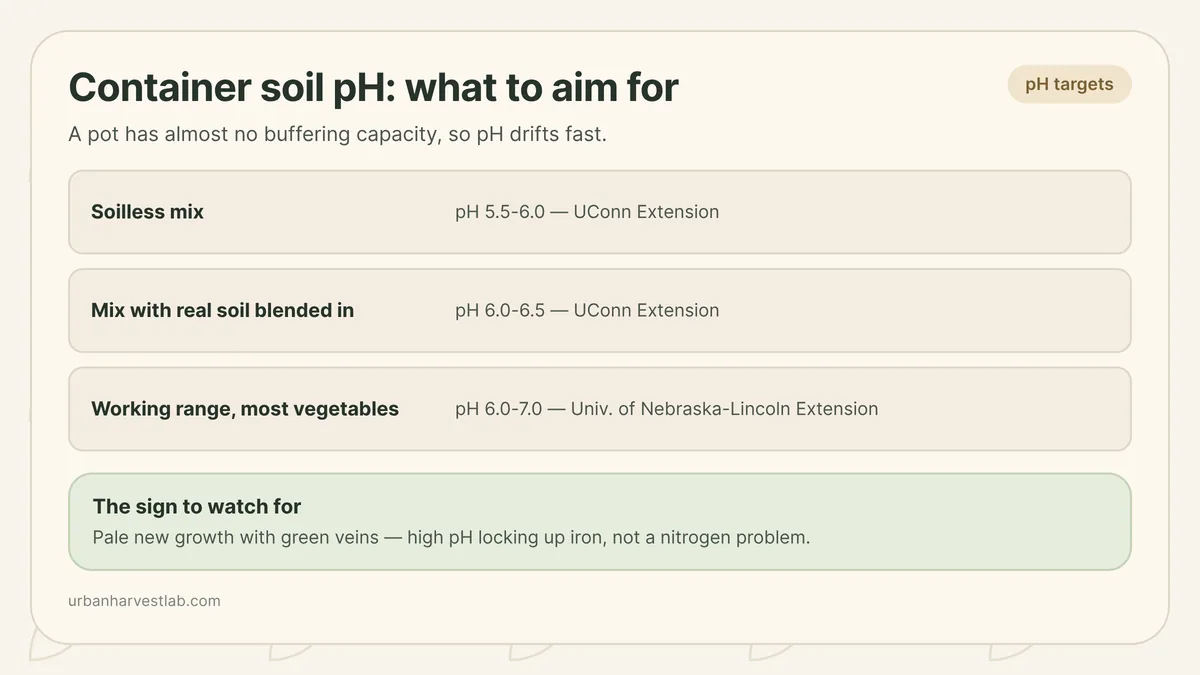
Extension guidance treats lockout as an availability problem, not a supply problem. Below about 5.5 or above about 7.5, correction becomes necessary because pH itself starts working against the plant, independent of how much fertilizer is already in the mix. Nebraska gives 6.0 to 7.0 as the working range most crops tolerate without active correction; Utah State gives 6.0 to 7.2, with many drought-adapted Western species tolerating 7.0 to 8.0. Aim for the mid-6s and treat a reading outside roughly 5.5 to 7.5 as a reason to test rather than to fertilize.
That framing matters because it changes what “more fertilizer” can and cannot do. A complete fertilizer supplies nitrogen, phosphorus, potassium, and usually iron, manganese, and zinc in a chemical form the label assumes the roots can use. Soil pH decides whether that assumption holds. Outside the working range, the label’s stated analysis stops predicting what the plant actually receives.
The pH-availability chart
The table below is an availability chart, not a target chart — container soil pH covers the mix-type pH targets themselves; what follows is about what a given reading actually does to nutrient uptake. It is general, not a per-crop lookup — use it to place a reading, not to pick a target down to a tenth of a point.
| Soil pH zone | What’s happening | Source |
|---|---|---|
| Below 5.5 | Aluminium toxicity and calcium/magnesium deficiency; possible copper and manganese toxicity and phosphorus deficiency, showing as chlorotic, distorted, sometimes necrotic new foliage | UC IPM |
| 6.0-7.5 | UC IPM’s optimal range for nutrient availability overall | UC IPM |
| 5.0-6.5 | Iron’s free-ion form is available to roots in this band, per Illinois Extension | University of Illinois Extension |
| 6.5-6.7 and above | Iron becomes increasingly insoluble as pH climbs past this point | University of Illinois Extension |
| Above 7.5 | Outside UC IPM’s optimal range; iron, manganese, and zinc availability all decline, and interveinal chlorosis is the visible sign to watch for | UC IPM |
Utah State University Extension’s container-specific advice for an acid-preferring plant like blueberries is to grow it in a box or half-barrel heavily amended with acidic organic matter, rather than assuming the general vegetable range applies.
Which leaves turn pale tells you which nutrient
Which leaves show the pattern narrows which nutrient is locked out. UC IPM places iron and manganese lockout on new foliage — undersized and yellow to whitish, with the veins staying green — because neither element moves easily out of older tissue once it has settled there. Zinc lockout follows the same new-growth pattern for UC IPM but Illinois Extension disagrees, placing manganese and zinc deficiency on the inner or older leaves first instead; the two extension services simply do not agree on where those two elements show up, so record both rather than picking one. Utah State University Extension describes high-pH iron lockout as a common problem wherever soil pH runs high, and it shows up first in new growth because a plant cannot move locked-out iron out of older leaves to rescue younger ones the way it can with a genuinely mobile nutrient.
That pattern is worth distinguishing from a uniform, whole-leaf yellowing that includes the veins, which points toward light, water, or a straightforward feeding gap rather than pH. Green veins on a yellowing leaf are the detail that narrows the search — why are my plant leaves turning yellow? walks through the full set of yellowing patterns and what each one points to.
Salt buildup is a different problem with a different fix
A white, crusty deposit on the mix surface or around a pot’s rim gets blamed for the same symptoms as pH lockout, but the mechanism and the fix are both different. Colorado State University Extension and University of Maryland Extension describe salt buildup as an osmotic problem: dissolved fertilizer and mineral salts left behind as water evaporates or transpires, concentrating until they scorch leaf margins and tips or wilt the plant outright. That is a water-stress mechanism, not a pH shift. They are two separate readings from two separate instruments, and a plant can have either problem, both at once, or neither.
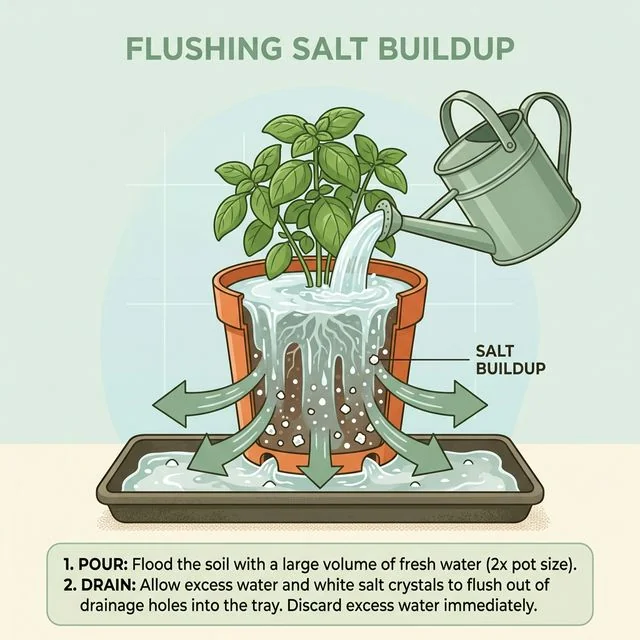
The fixes don’t overlap either. Salt buildup responds to leaching — flushing the mix with water to carry dissolved salts out the drainage holes — which does nothing to move soil pH. A pH-driven lockout responds to a pH test and, where needed, a pH amendment; leaching alone won’t correct it. Treating a white crust as a pH symptom sends you to test the wrong thing, and treating interveinal chlorosis as a salt problem sends you to flush a pot that didn’t need it.
Why feeding harder doesn’t fix it
If a nutrient is chemically locked out by pH, the fertilizer aisle can’t out-dose the chemistry. Doubling a feeding schedule adds more of a nutrient the roots already couldn’t absorb at the original dose, while also raising the amount of dissolved salt sitting in the mix — trading one problem for a second one instead of solving the first. Reading the fertilizer label correctly still matters for choosing a complete product with the micronutrients a plant needs, but the label can’t compensate for a mix whose pH won’t let those micronutrients move. If a plant shows the tip-and-margin scorch or surface crust of overfeeding rather than the green-veined pallor of iron lockout, that overfeeding pattern has its own separate diagnosis and its own separate fix.
Getting the pH itself back in range
The chart above tells you where a reading sits and what it predicts; it doesn’t walk through how to move a container’s pH once you’ve tested it. Container soil pH covers testing a mix while it’s moist, sampling more than one spot in the pot, and the two amendments — lime to raise pH, elemental sulfur to lower it — along with why bed-scale application rates don’t translate cleanly down to a single container. For a plant showing interveinal chlorosis in an otherwise well-fed pot, that page is the next step; this one is about recognizing that pH, not the fertilizer bag, is the thing to test first.
Sources
- Utah State University Extension — Solutions to Soil Problems II: High pH
- University of Nebraska-Lincoln Extension, G945 — Fertilizers for Vegetables in Home Gardens
- UConn Extension, Home Garden Education Office — Potting Media
- Colorado State University Extension, PlantTalk Colorado #1338 — Whitish Crust on Potting Mixes
- University of Maryland Extension — Watering Indoor Plants
- UC IPM — pH Problems
- University of Illinois Extension — Chlorosis
Sort pH lockout from the other soil problems
These cover the mechanism, the fix, and the two problems nutrient lockout gets confused with.
Common questions
What causes nutrient lockout in potted plants?
Soil pH outside a nutrient's available range is the usual cause. As pH climbs toward the high end, iron in particular converts into a chemical form roots cannot take up, according to Utah State University Extension, even when the mix or fertilizer still contains it. Illinois Extension notes that high levels of calcium, zinc, manganese, phosphorus, or copper can also tie up iron on their own, and poor drainage or damaged roots can produce the same look without any pH problem at all.
Does salt buildup cause nutrient lockout?
No — they are two different problems. Salt buildup is osmotic: accumulated fertilizer and mineral salts, described by Colorado State University Extension and University of Maryland Extension as causing leaf scorching and wilting through water stress, not a pH shift. The two problems show up differently and are fixed differently.
What does nutrient lockout look like?
The clearest sign is interveinal chlorosis: new leaves turn light green or yellow while the veins stay visibly green. Utah State University Extension describes this as the classic result of high pH making iron unavailable, and calls it a common problem wherever soil pH runs high.
Will adding more fertilizer fix nutrient lockout?
Not on its own. If a nutrient is already present but chemically unavailable because of pH, adding more of it does not change what the roots can absorb. Testing and correcting the mix's pH addresses the cause; a heavier feeding schedule does not.
Related guides
Container soil pH: when it matters and how to fix it
A container's small volume has almost none of the buffering capacity open ground has, so pH drifts faster and matters sooner. Here is when to test, what to aim for, and how to move it.
Best fertilizer for herbs in pots: a label-first guide
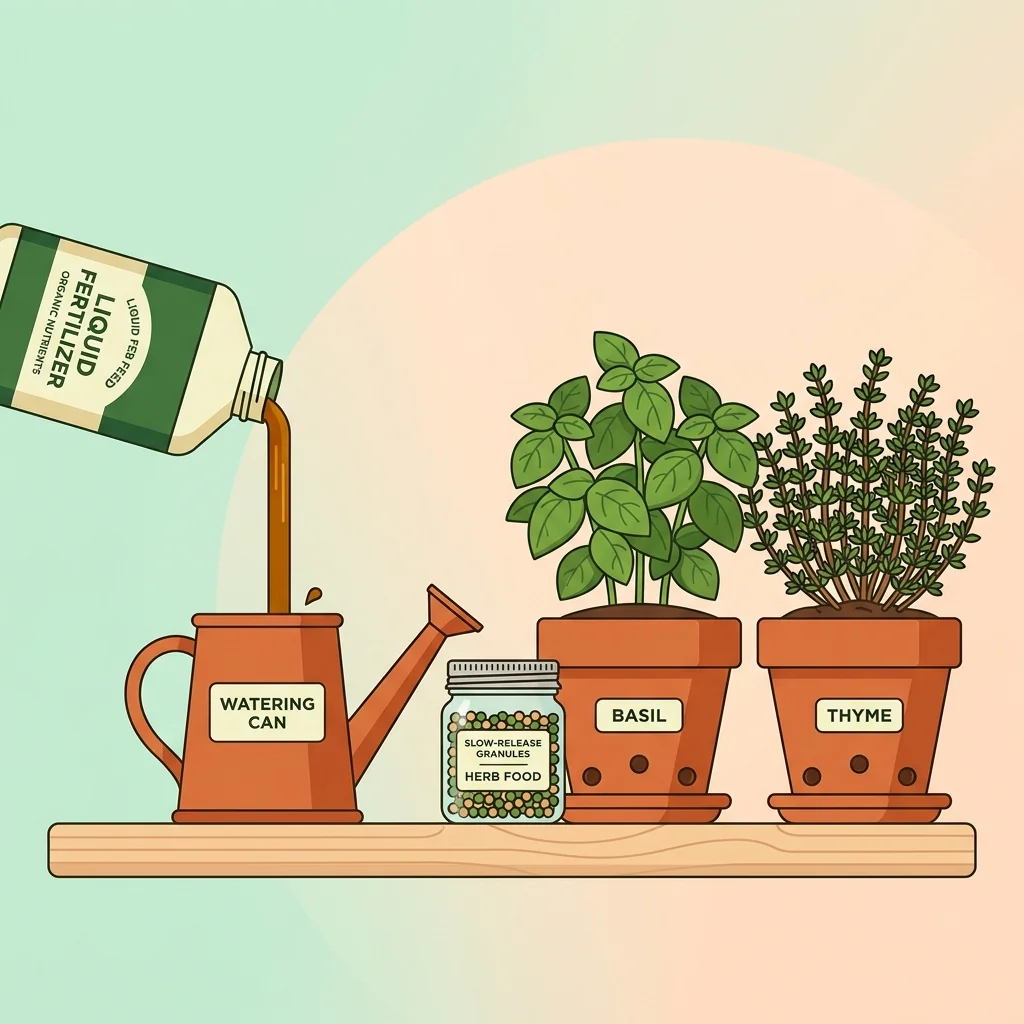
A practical, label-first guide to complete liquid and controlled-release fertilizers for potted herbs, with a decision table and a safer first application.
Salt buildup in herb pots: when to flush and when to repot
Every time you water your plants with liquid fertilizer, you are leaving heavy chemical salts behind. If you don't periodically wash them out, your herbs will suffer from chemical burn and nutrient lockout.