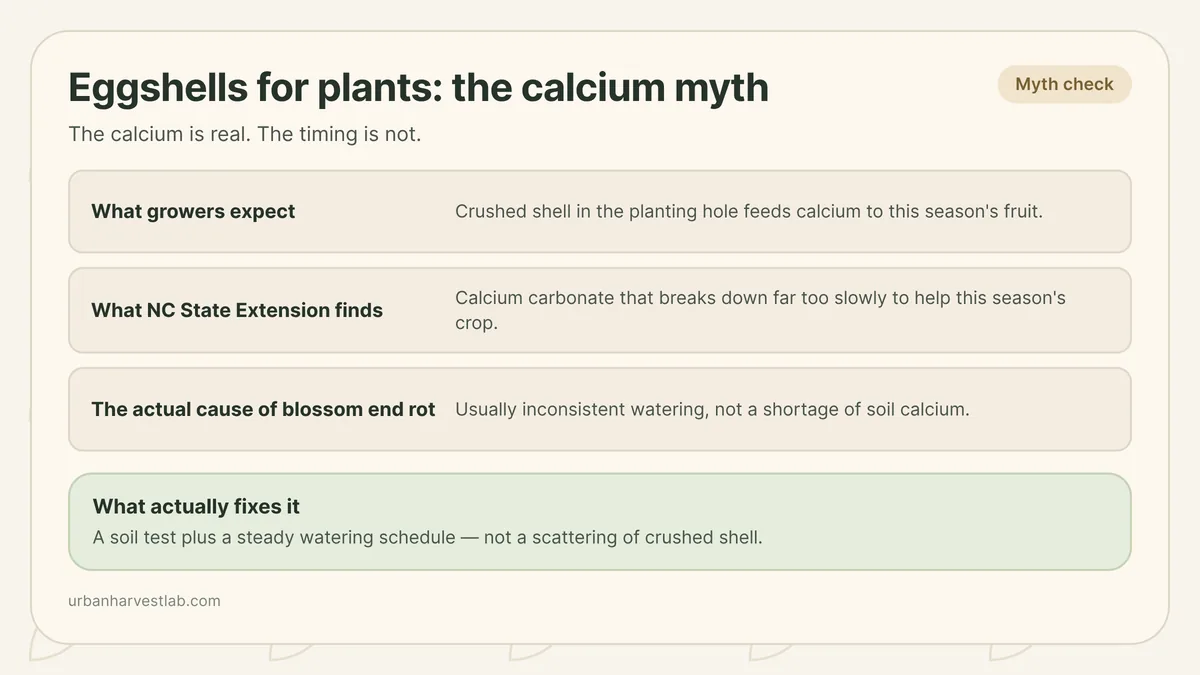
What eggshells actually do versus what growers expect
| Claim | What growers expect | What the extension source finds |
|---|---|---|
| Crushed shell in the planting hole | Available calcium for that season's fruit | Calcium carbonate that releases far too slowly to help this season's crop |
| Eggshells fix blossom end rot | A soil-calcium problem, corrected by feeding calcium | Usually a watering-consistency problem; the fix is a soil test plus steady watering |
| Whole shells buried near roots | Faster breakdown once in contact with soil | Still a slow-dissolving mineral regardless of placement |
| A soil test before adding anything | Skipped because eggshells feel like a safe default | The step NC State recommends first |
Eggshells are a genuine source of calcium carbonate, but they decompose far too slowly to supply that calcium to a plant on any useful timeline. NC State Cooperative Extension states directly that adding eggshells will not make calcium available in a timely enough fashion to help with blossom end rot — and blossom end rot itself is usually a watering problem, not a soil calcium shortage, so the shell was not treating the actual cause.
The habit persists because the chemistry sounds right on the label: eggshells are mostly calcium, tomatoes with blossom end rot supposedly need calcium, so crushed shell in the planting hole looks like a free, zero-waste fix. Checking a container’s soil pH is a more useful first move than crushing another shell; container soil pH covers how to test it and what range most vegetables want.
What eggshells actually contain
The shell of an egg is largely calcium carbonate — the same mineral compound found in agricultural lime and limestone. That part of the folk claim is accurate. NC State Cooperative Extension’s Chowan County Center confirms eggshells contain “mainly calcium carbonate,” so a gardener who says a shell is a calcium source is not wrong about the chemistry.
The problem is speed, not composition. Calcium carbonate is not water-soluble in the way a fertilizer salt is. It needs to break down before roots can take up the calcium inside it, and NC State’s assessment is that this does not happen in a timely enough fashion to help a plant that is already showing blossom end rot.
Grinding the shell to a fine powder increases the surface area exposed to soil moisture, the same reasoning behind Clemson’s guidance to apply agricultural lime two to three months before planting so it has time to react fully. It does not change the underlying problem for a container grower who needs calcium available this week rather than next season, and a home eggshell rarely gets ground anywhere near as fine as a commercial lime product built for exactly that reaction.
Why this looks exactly like the Epsom salt myth
If the pattern feels familiar, it should. Epsom salt for plants is the same shape of claim about a different mineral: a kitchen or garden-shed material that supplies a real nutrient, applied on the assumption that supplying the nutrient is the same thing as fixing the symptom. North Dakota State University Extension’s testing found Epsom salt supplies magnesium and no calcium at all, and that magnesium competes with calcium for uptake — so it makes blossom end rot worse rather than better. Eggshells at least supply the right element — calcium — but fail on timing instead of on chemistry.
Both cases point to the same underlying mistake: treating a visible symptom as proof of a soil-nutrient deficiency without checking what is actually happening at the root.
Blossom end rot is usually not a soil calcium shortage
Blossom end rot shows up as a flat, sunken, leathery-brown patch on the blossom end of a tomato, pepper, or squash fruit. It is easy to read as “this plant needs calcium,” which is why eggshells and Epsom salt both get reached for. NC State’s assessment reframes the cause: the underlying issue is usually a watering-consistency problem — the same root cause behind the Epsom salt myth — rather than a genuine shortage of calcium in the soil itself.
Calcium reaches the fruit through the water stream, and uneven watering interrupts that delivery even when the soil itself holds enough calcium to spare — Epsom salt for plants covers the full delivery mechanism. Adding more calcium to the soil, whether from a shell or a supplement, does not fix an interruption in how that calcium is being delivered.
What NC State recommends instead
The extension recommendation is a soil test, and a consistent watering schedule — not a shell scattered into the mix. A soil test tells you whether the growing medium genuinely lacks calcium. University of Maryland Extension notes that conventional potting and seed-starting mixes have lime added, so a bagged mix is not usually starting from zero calcium. Consistent watering addresses the mechanism that is actually responsible for most blossom end rot: keeping soil moisture even rather than swinging between dry and saturated.
A soil test also settles the question directly rather than leaving it to guesswork, since a fruit already showing rot cannot tell you whether the soil holds too little calcium or the delivery to that fruit failed for another reason — and only one of those two problems responds to adding more calcium at all. Testing costs less time than a season of guessing and reapplying a fix that was not going to address the actual cause.
For a container specifically, that means:
- Water on a schedule you can actually hold to, rather than reacting only once the mix looks visibly dry.
- Choose a pot and mix that don’t dry out unpredictably fast, since a small container in full sun can go from moist to bone-dry in a single hot afternoon.
- Mulch the surface to slow evaporation between waterings, evening out the swings that interrupt calcium delivery.
- Test before amending. If a soil test does show a genuine calcium shortfall, that is a different situation than most blossom-end-rot cases and calls for an amendment sized to the actual result, not a scattering of shell.
A bagged potting mix usually starts with adequate calcium already built in, which is one more reason a shortfall is the less likely explanation for fruit showing up with a sunken end. Best fertilizer for herbs in pots covers how to check what a mix and a complete fertilizer are already supplying before adding anything else on top of it, so a calcium-specific amendment does not get layered onto a pot that did not need one.
Where crushed eggshells are still worth using
None of this makes eggshells useless in the garden — it just puts them in a different category than a fast-acting fix. Finely crushed shell can go into the compost pile as a way of not throwing it away, and the calcium it eventually contributes arrives on the same slow timeline described above, not on a faster composting one. Worked into garden soil over multiple seasons, shell fragments do eventually contribute calcium as they dissolve — it just will not happen in time to save this year’s fruit.
Some gardeners also scatter sharp shell fragments around seedlings as a minor physical deterrent to soft-bodied pests. That use has nothing to do with calcium nutrition and stands or falls on its own, separate from the fertilizer claim.
Eggshells are not an isolated case, either. Coffee grounds for herbs and banana peel water circulate as the same kind of free kitchen-scrap fertilizer, each supplying a real nutrient on a timeline or in a form that does not match what the plant needs when the symptom appears. None of the three household staples is fake. All three are slower, weaker, or less targeted than the claim made for them.
Sources
Other kitchen-scrap fixes, checked against the same sources
Eggshells are one of several folk remedies that extension research has already tested. These cover the others.
Common questions
Do eggshells add calcium to soil?
Eggshells are largely calcium carbonate, so the calcium is real. NC State Cooperative Extension notes the shell breaks down too slowly to make that calcium available in a timely enough fashion to help a plant that needs it now, such as one showing blossom end rot.
Will eggshells stop blossom end rot on tomatoes?
Not reliably. Blossom end rot is usually caused by inconsistent watering interrupting calcium movement inside the plant, not by a shortage of calcium in the soil. Extension guidance points to a soil test and a steady watering schedule rather than crushed shell.
How long do eggshells take to break down in soil?
No extension source puts a number on it. What NC State Cooperative Extension does state is that adding eggshells will not make calcium available to plants in a timely enough fashion to help with blossom end rot, which is why they cannot correct a current-season problem.
Is there any use for eggshells in the garden?
Crushed shell can still go into a compost pile or be worked into soil as a long-term, slow-release calcium source over multiple seasons, and some gardeners use sharp shell fragments as a minor deterrent around seedlings. Just do not rely on it to fix an active nutrient problem.
Related guides
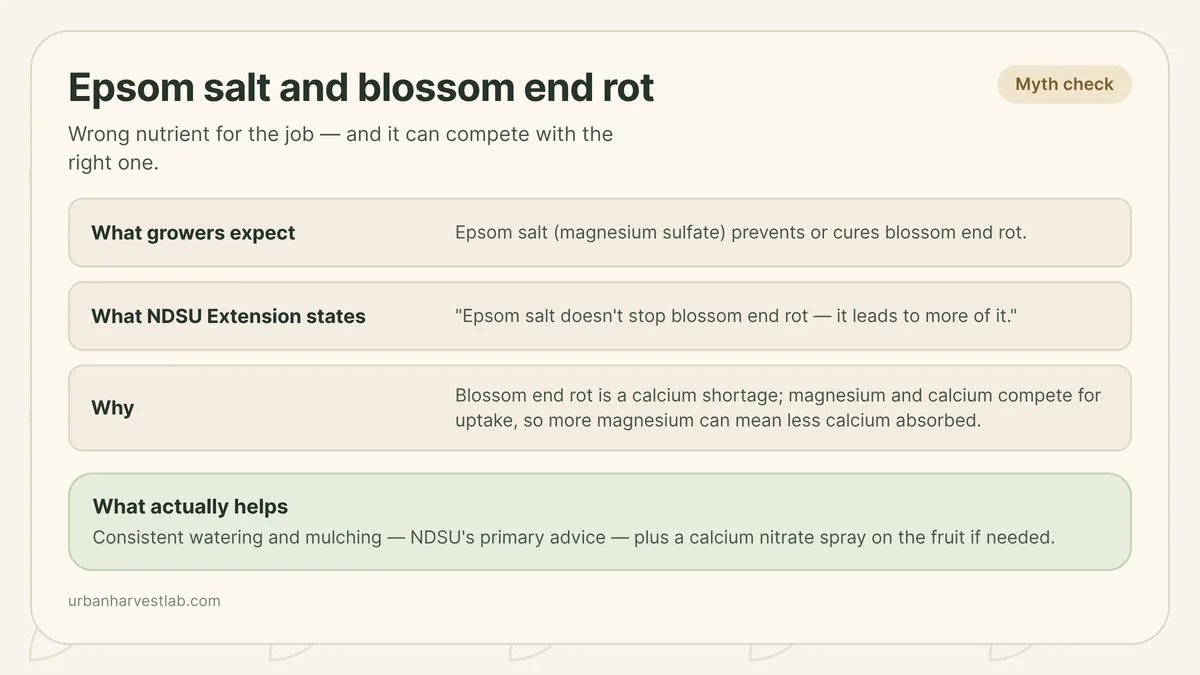
Epsom salt for plants: what the evidence actually shows
Epsom salt is one of the most repeated garden fixes there is, and North Dakota State University Extension says the opposite of what the jar's reputation claims.
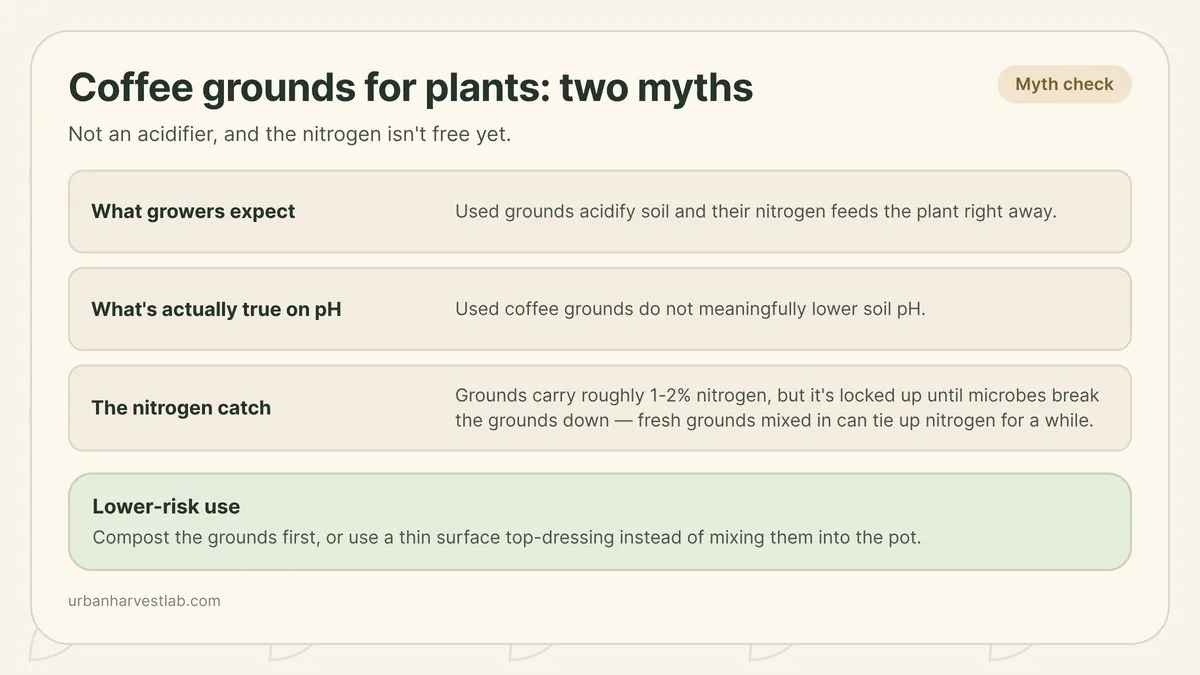
Coffee grounds for plants: the acidity myth and the nitrogen catch
Used coffee grounds do not meaningfully lower soil pH, and the nitrogen inside them stays locked up until soil microbes finish decomposing the grounds.
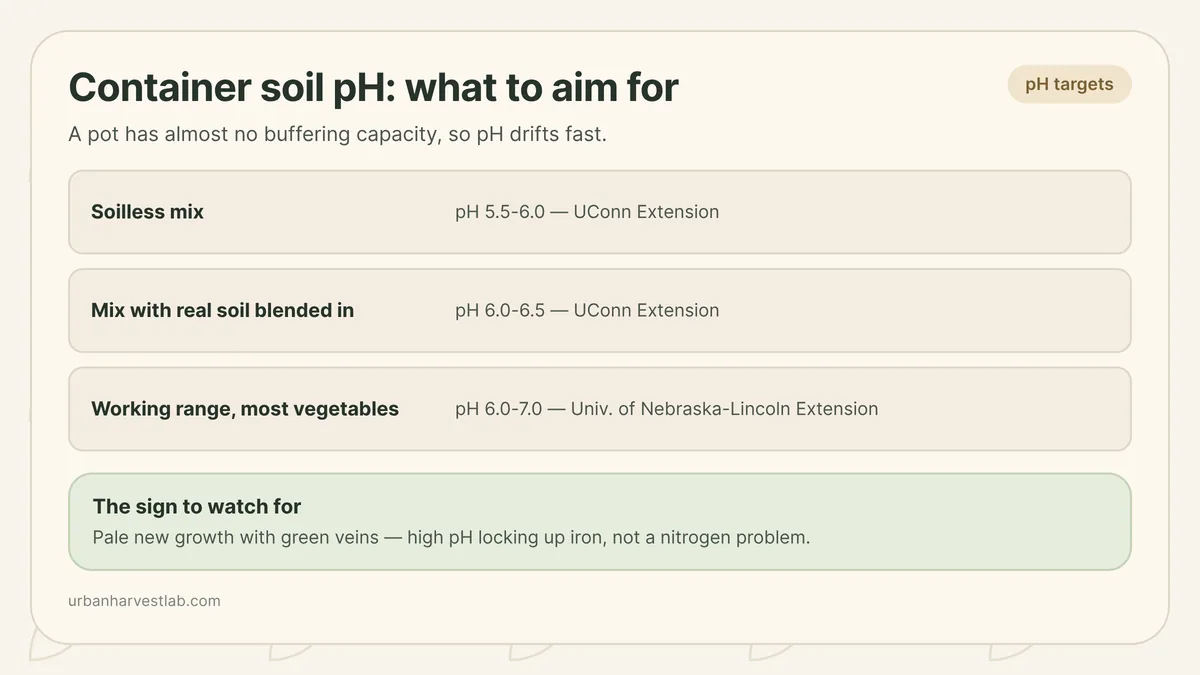
Container soil pH: when it matters and how to fix it
A container's small volume has almost none of the buffering capacity open ground has, so pH drifts faster and matters sooner. Here is when to test, what to aim for, and how to move it.