The Epsom salt claim versus what NDSU states
| Claim | What growers expect | What NDSU states |
|---|---|---|
| Epsom salt prevents blossom end rot | Magnesium sulfate feeds the plant and stops the rot from forming | Blossom end rot is a calcium shortage; Epsom salt supplies none at all |
| More Epsom salt means more nutrition | Extra magnesium can only help a stressed plant | Magnesium and calcium ions compete for uptake, so more magnesium can mean less calcium absorbed |
| Epsom salt is a safe all-purpose feed | A mineral salt used at any dose is harmless | Unneeded magnesium adds to the soluble-salt load in a container without fixing the underlying problem |
| Epsom salt greens up a yellowing plant | Yellow leaves mean a magnesium shortage | Yellowing in a container is more often a nitrogen or watering problem, and Epsom salt supplies no nitrogen |
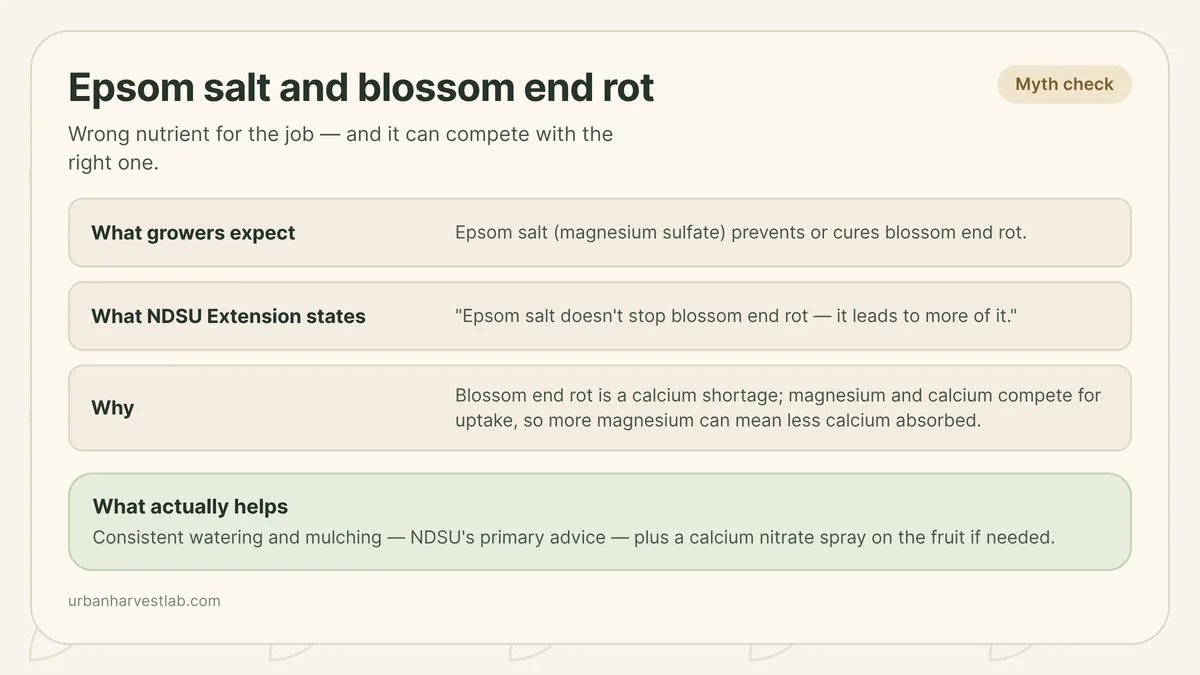
For most container plants, Epsom salt adds a nutrient they are not short of; the one case it is famously recommended for is the one where it does the most harm. Epsom salt does not prevent or treat blossom end rot on tomatoes and peppers, and North Dakota State University Extension states it can make the problem worse. Blossom end rot is a calcium-supply problem. Epsom salt is magnesium sulfate, and it supplies “no calcium at all” — so scattering it around a rotting tomato plant does nothing for the actual shortage, and the magnesium it does add can crowd out what little calcium the plant is already struggling to take up.
The habit survives because Epsom salt is cheap, already sitting in most bathroom cabinets, and does produce a visible response on a plant that is genuinely starved of magnesium. None of that makes it the fix for the specific problem most container gardeners are reaching for it to solve. If overfeeding rather than a deficiency is the more likely explanation for how a plant looks, signs you’re overfertilizing herbs covers the symptoms that point to too much of any nutrient, and choosing a fertilizer for herbs in pots covers what a container plant actually needs from a feeding schedule before any single-nutrient add-on gets involved.
Why the Epsom salt habit took hold
Blossom end rot looks dramatic — a sunken, leathery, dark patch on the bottom of an otherwise healthy tomato or pepper — and it shows up fast, usually on the first fruit of the season. A gardener staring at a ruined tomato wants a fast, specific-sounding fix, and “add Epsom salt” has circulated in gardening advice for decades with exactly that tone of confident specificity. Magnesium sulfate dissolves instantly in water, is inexpensive by the pound, and does not require reading a fertilizer label or running a soil test. It is an easy answer to reach for, which is a different thing from being the right one.
What blossom end rot actually is
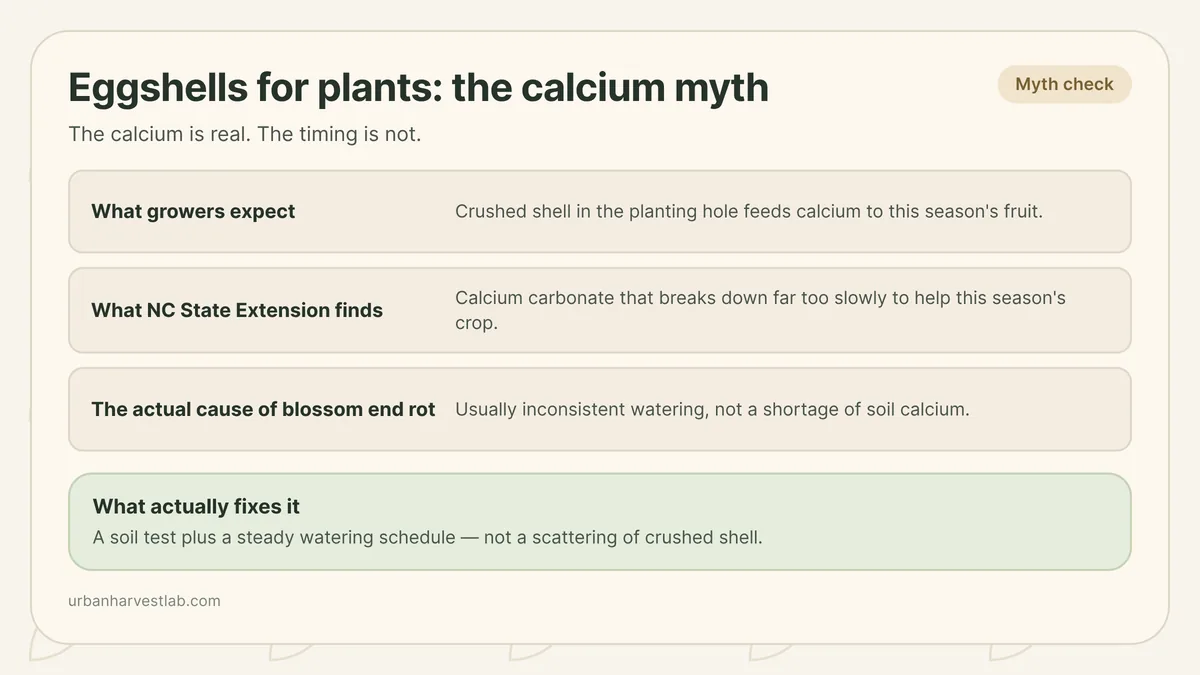
Blossom end rot is not a disease and it is not caused by a soil-borne pathogen. It develops when the fruit’s tissue cannot get enough calcium during rapid growth, usually because of uneven watering rather than a genuine absence of calcium in the soil. North Dakota State University Extension explains the same mechanism from the other side: actively growing leaves take calcium from the vine before the fruit gets it, so a dry spell followed by a heavy watering, or an irregular schedule generally, interrupts that flow to the fruit even in soil that has plenty of calcium available. That mechanism is also why eggshells — a real calcium source — do not solve the same problem: they “will not make calcium available to plants in a timely enough fashion to help with blossom end rot,” and the fix NC State Extension gives instead is a soil test paired with consistent watering, not a shell in the hole. Are eggshells actually good for plants? covers that comparison directly.
What North Dakota State University Extension says
North Dakota State University Extension addresses the claim head-on: “Epsom salt doesn’t stop blossom end rot — it leads to more of it.” The mechanism is straightforward once the two nutrients are separated. Epsom salt supplies magnesium, and magnesium and calcium ions compete for uptake at the root — so “the more magnesium in the soil, the less chance that calcium will be absorbed.” A gardener who reaches for Epsom salt at the first sign of rot is not adding a neutral, harmless mineral on top of an existing feeding plan. They are adding the one nutrient most likely to interfere with the nutrient the plant is already short on.
This does not mean magnesium itself is worthless to a plant. It means the specific claim — that Epsom salt fixes blossom end rot — runs backward from how the two nutrients actually behave at the root.
The fix that is actually sourced
North Dakota State University Extension’s primary advice is consistent watering and mulching, since uneven water uptake is what interrupts the calcium supply in the first place. Beyond that, NDSU says a foliar spray of calcium nitrate might or might not help: about 4 tablespoons per gallon of water, applied to the fruit rather than the leaves, 2 to 3 times a week, most usefully when fruits are dime-sized or smaller. Either way, the two products are not interchangeable at any rate, because one supplies calcium and the other does not.
Consistent watering does the rest of the work. A container that dries out between waterings and then gets soaked is a more reliable predictor of blossom end rot than anything measurable in the soil’s nutrient profile, which is also why the fix reads more like an irrigation habit than a fertilizer purchase.
When Epsom salt might actually have a place
None of this means magnesium sulfate is useless in every situation — only that blossom end rot is not one of them. NDSU’s page addresses only the blossom-end-rot claim and takes no position on other uses. A confirmed magnesium deficiency from a soil test is a different problem from blossom end rot, and treating that deficiency is a separate question from anything NDSU tested here. Reading a fertilizer label covers how to tell what a product actually supplies before adding it on the strength of a forum post, and a soil test remains the only way to confirm a magnesium shortfall rather than guess at one from a rotting tomato.
Treating Epsom salt as a routine, precautionary additive — “it can’t hurt” — skips that step entirely, and it is exactly the framing NDSU’s page contradicts.
If a plant has already had Epsom salt added
Magnesium sulfate is a soluble salt like any other, so a heavy or repeated dose does not simply wash away without consequence. It adds to the same dissolved-mineral load that causes leaf scorch, stunted growth, and a white crust on the soil surface in a container. Salt buildup in herb pots covers when that buildup needs flushing and what the crust actually signals. If a plant has been getting regular Epsom salt “just in case,” treat it the same way as any other over-application: watch for the same salt-stress symptoms, not for a magnesium-specific one, and back off the additive rather than layering a second fix on top.
Epsom salt is not the only cabinet fix that does not hold up
The pattern here — a cheap household item, a folk reputation, and an extension test that lands somewhere between “unnecessary” and “counterproductive” — shows up in a handful of other kitchen-cabinet fixes. Do coffee grounds actually help plants? and does banana peel water actually fertilize plants? cover two more of the same shape: a plausible-sounding mechanism, a real ingredient, and a much smaller or slower effect than the claim built around it. None of these are cases of an ingredient being fake — coffee grounds do contain nitrogen, banana peel does contain potassium, and Epsom salt does contain magnesium. The gap is between what an ingredient supplies and what the specific problem it gets credited with fixing actually needs.
Sources
Fix blossom end rot without Epsom salt
These cover the calcium, feeding, and salt questions Epsom salt keeps getting credited with solving.
Common questions
Does Epsom salt stop blossom end rot on tomatoes?
No. North Dakota State University Extension found that Epsom salt does not prevent or treat blossom end rot and can make it worse, because the rot comes from a calcium shortage, not a magnesium one, and the two nutrients compete for uptake by the plant.
What actually fixes blossom end rot?
North Dakota State University Extension's primary advice is consistent watering and mulching. Beyond that, NDSU says a foliar spray of calcium nitrate might or might not help: about 4 tablespoons per gallon of water, applied to the fruit rather than the leaves, 2 to 3 times a week, most useful when fruits are dime-sized or smaller.
Is Epsom salt ever useful for a plant?
Only where a soil test confirms an actual magnesium deficiency, which is a different problem from blossom end rot. NDSU's page addresses only the blossom-end-rot claim and takes no position on other uses.
Can too much Epsom salt hurt a plant?
Magnesium sulfate is a soluble salt, so a heavy or repeated dose adds to the same salt load that causes leaf scorch and crusting in containers, on top of crowding out calcium uptake.
Related guides
Eggshells for plants: what the calcium myth gets wrong
Crushed eggshells in the potting mix feel like free calcium, but the shell breaks down far slower than a growing tomato needs it to.
The banana peel water myth: what it actually feeds your plants
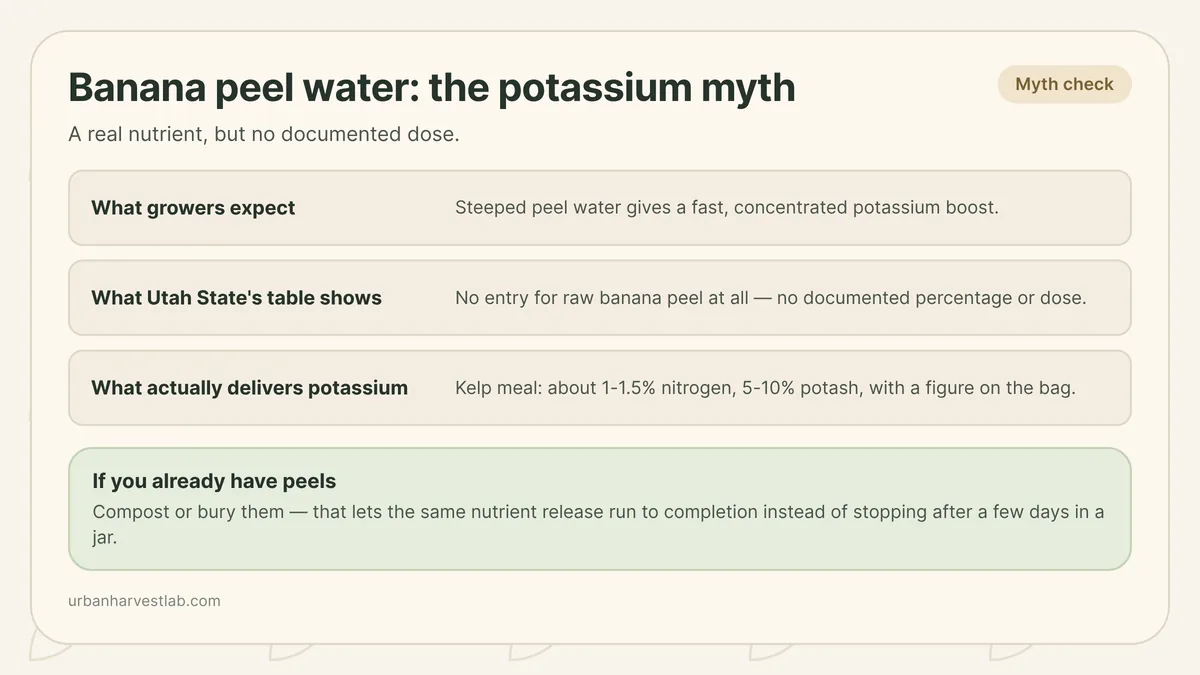
Soaking banana peels in water is a popular DIY feed, but Utah State's organic-fertilizer table has no entry for it, and the mechanism explains why the soak barely helps.
Coffee grounds for plants: the acidity myth and the nitrogen catch
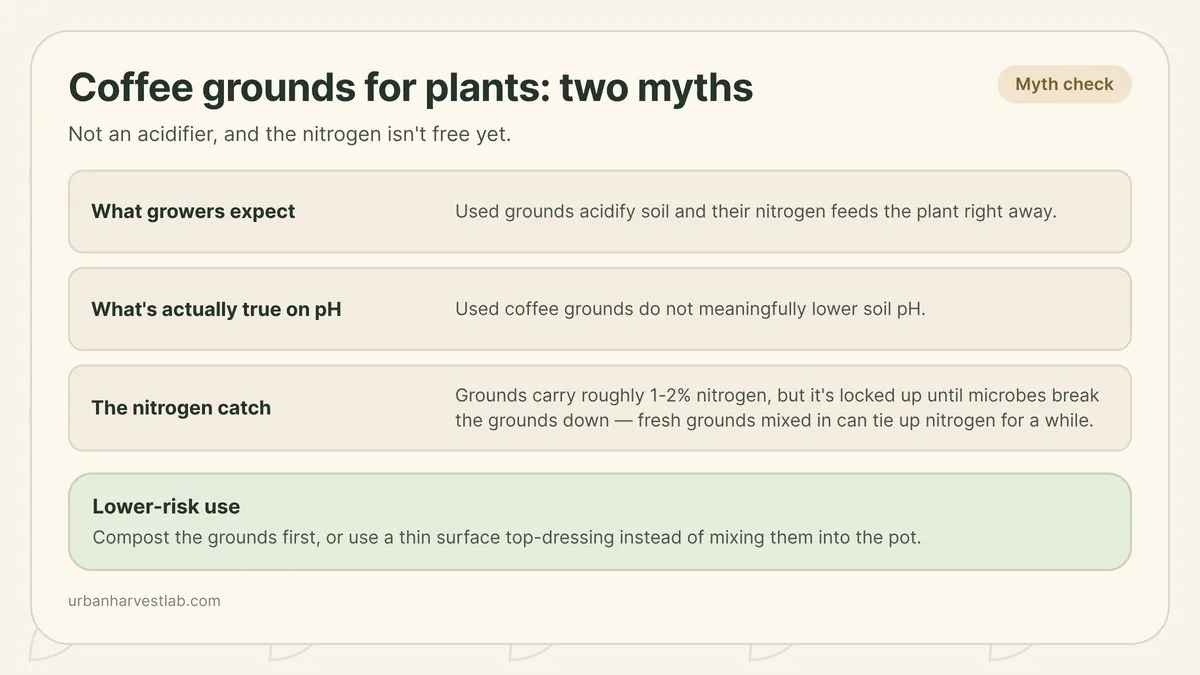
Used coffee grounds do not meaningfully lower soil pH, and the nitrogen inside them stays locked up until soil microbes finish decomposing the grounds.