Banana peel water against other potassium sources with a documented figure
| Input | What's documented | Best used as |
|---|---|---|
| Banana peel, soaked in water | Missing from Utah State's organic-fertilizer table; no traceable primary measurement found for raw peel | An occasional, minor topping — not a primary feed |
| Banana peel, buried or composted | Same lack of a documented figure, but full decomposition instead of a brief soak | A slow-release addition to compost or a planting hole |
| Kelp meal | Utah State Extension: roughly 1-1.5% nitrogen and 5-10% potash (K₂O), moderate release | A measured, labelled potassium source |
| Fish emulsion | University of Illinois Extension: N-P-K around 2-4-1 plus calcium, magnesium, and sulfur | A documented liquid feed with directions to follow |
| Compost | Utah State Extension: roughly 1-3% nitrogen, enough N-P-K to cover about two to three weeks in a fresh mix | Low-dose, ongoing nutrition alongside a labelled fertilizer |
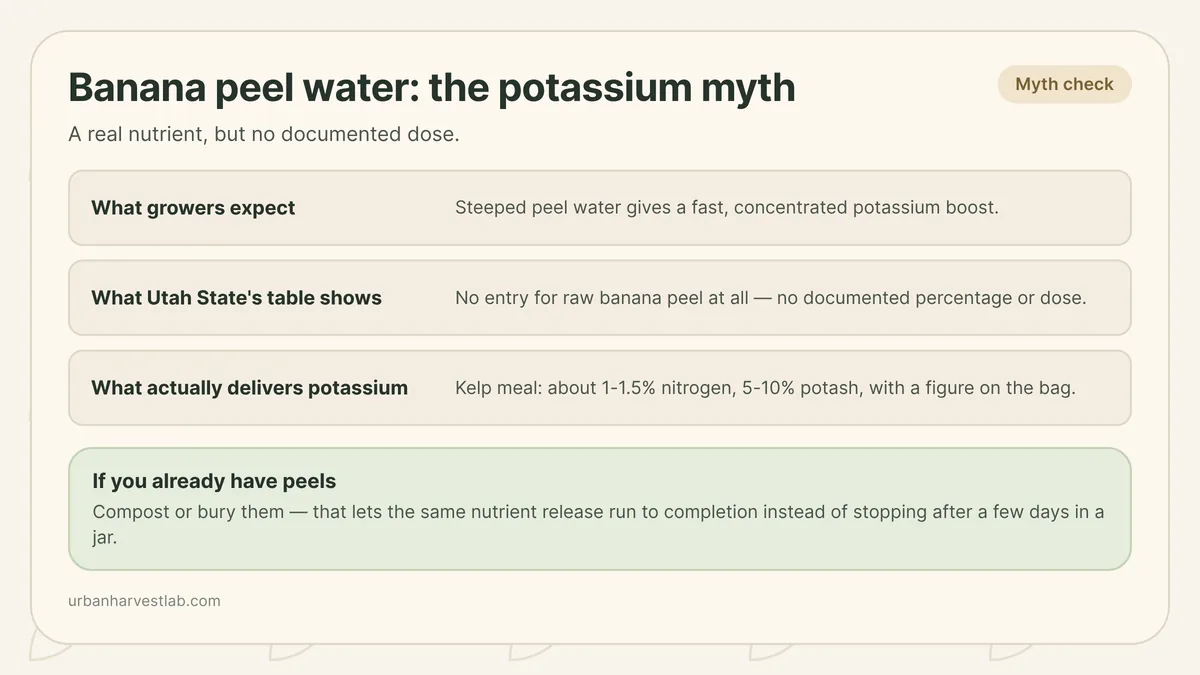
Banana peel water is a real but weak and slow source of potassium to begin with, and no extension horticulture source publishes a nutrient breakdown for raw banana peel or has measured what a water soak actually extracts from it. It is not a substitute for a labelled fertilizer, and treating it as one can leave a potassium-hungry plant short on what it actually needs.
If a container herb or vegetable needs feeding, choosing a fertilizer labelled for container edibles with a stated N-P-K on the bag is the more reliable path. Banana peel water is worth understanding for what it contributes on top of that, not as a replacement for it.
Where the habit comes from
The logic sounds reasonable: bananas are famously high in potassium, potassium supports flowering and fruit set, and the peel already goes into the compost bin, so soaking it in a jar of water first feels like an easy way to get that potassium to a plant sooner. Recipes online tell you to cover chopped peels with water, let the jar sit for one to several days, then pour the liquid onto the soil.
Potassium is genuinely present in banana tissue — that part of the claim is not invented. The gap is what happens next: presence in the fruit does not automatically mean a documented, extractable dose in the jar of water sitting on your counter.
What’s actually documented about organic potassium sources
Utah State University Extension sorts common organic fertilizer inputs by release speed and nutrient content, and the sorting is specific: blood meal runs around 12% nitrogen with rapid release; bone meal supplies 1-6% nitrogen and 11-30% phosphate on a moderate release schedule; kelp meal delivers about 1-1.5% nitrogen and 5-10% potash, also on a moderate timeline; compost contributes roughly 1-3% nitrogen. None of that table carries an entry for raw banana peel.
That absence matters because it is the same reason you should be skeptical of a specific percentage attached to banana peel online. A number that cannot be traced to a primary measurement of fresh peel is not a figure you can dose by, whatever website is repeating it.
What a water soak can and cannot tell you
Banana peel is a minor, slow potassium source to begin with, and no extension source in this research has measured what a passive water soak actually extracts from the tissue — so the jar has no known dose, whether you soak it for one day or five.
Composting is the route extension sources actually describe for kitchen scraps like this. Iowa State University Extension describes compost as a component that supplies “low-dose nutrition and biological activity” as it decomposes, faster than a base material like peat. Utah State University Extension gives one concrete marker for how slow even a finished, nutrient-supplying compost blend is: a fresh compost-amended mix carries enough nitrogen, phosphorus, and potassium to meet a plant’s needs for roughly the first two to three weeks after potting, which is also why that source advises against adding liquid fertilizer during that same window. No source has measured a water soak against composting or burying directly, but a banana peel is a minor, slow potassium input by either route — the practical difference between soaking, burying, and composting is convenience and where the material physically ends up, not a documented gap in how much potassium any one of the three actually delivers to a plant.
A documented alternative, side by side
The comparison worth making isn’t banana peel water against nothing — it’s banana peel water against inputs that do carry a number. Kelp meal fills the same potassium-focused role banana peel water is often asked to fill, except kelp meal’s figure is printed on the bag. Fish emulsion is a different category — University of Illinois Extension gives a typical N-P-K around 2-4-1 for a commercial fish emulsion product, plus calcium, magnesium, sulfur, chlorine, and sodium — but it shares the same practical advantage: a label with directions, rather than a jar of steeped peel with none.
A bagged product carries a declared analysis by weight; a jar of steeped peel carries none — reading a fertilizer label covers what those numbers promise. Kelp meal and compost are the potassium-relevant organic inputs here; how organic and synthetic fertilizers actually differ covers the fuller release-rate picture, including blood meal and bone meal.
If you already have peels, compost or bury them instead
Banana peels are not wasted by skipping the water jar. Adding them to an active compost pile, or burying pieces directly in a planting hole, lets the same microbial process that Iowa State’s description of compost relies on run to completion instead of stopping after a few days in a jar. How much compost to add to a potting mix and choosing compost that’s safe for edible containers cover the dose and the safety checks for using finished compost in a container planting, which is a more direct route to whatever nutrient value a banana peel holds than steeping it does.
For a plant that needs feeding now rather than over the coming weeks, whether a potted herb needs fertilizer at all is worth checking first — pale or slow growth has causes besides a nutrient shortage, and a jar of banana peel water addresses none of the others.
Part of a pattern, not a one-off
Banana peel water sits alongside a small group of viral kitchen-scrap habits that extension horticulture keeps correcting in the same shape: a real ingredient, a real nutrient somewhere in it, and a specific mechanism that keeps that nutrient from reaching the plant the way the habit assumes. Epsom salt for blossom-end rot, coffee grounds worked into soil, and eggshells as a calcium fix each fail for their own specific reason, but the shared thread is the same one here: a kitchen input treated as a concentrated, fast-acting substitute for a fertilizer that was tested and labelled to do that job.
What to do for a plant that actually needs potassium
Check the fertilizer label’s stated analysis rather than reaching for a jar with no analysis at all. If potassium specifically is the concern, the label’s stated potash percentage and, where available, a soil test are what establish need — Clemson is explicit that a nutrient the medium already has enough of should not be added on top. A kelp-based product with the figure Utah State University Extension gives delivers a known amount instead of an estimate. Watch the plant’s response over the following weeks rather than adding more of anything because a single dose didn’t visibly change things overnight, and if new growth stalls or leaf edges scorch after feeding, that’s a signal to review the dose rather than add banana peel water on top of it.
Sources
- Utah State University Extension — Selecting and Using Organic Fertilizers
- Utah State University Extension — Using Compost in Utah Gardens
- Clemson Cooperative Extension, HGIC — Reading a Fertilizer Label
- University of Illinois Extension — Scale up your garden’s health with fish emulsion fertilizer
- Iowa State University Extension, Yard and Garden — Potting Media: Components and Handling
The other kitchen-scrap fertilizer myths
Banana peel water belongs to a family of viral feeding habits that extension testing keeps correcting the same way.
Common questions
Does banana peel water actually fertilize plants?
It supplies a small amount of potassium and trace minerals, but it is a weak, slow input rather than a fertilizer replacement. A labelled product still gives you a known dose; banana peel water does not.
How much potassium is in banana peel water?
Utah State's organic-fertilizer release-rate table, which lists kelp meal, bone meal, and compost by percentage, has no entry for banana peel. Figures circulating online for banana peel could not be traced back to a primary measurement, so there is no reliable number to dose by.
Is composting banana peels better than soaking them in water?
Composting or burying is the route extension sources actually describe for kitchen scraps like this, but no source has measured that release against a water soak directly. Either way, banana peel is a minor, slow potassium input rather than a primary feed.
How long should you soak banana peels to make fertilizer?
There is no established soak duration in the extension sources reviewed here. A longer soak draws a little more out of the peel's surface, but it does not turn the liquid into a measured feed, so timing it precisely will not fix the underlying problem.
Related guides
Coffee grounds for plants: the acidity myth and the nitrogen catch
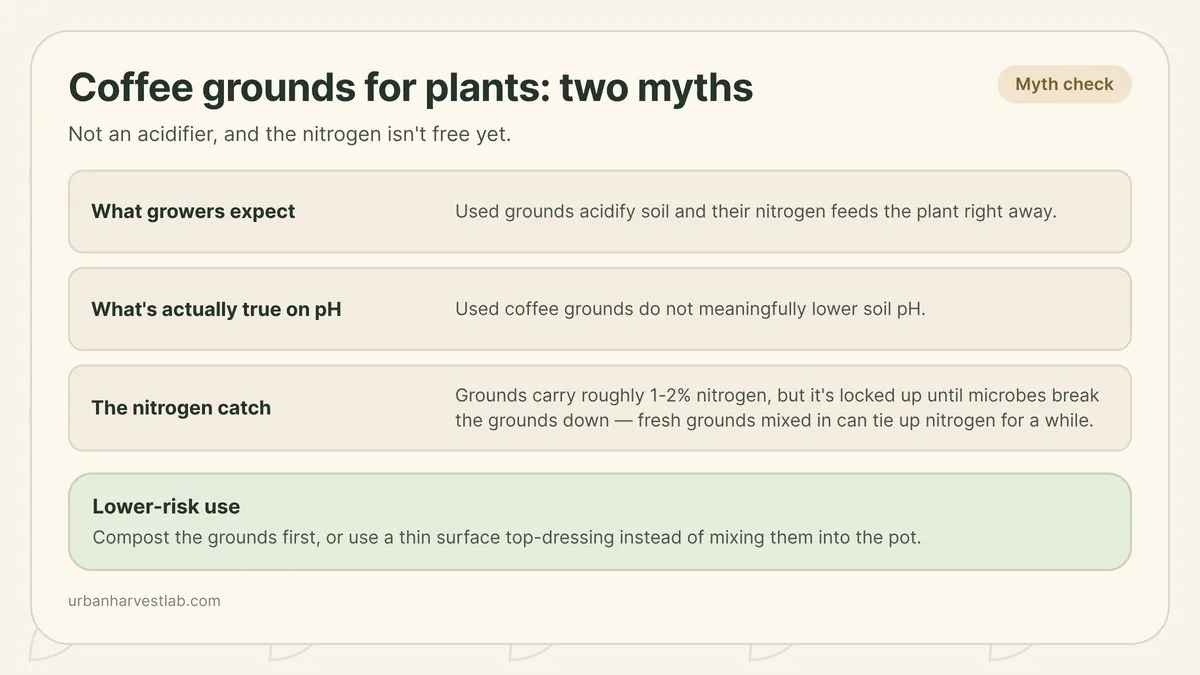
Used coffee grounds do not meaningfully lower soil pH, and the nitrogen inside them stays locked up until soil microbes finish decomposing the grounds.
Eggshells for plants: what the calcium myth gets wrong
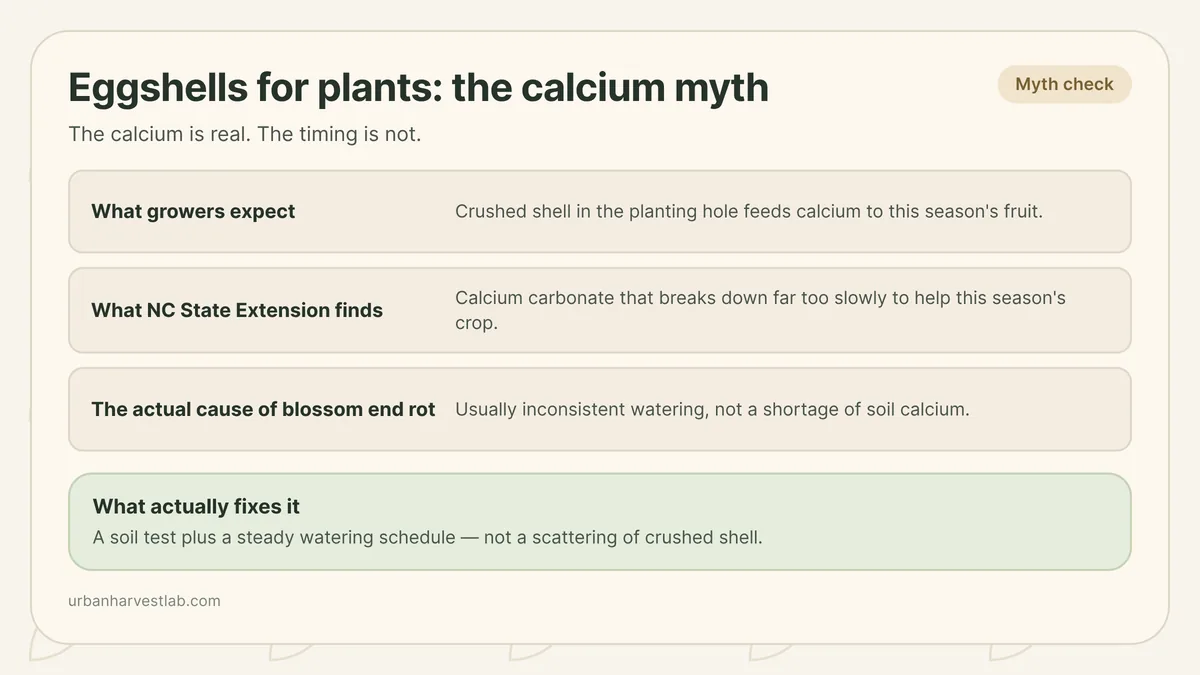
Crushed eggshells in the potting mix feel like free calcium, but the shell breaks down far slower than a growing tomato needs it to.
Epsom salt for plants: what the evidence actually shows
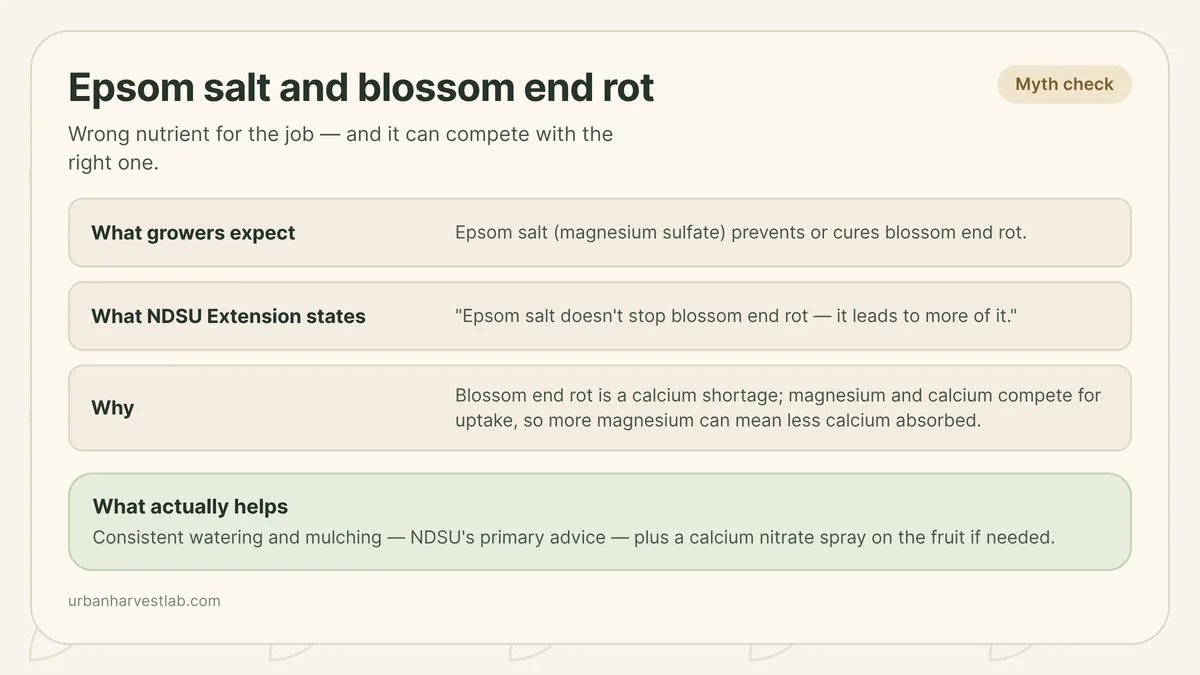
Epsom salt is one of the most repeated garden fixes there is, and North Dakota State University Extension says the opposite of what the jar's reputation claims.