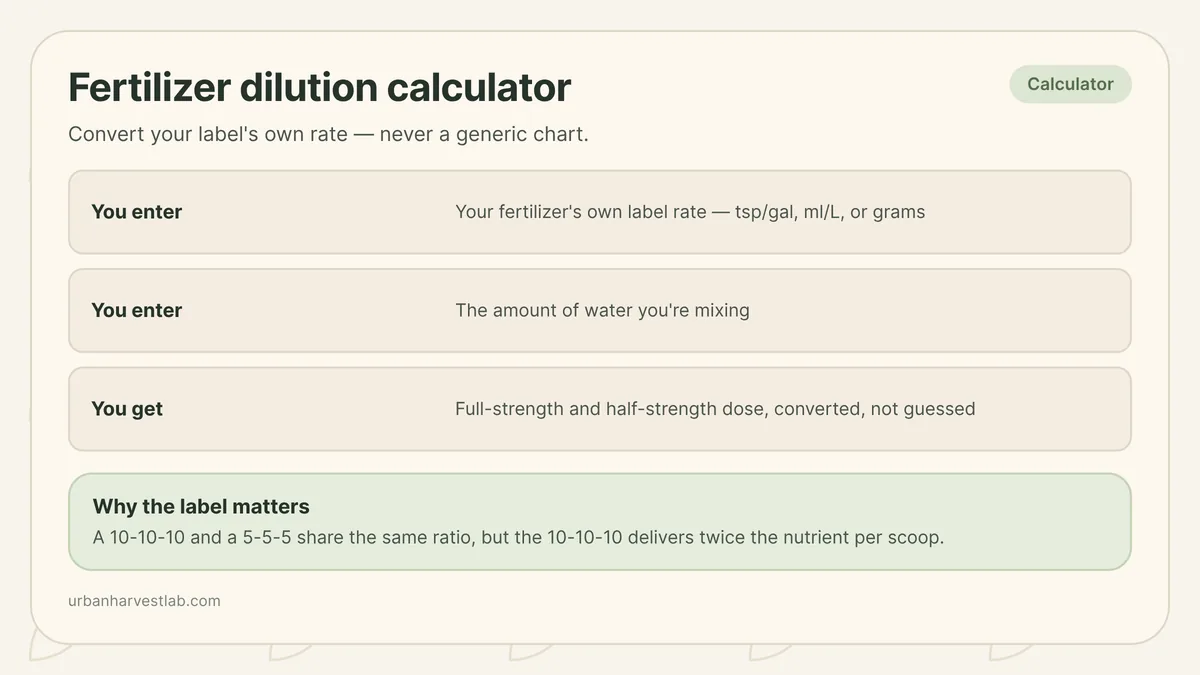
Common label rates converted to metric, full and half strength
| Label rate | Per gallon | Per liter | Half strength per liter |
|---|---|---|---|
| 1/4 tsp per gallon | 1.23 ml | 0.33 ml | 0.16 ml |
| 1/2 tsp per gallon | 2.46 ml | 0.65 ml | 0.33 ml |
| 1 tsp per gallon | 4.93 ml | 1.30 ml | 0.65 ml |
| 1 tbsp per gallon | 14.79 ml | 3.91 ml | 1.95 ml |
| 1 tbsp per 2 gallons | 7.39 ml | 1.95 ml | 0.98 ml |
Type the rate straight off your fertilizer’s own bottle, and this calculator converts it into milliliters per liter, teaspoons per gallon, or a half-strength dose for the amount of water you’re actually mixing. Every product sets its own concentration, so a rate that’s correct for one bottle can double- or halve-dose another even when the two share the same N-P-K ratio — the number has to come from the label in your hand, not from a chart that assumes one universal fertilizer.
If you haven’t settled on how often to apply what you mix, fertilizer schedule for container vegetables lays out the slow-release-plus-liquid routine most extension guidance follows for container crops. The arithmetic between what a label states and what ends up in your watering can or sprayer is what follows below.
Calculate your dilution
Live estimate
Enter the rate exactly as your product's label states it, then the amount of water you're mixing. Nothing here is prefilled — the rate has to come from your bottle.
Add to your water, full strength
—
Half strength: —
- Full strength, metric
- —
- Full strength, US
- —
- Half strength, metric
- —
- Half strength, US
- —
Enter the rate from your product's label.
If you would rather do it on paper, the same two conversions are below.
Why the same fertilizer needs a different dose from the next bottle
A dilution rate depends on the concentration of the specific product in your hand, not on the crop or the season. Clemson Cooperative Extension’s own comparison makes the point directly: a 10-10-10 fertilizer and a 5-5-5 fertilizer both reduce to the same 1:1:1 ratio once you divide by the smallest number, but the 10-10-10 delivers twice as much nutrient per unit applied. Using one product’s label rate on the other would double- or half-dose the plant by accident, even though the front of both bags might look interchangeable at a glance.
Reading a fertilizer label walks through what the three printed numbers mean and how to compare two products’ concentration before you reach for a measuring spoon. This calculator assumes you already have the rate the manufacturer printed for the product you’re using — it doesn’t derive a rate from the N-P-K numbers, because concentration and the recommended dilution are two separate things a manufacturer sets independently, and only the label states the second one.
Do the same math by hand
Two conversion facts do all the work: 1 US teaspoon holds about 4.93 milliliters, and 1 US gallon holds about 3.785 liters. Everything the calculator does is those two numbers applied in sequence.
Example 1 — a label that reads “1 teaspoon per gallon.” Convert the teaspoon first: 1 tsp × 4.93 ml/tsp = 4.93 ml per gallon. Convert the gallon next: 4.93 ÷ 3.785 = about 1.30 ml per liter. Half strength is half of that figure, or about 0.65 ml per liter. If you’re mixing 2 gallons (about 7.57 liters), the full-strength total is 2 tsp — roughly 9.86 ml — and half strength is 1 tsp, roughly 4.93 ml.
Example 2 — a label that reads “1 tablespoon per gallon.” A tablespoon holds about 14.79 ml (three teaspoons), so the same two steps give 14.79 ÷ 3.785 = about 3.91 ml per liter, and half strength is about 1.95 ml per liter.
Example 3 — a powdered concentrate labelled “1 scoop, about 30 g, per gallon.” Powders convert by weight only: 30 ÷ 3.785 = about 7.93 grams per liter, and half strength is about 3.96 grams per liter. There’s no teaspoon or milliliter equivalent to hand over here, because a gram of one powder doesn’t occupy the same volume as a gram of another — a fine, dense mineral powder and a light, fluffy organic one can differ enough that converting by volume would misstate the dose. Stay in grams for a mass-based label, the same way the calculator does.
Round only at the end of a calculation, not after each step — rounding a teaspoon to 5 ml instead of 4.93 shifts the result by about 1%, which is small, but round at the end anyway so the numbers stay consistent if you scale the batch up.
Full strength or half strength
Both rhythms are sourced, not folklore, and they aren’t interchangeable adjustments to the same schedule. University of Illinois Extension lists an every-watering, half-strength fertilizer solution as an accepted alternative to biweekly full-strength feeding, paired with occasionally watering with plain water only to leach the pot. (Penn State Extension gives the two-to-four-week interval for the full-strength side of that comparison.) Clemson Cooperative Extension gives a broader menu for houseplants generally: the full label rate every two to three months, a dilution to roughly one-tenth strength at every watering, or a full-strength dose every seventh watering — three different accepted schedules, not one universal rule.
The calculator’s half-strength result is exactly half of whatever full-strength rate you entered, which matches the Illinois routine directly. If you’re following Clemson’s one-tenth-strength schedule instead, take the full-strength figure the calculator gives you and divide it by ten yourself rather than by two — halving twice doesn’t land on a tenth, and the calculator only offers the one fraction rather than guessing which schedule you’re on.
Switching between the two changes what the calculator above should return. For Illinois’s every-watering routine, use the half-strength figure. For Clemson’s tenth-strength routine, divide the full-strength figure by ten instead. A container-vegetable fertilizer schedule covers choosing which rhythm actually fits your routine.
Mistakes that throw the number off
- Confusing teaspoons and tablespoons. A tablespoon holds three teaspoons, so mixing up the two changes the dose by a factor of three in either direction — the single most common way a “diluted” fertilizer ends up at full strength or beyond.
- Carrying an old rate over to a new product. A rate that was correct for a previous bottle doesn’t transfer to a replacement with a different concentration, even if the front label says the same thing in the same font.
- Applying concentrate to dry soil. University of Illinois Extension is explicit that fertilizing bone-dry soil risks root damage, so water first with plain water if the mix has already dried out, then apply the diluted feed.
- Doubling a skipped half-strength dose. Missing a scheduled half-strength watering and then mixing a full-strength batch “to catch up” concentrates two applications worth of salt into one watering, which is the burn risk — not that it delivers more total nutrient over time.
- Reusing a labelled sprayer for a different concentrate. A spray bottle marked for one product’s rate, refilled later with something else at the same markings, carries the old dose forward silently.
Diluting more often at a lower strength doesn’t remove the need to leach the pot occasionally — frequent watering still moves dissolved nutrient toward the drainage hole and, over time, toward the surface as water evaporates. Salt buildup in pots covers that mechanism and when a plain-water flush is worth doing regardless of which dilution schedule you’re on.
When full strength is the only option
Not every fertilizer format has a dilution rate to convert in the first place. A controlled-release granule worked into the mix at planting releases on its own schedule rather than being mixed into water at all, so there’s no rate to halve — slow-release versus liquid fertilizer covers that format choice directly. Clemson recommends against feeding a nutrient a soil test shows the medium already has, and recommends a soil test before adding a micronutrient product on top of a complete fertilizer — use the test to decide whether to feed at all, and the label to decide the rate.
If you’re still deciding which product to buy in the first place, best fertilizer for herbs in pots compares water-soluble and controlled-release options before dilution math becomes the question at all.
Sources
Feed by the label, not by guesswork
These guides cover when to apply what you mix, how concentration changes the dose, and what to check before you buy or dilute.
Common questions
How do I convert a fertilizer label's teaspoons-per-gallon rate to ml per liter?
Multiply the teaspoons by about 4.93 to get milliliters for that gallon, then divide by 3.79 to convert a gallon into liters. A label calling for 1 teaspoon per gallon works out to roughly 1.3 ml per liter.
What does fertilizing at half strength mean?
It means diluting to half of whatever rate the label states, so half the usual dose of nutrient reaches the plant at each watering. University of Illinois Extension lists feeding at half strength with every watering as an accepted alternative to a full-strength dose on a longer interval.
Can I use the same dilution rate for every fertilizer brand?
No. Concentration varies between products even when the N-P-K ratio looks identical, so a rate that is correct for one bottle can underfeed or overfeed another. Convert the number printed on the specific product you are using, not a rate remembered from a different bag.
Is fertilizing at half strength safer than full strength?
Not automatically. The half-strength-every-watering routine and the full-strength longer-interval routine are two accepted schedules, University of Illinois Extension and Clemson Cooperative Extension respectively; half strength is not a licence to feed more often than the schedule you picked. Pick one accepted schedule and follow it, rather than mixing pieces of both.
Related guides
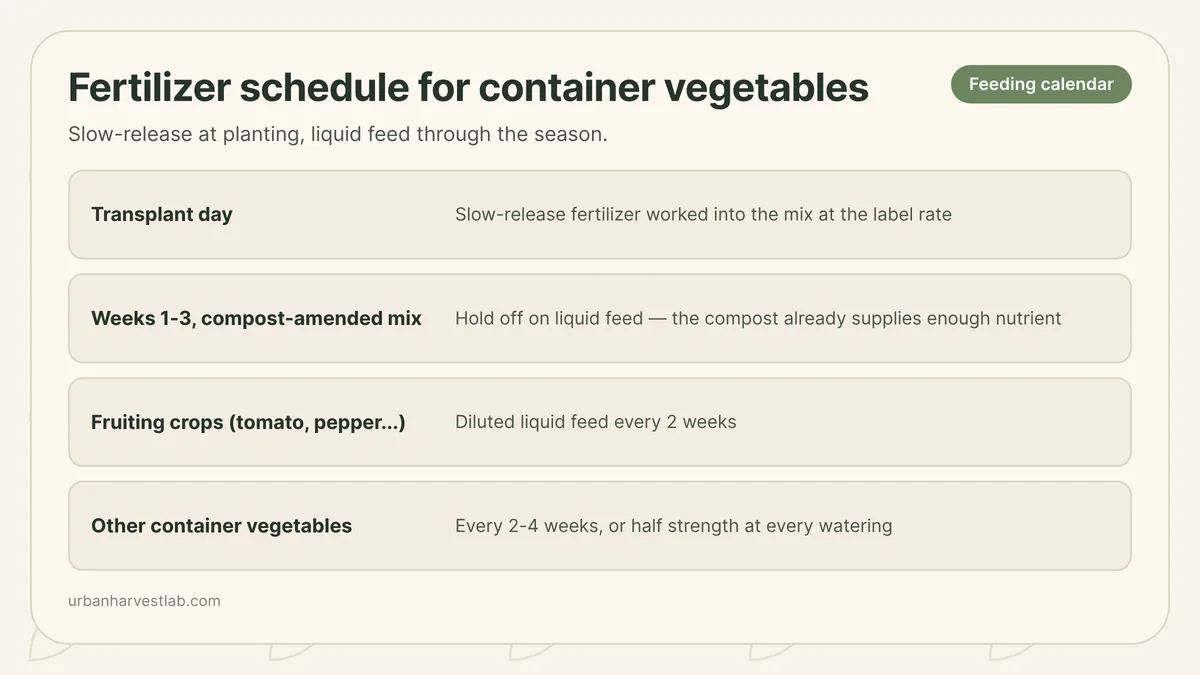
Fertilizer schedule for container vegetables: what to feed and when
A stage-by-stage feeding calendar for container vegetables, built from extension guidance on slow-release charges, liquid top-ups, and the intervals that keep fruiting crops producing.
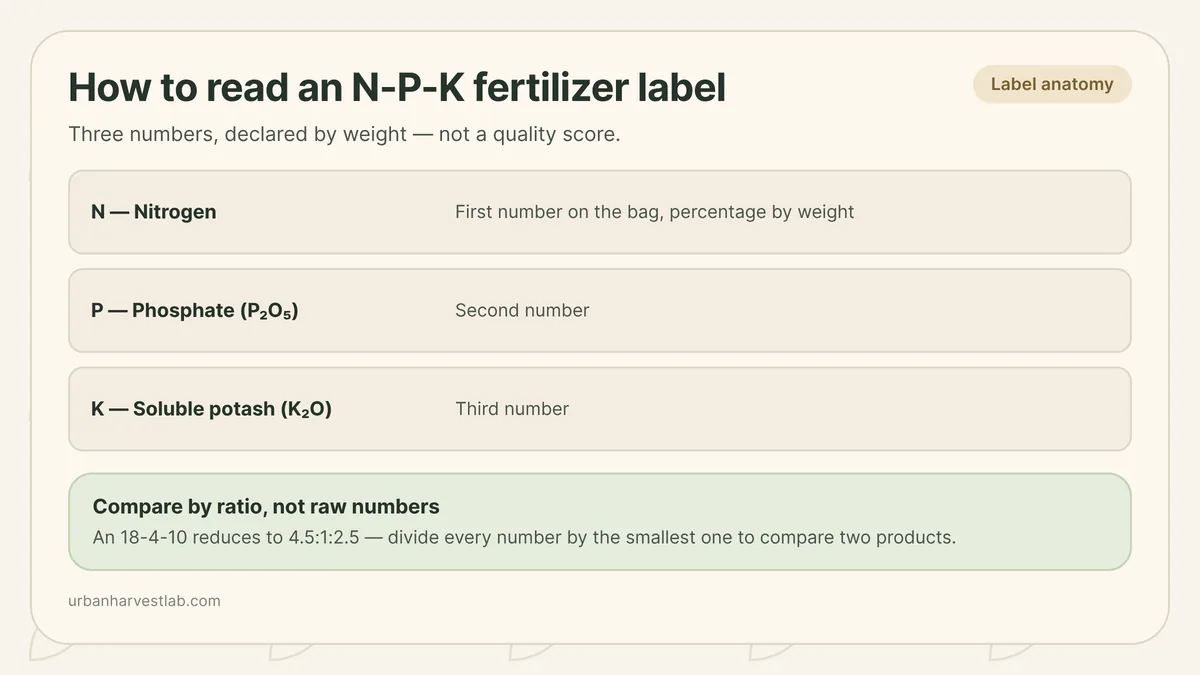
How to read an NPK fertilizer label for herbs
The three numbers on a fertilizer bag tell you exactly what's inside by weight, nothing about whether your herbs need it. Here's how to read them and compare products correctly.
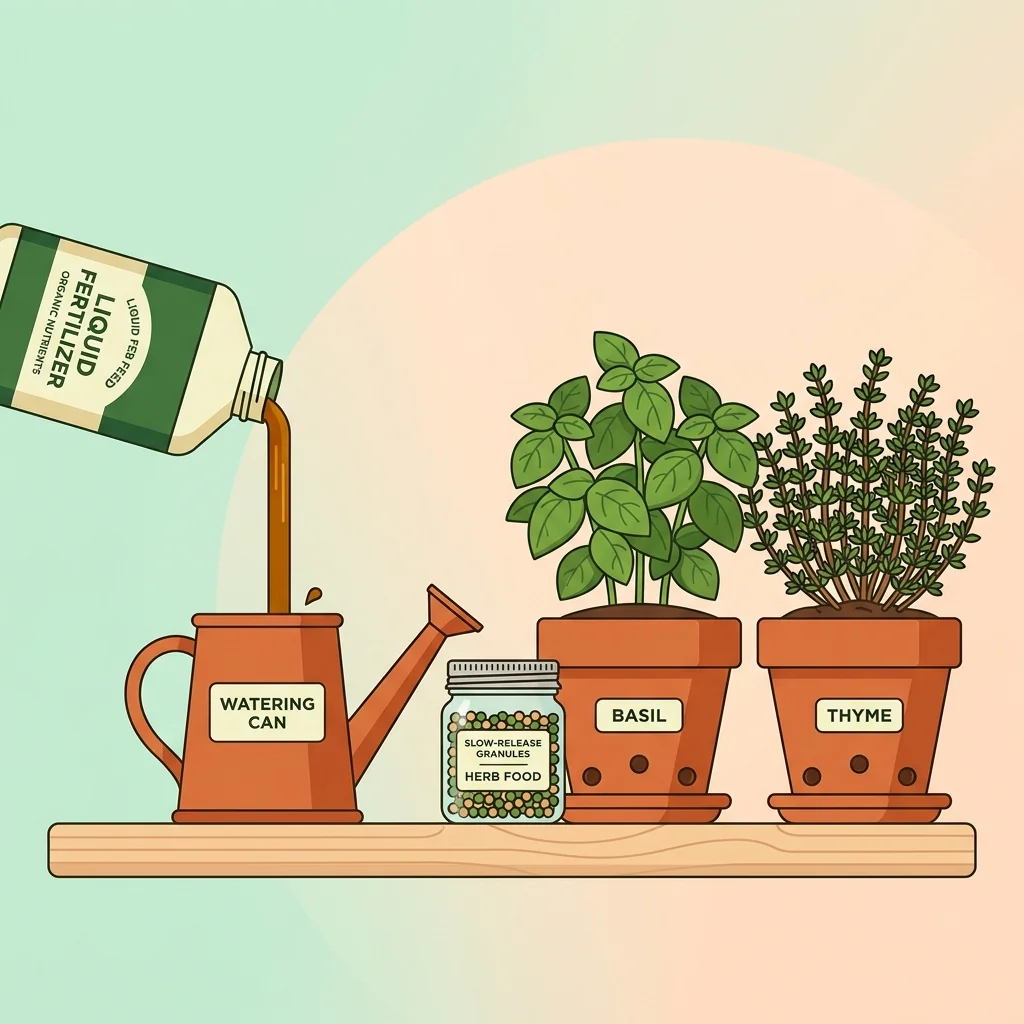
Best fertilizer for herbs in pots: a label-first guide
A practical, label-first guide to complete liquid and controlled-release fertilizers for potted herbs, with a decision table and a safer first application.