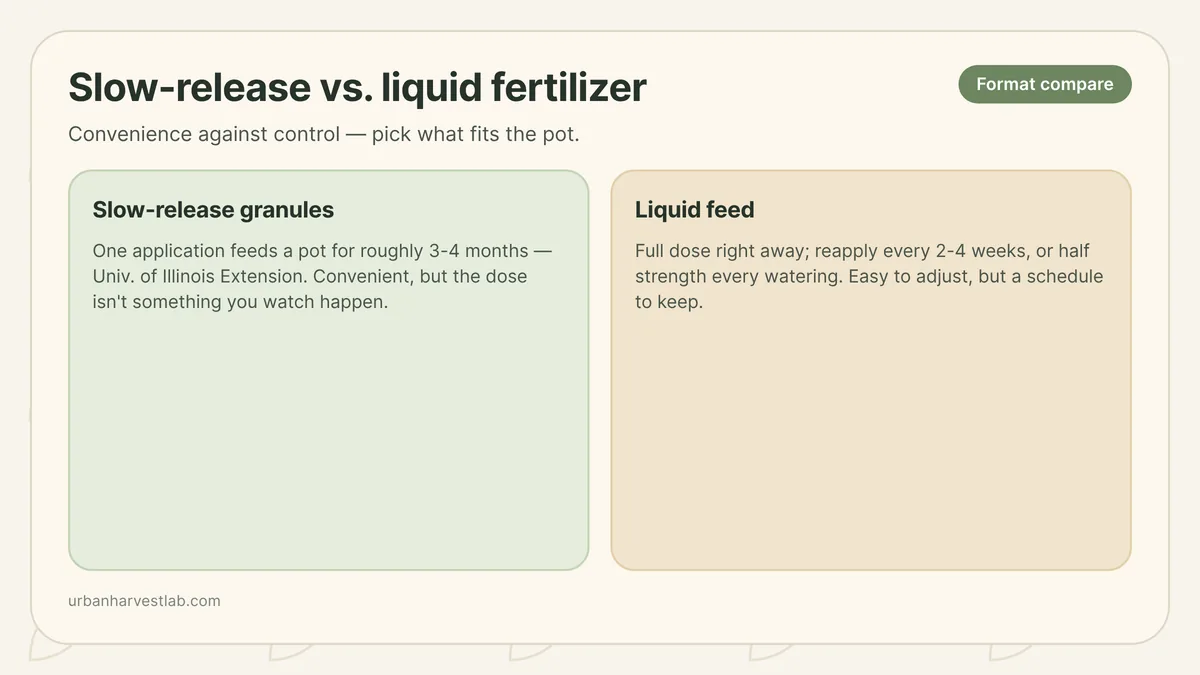
Slow-release vs. liquid fertilizer in a container
| Format | Best for | Application effort | Main risk |
|---|---|---|---|
| Slow-release granules | Low-maintenance pots and long-season crops | One application, roughly every 3-4 months | Over-application is invisible, and it corrects a deficiency slowly |
| Liquid feed | Correcting a visible problem or a crop you monitor closely | Every 2-4 weeks, or every watering at reduced strength | Easy to over-apply through frequent, unrecorded doses |
| Both combined | Long-season fruiting crops: tomato, pepper, cucumber, eggplant | Granular charge at planting, liquid top-up through the season | Stacking nutrient if the granular dose is not accounted for |
Slow-release granules trade control for convenience: one application feeds a container for roughly three to four months, per University of Illinois Extension, without a schedule to keep. Liquid fertilizer trades convenience for control: it acts fast and you can adjust or stop it between waterings, at the cost of reapplying on a schedule. Which one fits your pot depends on how closely you watch it and what the crop needs from a feeding — a decision that starts with whether the pot needs fertilizer at all before you choose a product.
How the resin coating meters a dose
A slow-release, or controlled-release, product is a water-soluble fertilizer encased in a semi-permeable resin coating. Water moves through that coating with every watering and carries a small dose of dissolved nutrient out with it, over roughly three to four months, depending on moisture and temperature, according to University of Illinois Extension. Nothing measurable happens at the moment you apply it; the coating is doing the metering, not you.
Liquid, or soluble, fertilizer is already dissolved, or dissolves the moment you mix it, so the container gets a full, measured dose right away. Reapplication follows whatever interval you choose, which is exactly the flexibility a slow-release product does not offer: dilute it further, skip a week, or feed more often in response to what the plant actually looks like.
The price of not watching a dose
A resin-coated granule’s output is not a fixed drip. It scales with soil temperature and how much you water, so a warm stretch or a run of daily watering pushes more nutrient out than a cool, drier one, without you doing anything differently. A grower who feeds a pot once in spring and checks it again in midsummer will not have watched that curve; they will see whatever growth resulted from however much release actually happened in between.
That same invisibility is what makes over-application easy to miss. There is no discrete dosing event to look back on days later, unlike a bottle you measured and can log. Add a liquid feed on top of an already-working granular charge without tracking it, and neither the label nor the plant announces that two systems are now running at once. Keeping that math straight across a season is exactly what a container-vegetable fertilizer schedule is for.
The word “slow-release” on a bag also covers a wider range than it sounds like it should. Clemson Cooperative Extension’s guide to reading a fertilizer label states that a product only needs at least a third of its total nitrogen in slow-release form to use the term; look for 50 percent or higher for the most sustained release. Two bags on the same shelf, both labelled controlled-release, can behave differently in a pot for that reason, which is exactly why reading an N-P-K label by its stated percentages matters more than trusting the front of the bag.
What liquid feed asks of you in return
Liquid feed’s advantage is that you can react: dilute it, skip an application, or add an extra half-strength dose if new growth looks pale. That reactivity depends on you keeping the interval. University of Maryland Extension’s schedule for long-season fruiting crops — tomato, cucumber, eggplant, pepper — calls for light feeding roughly every two weeks through the season. Penn State Extension describes almost the same rhythm from a different starting point: an initial slow-release charge at planting, then a diluted soluble feed every two to four weeks after.
University of Illinois Extension records a lighter-touch version of the same idea as an accepted alternative, not a shortcut: fertilize with every watering at half strength, and occasionally use plain water alone to leach the pot. Clemson Cooperative Extension gives a soluble feed schedule of its own, which is a reminder that “how often” is a product-and-routine decision, not one fixed number — the fertilizer dilution calculator owns the dose-and-interval arithmetic across products.
Frequent container watering is also what leaches nutrient out of the pot in the first place, per Illinois Extension, so a liquid-fed container watered daily through summer heat may need a shorter interval, not a longer one, to keep up. None of this makes liquid feed less controllable; it makes the control a responsibility rather than a convenience.
Fish emulsion and kelp are the organic branch of the liquid category, and their sourced caveats go past the smell. Fish emulsion and kelp function as effective liquid fertilizers, per Illinois Extension, but carry a real odor and a wildlife-attraction risk that synthetic liquids do not — outdoor use is usually more practical than indoor. Fish emulsion and seaweed for herbs covers the tested claims and the odor and placement details in full.
Neither one solves leaching
A slow-release product does not remove nutrient salt from the leaching problem; it just changes when the nutrient enters the water. Illinois Extension is explicit that a granular product still depends on watering to release its dose, and that same watering still carries dissolved nutrient, and eventually salt, out the drainage hole if it is applied at label rate or heavier. A pot fed with a slow-release charge is not exempt from the routine covered in salt buildup in herb pots; it is just one step removed from the moment of application, so the crust can still show up months after you last touched the bag.
Where each format wins
Slow-release fits a container you cannot check often: a pot left for a stretch of travel, a rarely visited balcony planter, or a grower who wants one application to carry most of a season without a recurring task. Liquid feed fits the opposite situation: a crop you are actively watching, a deficiency you are correcting, or any point where you want to change the dose based on what the plant just did.
For long-season fruiting crops, the sourced pattern is neither one alone. Apply a slow-release product at planting, then top up with a diluted liquid feed through the season, per both University of Maryland Extension and Penn State Extension. A fresh compost-amended mix complicates the timing further: Utah State University Extension states that compost alone supplies enough nitrogen, phosphorus and potassium to meet plant needs for the first two to three weeks after potting, and instructs against adding liquid fertilizer in that window. A slow-release granule applied at potting time is not subject to the same wait, since its release is already metered rather than delivered as one immediate liquid dose — though whether to add one on top of an already nutrient-carrying compost mix is exactly the stacking question raised above.
Apply either format to moist soil, not a dry pot. Illinois Extension treats fertilizing bone-dry soil as a root-damage risk regardless of which format is going in, so water first and feed second either way.
Turning the choice into a season-long routine
Once you have picked a format, the specific numbers — how much, how often, and what to do when growth stalls — belong to a season-long routine rather than a one-time choice. A container-vegetable fertilizer schedule sets that routine up crop by crop, and reading an N-P-K label covers why the three numbers on a bag do not by themselves tell you release speed or concentration — both matter more than the ratio. If growth already looks stressed rather than merely due for a feeding, signs of overfertilizing herbs is the place to check before adding either format.
Sources
- University of Illinois Extension — Fertilizing (Container Gardens)
- University of Illinois Extension — Scale up your garden’s health with fish emulsion fertilizer
- Penn State Extension — Container Vegetable Gardening: Four Keys to Success
- University of Maryland Extension — Maintaining Container Grown Vegetables
- Clemson Cooperative Extension, HGIC — Reading a Fertilizer Label
- Clemson Cooperative Extension, HGIC — Indoor Plants: Cleaning, Fertilizing, Containers & Light Requirements
- Utah State University Extension — Using Compost in Utah Gardens
If you are deciding how to feed a container
These guides cover the label math, the season-long schedule, and what over-feeding looks like once you have picked a product.
Common questions
Is slow-release or liquid fertilizer better for containers?
Neither wins outright. Slow-release granules are convenient and hard to forget, while liquid feed gives you control to adjust or stop between waterings. Pick slow-release for a low-maintenance pot and liquid feed for a crop you are actively correcting.
Can you use slow-release and liquid fertilizer together?
Penn State Extension and University of Maryland Extension both describe this combination for long-season fruiting crops: a slow-release product at planting, then a diluted liquid feed through the season. The risk is stacking doses without accounting for what the granules are still releasing, so track what is already in the pot before adding more.
How long does slow-release fertilizer actually last in a pot?
University of Illinois Extension gives roughly three to four months, depending on moisture and temperature, since the resin coating releases faster in warm, well-watered conditions and slower in cool or dry ones. That range is a guide, not a fixed countdown, so watch plant response rather than only the calendar.
Why does my slow-release fertilizer seem to stop working?
Release slows in cool soil and in a pot that is watered lightly, so a cold snap or a dry stretch can make a granular feed seem to underperform even though the product has not run out. University of Illinois Extension's three-to-four-month window depends on moisture and temperature, so check the product's stated release window and the plant's response before assuming the granules need replacing.
Related guides
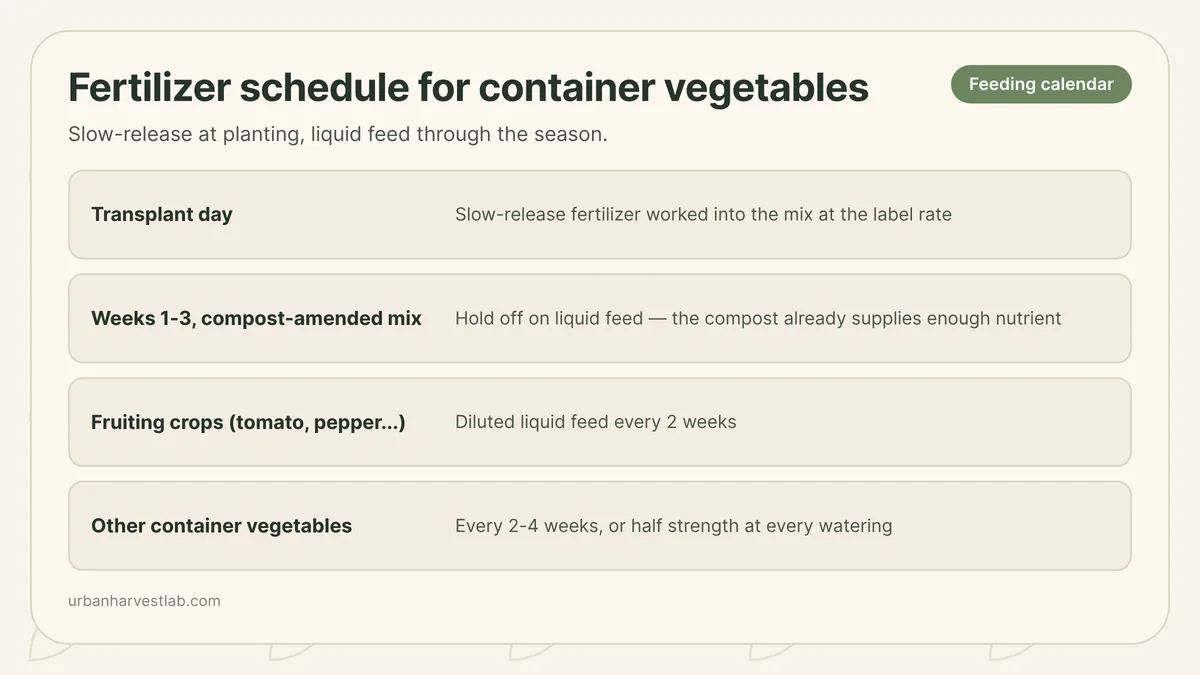
Fertilizer schedule for container vegetables: what to feed and when
A stage-by-stage feeding calendar for container vegetables, built from extension guidance on slow-release charges, liquid top-ups, and the intervals that keep fruiting crops producing.
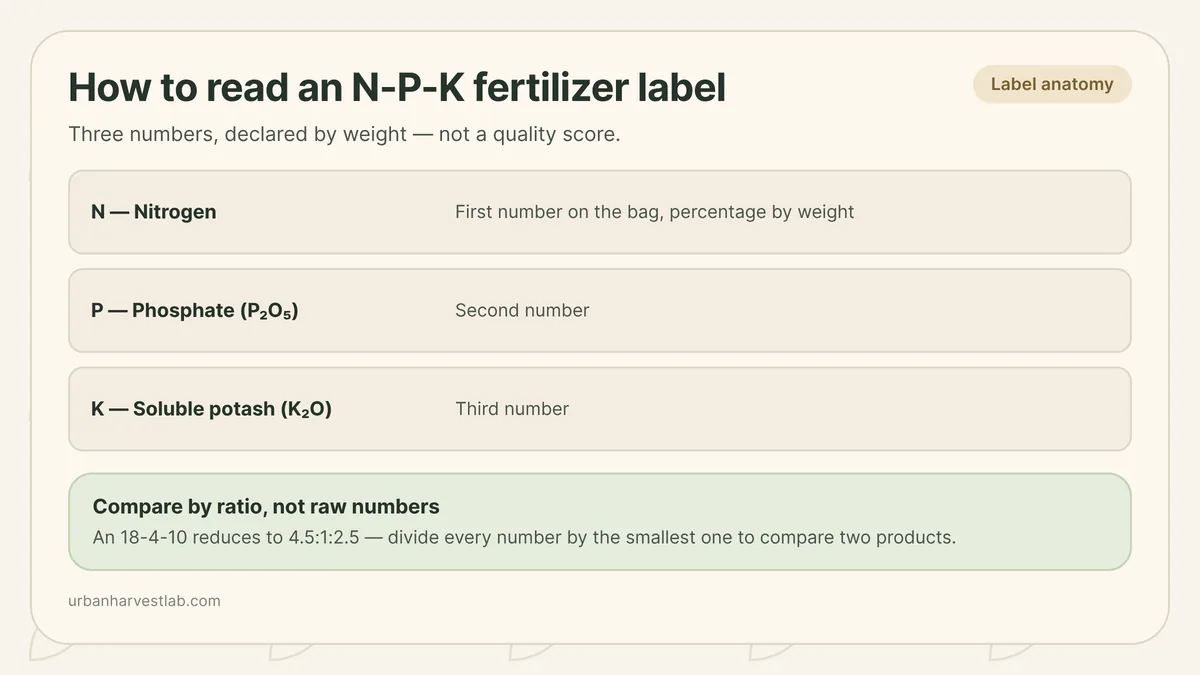
How to read an NPK fertilizer label for herbs
The three numbers on a fertilizer bag tell you exactly what's inside by weight, nothing about whether your herbs need it. Here's how to read them and compare products correctly.
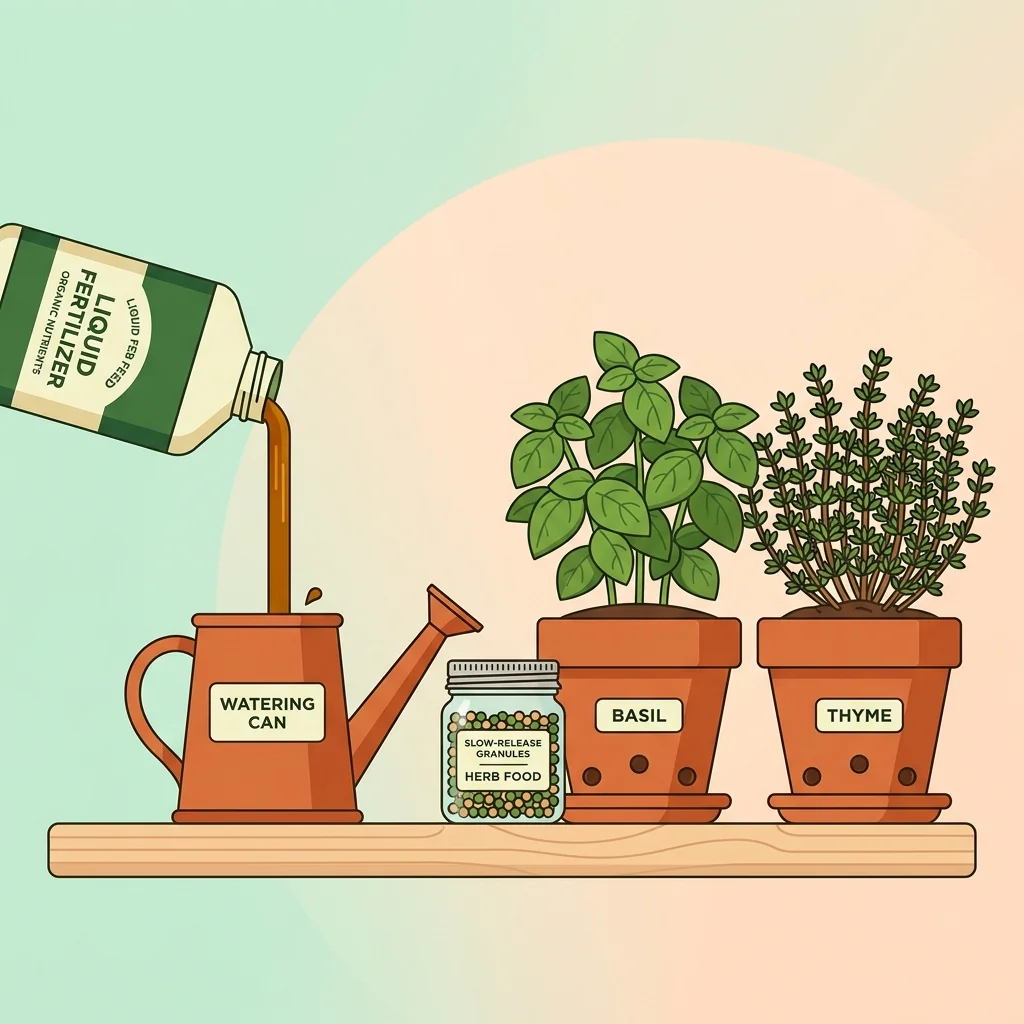
Best fertilizer for herbs in pots: a label-first guide
A practical, label-first guide to complete liquid and controlled-release fertilizers for potted herbs, with a decision table and a safer first application.