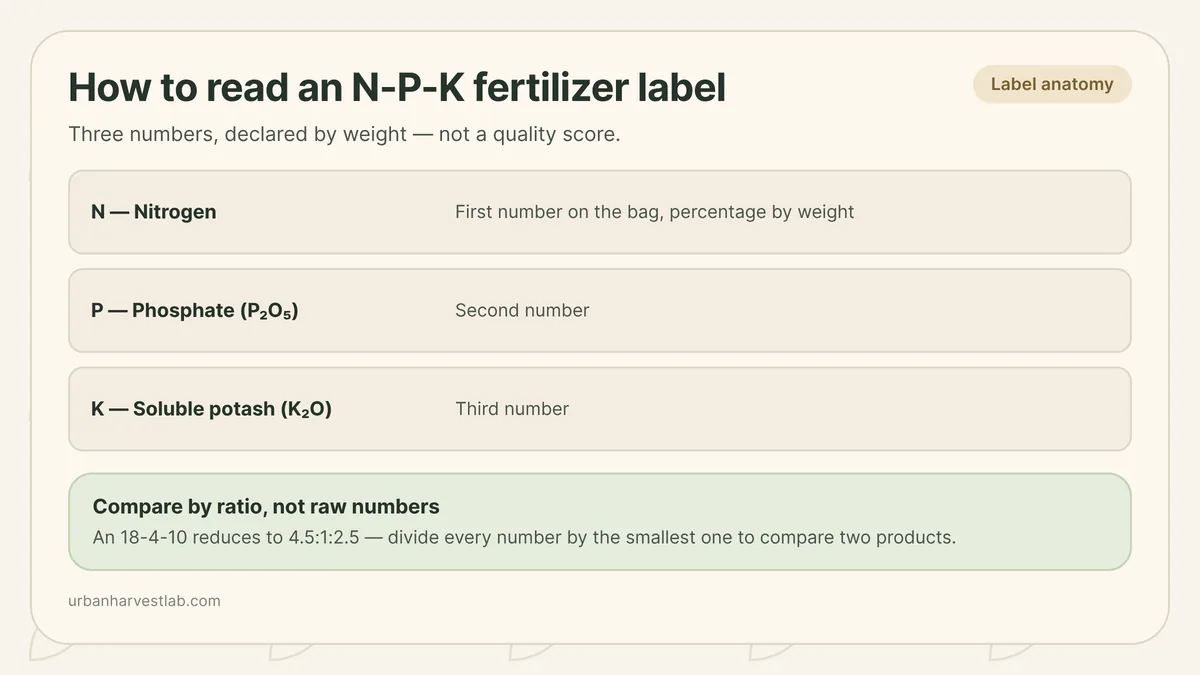
The three numbers on a fertilizer bag are its declared analysis by weight: nitrogen, phosphate, and soluble potash, in that order. They tell you exactly what’s in the bag and in what proportion, and nothing at all about whether your herbs actually need it. Once you can read the label correctly, choosing a fertilizer for potted herbs stops being a guess about which bag looks most impressive.
N, P and K: what the label is declaring
Clemson Cooperative Extension’s HGIC lays out the label plainly: the first number is nitrogen (N), the second is available phosphate (P₂O₅), and the third is soluble potash (K₂O), each stated as a percentage of the product’s total weight. An “18-4-10” fertilizer contains 18% nitrogen, 4% phosphate, and 10% potash by weight. Most of the remaining weight, over two-thirds of the bag in that example, is inert carrier material aside from any secondary and micronutrients the panel declares — it doesn’t feed the plant, and it isn’t supposed to.
That’s a declared analysis, not a marketing claim. A bag doesn’t need to look premium or list a long ingredient story to be complete; it needs those three numbers, a clear application rate, and a label that says it’s suitable for the crop and container you’re using it in.
A balanced number is not automatically the right one
A “balanced” fertilizer — equal numbers, like 10-10-10 — sounds like the safe default: some of everything, symmetrical, hard to get wrong. Clemson’s own guidance says otherwise. When a soil test already shows adequate phosphorus and potassium, HGIC recommends against reaching for a balanced formula anyway, because adding nutrients a container mix doesn’t need isn’t a neutral act.
That matters most for potted herbs precisely because most home growers skip running a soil test on a bag of potting mix and assume “balanced” means “correct.” If you’re feeding a fresh commercial mix that already carries a starter charge, adding another balanced product on top is stacking, not correcting a deficiency. Confirm the potted herb actually needs feeding first before the ratio question is even relevant.
Compare products by ratio, not by the raw numbers
The single most useful trick on a fertilizer label is dividing every number by the smallest one. Clemson’s own worked example: an 18-4-10 fertilizer reduces to a 4.5:1:2.5 ratio once you divide 18, 4, and 10 by 4. That ratio is what you compare between products — not the raw percentages, which change with concentration even when the underlying proportion of nutrients stays identical.
This is where two bags with the same ratio at different strengths get treated as interchangeable when they aren’t. A 10-10-10 and a 5-5-5 share exactly the same 1:1:1 ratio, but the 10-10-10 delivers twice the nutrient per scoop or per gallon of dilution. Applying both at the “one tablespoon per gallon” instructions of a different product, or matching doses by eye instead of by label rate, is how a grower ends up over- or under-feeding without ever changing the ratio at all.
| Label | Ratio (divide by smallest) | What that means in practice |
|---|---|---|
| 18-4-10 | 4.5 : 1 : 2.5 | Nitrogen-heavy relative to phosphate and potash |
| 10-10-10 | 1 : 1 : 1 | Balanced, but concentrated — double the nutrient of a 5-5-5 per unit applied |
| 5-5-5 | 1 : 1 : 1 | Same ratio as 10-10-10, half the concentration per unit applied |
| 2-4-1 (typical fish emulsion) | 2 : 4 : 1 | Phosphate-heavy relative to nitrogen and potash |
Read the ratio to understand what a product emphasizes; read the raw percentage to know how much of it you’re actually applying at a given dose.
What “slow-release” legally has to mean
A label that says slow-release, timed-release, or controlled-release nitrogen isn’t just marketing language — it carries a legal minimum. Clemson Cooperative Extension states that a slow-release fertilizer must contain at least one-third, or 33%, of its total nitrogen in slow-release form. A product sitting right at that floor releases only some of its nitrogen gradually; the rest behaves like an ordinary fast-release feed. For the most sustained release between applications, look for 50% or more slow-release nitrogen on the label’s stated analysis, not just the word “slow-release” on the front of the bag.
Reading an organic label the same way
Organic-labelled products carry the same three numbers, they’re just usually lower and less concentrated. Utah State University Extension’s release-rate table gives a few examples: blood meal runs around 12% nitrogen and releases rapidly. Bone meal contributes 1-6% nitrogen and a much larger 11-30% phosphate, releasing at a moderate pace. Kelp meal supplies about 1-1.5% nitrogen and 5-10% potash, also moderate. How organic and synthetic fertilizers actually differ covers the full release-speed table; fish emulsion and seaweed for herbs covers the commercial fish emulsion product, roughly N-P-K 2-4-1 per University of Illinois Extension.
None of that makes an organic product inherently safer at the same nutrient dose. Utah State is explicit that many organic materials carry high salt levels of their own, and over-application burns plants from those salts the same way a synthetic overdose does — the organic label changes the release curve, not the burn risk.
Reading the panel before you add anything on top
Secondary and micronutrients — calcium, magnesium, sulfur, iron, manganese, zinc, and the rest — are also listed on the label by weight percentage, usually below the three headline numbers. Clemson’s guidance is direct about the risk here: excessive amounts of these can damage or kill plants. That’s why HGIC recommends a soil test before adding a standalone micronutrient product on top of an already-complete fertilizer. A product’s secondary and micronutrient content is whatever its declared-analysis panel actually lists — read that panel first, since stacking a supplement without knowing what the mix already contains is a common way to push an element into excess rather than correct a shortage. If leaf symptoms show up after a change in feeding routine, check the overfeeding signs specific to potted herbs before adding anything else.
Reading a label before you buy
Once a bag is in front of you, the numbers only mean something in combination with a few other checks:
- Find the three headline numbers and divide by the smallest to see the actual ratio, not just the raw figures.
- Look for the phrase “slow-release” or “controlled-release” only if the declared analysis backs it up with a stated slow-release nitrogen percentage.
- Scan the secondary and micronutrient list rather than assuming a product is complete because the front label says so.
- Check that the label names your use case — container-grown, edible, or herb-specific wording, rather than a general lawn-and-garden formula.
- Match the concentration to your container, since a higher-analysis product needs a smaller dose to deliver the same nutrient load as a lower-analysis one at the same ratio.
Reading the label correctly still leaves two separate decisions: which product actually fits your setup, covered in the herb fertilizer buying guide, and how often to apply it once you’ve chosen one, which is a feeding schedule question rather than a label question. The label tells you what’s in the bag; it doesn’t tell you when to open it again.
Sources
Once you can read the label, choose and schedule the feed
The label tells you what's in the bag. These cover which product to buy and when to actually apply it.
Common questions
What does NPK mean on a fertilizer label?
N-P-K stands for nitrogen, phosphate, and soluble potash. Clemson Cooperative Extension explains that the three numbers are the declared analysis by weight, so an 18-4-10 fertilizer contains 18 percent nitrogen, 4 percent phosphate, and 10 percent potash by weight, with the remaining weight made up of inert carrier material.
What is the best NPK ratio for herbs?
There is no universal best ratio. What matters is whether the mix or a soil test already shows adequate phosphorus and potassium — Clemson Cooperative Extension recommends against a balanced formula once those levels are sufficient — and how concentrated the product is at the dose you apply.
Is 10-10-10 fertilizer good for herbs?
A 10-10-10 is a balanced ratio, but balanced does not mean necessary. It also delivers roughly twice the nutrient per scoop that a 5-5-5 does at the same dose, even though both share the same 1:1:1 ratio, so matching the concentration to your container matters as much as the ratio itself.
What does slow-release nitrogen mean on a fertilizer label?
By law, a product labelled slow-release must contain at least one-third of its total nitrogen in slow-release form, per Clemson Cooperative Extension. Products with 50 percent or more slow-release nitrogen give the most sustained feeding between applications.
Related guides
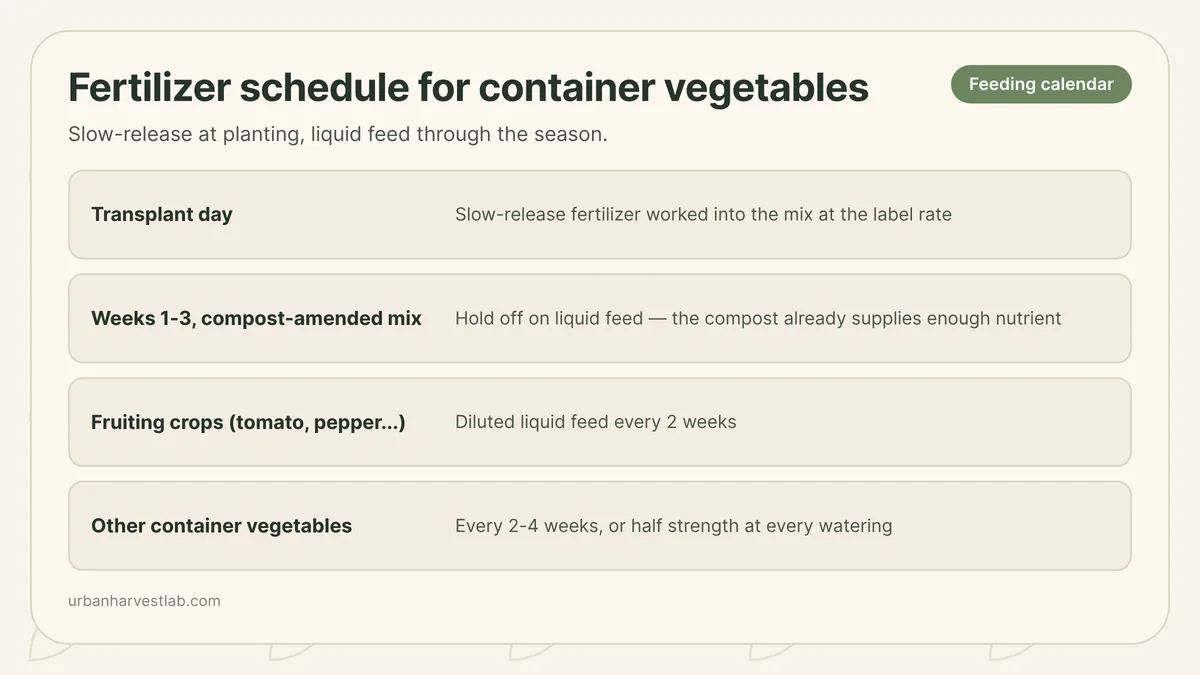
Fertilizer schedule for container vegetables: what to feed and when
A stage-by-stage feeding calendar for container vegetables, built from extension guidance on slow-release charges, liquid top-ups, and the intervals that keep fruiting crops producing.
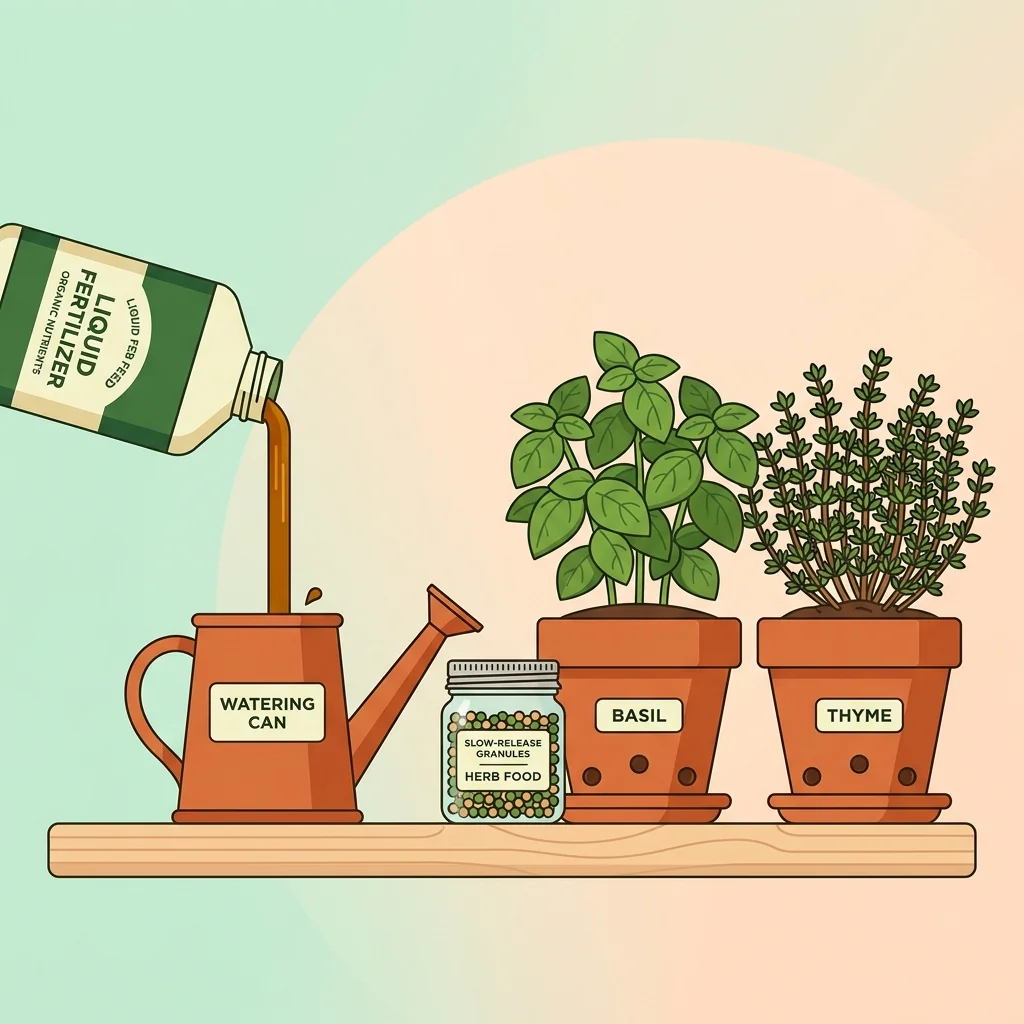
Best fertilizer for herbs in pots: a label-first guide
A practical, label-first guide to complete liquid and controlled-release fertilizers for potted herbs, with a decision table and a safer first application.
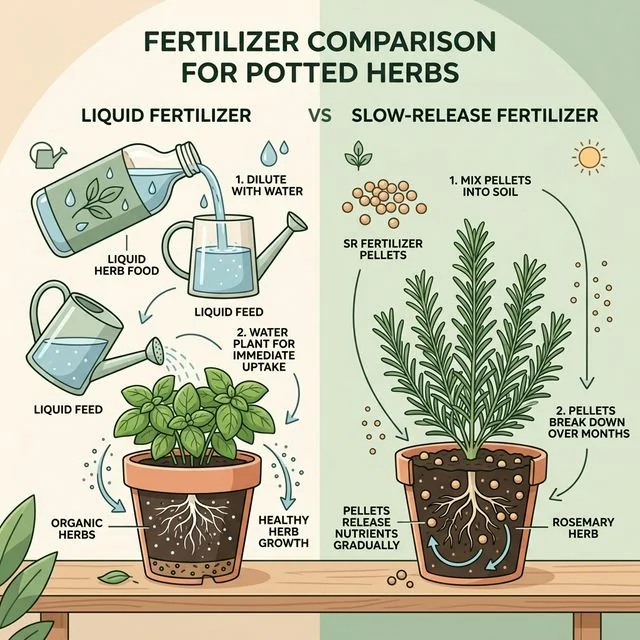
Do potted herbs need fertilizer? When to feed and avoid burn
Most potted herbs need fertilizer eventually, but timing matters. This guide explains when to feed, how often to do it, and how to avoid burning stressed roots.