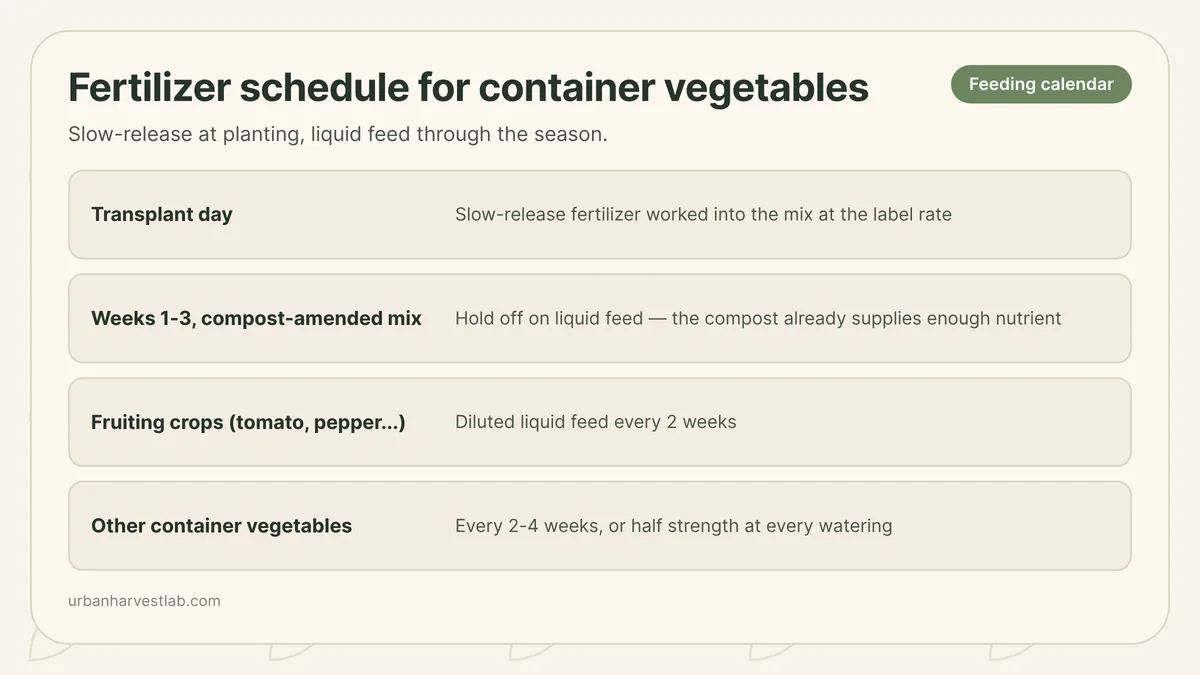
Most container vegetables run on the same two-part system: work a slow-release fertilizer into the mix at planting, then add a diluted liquid feed every two to four weeks once that starter charge tapers off — tightening to roughly every two weeks for long-season fruiting crops like tomatoes, peppers, cucumbers and eggplant, because University of Maryland Extension and Penn State Extension both size the interval to keep a plant setting fruit continuously rather than to hit one application date. If you’re still choosing pots and building a mix for a small-space setup, small-space herb gardening is the place to start before feeding becomes the question.
The schedule below assumes an ordinary container mix and ordinary watering. Two things push it around in practice: what’s already in the mix (a compost-amended blend starts with its own nutrient reserve), and how often you water, since a container watered daily in summer heat sheds dissolved nutrient out the drainage hole faster than one watered every few days.
What your potting mix already gave you
A fresh bag of soilless mix and a fresh batch of homemade mix don’t start from the same place. Utah State University Extension found that a compost-amended container mix carries enough N-P-K to cover a plant’s needs for the first two to three weeks after potting, and states the rule directly: don’t add liquid fertilizer during that window. Feeding into it doesn’t help the plant faster — it just stacks nutrient the mix is already supplying.
If your own mix leans heavily on compost, see how much compost to add to potting mix before you also start a feeding calendar on top of it, and check the DIY potting mix for container vegetables guide if you’re building your own batch rather than buying one. If your mix has no compost or starter fertilizer blended in, begin the slow-release-and-liquid routine below at planting rather than holding off.
The two-part system: slow-release at planting, liquid through the season
Two extension sources describe the same pattern, in slightly different words. Penn State Extension’s container-vegetable guidance is to apply a slow-release or timed-release product at planting, then top up with a diluted soluble feed every two to four weeks through the season. University of Illinois Extension describes the same slow-release mechanism directly: a water-soluble fertilizer encased in a semi-permeable resin coating, releasing with each watering over roughly three to four months depending on moisture and temperature.
Neither format solves the leaching problem on its own. University of Illinois Extension notes that frequent container watering leaches nutrient regardless of which format supplied it — a slow-release granule still depends on watering to release its dose, and that same water still carries dissolved nutrient toward the drainage hole. That’s the reason a “set and forget” slow-release product still benefits from a plan rather than a single application at planting and nothing else.
There’s also a lower-effort alternative to counting weeks: University of Illinois Extension lists fertilizing with every watering at half strength as an accepted routine, paired with occasionally using plain water only, to avoid building up a dose. It’s a different rhythm from the biweekly full-strength approach, not a lesser one — pick whichever one you’ll actually keep up.
Choosing which product to buy in the first place — a resin-coated granule, a soluble powder, a concentrated liquid — comes down to convenience against control more than one format being objectively better. The slow-release versus liquid fertilizer comparison walks through that tradeoff in more depth.
Someone who waters daily and is standing right there anyway loses little by folding a half-strength dose into that routine every time.
Printable container vegetable feeding schedule
Apply fertilizer to moist soil, not to a dry pot — University of Illinois Extension is explicit that fertilizing bone-dry soil risks root damage, so water first if the mix has dried out. With that rule standing behind every row, here’s the schedule:
| Growth stage | Timing | What to feed | Frequency and source |
|---|---|---|---|
| Transplant / potting day | Day 0 | Slow-release (controlled-release) fertilizer worked into the mix at the label rate | Releases over roughly 3-4 months (University of Illinois Extension) |
| Establishment, compost-amended mix only | Weeks 1-3 | Nothing — hold off on liquid feed | Utah State University Extension: skip liquid feeding for the first 2-3 weeks |
| Active growth, long-season fruiting crops (tomato, pepper, cucumber, eggplant) | Week 3 onward (or from planting if the mix has no compost/starter charge), through harvest | Diluted liquid or soluble fertilizer | Every 2 weeks (University of Maryland Extension); every 2-4 weeks (Penn State Extension) |
| Active growth, other container vegetables (leafy greens, roots, bush beans, and similar fast crops) | Same window as above | Diluted liquid fertilizer, full strength on a longer interval or half strength every watering | Every 2-4 weeks full strength, or half strength at every watering (University of Illinois Extension) |
| Ongoing maintenance | Every 4-6 months | Plain water only, at least twice the pot’s physical volume, drained fully | University of Maryland Extension |
Copy this table as-is for a fridge or potting-bench reference; the row you need changes with the crop, not the calendar month.
Reading the dose off the label
The label’s own stated rate is the dose to follow, and the number that actually varies between two bags sharing the same ratio is concentration, not proportion: a 10-10-10 and a 5-5-5 are both a 1:1:1 ratio, but the 10-10-10 delivers twice the nutrient per unit applied, so treating them as interchangeable at the same scoop count over- or under-feeds depending on which one you actually bought. A “balanced” formula with equal numbers isn’t automatically the safer default either — Clemson recommends against one specifically when a soil test already shows adequate phosphorus and potassium, since feeding nutrient the mix doesn’t need isn’t “safe by symmetry.” A slow-release bag’s declared slow-release-nitrogen percentage is also worth checking before you buy, since it tells you how much of the nitrogen is metered out over time versus available immediately. N-P-K label anatomy walks through the ratio math and the slow-release percentage rule in full, and the fertilizer dilution calculator handles the half-strength and full-strength math this schedule assumes throughout.
A slow-release product’s own label carries a second number worth checking before you buy: Clemson requires at least one-third of the total nitrogen to be in slow-release form for a product to legally use the term, and a bag with 50% or more slow-release nitrogen gives the longest, steadiest release between applications. Two bags that both say “slow-release” on the front can still behave quite differently once you compare that percentage on the back panel — the front-of-bag language is marketing, the declared-analysis panel is the actual specification.
Long-season fruiting crops: tomatoes, peppers, cucumbers, eggplant
These four are named explicitly in University of Maryland Extension’s container guidance as needing light feeding roughly every two weeks to sustain a continuous harvest — a tighter interval than the general two-to-four-week range, because a fruiting plant is drawing on the mix continuously rather than putting on one flush of growth and stopping. Penn State Extension’s own interval for the same crops, described as “every two to four weeks” after the initial slow-release charge, overlaps with that but leaves more room; treat two weeks as the safer default once a plant is setting fruit heavily in summer heat, when watering (and leaching) also speeds up.
If you’re growing a dwarf or patio tomato variety specifically, the container size and light requirements that make the feeding schedule worth following are covered in growing dwarf tomatoes in pots.
Everything else: leafy greens, roots, and fast crops
Penn State Extension gives fast crops — lettuce and other leafy greens, radishes, bush beans — the same general interval rather than a separate number for each: a diluted liquid feed every two to four weeks. University of Illinois Extension’s half-strength every-watering routine is the alternative for the same fast-crop group. A fast crop that’s harvested within a few weeks of germination may only need one or two feedings in its entire life; a longer-standing root crop or a cut-and-come-again green benefits from staying on the interval for as long as it’s actively growing.
A succession-sown crop resets that clock every time you sow a fresh batch into the same container. Lettuce or radishes reseeded into the same pot every couple of weeks are effectively a new planting each time from the feeding schedule’s point of view, even though the container itself stayed continuously in use — treat each new sowing’s first few weeks the same way you would a brand-new pot, rather than assuming the whole container is on one continuous interval regardless of what is actually growing in it at the moment.
Signs you’re feeding too much or too little
A schedule is a starting point, not a guarantee — watch the plant against it. The documented symptom set for too much fertilizer is osmotic, not subtle: Colorado State University Extension describes wilting, yellowing, and marginal or tip burn on leaves, and a whitish crust on the surface of the mix is a related sign covered in the same guidance. That crust forms as water wicks salts up to the surface and evaporates, leaving the dissolved fertilizer behind rather than carrying it back down to the roots, which is why it shows up on the mix itself and on a pot’s rim before the plant looks obviously stressed. That’s a different mechanism from a nutrient deficiency, which tends to show up as slow, pale, or stalled growth rather than burned margins. The full symptom list and how to tell the two apart is in signs you’re overfertilizing herbs, which applies to container vegetables using the same mix and the same feeding logic.
Leaching and maintenance
Frequent watering is exactly why a feeding schedule needs a leaching plan alongside it — the same water that carries nutrient to the roots eventually carries the leftover salts back toward the surface as it evaporates. University of Maryland Extension’s fix is straightforward: pour at least twice the pot’s physical volume of water through the mix and let it drain completely, repeated roughly every four to six months as routine maintenance, and best done before the next feeding rather than right after one (so a fresh dose isn’t rinsed straight through). See salt buildup in pots for the full mechanism and what a salt crust looks like before it gets that far.
Sources
- Penn State Extension — Container Vegetable Gardening: Four Keys to Success
- University of Maryland Extension — Maintaining Container Grown Vegetables
- University of Maryland Extension — Watering Indoor Plants
- University of Illinois Extension — Fertilizing (Container Gardens)
- Utah State University Extension — Using Compost in Utah Gardens
- Clemson Cooperative Extension, HGIC — Reading a Fertilizer Label
- Colorado State University Extension, PlantTalk Colorado — Whitish Crust on Potting Mixes
If you are feeding container vegetables, also read
These guides cover the potting mix your schedule depends on, how to choose between product formats, and how to read the numbers on the label.
Common questions
How often should you fertilize container vegetables?
Most container vegetables take a diluted liquid feed every two to four weeks once a starter charge runs out, per Penn State Extension. Long-season fruiting crops such as tomatoes, peppers, cucumbers and eggplant do best on the tighter two-week end of that range, per University of Maryland Extension, since the goal is a continuous harvest rather than a single application date.
When do you start fertilizing a newly potted container vegetable?
If the mix is amended with compost, Utah State University Extension found enough nutrient already present to skip liquid feeding for the first two to three weeks after potting. Without that head start, begin the slow-release-and-liquid routine at planting instead of waiting.
Can you fertilize container vegetables every time you water?
Yes. University of Illinois Extension lists an every-watering, half-strength fertilizer solution as an accepted alternative to biweekly full-strength feeding, alongside occasionally using plain water to leach the pot.
Do tomatoes and peppers need a different fertilizer once they start flowering?
Clemson Cooperative Extension's label guidance is about matching a formulation to what a soil test shows, not about switching to a different ratio once flowers appear — Clemson does not give a different N-P-K ratio for flowering. University of Maryland Extension's two-week interval for fruiting crops is the tighter end of Penn State Extension's two-to-four-week range, so the interval can shorten even though the product does not change.
Related guides
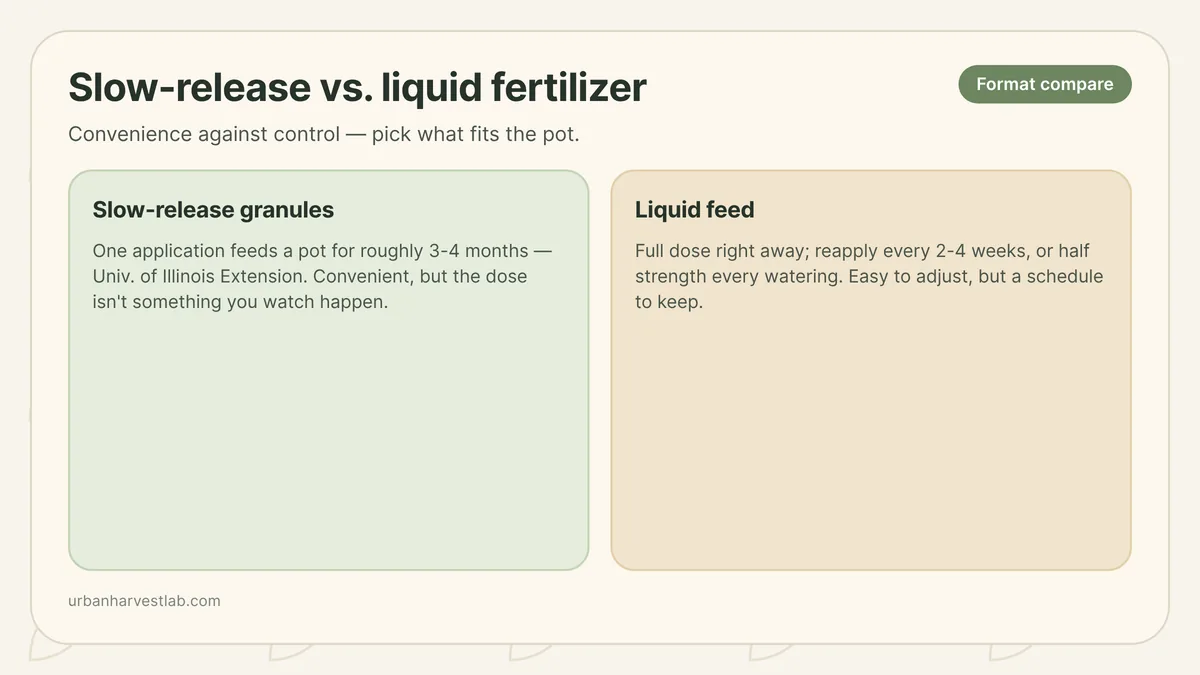
Slow-release vs. liquid fertilizer: which one fits your container
Granular slow-release and liquid fertilizer solve different problems in a pot. Here is how each one actually releases nutrient, and which situation calls for which.
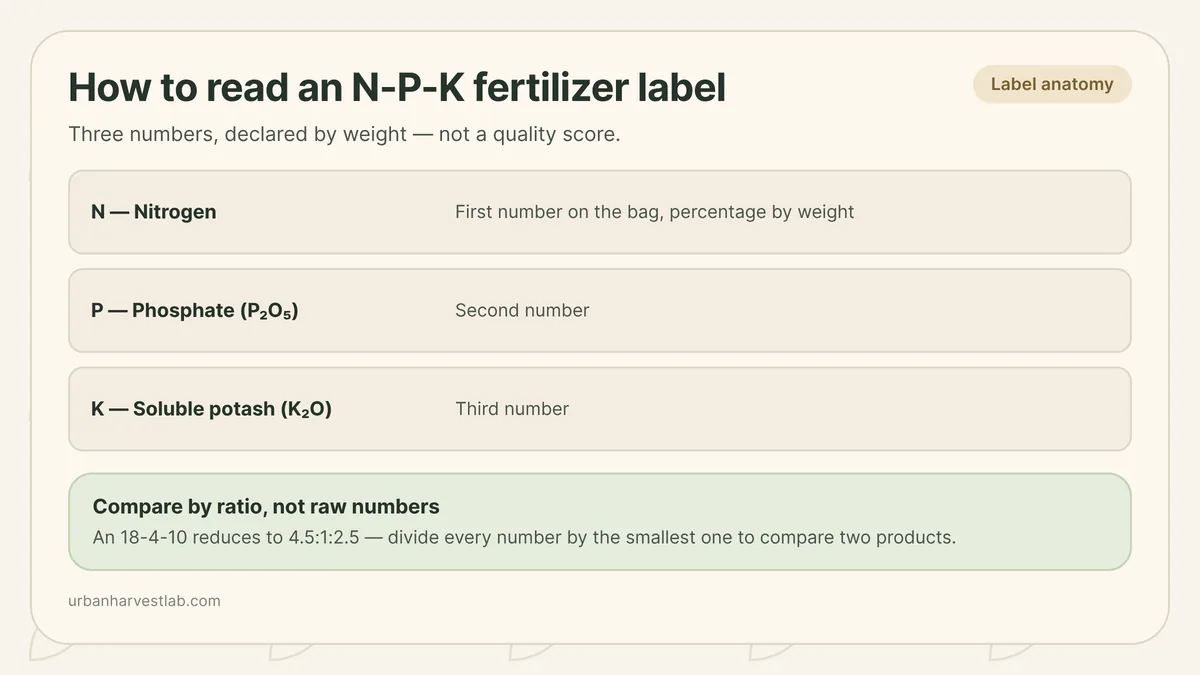
How to read an NPK fertilizer label for herbs
The three numbers on a fertilizer bag tell you exactly what's inside by weight, nothing about whether your herbs need it. Here's how to read them and compare products correctly.
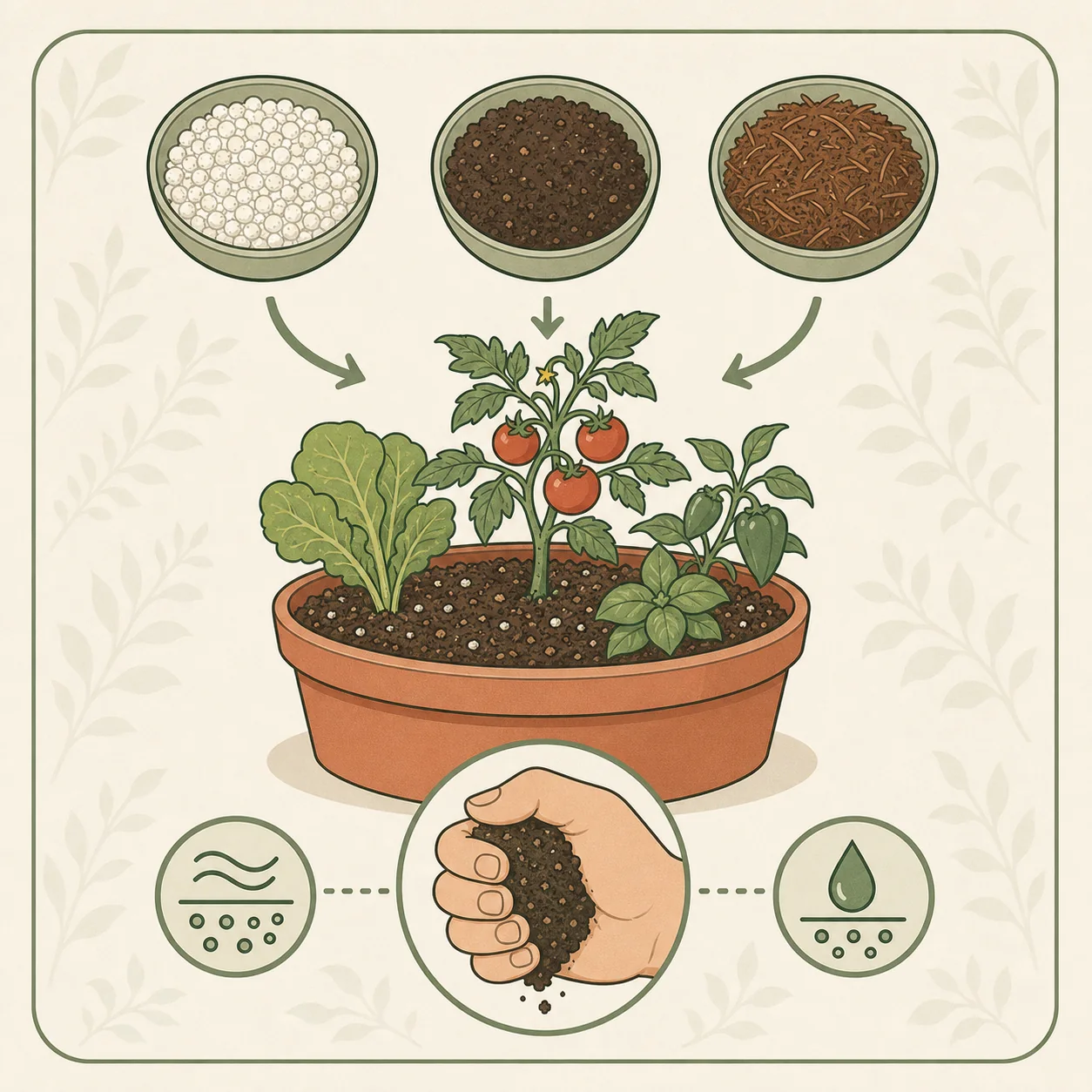
How to make potting mix for container vegetables
A useful potting mix recipe describes the job of each ingredient and gives you a way to correct the result. The goal is stable air and moisture, not a magic ratio.