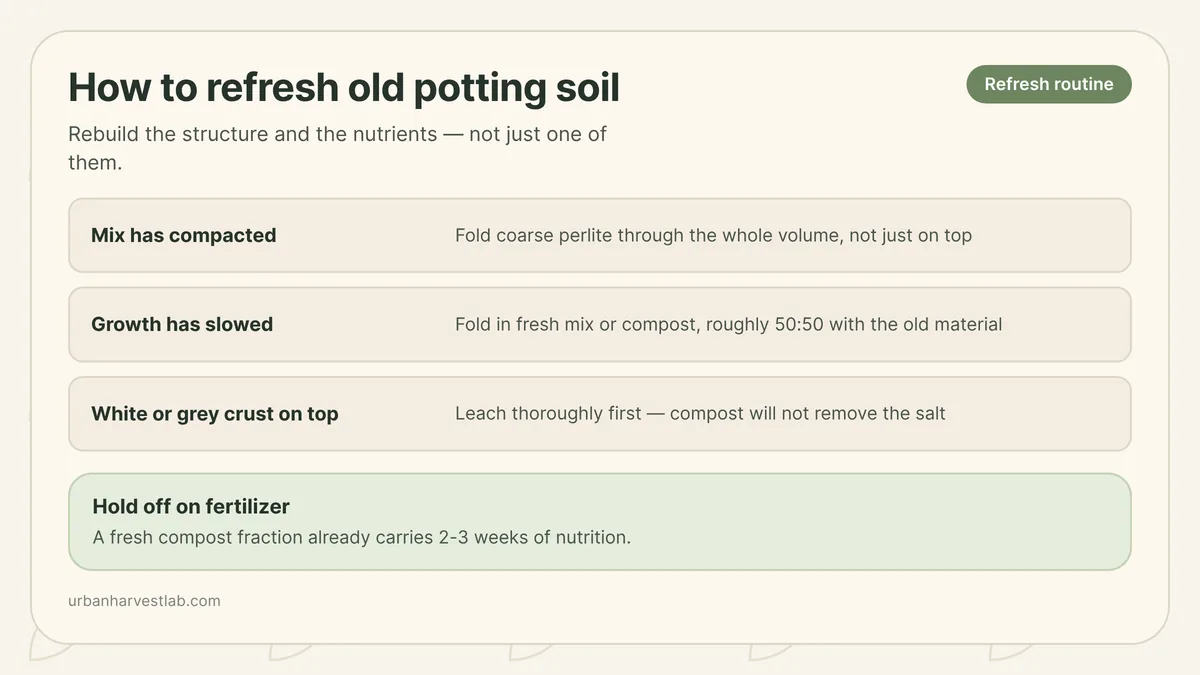
What a sign in old potting mix usually means, and what to add back
| Sign in the old mix | What it usually means | What to add back |
|---|---|---|
| Mix has compacted and shrunk in the pot | Aeration components have broken down or settled with repeated watering | Coarse perlite or bark folded through the whole volume, not scattered on top |
| Growth has slowed even with regular watering | Nutrients from the original mix and any starter charge are used up | Fresh mix or mature compost folded in at roughly 20 to 33 percent by volume |
| A white or grey crust on the surface or rim | Dissolved fertilizer and mineral salts have concentrated as water evaporated | A thorough leach before anything else — compost will not remove the salt |
| Water beads on the surface or runs down the inside wall | The peat or coir component has dried out and turned hydrophobic | Pre-wetted fresh peat or coir mixed through, not poured on dry |
Refresh old potting mix by folding in roughly equal parts fresh mix or compost, working coarse perlite back through it if it has compacted, and leaching out any salt crust before you add anything else. Old mix has usually lost two separate things — its air-filled structure and its nutrients — and treating only one is why a “refreshed” pot often still underperforms.
If you are still deciding whether reusing the mix makes sense at all, whether you should reuse potting mix covers that decision and when it does not make sense. Assume the answer is yes here, and focus on what to actually do to the mix before planting into it again.
Old mix loses structure and nutrients at the same time
A season of watering does two things to a container mix, and they call for different fixes.
Physically, the mix settles. Iowa State University Extension describes traditional potting soil and soilless mix as both relying on components like peat, bark, and perlite to hold their air-filled structure, and University of Maryland Extension notes that structure degrades with repeated watering and root growth over a season. Iowa State University Extension puts a number on how much handling alone can cost you: tapping a filled container reduces air-filled porosity from about 15% to 9%, and pressing the mix down reduces it further to about 4%. A pot that has been watered dozens of times over a growing season has been through a milder version of the same compaction, minus the deliberate pressing.
Nutritionally, the mix is spent. Whatever starter charge or compost fertility the original mix carried has been used up by the first crop and leached out by routine watering. Neither problem fixes the other — adding only compost to a compacted mix leaves it dense and slow-draining; adding only perlite to an exhausted mix leaves it structurally fine but starved.
Start by fixing what is actually wrong, not by adding more
Before adding anything, empty the pot and look at what you actually have.
Pull out old roots, especially anything thick, woody, or clearly still alive from the previous plant — they will compete with a new one for the same volume. Check for a visible white or grey crust on the surface or around the rim, which Colorado State University Extension identifies as concentrated mineral and fertilizer salts left behind as water evaporated, not a soil texture problem. If a crust is present, deal with it before you add fresh material: University of Maryland Extension recommends flushing with at least twice the pot’s volume of water and letting it drain completely, a step worth repeating every four to six months as routine maintenance whether or not you are refreshing the mix. Folding compost or fresh mix into salt-loaded material does not remove the salt; it just dilutes it into a bigger volume. If leaf-tip burn or a recurring crust was the reason the mix looked tired in the first place, diagnosing salt buildup in the pot goes into the symptoms in more depth.
Also check whether the peat or coir base has dried out completely. Iowa State Extension notes that both become hydrophobic once fully dry — water beads on the surface or runs straight down the inside of the pot rather than soaking in. If that has happened, rehydrate a small amount of fresh peat or coir ahead of time and mix it through rather than watering the old mix directly and hoping it re-wets on its own. If you would rather build the fresh fraction yourself instead of buying a bag, the same components show up in how to make potting mix for container vegetables.
The refresh ratio: how much fresh mix and compost to add back
Once the crust and dried-out patches are dealt with, the working ratio is straightforward. University of Maryland Extension’s guidance for reusing media across seasons is to mix the spent material roughly 50:50 with fresh media or compost, addressing both the nutrient depletion and the physical breakdown at once.
That figure sits inside a wider range depending on how compost-heavy you want the result. Penn State Extension’s own ceiling for a soilless mix is compost making up as much as 50% by volume. Utah State University Extension gives a narrower typical range for potting mixes generally — 20% to 33%, depending on the species and other additives in the mix — the same range covered in more depth in how much compost belongs in potting mix. Penn State’s 50% ceiling and Utah State’s 20-33% range describe compost in a fresh mix rather than a refresh, while Maryland’s 50:50 figure is specifically about reusing a spent season’s media: start around a quarter to a third fresh compost by volume if you want a milder result, or go closer to half spent-to-fresh if the old mix is heavily depleted or badly compacted. Worm castings are a slower-release alternative to compost for the nutrient fraction if you want to try using worm castings in containers instead.
If the old mix still looks and feels reasonably loose and you are mainly replacing nutrition, lean toward the lower end of that range. If it has visibly shrunk in the pot or holds together in a dense clump when squeezed, lean toward the higher end and add coarse perlite on top of the compost fraction, not instead of it — compost adds nutrients and some structure, but it is not an aeration component itself.
Perlite and structure: work it through, do not sprinkle it on top
What matters more than a precise ratio is distribution: perlite scattered on the surface does nothing for the root zone underneath it. A fresh general-purpose batch runs about one part coarse aeration material to two parts base and one part compost, per the recipe in how to make potting mix for container vegetables — bringing a refreshed batch back toward roughly a quarter aeration by volume is the target. Work it through the full depth of the pot, and stop adding once a handful of moist mix breaks apart with light pressure rather than holding together as a dense ball. Rice hulls are a cheaper substitute for a short-cycle crop, but they decompose faster than perlite and are a weaker choice for anything staying in the pot for a full season.
When to start feeding again
If you have folded fresh compost into the refreshed mix, hold off on liquid fertilizer at first. Utah State University Extension states that a compost-amended mix already carries enough nitrogen, phosphorus, and potassium to meet plant needs for the first two to three weeks, and explicitly advises against adding liquid fertilizer during that window. Adding a full feeding schedule on top of a fresh compost fraction risks over-supplying nutrients right when the mix needs least. Past that initial window, how much your container-grown plant needs and how often depends on the crop rather than on the fact that the mix was refreshed rather than store-bought.
If you are adding compost or manure from an outside source
A refreshed mix is often the moment gardeners reach for compost from a neighbor, a municipal program, or a bag of composted manure rather than their own bin. The National Pesticide Information Center documents a real risk in that swap: herbicides such as clopyralid, aminopyralid, and picloram pass through livestock digestive tracts unchanged and remain active in manure and compost made from treated forage, sometimes for months to years, and peas, beans, lettuce, tomatoes, potatoes, and peppers are named as sensitive crops. Choosing compost that’s safe for edible containers covers vetting an outside source in full: the maturity check, the salt ceiling, and running a bioassay before trusting it.
Once the compost fraction itself is in hand, Utah State’s sensory test still applies: finished compost should look and smell earthy, even when wet — anything sour, ammonia-like, or still recognizably raw is not ready to fold in. Compost also decomposes faster than peat once it is worked into a mix, per Iowa State, so it corrects the mix’s structure and nutrient base at the start rather than replacing supplemental feeding through the rest of the season.
Sources
- University of Maryland Extension, “Growing Media (Potting Soil) for Containers”
- Iowa State University Extension, “Potting Media: Components and Handling”
- Penn State Extension, “Potting Media and Plant Propagation”
- Utah State University Extension, “Using Compost in Utah Gardens”
- Colorado State University Extension, PlantTalk Colorado #1338, “Whitish Crust on Potting Mixes”
- University of Maryland Extension, “Watering Indoor Plants”
- National Pesticide Information Center, “Can I use compost contaminated with clopyralid or other herbicides?”
Get the reuse decision and the mix right
Whether to reuse old mix at all, how much compost belongs in it, and where the nutrients come from once it is refreshed.
Common questions
How do I revive old potting soil?
Empty the pot, pull out old roots and debris, and check for a white or grey salt crust — leach that out first with a heavy watering before adding anything else. Then work in fresh potting mix or compost at roughly a 50:50 ratio with the spent material, adding coarse perlite back in if the mix feels dense or compacts easily. Hold off on liquid fertilizer for the first two to three weeks if you have added compost.
Can I just add compost to old potting soil instead of replacing it?
Yes, within limits. Penn State Extension describes compost making up as much as half of a soilless mix by volume, and Utah State places a typical range at 20 to 33 percent for potting mixes generally. Folding in compost rebuilds nutrition and some structure, but it does not fix a salt crust or restore aeration that has physically collapsed — those need a leach and fresh perlite or bark, not more compost.
How much perlite should I add back to old potting mix?
Start by working coarse perlite through until the refreshed mix is roughly a quarter aeration material by volume, the fraction a fresh general-purpose batch uses, then stop adding once a handful of moist mix breaks apart under light pressure. Iowa State Extension notes that simply tapping or pressing a filled container down cuts air-filled pore space dramatically — the same compaction that happens to a pot over a season of watering.
Does old potting soil need to be leached before you reuse it?
Only if you see a crust or the plant showed salt-injury symptoms such as leaf-tip burn. University of Maryland Extension recommends flushing with at least twice the pot's volume of water and letting it drain fully, a maintenance step worth repeating every four to six months regardless of whether you are refreshing the mix.
Related guides
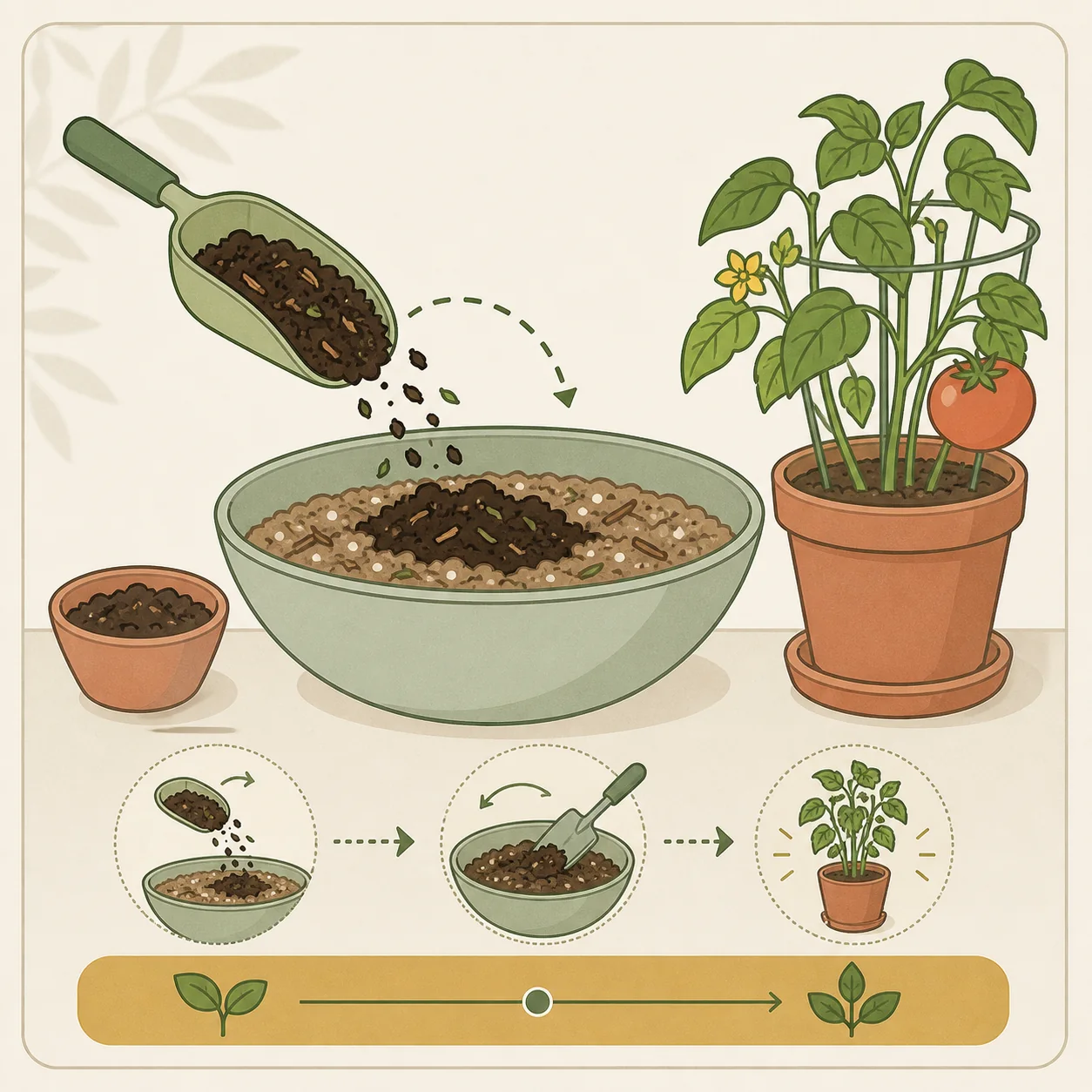
How much compost should you add to potting mix?
More compost is not automatically better. In a container, compost must share limited space with the coarse particles that preserve air around roots.
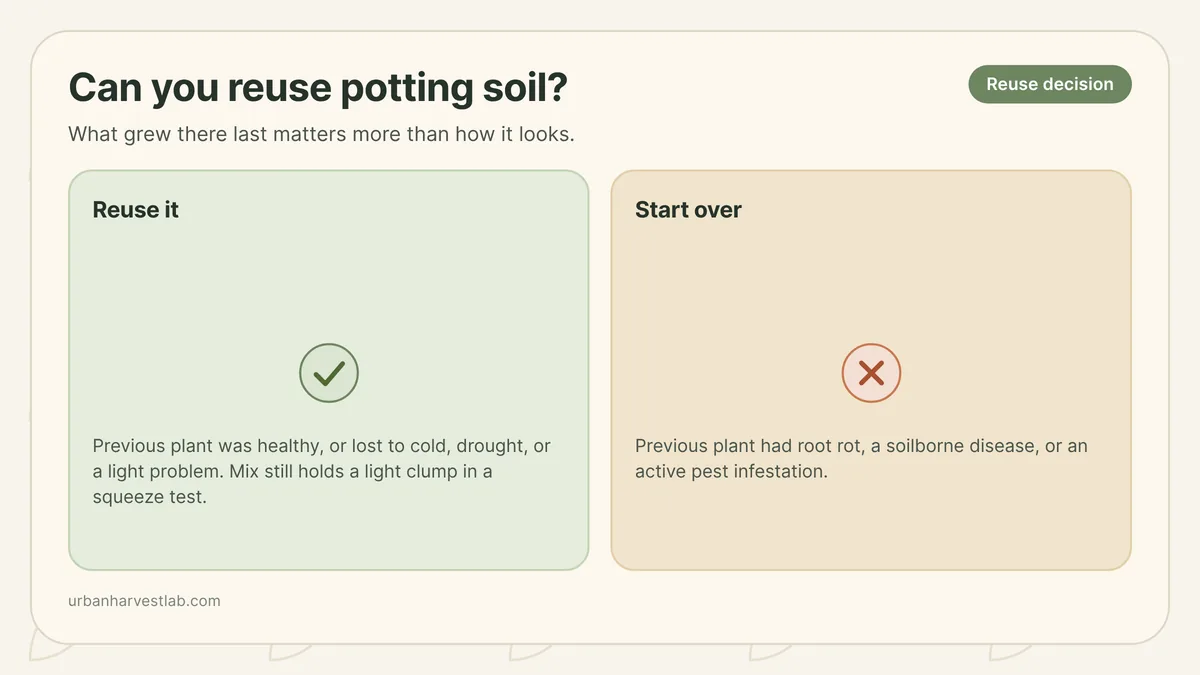
Can you reuse potting soil? When it's safe and when not to
Whether last season's mix belongs back in a pot depends less on how it looks than on what grew in it and why that plant left.
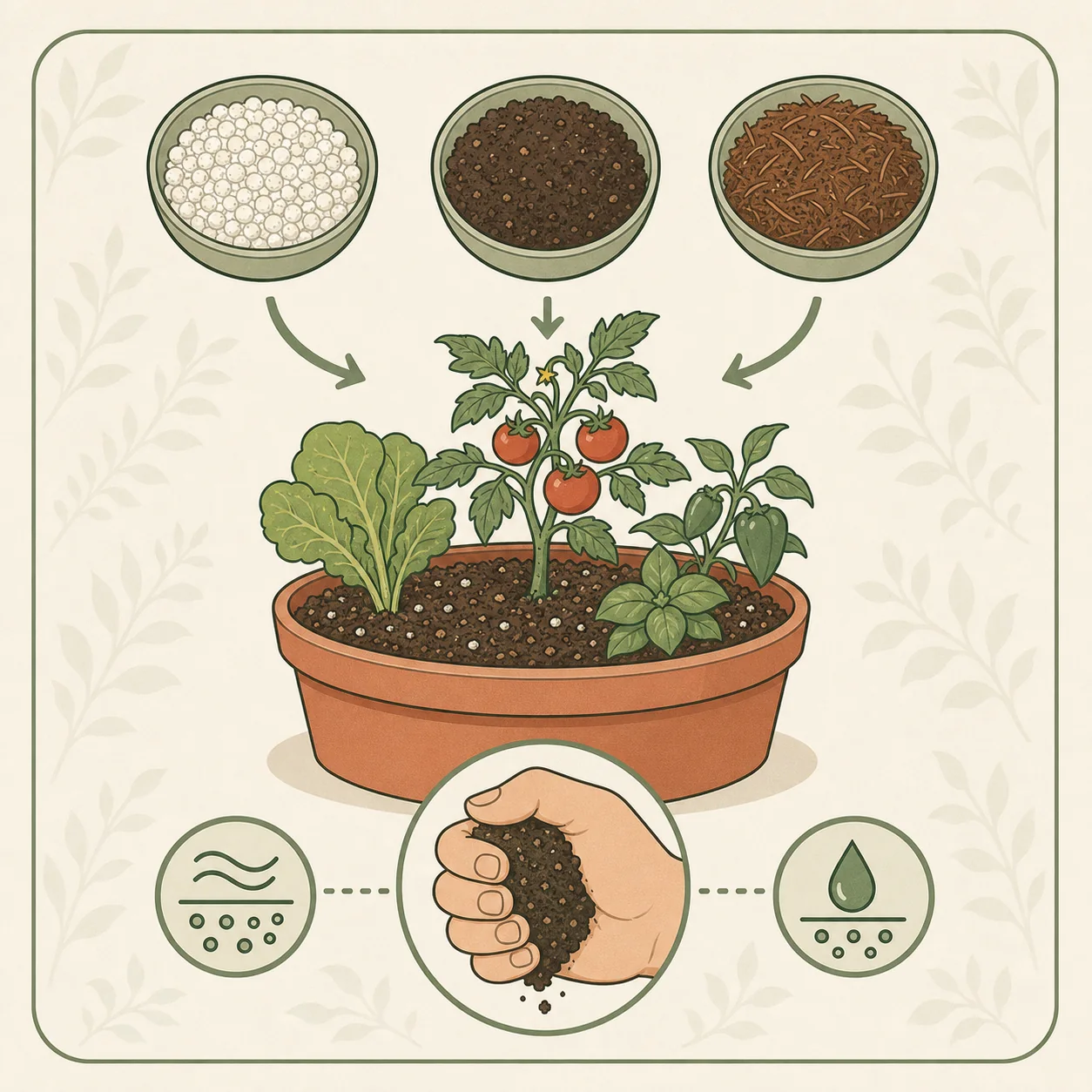
How to make potting mix for container vegetables
A useful potting mix recipe describes the job of each ingredient and gives you a way to correct the result. The goal is stable air and moisture, not a magic ratio.