Asparagus from crown to full harvest, by source
| Year after planting | RHS | Utah State | Maryland |
|---|---|---|---|
| Year 1 | No harvest | No harvest | No harvest |
| Year 2 | No harvest | No harvest | Light pick for 3 to 4 weeks |
| Year 3 | Six weeks, from mid-April | Up to 4 weeks | Light pick |
| Year 4 | Eight weeks | 6 weeks | 8 to 10 weeks |
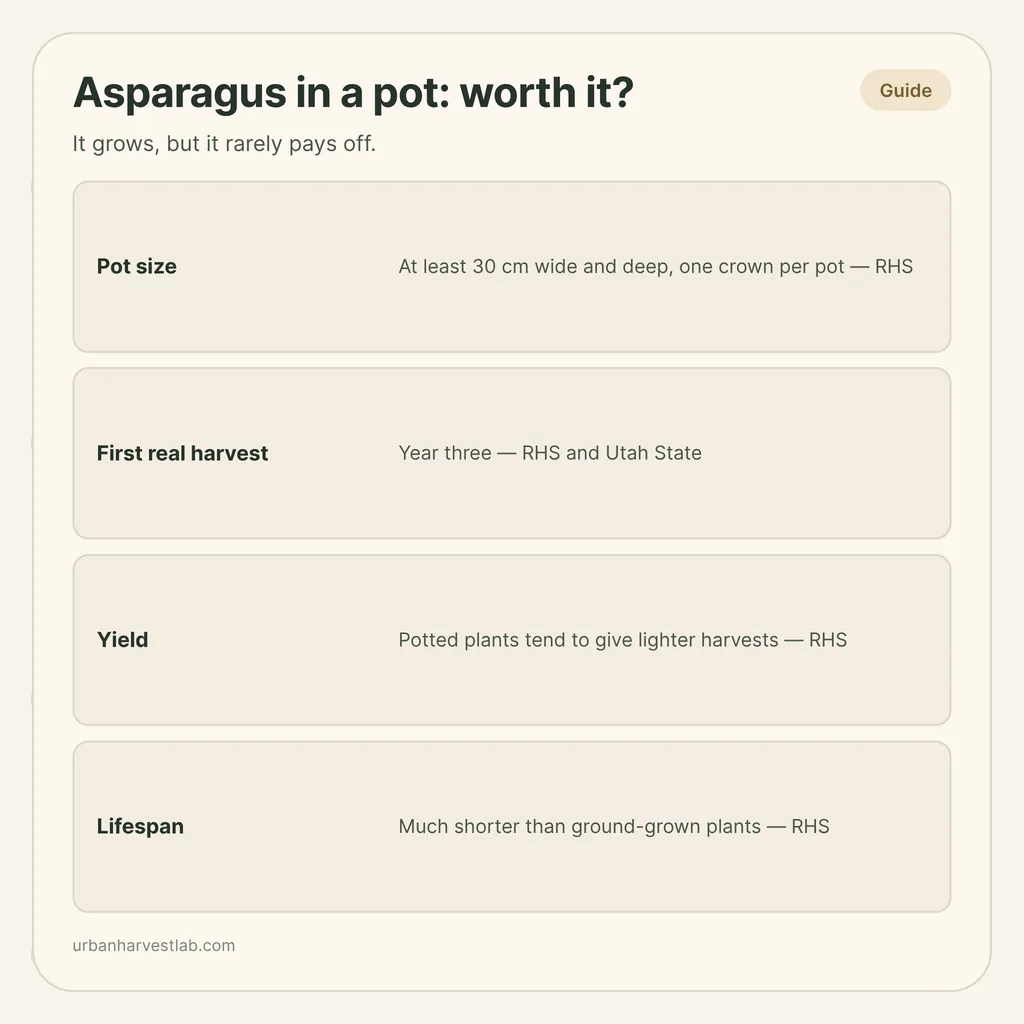
Asparagus grows in a container, but it is one of the weaker bargains in a pot. The Royal Horticultural Society (RHS) says asparagus “undoubtedly grows better in the ground”, asks for pots at least 30 cm (1 ft) wide and deep, and warns that a potted plant has a much shorter lifespan and tends to give lighter harvests. You pay for the pot, the crown and two years of watering before the first real pick. Rhubarb is the other long-wait perennial people try in pots, with a bigger pot and a cold winter to plan for; rhubarb in a pot covers it.
What the wait looks like
The wait is the main cost, and the sources agree on its shape. The RHS says to resist harvesting newly planted crowns for the first two years, then harvest for six weeks in the third year and eight weeks after that. Utah State University Extension says not to harvest until year 3 after planting, with up to 4 weeks that year, 6 weeks in year 4 and up to 8 weeks once the plant has five years of growth behind it. University of Maryland Extension is gentler: a light pick for 3 to 4 weeks in the second year, and 8 to 10 weeks from the fourth season. It also warns that plants harvested too heavily too soon often become weak and spindly.
A plant grown from seed takes longer still. The RHS says to wait three years, and Maryland says no harvest at all for the first two seasons.
In a pot, follow the slower schedule: the RHS says potted plants give lighter harvests, and Maryland warns that plants harvested too heavily too soon often become weak and spindly.
Why a pot cuts the payoff
Asparagus is built for a bed. The RHS describes a dedicated, permanent bed of several square metres, depending on how many plants you grow, with crowns 30 to 45 cm (12 to 18 in) apart. Utah State plants crowns in furrows 8 inches deep and says to irrigate so that water goes down 3 to 4 feet in the soil. A 30 cm pot gives one crown a fraction of that room, and nothing in it is deep enough to match that watering advice.
Yield follows. The RHS expects an established plant to give about 10 spears over the harvest period, and Utah State puts a mature plant at three-quarters of a pound. Both numbers describe plants in the ground. Utah State says 25 plants supply enough spears for fresh eating and storage, which would be 25 pots. One pot gives you a few spears to eat on the day.
Lifespan is the other half. The RHS says ground-grown plants give reliable harvests for up to 20 years, and Utah State says 10 to 15. For potted plants the RHS offers no number, only “much shorter”. After two or three years of waiting, you are on borrowed time.
If you try it anyway
The RHS lays out the basics. Use pots at least 30 cm (1 ft) wide and deep, filled with good-quality peat-free compost, with one crown in the centre of each pot. Feed with a balanced liquid fertiliser during the growing season and topdress each spring. The ferny stems grow tall over summer, so give them support to stop the pot toppling over.
Buy one-year-old crowns. Both Utah State and Maryland recommend them, and Maryland suggests choosing all-male hybrid varieties, which are more productive and disease-resistant than older ones. The RHS agrees that male plants produce more and better spears, and says female plants also throw seedlings that compete with the crown. Maryland also asks for direct sun for at least 6 hours a day and prefers 8 to 10. The RHS prefers full sun but says asparagus tolerates dappled shade.
Water matters in summer. Utah State says new spears form in July and August, so water or heat stress then affects their size the following spring. A small pot dries out fast, which makes this harder to manage than in a bed. Check the drainage holes on any pot you choose, and if it is a reused container, food-safe containers covers what to rule out.
At the end of the year, let the ferns grow through summer. The RHS says to cut the stems to the ground in autumn, and they re-sprout in spring. Maryland cuts the foliage to 2-inch stubs after frost, once it yellows. How to carry the pot itself through a cold winter is covered in overwintering perennial edibles in containers.
Harvest and the berry warning
When the harvest years arrive, the RHS cuts spears 2.5 cm (1 in) below the soil surface when they are no more than 18 cm (7 in) tall or about finger thickness, every two to three days in warm weather. Utah State stops when most spears are thinner than a pencil.
Female plants set orange-red berries. NC State Extension rates asparagus as having low-severity poison characteristics, lists the fruits and stems as having low poisonous toxicity, and says eating the berries may cause gastrointestinal problems. It also warns that contact dermatitis is likely from young, raw shoots, so wear gloves when handling them. Maryland cuts the foliage before the berries fall off, and notes that all-male hybrids do not produce them. If you have children around the balcony, an all-male crown removes the question.
Grow it or skip it
Grow asparagus in a pot if you are happy to treat it as a long project, you have a pot of at least 30 cm per crown and the weight to carry it, and a few home-grown spears each spring would satisfy you. Skip it if you want a harvest this season, want a reliable crop for your effort, or have room for only one big container. A deep container of potatoes in grow bags gives you food the same year, and the pot is free again afterwards.
Sources
Perennial crops in pots
Another long-wait perennial, how to carry roots through winter, and a vegetable that pays off within one season.
Common questions
Can you grow asparagus in pots?
Yes. The Royal Horticultural Society says it is possible to grow asparagus in large containers, using pots at least 30 cm (1 ft) wide and deep with one crown in the centre of each. It also says asparagus grows better in the ground, and that potted plants have a much shorter lifespan and tend to give lighter harvests.
How long does asparagus take to produce in a container?
Expect to skip the first two springs. The RHS says to resist harvesting newly planted crowns for the first two years, then harvest for six weeks in the third year. Utah State University Extension says not to harvest until year 3 after planting, and University of Maryland Extension allows a light 3 to 4 week pick in year two. Plants grown from seed take a year longer, according to the RHS.
How many spears does one potted asparagus plant give?
The RHS expects an established plant to give about 10 spears over the harvest period, and that figure is for a plant in the ground. Utah State gives three-quarters of a pound of spears per mature plant. The RHS says potted plants tend to produce lighter harvests than plants in the ground.
Are asparagus berries poisonous?
NC State Extension lists the fruits and stems as low-severity poisonous and says eating the berries may cause gastrointestinal problems. Only female plants set the red berries; University of Maryland Extension notes that all-male hybrids do not produce them. Do not let children eat them.
Related guides

How to grow rhubarb in a pot: size, cold and the leaf warning
A rhubarb planting stays productive for 8 to 15 years, according to Michigan State Extension, so the pot, the winter and the patience matter more than any feeding trick. Here is what a container changes, and what it does not.
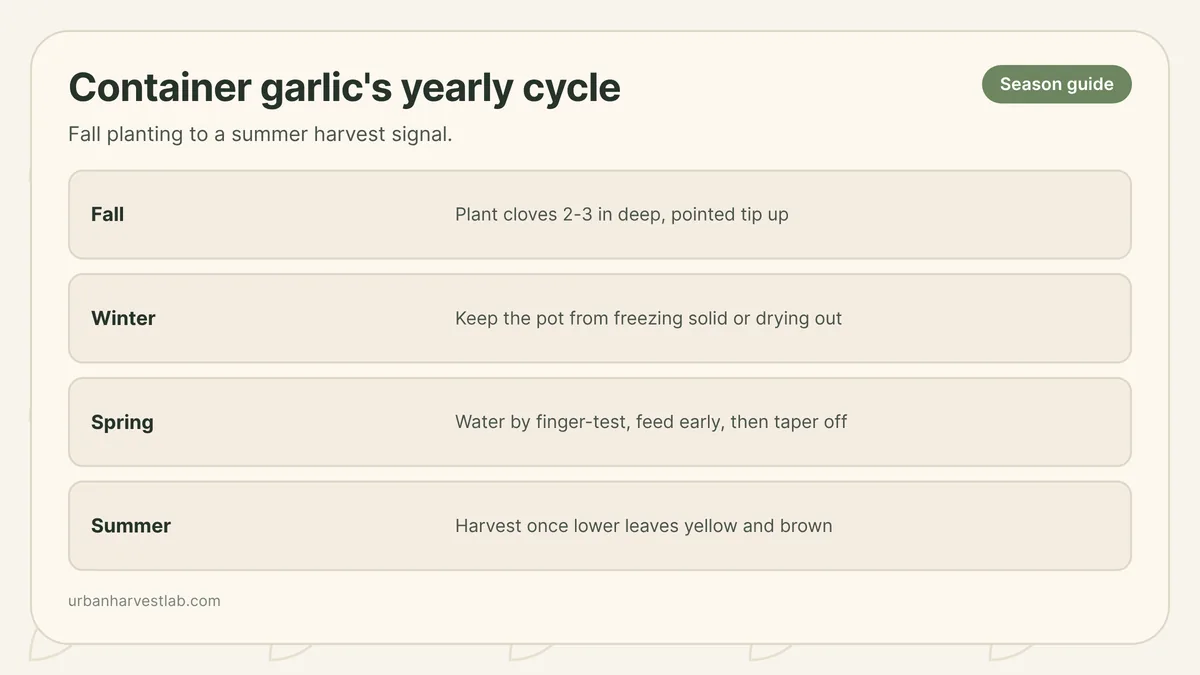
Growing garlic in containers: fall planting to summer harvest
Container garlic runs the same yearly cycle as garlic in the ground, but a pot freezes and dries out faster than garden soil. Here is the full process, season by season.
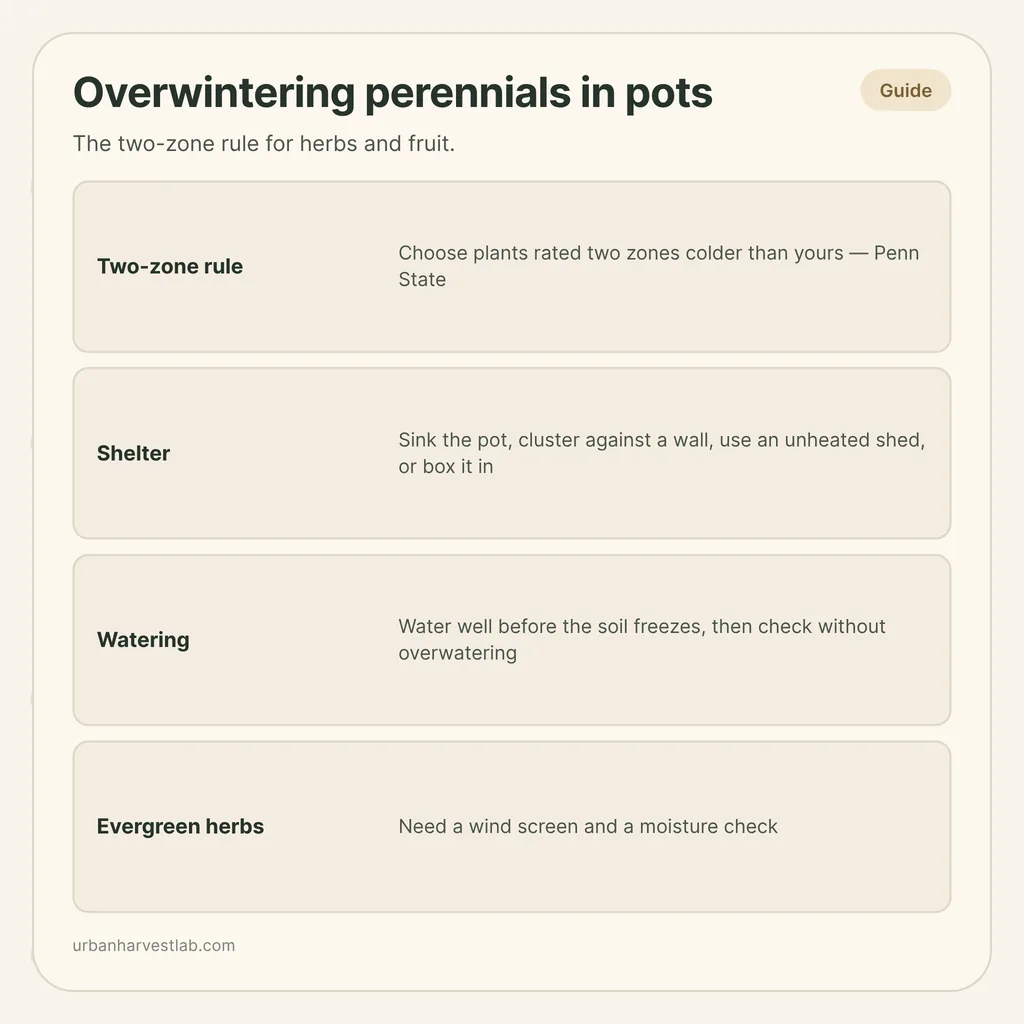
Overwintering perennials in pots: the two-zone rule for herbs and fruit
The hardiness zone on a plant tag assumes the roots are in the ground. In a pot they are not, so the rule, the shelter and the winter watering all change.