
Rhubarb in a pot, year by year
| Year | What the plant is doing | What you do |
|---|---|---|
| Planting year | Building roots and a crown | Water steadily, skip the harvest, and hold off on fertiliser (Utah State) |
| Year two | Still establishing | Utah State takes nothing; the RHS takes just a few stalks |
| Year three | Established | Utah State harvests for 3 to 4 weeks; the RHS harvests normally, up to a third of the stalks at a time |
| Year four onward | Full production | Utah State harvests for 6 to 10 weeks, then stops so the leaves can refill the crown |
Rhubarb grows in a container if the pot is large, the winter is properly cold and you wait before harvesting. The Royal Horticultural Society (RHS) asks for a pot at least 50 cm (20 in) deep and wide, filled with soil-based compost, with plenty of drainage holes. The plant is a hardy perennial that comes back for years, so you are choosing a long-term resident, not a summer crop. Check that the pot itself is safe for edibles first: food-safe containers covers which materials and reused buckets to rule out.
Check your climate before you buy a crown
Rhubarb is a cool-season plant. Ohio State University Extension says it requires winter temperatures below 40 F to break dormancy and start spring growth, and that summers averaging under 75 F suit vigorous leaf growth. Michigan State University Extension describes it as rarely grown where the summer mean passes 75 F or the winter mean stays above 40 F. That points to a simple test: if your balcony has real winters and mild summers, rhubarb fits. If winters are frost-free and summers are hot, expect a struggle.
Cold does not hurt the plant. Ohio State notes that the tops are usually killed in the first heavy freeze, but the roots survive and send up new growth the next spring. The RHS describes the plant as thriving even in the coldest sites.
A pot changes the cold picture, though. University of Illinois Extension points out that potted roots sit in colder conditions than roots in the ground, and suggests choosing plants that survive two zones colder than yours. Ohio State lists varieties that do well in USDA zones 4 to 7. If you live near the cold edge of that range, wrap or shelter the pot rather than assuming it behaves like a garden bed. First and last frost dates for a balcony explains how to read your zone and find your frost dates.
The reverse matters too. A crown kept in a warm apartment all winter misses its cold spell. Leave it outside.
Choose the pot and the variety
The RHS recommendation is the one concrete size on offer: at least 50 cm (20 in) deep and wide, plus a compact variety. Utah State describes a mature plant in open ground as over 3 feet tall and wide, and the RHS says a clump can reach 1.5 m (5 ft) across, so a pot at the minimum limits size by design. Pick the biggest pot your balcony can carry once wet; container depth for vegetables and herbs helps you compare depths. Drainage holes are not optional, and the drainage holes guide covers how to check them.
Variety affects flowering. Utah State lists Cherry Wine and Strawberry as producing few flower stalks, and rates Victoria as very likely to produce flower stalks that need removal. Sources split on Valentine: the University of Wisconsin-Madison Division of Extension says it produces few or no seed stalks, while Ohio State lists it among the varieties more likely to bolt.
Plant the crown high
Buy a dormant crown or a potted plant. The RHS says container-grown plants can go in at any time, with spring or autumn best, and says to avoid very hot, dry weather. Ohio State says dormant crowns are best planted in early spring.
Depth is where people go wrong. For container-grown plants, Utah State covers the top of the root-ball with 1 inch of soil, and warns that planting too deep delays maturity and can kill the plant. The RHS puts the main growth bud, where the leaf stalks emerge, just above the compost surface. Both rules keep the crown near the top. Firm the compost and water well.
Water and feed for a pot, not a bed
The RHS singles out containers: water regularly through the growing season because the compost dries out quickly, and keep it moist but not waterlogged. Do not stand the pot in a tray of water, since the RHS lists rot in damp conditions, especially in winter, as a main problem. A saucer that drains is fine; one that holds water is not.
For feeding, Utah State says to skip fertiliser in the first year. Once the plant is settled, the RHS suggests a high-nitrogen, organic-based fertiliser in spring or summer if growth is slow, and a spring mulch of well-rotted organic matter about 7 cm (2.5 in) deep, taking care not to bury the crown. Mulching container plants shows how to do that in a pot.
Late frost can burn young shoots in spring. The RHS suggests covering them with straw or fleece when freezing temperatures are forecast.
Wait for the first harvest
Rhubarb pays off slowly, and sources differ on how slowly. Utah State says to harvest no stalks for the first two years, then 3 to 4 weeks in year three and 6 to 10 weeks from year four. The RHS says to skip the first year, pick a few stalks in the second, and harvest normally in the third. A container plant has less root room than a garden plant, so lean toward the slower schedule.
Utah State gives 4 to 12 pounds of stalks per plant per year in open ground. Treat that as a ceiling for a pot.
When stalks are ready, they are about 10 to 15 inches long according to Utah State; the RHS picks a young stalk about 30 cm (1 ft) long. Grasp it at the base, then pull and twist to ease it out. The RHS says not to cut it, since a cut leaves a stump prone to rotting. Take no more than a third of the stalks at one time, as both Utah State and the RHS advise, so enough leaves remain to feed the crown. The RHS suggests stopping in late June or early July.
Stalks keep in the fridge for 2 to 4 weeks in a plastic bag, according to Utah State, and can be frozen after blanching for 1 minute.
Do not eat the leaves
The stalks are the food. The University of Wisconsin-Madison Division of Extension says the leaves contain a toxic amount of oxalic acid and are poisonous, and Utah State says leaf oxalic acid can make you quite sick and lead to kidney failure, while the stalks have almost no oxalic acid. Ohio State says the leaves should not be eaten. The RHS adds that the oxalic acid in stems is not enough to have a toxic effect.
So cut off the leaf blade and discard it at harvest. Keep the pot out of reach of children and pets. Ornamental rhubarb (Rheum palmatum) is not edible, according to Ohio State, so check the plant label.
Flower stalks, winter and division
Flower stalks sap the crown. Utah State says flowering tends to reduce vigour and leaf and stalk production, so remove stalks as they begin to elongate.
Through winter, leave the pot outside where it cannot sit in standing water. The cold is the point. In a climate near the cold limit for your variety, wrap or shelter the pot, as the Illinois two-zone rule above suggests. Do not bring it into a warm room.
The RHS describes forcing for early pale stalks, either under a cover or by putting potted plants in the dark, with harvest four to eight weeks later. The RHS adds that forced crowns are significantly weakened and usually discarded. Skip it for a pot you want to keep.
When the crown crowds the pot, divide it. The RHS says about every five years, in late autumn or winter. Utah State says every 5 to 10 years in early spring, with one large bud per section.
If you want a second crop that needs a cold winter in its pot, garlic in containers works the same way.
Sources
- Royal Horticultural Society, “Rhubarb: grow your own”
- Utah State University Extension, “How to Grow Rhubarb in Your Garden”
- University of Wisconsin-Madison Division of Extension, “Rhubarb, Rheum rhabarbarum”
- Ohio State University Extension, “Growing Rhubarb in the Home Garden” (HYG-1631)
- Michigan State University Extension, bulletin E-1577
- University of Illinois Extension, “Overwintering potted plants”
Before you plant a perennial in a pot
Container safety, frost timing and pot depth all matter more for a crop that stays in the same pot for years.
Common questions
How big a pot does rhubarb need?
The Royal Horticultural Society recommends a pot at least 50 cm (20 in) deep and wide, with plenty of drainage holes and a soil-based compost, and suggests a compact variety. A mature plant in open ground grows over 3 feet in height and width according to Utah State University Extension, so a pot at that minimum size limits the plant rather than matching it.
How deep do you plant rhubarb in a pot?
Shallow. Utah State University Extension covers the top of the root-ball with 1 inch of soil, and warns that planting too deep delays maturity and can kill the plant. The RHS sets the main growth bud just above the compost surface. Either way, the crown is not buried.
Can you eat rhubarb leaves?
No. The University of Wisconsin-Madison Division of Extension states that the leaves contain a toxic amount of oxalic acid and are poisonous, and Ohio State Extension says the leaves should not be eaten. The stalks are the edible part. Remove and discard the leaf blades when you harvest.
Does rhubarb need cold winters to grow in a pot?
Yes. Ohio State University Extension says rhubarb requires winter temperatures below 40 F to break dormancy and stimulate spring growth, and needs summers averaging under 75 F for vigorous growth. Michigan State Extension adds that it is rarely grown where the winter mean is above 40 F. Keep the pot outdoors through winter rather than indoors.
Related guides
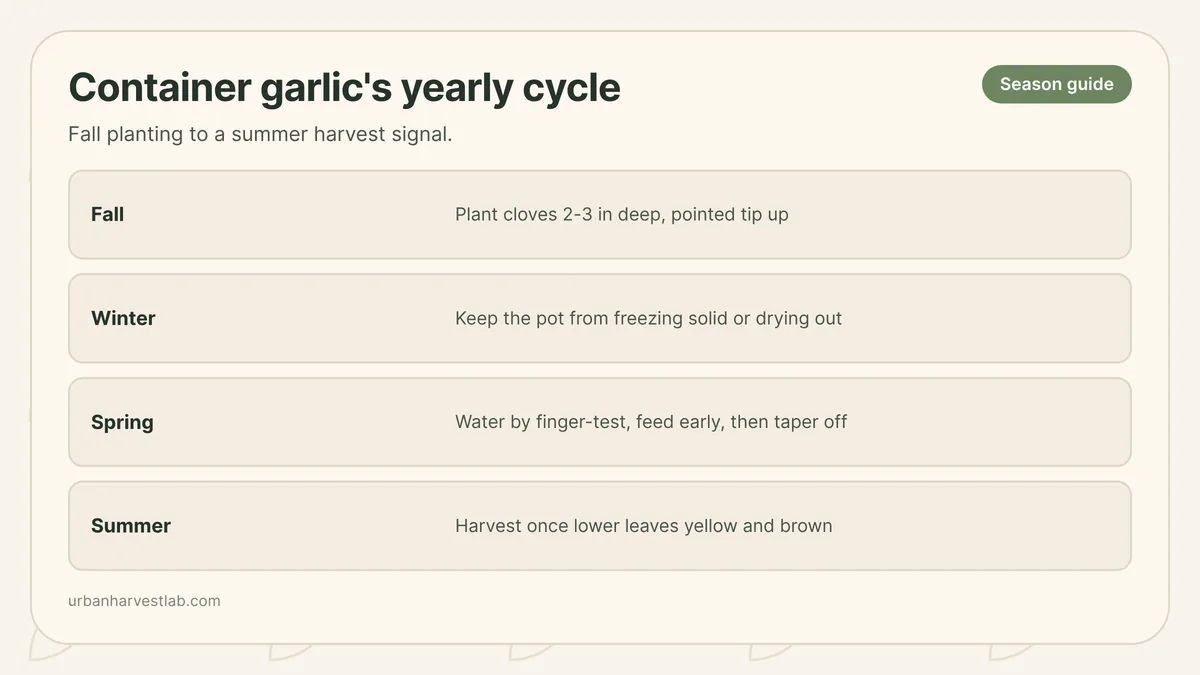
Growing garlic in containers: fall planting to summer harvest
Container garlic runs the same yearly cycle as garlic in the ground, but a pot freezes and dries out faster than garden soil. Here is the full process, season by season.
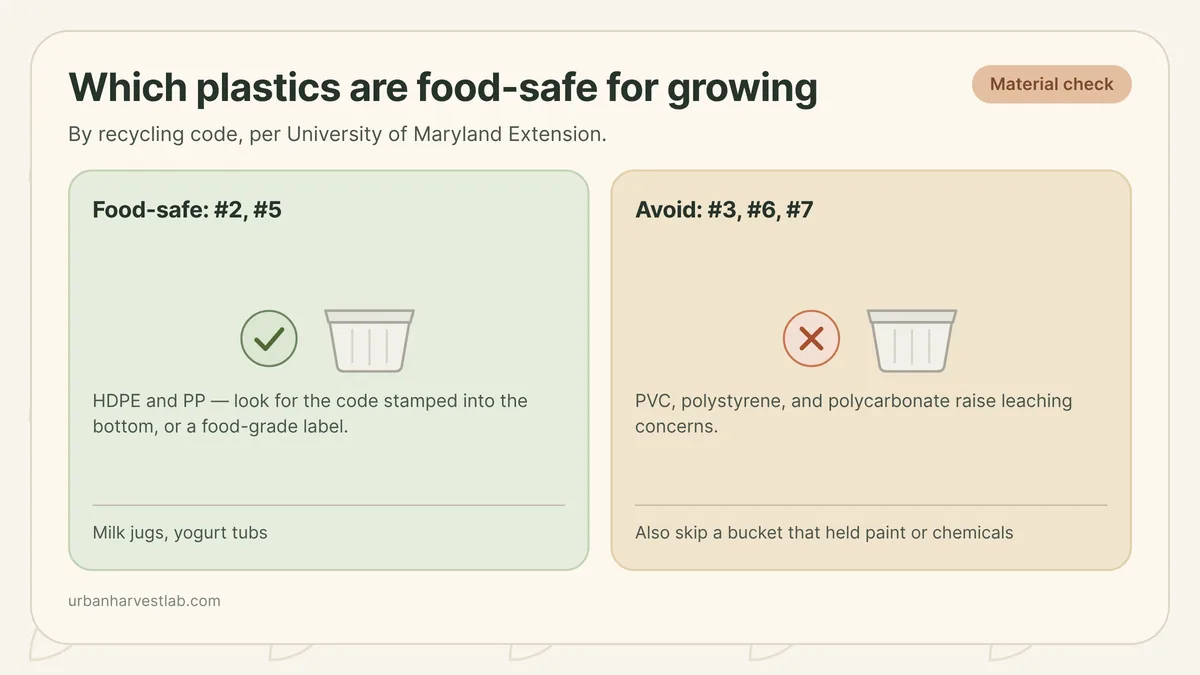
Food-safe containers for growing vegetables and herbs
A container's recycling code and its history both decide whether it's safe to grow food in -- and the two questions have different answers.
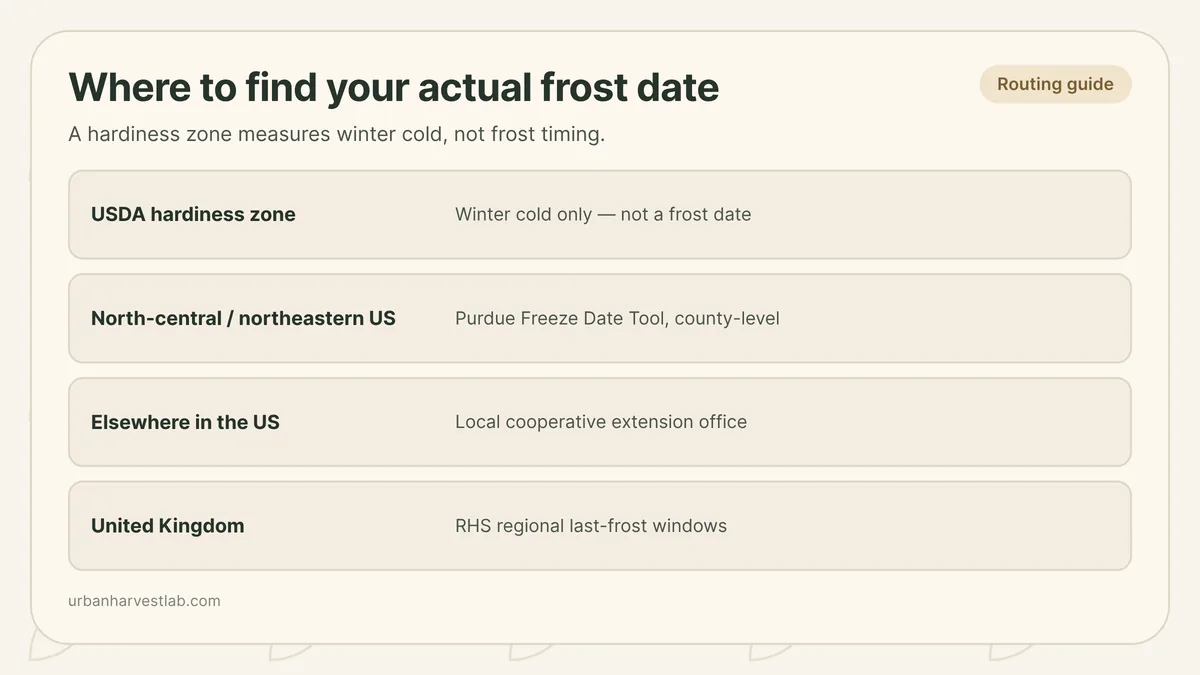
First and last frost dates for a balcony: start with your zone
Your hardiness zone tells you how cold winter gets, not when frost starts or ends. Look up the zone's temperature band, then use the tools built to answer the date question directly.