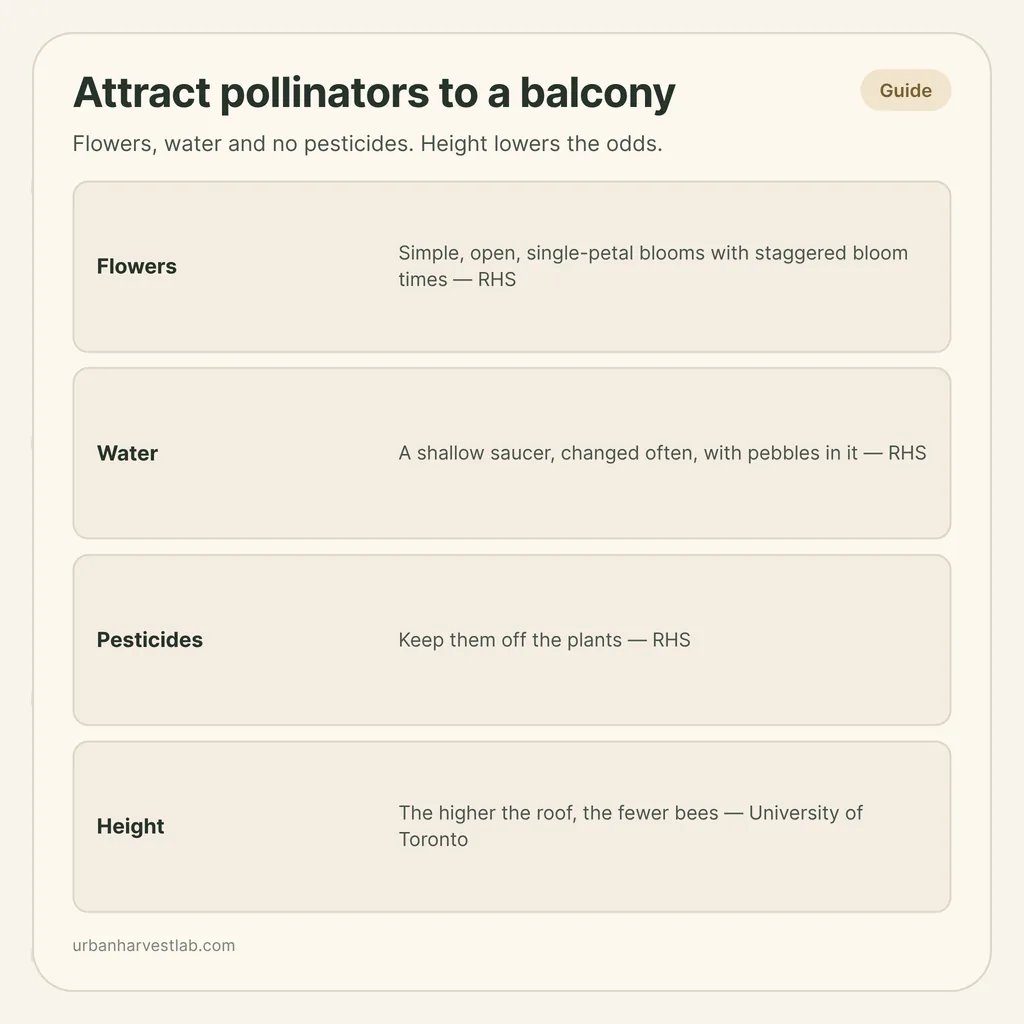
To attract pollinators to a balcony, grow simple, open flowers in several pots with staggered bloom times, set out a shallow saucer of water with pebbles in it, and keep pesticides off the plants. The Royal Horticultural Society (RHS) says that even people with little more than a patio, balcony or a windowbox can help pollinators, and University of Georgia Extension says the same of a small porch or patio. Height is the one thing you cannot design around, so set your expectations for a high balcony below.
If your goal is fruit on a tomato or pepper plant rather than insect visits, the technique is in the guide to hand-pollinating tomatoes and peppers on a balcony. The two work together: flowers that draw insects raise the odds, and a brush covers the days nothing arrives.
What building height changes
The nearest evidence comes from green roofs, not balconies. University of Toronto researchers writing about roof studies report that the higher the roof, the fewer bees were found there, and that green roofs above the eighth storey would not attract bees or benefit from added nesting resources.
Two cautions go with that. The finding is about roofs, not about a flower pot behind a railing. And “fewer” is not “none”. On a fourth-floor balcony you are planting for whoever does arrive, and on a fifteenth-floor one you are running a test. Either way, the steps below cost little.
Wind is the practical side of height, and the guide to a windproof balcony garden covers anchoring and sheltered placement.
Pick flowers by shape and bloom time
Flower shape and bloom time matter more than any single variety.
| What to look for | Who it suits | Source |
|---|---|---|
| Single layer of petals, open centre | Bees and hoverflies reach the pollen and nectar | RHS |
| White and yellow flowers | Flies, including hoverflies | University of Georgia Extension |
| White, yellow and blue flowers | Bees | University of Georgia Extension |
| Flowers a butterfly can land on, in red or purple | Butterflies | University of Georgia Extension |
| Tubular flowers a bumblebee can crawl into, such as beardtongue | Bumblebees | University of Georgia Extension |
The RHS gives a concrete case. Its patio-plant pick of dahlias is the single-flowered Happy Single series, because single forms are much more pollinator-friendly than ball or pompom dahlias, where pollen and nectar are less accessible. For cosmos, the RHS highlights the Apollo series, which grows to about knee height and flowers from June to autumn, so it suits a container.
University of Georgia Extension points to the Great Southeast Pollinator Census for container-friendly plants that tend to attract pollinators: zinnia, dwarf sunflowers, lavender, blazing star, wild bergamot, prairie onions and sweet alyssum. That census is a Southeast US source, so match it against what grows in your own climate before you buy.
Alyssum deserves a note. The RHS says its individual flowers provide only a small nectar supply, but they open in huge numbers and appeal to a variety of pollinators. Georgia Extension adds that its small white flowers attract syrphid flies, which are hoverflies, as well as small bees. It is low and spills over a pot edge, so it fits a railing planter.
Then spread the blooms out. Georgia Extension notes that annuals give pollen and nectar for a limited time and must be replaced, while perennials stay in the pot, and it advises mixing bloom times so nectar and pollen are available through each season. In practice: bulbs and a perennial for the early pots, annuals for summer, something that flowers late for the end. The RHS suggests ornamental alliums tucked into pots when space is tight, and a honeysuckle on a bare wall.
Sun matters too. Georgia Extension suggests plants such as trailing lantana or beebalm for a porch that gets full afternoon sun, and salvia or creeping phlox for a porch with only a short spell of morning sun. A shady balcony changes the list more than any pollinator concern does.
Give them water
The RHS suggests a shallow saucer of frequently changed water with pebbles placed in it. A single dish tucked beside a planter, out of the wind, is enough to start.
Keep pesticides off the plants
The RHS quick tips start with avoiding any pesticides in your outdoor space. Two further points come from the Xerces Society, which publishes a brochure on neonicotinoid insecticides in gardens.
- Check what you buy. The Xerces Society advises asking nursery or garden center staff whether plants were treated with neonicotinoids. These insecticides are systemic: the plant absorbs them and spreads them through its tissues, including pollen and nectar, and the brochure says imidacloprid can remain active in flowers, shrubs or trees for a year or more.
- Look at your own shelf. The Xerces Society brochure tells gardeners to read the label of any garden product to see whether it contains neonicotinoids.
If aphids settle on your plants, the guide to choosing a pest treatment for plants you are going to eat compares the options. Hoverflies are on your side here: the RHS describes them as aphid-predators as well as pollinators, and a hoverfly lagoon made from an old plastic milk carton is one of its small-space suggestions.
Let the food plants do double duty
Herbs and edible flowers already on your balcony count. Georgia Extension lists parsley, dill, fennel and rue as larval host plants for black swallowtail butterflies that grow well in containers. For which flowers are safe to eat, see edible flowers to grow in pots. For what to place beside a tomato or pepper, see companion planting in containers.
Pots dry out faster than ground soil, a point Georgia Extension makes about container gardens in general. A pollinator pot that wilts offers little, so water it on the same rhythm as the rest of the balcony.
What a bare balcony cannot offer
The RHS also lists nest sites among its tips, including a sunny patch of bare soil for ground-nesting solitary bees. A balcony usually has no such patch, so the flowers and water carry the work. Treat the balcony as a place to feed and drink, and expect any nests to be elsewhere.
Sources
- Royal Horticultural Society: RHS Plants for Pollinators
- Royal Horticultural Society: Top 10 patio plants for bees
- Royal Horticultural Society: Plants for encouraging pollinators in small spaces
- Royal Horticultural Society: Plants for hoverflies
- University of Georgia Extension: Creating an Impactful Container Pollinator Garden (Circular 1375)
- University of Toronto News: Bees in the city, designing green roofs for pollinators
- Xerces Society: Protecting Bees from Neonicotinoid Insecticides in Your Garden
Balcony flowers, fruit set and pests
Related guides for a balcony that feeds insects and people.
Common questions
How do I attract pollinators to my balcony?
Grow simple, open flowers in several pots with staggered bloom times, put out a shallow saucer of frequently changed water with pebbles, and keep pesticides off the balcony. These are the three steps the Royal Horticultural Society and University of Georgia Extension both point to for small spaces.
Will bees visit a balcony high up in a building?
Possibly, but fewer. University of Toronto researchers report that the higher a green roof sat, the fewer bees were found there, and that green roofs above the eighth storey would not attract bees, in their summary of roof studies. That finding comes from roofs, not balconies, so a high balcony is a case to test, not rule out.
What flowers attract hoverflies to a balcony?
University of Georgia Extension says flies are attracted to white and yellow flowers and names sweet alyssum as attracting syrphid flies, another name for hoverflies, as well as small bees. The Royal Horticultural Society recommends open flowers that hoverflies can easily visit for pollen and nectar.
Do I still need to hand-pollinate tomatoes if I attract bees?
Often yes on a balcony, because a visit is not guaranteed. Flowers that draw insects help, but tomato and pepper flowers can be pollinated by hand on the days no insect arrives. The separate guide to hand-pollinating tomatoes and peppers covers the technique.
Related guides

Edible flowers to grow in pots: nasturtium, calendula and viola
A few edible flowers do well in containers. The real question is safety: what you can eat, where it was grown, and what to leave on the plant.
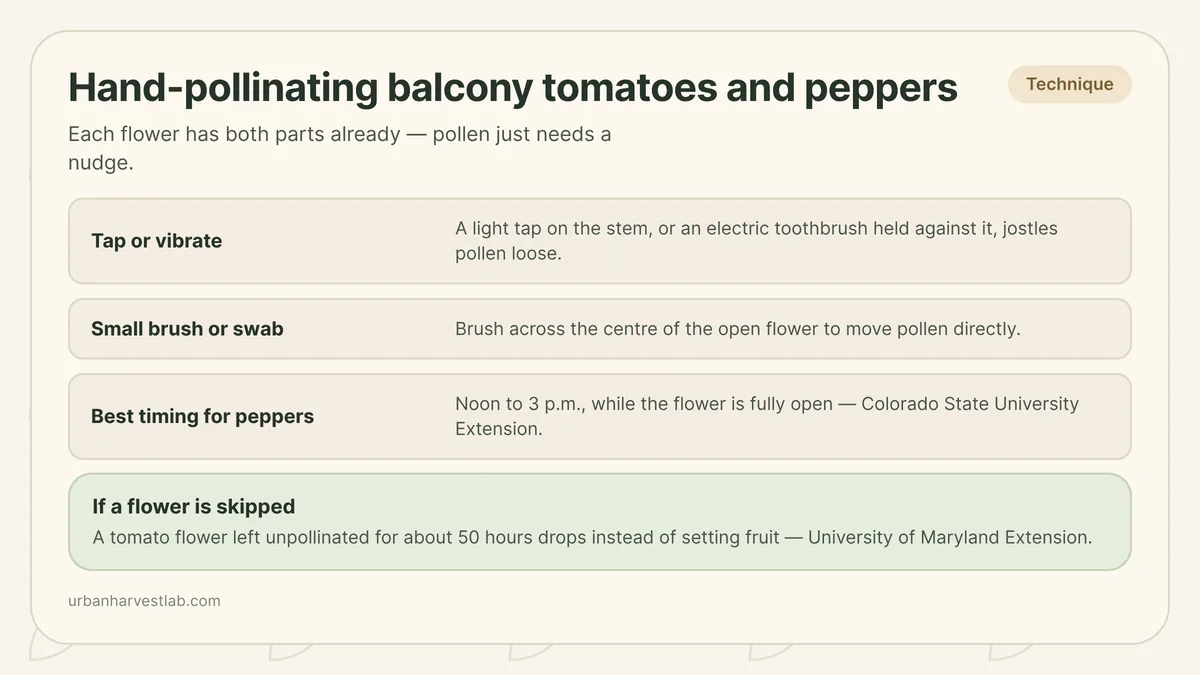
How to hand-pollinate tomatoes and peppers on a balcony
A tomato or pepper flower already carries both male and female parts, but nothing on a balcony reliably moves the pollen between them. This is the tap, brush, or vibrate technique that stands in for a bee.
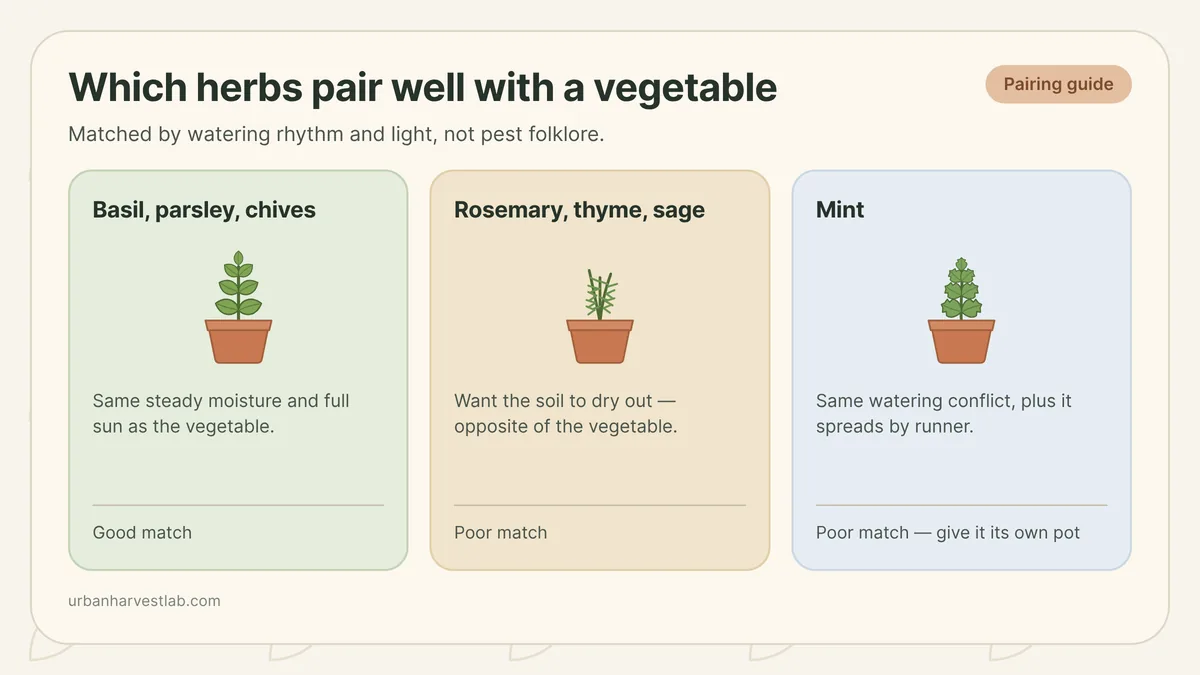
Companion planting in containers: what to grow with a tomato or pepper
A tomato or pepper can share a large pot with certain herbs, but the deciding factors are water, light, and root space, not the pest-repellent pairings companion-planting charts repeat.