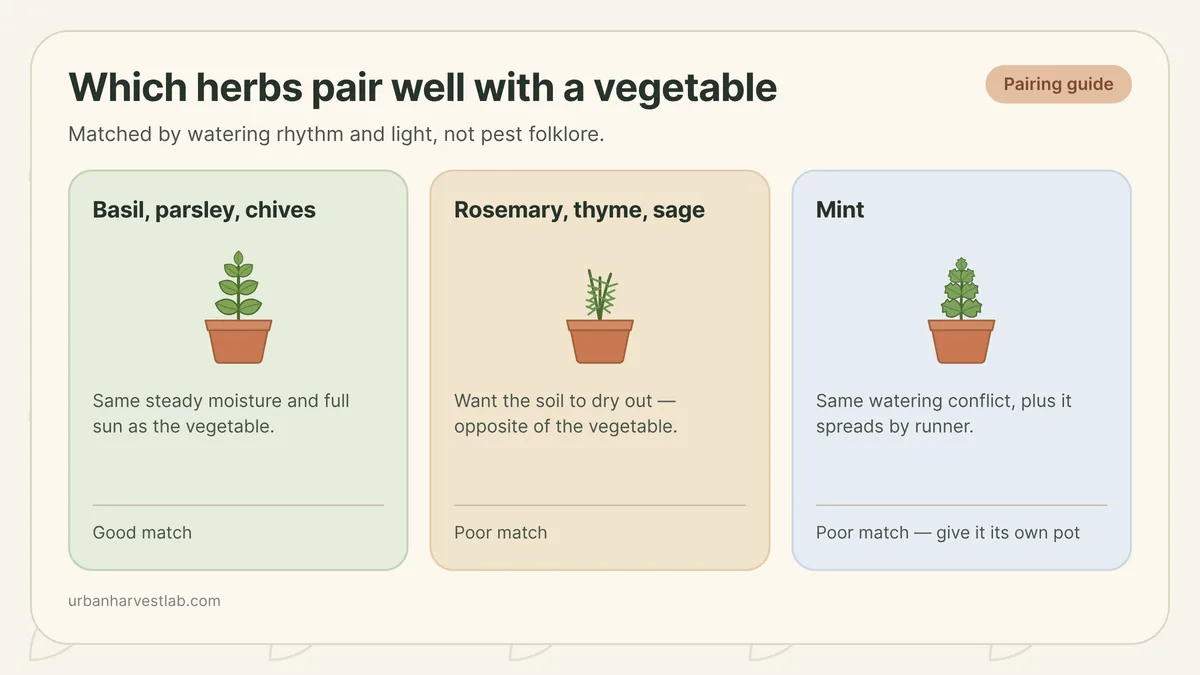
Vegetable and herb pairings for one large container
| Pairing | Watering match | Light match | Verdict |
|---|---|---|---|
| Tomato + basil | Both want steady moisture | Both full sun | Good match |
| Tomato + parsley or chives | Both want steady moisture | Both full sun | Good match |
| Pepper + basil or cilantro | Both want steady moisture | Both full sun | Good match, watch cilantro bolting in heat |
| Tomato or pepper + rosemary/thyme/oregano/sage | Conflicting: vegetable wants moist, herb wants dry | Both full sun | Poor match |
| Tomato or pepper + mint | Conflicting, plus mint spreads by runner | Both full sun | Poor match |
A tomato or pepper can share one large container with an herb when their watering rhythm, light needs, and root space all line up. Basil, parsley, cilantro, and chives usually work because they want the same steady moisture and full sun a fruiting vegetable does. Rosemary, thyme, oregano, and sage usually do not, because they want the soil to dry out between waterings while the vegetable wants the opposite. Size the container for the vegetable first, and the herb’s share takes care of itself.
This is a narrower question than which herbs can you plant together, which covers herb-only pots. Putting a vegetable and an herb in the same large container raises a different problem: the vegetable’s root system is several times the size of the herb’s, so the container has to satisfy the bigger, thirstier plant, and the herb has to fit into what is left over.
What actually decides a good pairing
Three things determine whether a vegetable and an herb can share a pot, and none of them is folklore about one plant “helping” another:
- Watering rhythm. Does the herb want the same moisture level as the vegetable, or does it want to dry out between waterings?
- Light. Do both plants need the same hours of direct sun, or will one shade the other as it grows?
- Root space. Does the container hold enough volume for the vegetable’s full mature root system, with room left over for the herb?
Get those three right and the pairing works. Get one wrong, and one plant is chronically over- or under-served no matter how the rest of the pot is managed.
Mature size matters too, and not just below the soil line. A tomato plant’s canopy fills in fast once flowering starts, and a low-growing herb planted directly under it can end up shaded for most of the day even if the container originally sat in full sun. Placement inside the pot, not just the pot’s total volume, decides whether the herb actually gets the light the label promises.
Size the container for the vegetable, not the herb
Extension figures for tomato container volume vary widely by growth habit and by source, and the full range is covered in what size pot for tomatoes. The number that matters for a shared container is the floor: most sources put a determinate tomato at a minimum of 5 gallons, with Texas A&M AgriLife Extension noting a 15-gallon container produces a more productive plant with less watering than a 5-gallon one for the same plant. Bell and chilli peppers vary more by source: Texas A&M AgriLife Extension and North Carolina A&T both give peppers 5 gallons — the same figure as a determinate tomato — while UGA Fulton County goes as low as 2 to 3 gallons and Illinois Extension’s 16-inch minimum works out to roughly 10. Pepper pot size covers that full breakdown.
An annual culinary herb needs far less than either. UGA Fulton County Extension’s own figure for annual herbs, including basil, dill, and cilantro, is about 1 gallon per plant. That gap is the whole reason a shared container works: add UGA Fulton County’s 5 gallons for a determinate tomato (10 for indeterminate) to its 1 gallon for an annual herb, and a 6- to 11-gallon shared pot has enough spare volume to hold the herb’s root system without competing for the tomato’s own share. Parsley is the exception in that annual-herb group: Texas A&M’s own table lists 1 gallon for three parsley plants, but University of Maryland Extension puts parsley in its 5-gallon-or-larger bucket instead, so a parsley pairing is safer sized toward the deeper end of the shared pot. Container depth for tomatoes, peppers, and herbs covers the depth side of the same logic in more detail.
The arithmetic changes with a drought-tolerant perennial herb. UGA’s own figure for that group, rosemary, sage, and mint among them, is closer to 5 gallons per plant, not 1. Adding one of those to a tomato pot is not adding a small extra plant; it is asking the container to satisfy two plants that each want a materially different amount of root space and, as covered next, opposite watering routines.
Herbs that usually work in a vegetable pot
Basil is the most common pairing with tomatoes, and for good reason: both want full sun and soil that stays evenly moist rather than drying out hard between waterings. Basil itself wants at least six to eight hours of direct sun a day, per Penn State Extension, which lines up with the full-sun exposure a fruiting tomato or pepper needs anyway. Parsley is a similar match on watering and light, though it wants more root room than basil, dill, or cilantro do. Chives are a perennial with no cited container-size figure here, so treat a chives pairing as a watering-and-light match rather than one backed by a volume number. Cilantro works too, with one caveat: it bolts in heat faster than a tomato slows down, so treat it as a herb you replace partway through the season rather than one that lasts as long as the vegetable.
None of these plants need their own separate feeding or watering schedule when planted with a tomato or pepper. Water when the top inch or two of the mix is dry, the same finger-depth check that applies to any large container, per Iowa State University Extension, and both plants get what they need from one routine.
Herbs that usually do not
Rosemary, thyme, oregano, and sage are the group to keep out of a vegetable pot. These herbs want to dry out between waterings, which is the opposite of what a tomato or pepper needs to keep fruiting well. Put them in the same container as a vegetable and one of the two is watered wrong on any given day. Keep them in their own pots instead, sized separately, as the herb pot size guide lays out by herb.
Mint deserves its own warning beyond watering. It spreads by underground runners and will crowd a shared root zone, vegetable or herb neighbor alike. Give it a pot of its own rather than folding it into any mixed container.
If the question is basil specifically, can you plant basil with other herbs covers the herb-only side of that pairing: which other herbs basil tolerates in its own pot, separate from the vegetable pairing above.
Why the pest-repellent pairings are not the deciding factor
Companion planting is often framed as a set of pairings that repel pests or improve flavor, basil next to tomatoes to deter hornworms, marigolds to keep nematodes down. None of the extension sources behind the container volume, watering, and light data above test that kind of claim; they measure root volume and soil moisture directly, not pest behavior around a companion plant. Choose a pairing on water, light, and root space instead. A tomato and a basil plant that share a watering rhythm will do well together whether or not the basil changes anything about a hornworm’s behavior.
Before you plant a shared container
Start with a pot sized for the vegetable, not the herb, since the vegetable’s root system is the one that cannot be shortchanged. If you are still deciding what to grow at all, a beginner’s apartment vegetable garden plan walks through the light-first planning that a mixed container depends on. Place the herb toward the edge of the pot rather than crowding it against the vegetable’s main stem, so both get their share of light as the vegetable’s canopy fills in. Water by checking the top inch or two of the mix rather than on a fixed schedule, and if one plant wilts while the other stays fine, that is the pairing telling you it was a mismatch, not a signal to add fertilizer.
Give the herb a defined section of the pot rather than tucking it in wherever there is a gap, and revisit that placement once the vegetable is fruiting and its canopy has filled out. Illinois Extension’s own figure runs even more generous than the floor used above — 17 to 20 gallons for a full-size tomato — so a shared container built around that larger end of the range has correspondingly more room to spare for the herb.
Sources
Before you plant a mixed container
These guides cover the pot sizing, watering, and herb-only pairings that decide whether a vegetable and herb combination actually works.
Common questions
Can you plant tomatoes and basil in the same container?
Yes. Both want full sun and steady moisture, and basil's modest root need (about 1 gallon, per UGA Extension) fits easily inside a tomato container sized at 5 gallons or more, which is the minimum most extension sources give for a determinate tomato plant.
Does basil actually repel pests when planted near tomatoes?
No extension source tests it, so treat it as unproven. Plant basil next to tomatoes because the two share a watering rhythm and a sunny spot, not to prevent a named pest.
Can you plant peppers with rosemary or thyme in one pot?
It is a poor match. Peppers want soil that stays evenly moist, while rosemary and thyme are drought-tolerant herbs that want to dry out between waterings. Keeping them in separate containers avoids forcing one plant into the wrong watering routine.
How big does a container need to be for a vegetable and an herb together?
Size it for the vegetable, then add the herb's modest share on top. A determinate tomato needs at least 5 gallons on its own (10 for an indeterminate one), plus about 1 gallon for an annual herb like basil, dill, or cilantro — a 6 to 11 gallon container, depending on the tomato type, leaves enough room without shorting either plant.
Related guides
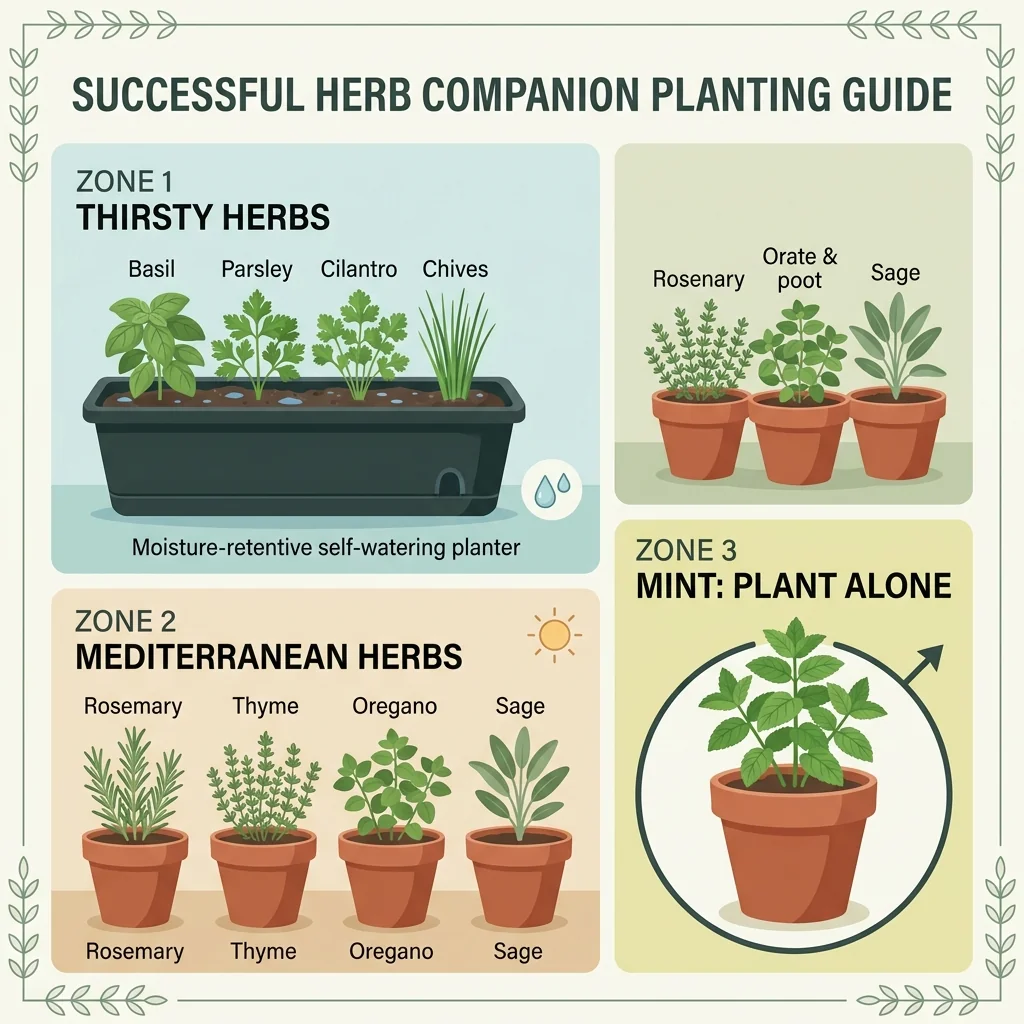
Which herbs can you plant together in one pot?
The simple rule for planting herbs together is to match their water and light needs. This chart shows which herbs share a pot happily and which ones to keep apart.
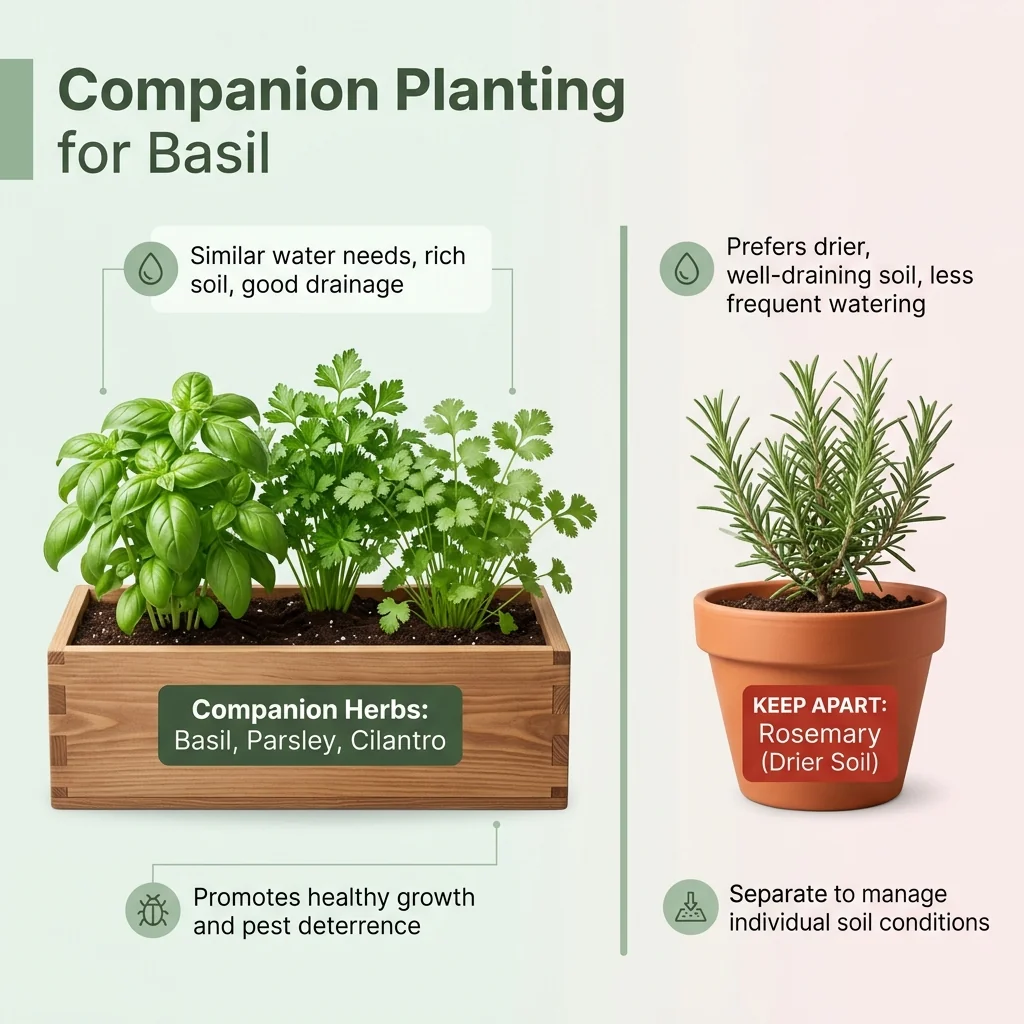
Can basil share a pot? Yes, with parsley, cilantro or chives
Basil grows happily with other thirsty herbs like parsley, cilantro, and dill, but clashes with drought-tolerant herbs. Here is what to plant with basil and what to skip.
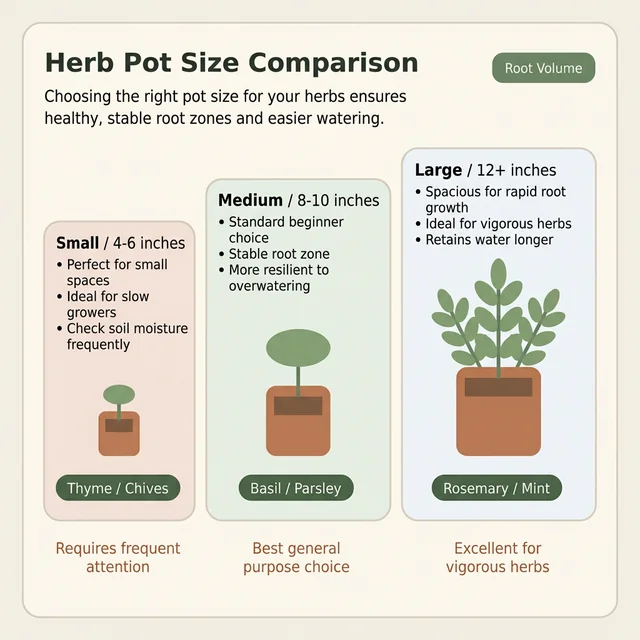
Container depth for tomatoes, peppers, and herbs: how much root space matters
Container size is one of the highest-leverage decisions in small-space gardening. When root volume is too small, every other care task becomes harder.