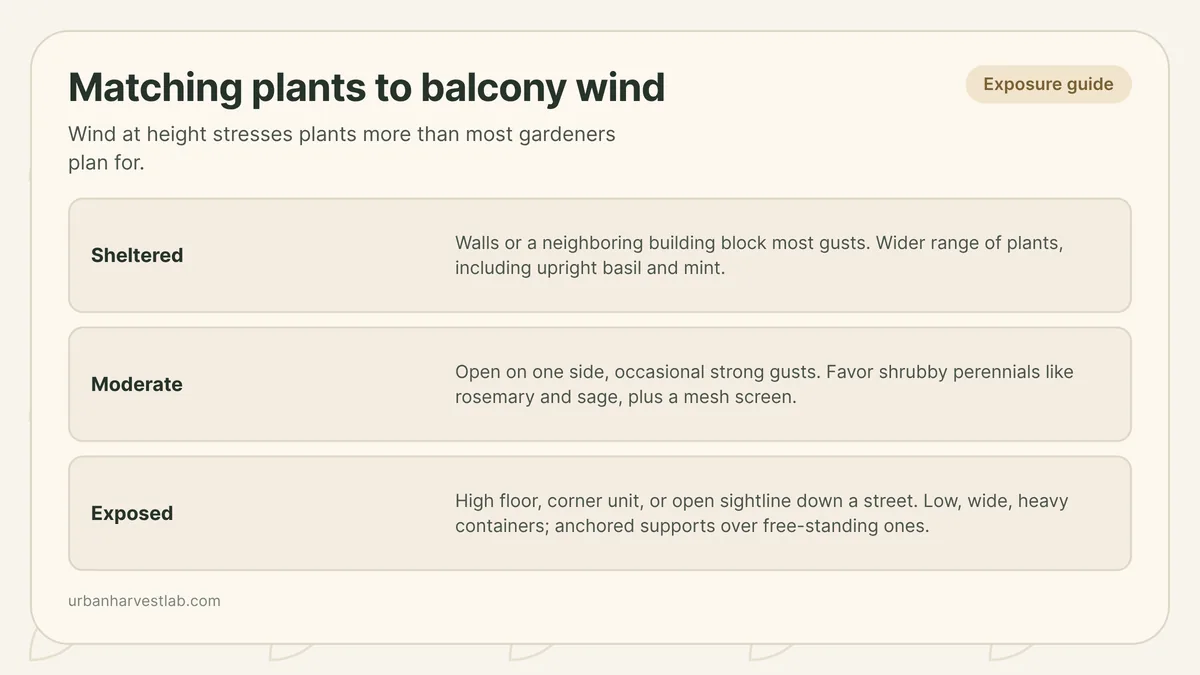
Matching balcony wind exposure to plant and container choices
| Exposure level | What it looks like | What tends to work |
|---|---|---|
| Sheltered | Walls or a neighboring building block most gusts | Wider range of plants, including upright growers like basil and mint |
| Moderate | Open on one side, occasional strong gusts | Favor shrubby perennials such as rosemary and sage; add a mesh or lattice screen |
| Exposed | High floor, corner unit, or open sightline down a street or courtyard | Low, wide, heavy containers; woody stems over soft ones; anchored supports rather than free-standing ones |
A balcony garden holds up to wind when the containers are wide and heavy rather than tall and light, the plants in the most exposed spots have a low or woody growth habit instead of soft upright stems, and anything that could blow over or snap is physically secured rather than left to the railing. None of that is one trick. It is three ordinary decisions — container, plant, and anchor — made with wind in mind instead of made by accident. For the full picture of setting up a balcony growing space, small-space herb gardening: start here covers the parts of the system wind does not touch; wind is the constraint that is easy to skip until a gust has already knocked something over.
Why balcony wind behaves differently than yard wind
A balcony a few floors up sits in faster, more turbulent air than a garden bed at ground level, and corners, gaps between buildings, and open sightlines down a street or courtyard concentrate that movement further. The effect shows up before anything actually tips over. Iowa State University Extension’s container-care guidance names wind directly as a factor that changes how often a pot needs water, putting frequency anywhere from “once or twice a day (small container, hot, windy weather) to once or twice a week (large container, cool weather).” Wind dries a container out the same way it dries laundry on a line — by moving air across a wet surface faster than still air would — so an exposed balcony pot can need checking well before the same plant in a sheltered spot does.
Read your balcony’s exposure before you plant
Walk the space on a breezy day and notice where the air actually moves, rather than assuming the whole balcony behaves the same way. A corner formed by two walls is usually calmer than an open railing edge. Stems that stay bent after a gust passes, soil that dries within hours of watering on an otherwise mild day, and a pot that rocks when nudged are all signs that a spot is more exposed than it looks, and each one is a reason to add weight, shelter, or anchoring before the next storm rather than after it. Note which containers show these signs and which do not; a balcony rarely behaves as one uniform wind zone from end to end.
Choose plants for the growth habit, not just the species
UGA Extension’s herb cultivation table codes each plant’s mature size and habit alongside its spacing: basil reaches “1–3 ft Upright” with 1–2 ft between plants, mint reaches “2–3 ft Upright,” and lavender tops out at “18–36 in. Upright, shrubby.” An upright habit puts most of the plant’s mass well above a comparatively narrow base — the shape that catches the most wind and needs the most help staying vertical. Lavender’s “shrubby” qualifier is the useful contrast: a branching, woody framework flexes under a gust and springs back, where a single soft basil stem just bends over and stays bent, or snaps at the base.
Clemson HGIC’s own life-cycle table sorts rosemary and sage into a “perennial evergreen shrub” category, distinct from herbaceous perennials like mint, oregano, and thyme. That woodier structure is the practical reason rosemary and sage tend to ride out gusts that flatten a younger basil plant — not a tested wind-resistance rating from either source, just what a lignified stem does compared with a soft, green one.
Anything taller and fruit-bearing deserves its own plan rather than a spot on the general list. A container tomato is the balcony’s classic wind casualty, because ripening fruit adds weight at the top of an already upright plant, right where it has the least support. Growing dwarf tomatoes in pots on a small balcony covers the container size and staking that keeps a fruiting plant from going over in the first place.
Weight and container shape do more than any single plant choice
A wide, low container resists tipping in a way a tall, narrow one cannot, regardless of what is planted in it, because the base has to lift further off the ground before the pot goes over. Weight held low in the pot works the same way a wide base does, and container material is the lever that actually controls it: a heavy terracotta, concrete, or glazed stoneware pot holds far more of its weight low down than the same size in thin plastic. University of Illinois Extension makes the same point from the other direction: plastic, resin, and fiberglass containers are lighter than glazed ceramic of the same size, and that lighter weight is exactly what makes them more prone to tipping once a plant grows tall and top-heavy in an exposed, windy spot outdoors. Fabric pots vs. plastic and glazed vs. terracotta pots both cover that material tradeoff in full, for a balcony where wind is only one of several things the container choice has to answer for.
How much weight a balcony structure can actually bear is a separate question with its own math, and it matters just as much as wind does — a container heavy enough to resist tipping still has to sit within what the floor can carry. How much weight a balcony can hold covers that side of the equation.
Anchor what you cannot make heavier
Not everything can be weighted into place — a trellis, a tall stake, or a climbing vine needs to be tied to something solid rather than just standing on its own. Tucking a container into a corner formed by two walls or a solid railing section gives it a wind shadow for free. Straps, clamps, and brackets that clip onto a railing’s uprights hold a pot or a support in place without penetrating the railing itself, which matters most in a rental where drilling is not an option. Grouping several pots close together also helps: a cluster buffers itself in a way that the same pots spread individually along a railing do not.
The specific hardware and step-by-step setup for anchoring a trellis or a climbing plant without drilling into a rented railing is its own subject. Building a trellis without drilling covers that method in full.
Build a windbreak instead of fighting open air
A solid barrier is not automatically the best fix for an exposed edge. A mesh screen, a lattice panel, or a dense row of shrubby herbs breaks the force of the wind while still letting some air move through, rather than creating a wall for gusts to slam into or eddy around. Position the sturdiest, most wind-tolerant plants — the shrubby perennials from the section above — on the exposed side, and keep taller, softer-stemmed growers like basil and mint tucked behind them where the worst of the gust has already been absorbed.
None of Iowa State’s, Clemson’s, UGA’s, or RHS’s container and herb guidance surveyed here publishes a wind-speed number at which a balcony crosses from breezy to unsafe for containers. Use the visible signs instead: stems that stay bent after a gust, soil dry within hours of watering, a pot that rocks when nudged.
Sources
Wind is only one balcony constraint
These guides cover the load, anchoring, and plant choices that go with wind protection on a balcony.
Common questions
What is the best way to protect balcony plants from wind?
Use wide, heavy containers with weight low in the pot, favor shrubby or low-growing perennials over tall soft-stemmed annuals in the most exposed spots, and add a mesh screen or lattice panel that breaks the wind's force rather than trying to block it outright.
Do heavier pots really help with wind?
Yes. A wide base and weight held low keep a container upright against gusts that would tip a tall, narrow, lightweight one. A dense pot material — terracotta, concrete, or glazed stoneware — is where most of that extra weight comes from, more than the growing mix inside it.
Which balcony plants handle wind best?
Woody perennial shrubs such as rosemary and sage, which Clemson Extension classifies as evergreen shrubs rather than soft-stemmed herbaceous plants, tend to flex and recover rather than snap. Tall upright growers like basil and mint, and any fruiting plant such as a container tomato, need more support in an exposed spot.
Can I anchor balcony plants without drilling into the railing?
Yes. Straps, clamps, and brackets that clip onto railing bars avoid drilling into a rented railing. A full anchoring method for trellises and climbing plants is covered in the site's guide to trellising a plant without drilling a single hole.
Related guides
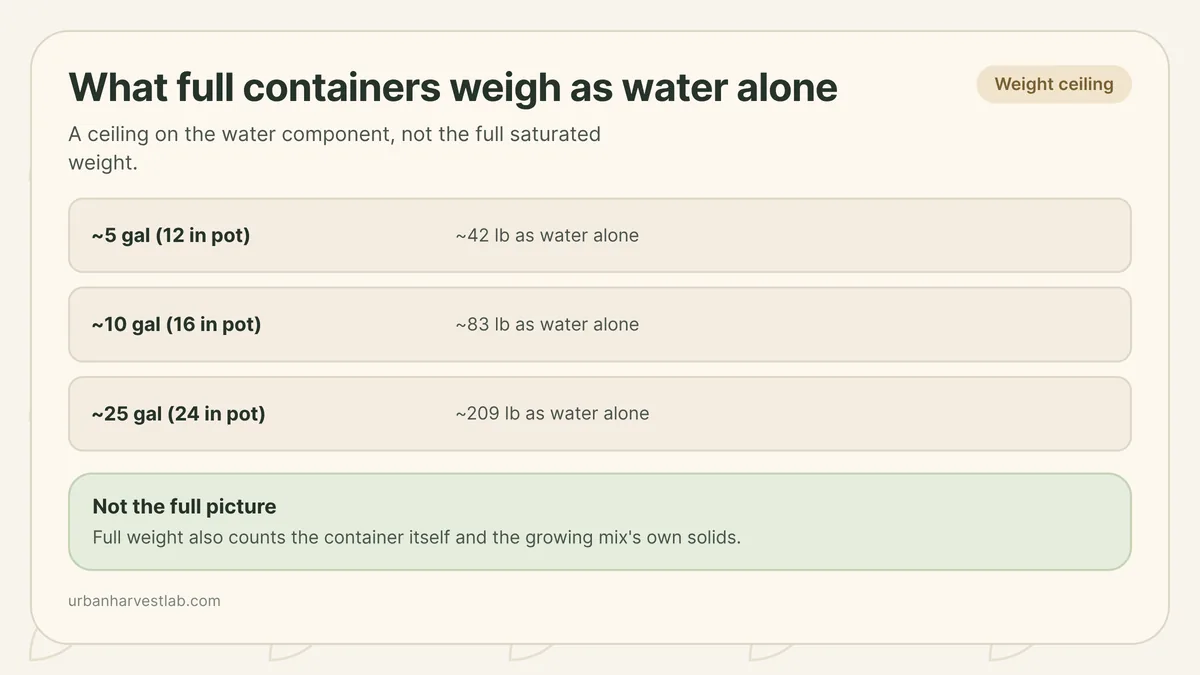
Balcony weight limit: calculate what your container garden really weighs
A balcony's real weight allowance comes from its own structural documentation, not a one-size figure online. What you can calculate yourself is exactly how much your containers weigh once every one of them is soaked through.
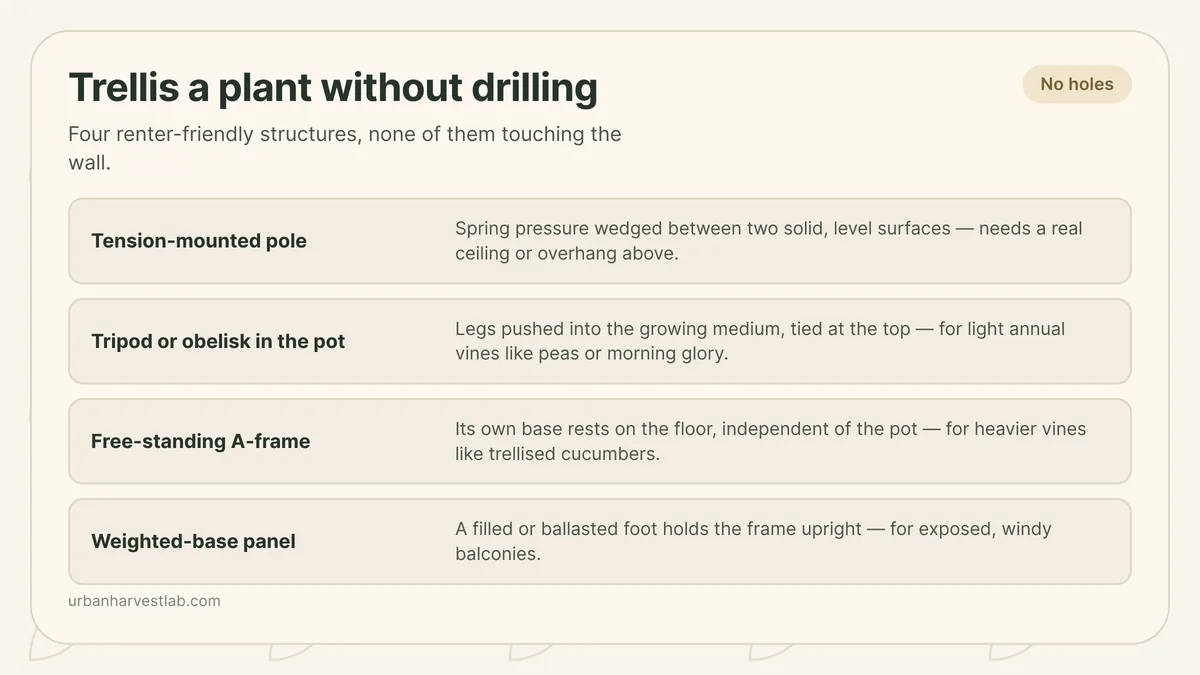
How to trellis a plant without drilling a single hole
A container has no ground to sink a post into, so a renter-friendly trellis has to get its stability from somewhere else. Four approaches do that without touching a wall, railing, or ceiling.
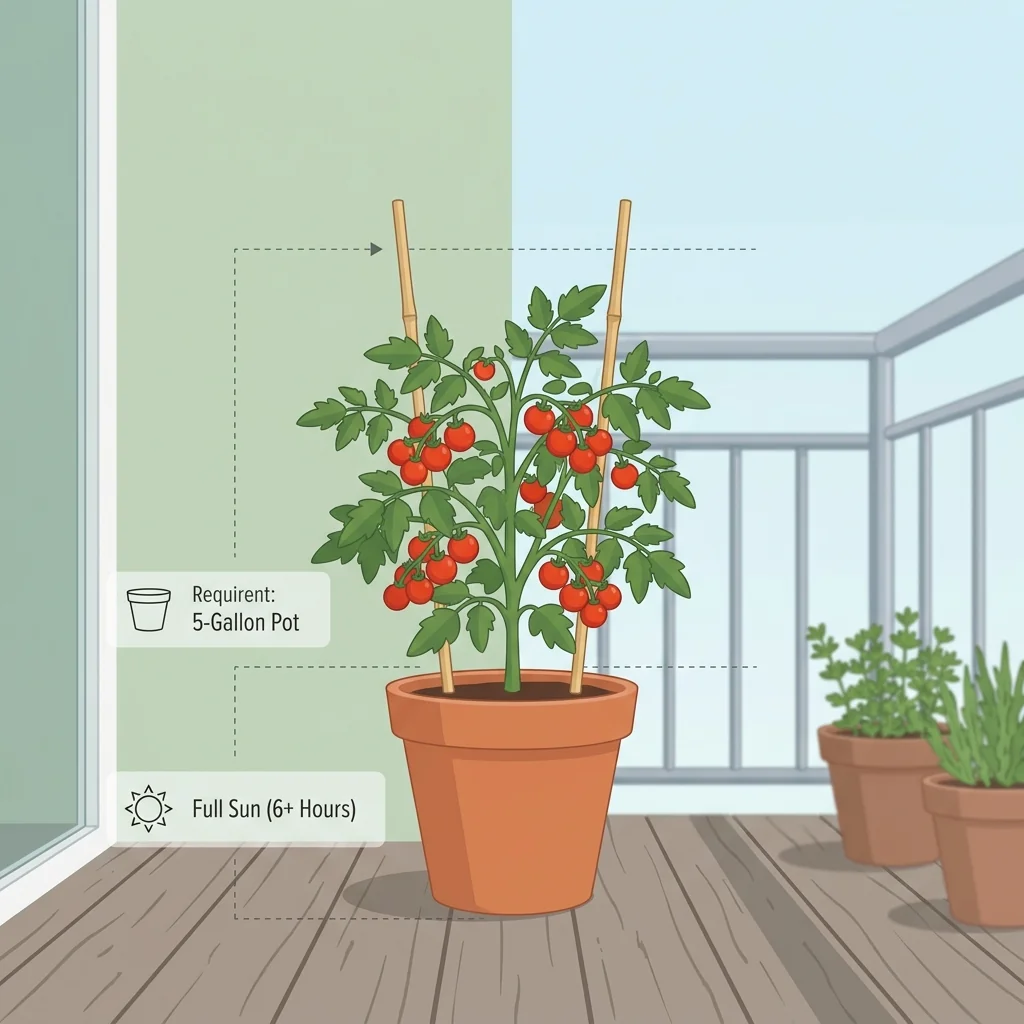
How to grow dwarf tomatoes in pots on a small balcony
Traditional tomato plants grow into massive, untameable 8-foot jungle vines that require giant cages and take over your entire balcony. But with modern 'micro-dwarf' or patio tomato varieties, you can grow heavy yields of sweet cherry tomatoes on a plant that stays under 2 feet tall. Here is the dwarf tomato container blueprint.