Pit in water or pit in soil
| In water on toothpicks | Straight in potting mix | |
|---|---|---|
| What you get | You can see the root and shoot appear | Fewer steps, no transplant shock from jar to pot |
| Care | Change the water at least every couple of weeks (CRFG) | Keep the mix damp, not soaked |
| Main drawback | Roots need oxygen, so seedlings grow better in soil (CRFG) | You cannot see what the pit is doing |
| Moving on | Pot up once it has several leaves and lots of fibrous roots (RHS) | Nothing to move until it outgrows the pot |
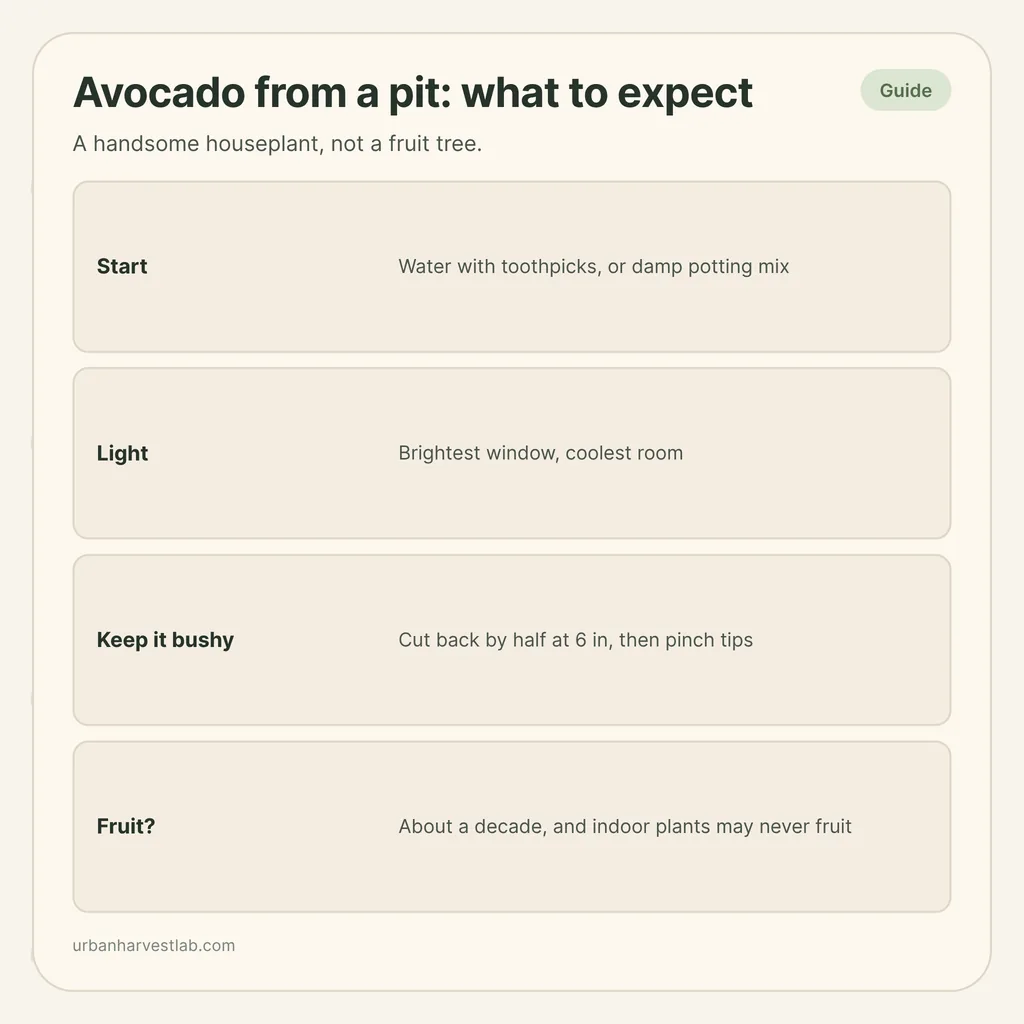
An avocado pit will sprout in a glass of water or in a pot of soil, and you get a handsome glossy-leaved plant either way. Fruit is the part to keep your expectations low on. The RHS says trees can take ten years or more to reach fruiting size, and the California Rare Fruit Growers (CRFG) put seed to fruit at about a decade even under good growing conditions, adding that indoor plants may not get good enough conditions to flower at all.
That makes this a houseplant project with a small lottery ticket attached. If what you want is a fruiting tree in a pot, a grafted citrus is a more realistic route. If you want something to watch grow on a windowsill, read on.
Start the pit: water or soil
Keep the pit whole. Set it with the base, the wider end, down, whichever method you use (CRFG).
For the water method, push three toothpicks into the side of the pit so it perches halfway immersed on the rim of a glass. The RHS uses four cocktail sticks, about halfway up, with the rounded end just in the water. Keep it at 20-25 C (68-77 F). The pit splits, then a root and a shoot appear, which the RHS says can take eight weeks or more.
Change the water at least every couple of weeks, before it turns dirty and short of oxygen (CRFG).
For soil, plant the pit in damp, free-draining seed or potting mix. The CRFG add one speed-up: remove the papery seed coat and slice a thin layer off the top and bottom of the pit before planting.
Water is more fun to watch. The CRFG point out that avocado roots, like most, need oxygen, so seedlings actually grow better in soil than in water. If you start in water, move the seedling to a pot once it has several leaves and lots of fibrous roots (RHS).
Potting up and light
Use a pot with holes in the bottom. UF/IFAS Extension says too much water applied too often results in root rot in avocado trees. If you are choosing between pots, the drainage hole guide explains why a hole matters more than the pot’s looks.
The RHS suggests a soil-based, free-draining mix, and a pot only slightly larger than the last one when roots show at the drainage holes. Oversizing the pot is the mistake to avoid. Water when the mix needs it rather than on a calendar. The RHS notes leaves may curl if the plant is overwatered and go brown and drop if underwatered, so curling or browning alone does not tell you which one it is.
Light is the thing most indoor avocados lack. The CRFG say a lack of light makes stems stretch, and put the plant in your brightest window, in the coolest room, because warmth exaggerates the stretching. If a window is not enough, a grow light for fruiting plants indoors covers the setup.
Keep it bushy
An unpinched avocado grows into one tall, bare stick. Cut it back early and keep pinching:
- Cut the main stem back by half once it is 15 cm (6 in) tall, just above a leaf, then pinch out the shoot tips regularly (RHS); each pinch wakes dormant buds lower on the stem (CRFG).
Expect some leaf drop regardless. The CRFG say avocados shed many buds along their stems and older leaves, and nothing can be done about the leaf shedding.
Where it lives through the year
The RHS says you can move a plant outdoors for summer to a warm, sheltered spot in dappled shade, then bring it in before temperatures drop. Keep it at 13-18 C (55-65 F) over winter and feed in spring and summer. For the moving routine, see bringing potted plants indoors for winter.
Will it ever fruit?
Plan for no. Three separate reasons stack up:
- Time. The CRFG: about a decade under good conditions, and indoors a plant may never flower. The RHS says trees can take ten years or more to reach fruiting size and may need to be several metres tall.
- Conditions. The RHS says plants need more humidity and light than most homes offer, and will not usually flower or fruit as houseplants.
- Genetics. UF/IFAS Extension: most avocado varieties do not come true from seed, so a seedling will not give you the variety you ate. The CRFG add that seedling trees rarely produce fruit as tasty as commercial trees, which are grafted to good-tasting cultivars.
Grafting changes the odds. UF/IFAS says grafted trees begin to produce after 3 to 4 years, in Florida’s outdoor conditions, and the RHS says grafted plants may be more likely to fruit. UF/IFAS also notes that if no other avocado is nearby you may want an A-type and a B-type tree for good pollination.
The RHS adds that avocados usually do well as houseplants for a few years, then decline and turn spindly with yellowing leaves. Replacing it with a new pit is the usual answer. Yellowing leaves before then most often point to water, so check overwatered vs underwatered first.
Pets
The ASPCA lists the avocado plant (Persea americana) as toxic to horses, with persin as the toxic principle. The Merck Veterinary Manual, written by a veterinarian at the ASPCA Animal Poison Control Center, says fruit, leaves, stems and seeds have all been linked to toxicosis in animals and that leaves are the most toxic part. Caged birds seem more susceptible. Dogs seem relatively resistant, but a dog swallowing an intact pit can develop an obstruction of the gut.
Neither source gives a cat verdict for the houseplant, so the cautious move is to keep the plant and pit where pets that chew plants and birds cannot reach them. If a pet eats some, call your vet or the ASPCA Poison Control at (888) 426-4435.
Sources
- California Rare Fruit Growers (Lee Reich, 1997), Growing avocados from seed, reprint
- Royal Horticultural Society, How to grow avocados
- UF/IFAS Extension, Avocados Growing in the Florida Home Landscape (MG213)
- ASPCA, Toxic and non-toxic plants: Avocado
- Merck Veterinary Manual, Avocado (Persea spp) toxicosis in animals
Other indoor fruit and winter care
A fruit tree you can buy grafted, how to bring pots inside, and the drainage a tall pot needs.
Common questions
How do you grow an avocado from a pit?
Keep the pit whole, wide end down. Either push three or four toothpicks in about halfway so it sits in a glass with the base in water, or plant it in potting mix. The RHS says to keep it at 20-25 C (68-77 F) and expect a split, then a root and shoot, in eight weeks or more. Pot it up once it has leaves and plenty of roots.
Will an avocado grown from a pit ever give fruit?
Possibly, but not soon and not reliably. The California Rare Fruit Growers say seed to fruit takes about a decade under good growing conditions, and indoors plants may fail to flower. The RHS says avocados will not usually flower or fruit as houseplants. UF/IFAS adds that most varieties do not come true from seed, so the fruit would differ from the one you ate.
Is it better to sprout an avocado pit in water or soil?
Both work. Water lets you watch the roots, but the California Rare Fruit Growers note that avocado roots need oxygen and seedlings grow better in soil. If you start in water, change it at least every couple of weeks and move the seedling to a pot once it has leaves and fibrous roots.
Are avocado plants safe around pets?
The ASPCA lists the avocado plant as toxic to horses and names persin as the toxic principle. The Merck Veterinary Manual says leaves are the most toxic part, caged birds seem more susceptible, and dogs seem relatively resistant, though a swallowed whole pit can block a dog's gut. Keep the plant and pit out of reach of birds and chewing pets, and call your vet if one eats some.
Related guides

Bringing potted plants indoors for winter: what to move and what to leave
Not every pot deserves a spot on the windowsill. Here is how to decide what comes in, clear the pests, and get the plants through the light drop.

How to grow a lemon tree indoors: light, water, pollination and winter
A potted dwarf lemon can fruit on a windowsill, but only with strong light, careful watering and a paintbrush. Here is what each stage needs, winter included.
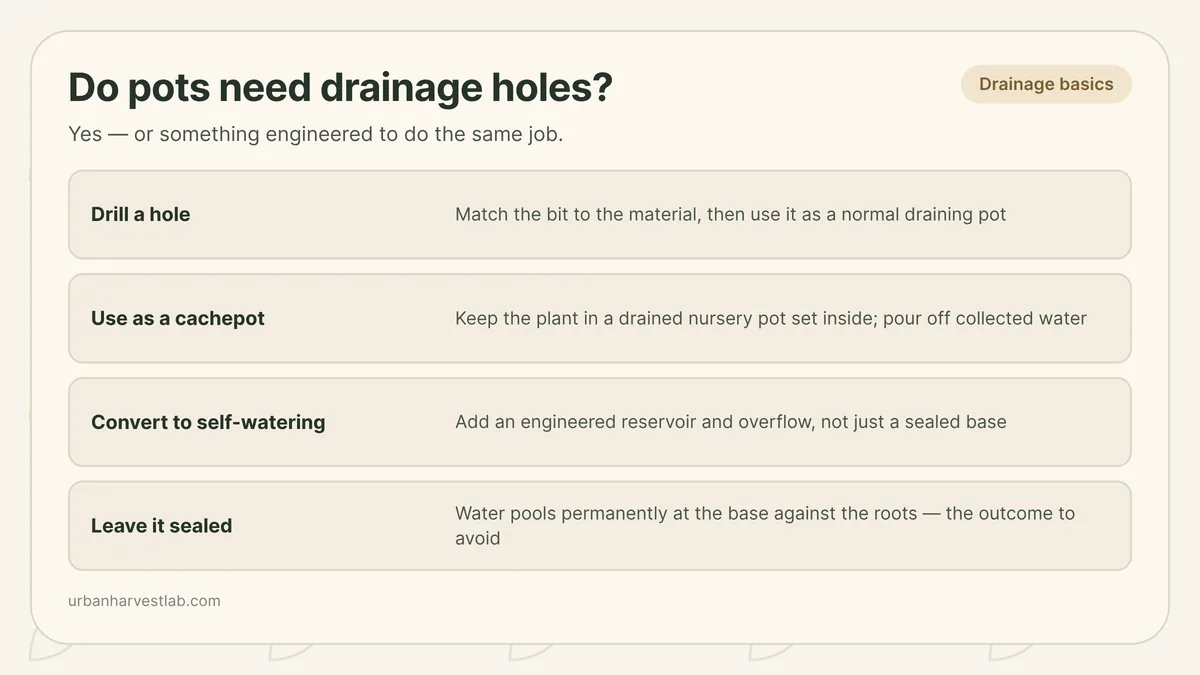
Do pots need drainage holes, and how to add one safely
A pot with no drainage hole is not a design quirk you can water around. Here is why that matters, how to drill one safely by material, and how to use a hole-less pot the right way instead.