
What to do with each kind of pot
| Kind of plant | Decision | Why |
|---|---|---|
| Tropical houseplants spending summer outside | Bring in before nights fall below 55 °F | Illinois Extension; Nebraska Extension notes damage at 40s to low 50s |
| Tender perennial herbs (rosemary) | Bring in, usually kept cool and dormant (Illinois Extension: 40-60 °F) | NC State lists rosemary as a tender perennial to bring indoors or mulch heavily |
| Pepper plants | Optional, for one plant you want to keep | Cut back and held dormant, not grown on |
| Basil and other annual herbs | Take cuttings, or pot the whole plant | NC State: annual herbs are killed by the first hard frost |
| Hardy perennial herbs (chives, mint, thyme) | Usually leave outside | NC State: many perennial herbs are winter hardy and can stay in the garden |
| Any plant with a heavy infestation | Discard | Illinois, Nebraska and K-State all say disposal can be the better option |
Illinois Extension says to move tender pots inside once nights are consistently below 55 °F. Check them for pests first, keep them apart from your other plants for 3-4 weeks (Illinois again), and put them in your brightest window. Not every pot earns the space. Hardy perennials can stay out, annual herbs are often better carried over as cuttings, and a badly infested plant is better in the bin than in your living room.
This is the decision and the routine for a whole balcony. For one plant’s details, see overwintering peppers and overwintering rosemary and thyme. If you are building a winter windowsill from scratch, the small-space herb gardening guide shows where this fits.
When to bring them in
Frost is the wrong trigger for tropical plants. Illinois Extension says to start moving houseplants back indoors when the thermometer starts to get below 55 °F consistently. Nebraska Extension goes further: some of these plants may be damaged by temperatures in the 40s or even the low 50s, so a balcony that has not seen frost can still be too cold.
Frost-sensitive herbs follow a different clock. NC State Extension says annual herbs are killed by the first hard frost, so basil and its relatives have to be in before it arrives. Your own date depends on where you live; the frost-date guide for balconies shows how to find it.
Start early. K-State Extension points out that the weather can swing from one week to the next, and that starting the transition and the pest control early beats a rush on the night a cold snap is forecast.
Decide what comes in
Tender perennial herbs are the clearest yes. NC State Extension lists rosemary as a tender perennial to bring indoors or mulch heavily, and says plants in this group may drop leaves unless they receive adequate light indoors. NC State Extension also notes that lemon verbena is deciduous, which means it will lose all its leaves indoors; that is normal, not a failure.
Basil is where people waste effort. NC State Extension classes it as a tender annual and says you can either take cuttings to root or pot the entire plant. Cuttings take a fraction of the space, and how to regrow herbs from cuttings covers the method. Whole plants need bright light: Iowa State Extension says herbs ideally get four to six hours of direct sun a day indoors.
Hardy perennial herbs can often stay put. NC State Extension says many perennial herbs are winter hardy and can be left in the garden, and its table lists chives, mint and thyme as normally hardy in the state’s regions. That table describes plants in the ground, and a pot is more exposed than a bed, so the extra risk is covered in the rosemary and thyme guide above. If you do want chives or mint on the windowsill, Iowa State Extension says parsley, mint and chives tolerate a little less light than rosemary, thyme and bay.
Plants that are not worth it include any with a severe infestation. Illinois Extension says it may be best to dispose of infested plants and buy new ones, Nebraska Extension says you might choose to discard severely infested plants and replace them, and K-State Extension says to discard any with a severe insect or disease problem so it cannot spread to the rest. A pot you cannot give a bright window to is a poor candidate as well, since light is what separates a plant that adjusts from one that sheds. Peppers sit in between: carrying one over is a project for a plant you want to keep, not a default.
Check for pests before they come inside
Indoor winter is a warm, sheltered place for insects, and Illinois Extension warns that the populations of aphids, whiteflies, mealybugs, scale and spider mites can rapidly increase and spread to other plants once indoors. Nebraska Extension adds a size guide for what to look for:
- Whiteflies: about 1/16 inch, white and gnat-like, on leaf undersides.
- Spider mites: about 1/50 inch, so look for stippling and webbing instead.
- Mealybugs: about 3/16 inch, with a white fluffy covering, on stems and then leaf undersides.
- Aphids: 1/16 to 1/8 inch, pear-shaped, with sticky honeydew on the plant.
- Fungus gnats: about 1/16 inch and dark; the larvae live in the soil.
Check the soil, not only the leaves. Illinois Extension says earwigs and ants often live in the growing media of potted plants. The pages on fungus gnats and spider mites help you identify what you find.
Clean them up
Start with water. Illinois Extension suggests spraying pests off with a hose, with the caveat that it may take several attempts, and says firmly attached scale can be scraped or wiped off with a sponge. Nebraska Extension suggests washing minor infestations with water or a mild soap solution. K-State Extension washes plants with a strong stream from a hose right before moving them, and soaks the pot in warm water for 15 minutes to deal with insects in the soil, but not for succulents or cacti. Illinois Extension’s alternative for the soil is to flush the pot with water to drive critters out, and to repot if ants are present. Nebraska Extension notes that repotting may remove fungus gnats or ants living in the potting soil.
If water fails, Illinois Extension lists pyrethrin, insecticidal soaps and neem as options and says to read and follow the label. On a plant you will eat from, the label matters more, so choosing a pest treatment for edible plants is worth reading before you reach for a bottle.
Quarantine for 3-4 weeks
Nebraska Extension points out that insect problems may not be obvious when plants first come in, and recommends keeping outdoor plants separate from other houseplants for several weeks. Illinois Extension puts a number on it: after 3-4 weeks without any pests showing up, it should be safe to move the plant closer to the others.
Quarantine does not need a spare room. A different windowsill, a shelf at the other end of the flat or a closed bathroom with light is enough, as long as leaves are not touching. Isolation also makes problems easier to watch for, treat and contain, as Nebraska notes. Preventing pests on indoor herbs covers what to do once everything is mixed together again.
Step the light down, then give them the brightest window
Light is the biggest change. Illinois Extension says light levels indoors are much lower than outdoors, even compared with shaded areas, and that the reduction often causes yellowing and leaf drop before new leaves appear.
Two extension sources describe a step-down. Illinois Extension suggests moving plants to a shaded area for a week, then indoors for a day or two, and gradually increasing the time. K-State Extension suggests moving them to areas with less light over a week before the move, then putting them somewhere with as much light as possible, then slowly moving them to their final winter spot. K-State adds that no grow light has the same intensity as the sun, so plants need to get used to it even when you plan to use one.
Once inside, Illinois Extension says to use the brightest, sunniest window, which is typically south or west facing, with supplemental lighting if that is not enough. For herbs, Iowa State Extension suggests a grow light on a timer for 12 to 16 hours a day if the window gives less than four to six hours of direct sun. The winter grow light guide covers the setup.
Some leaf loss is likely anyway. If it happens, the leaf drop after moving indoors guide separates normal adjustment from a real problem.
Water less and skip the fertilizer
Nebraska Extension says a plant that needed water once a day in July and August may need it once a week or less in the house during winter, so water when the soil starts to dry rather than on a schedule. Illinois Extension says to stop fertilizing until spring for most plants. For humidity, drafts, heat vents and day and night temperatures, see leaf drop after moving indoors.
Plants you are holding dormant, such as rosemary or a pepper, want it cooler: Illinois Extension gives 40-60 °F with bright light for tender perennials overwintered indoors, and the pepper and rosemary and thyme guides cover that routine. For plants you want to keep producing, the winter herb guide is the next step.
Sources
- Illinois Extension, “Tips for moving houseplants indoors and overwinter care”
- Nebraska Extension in Lancaster County, “Bringing Houseplants Indoors”
- K-State Extension, Butler County, “Bringing Houseplants Inside in the Fall”
- NC State Extension, “Winterizing the Herb Garden”
- Iowa State Extension, “Can I grow herbs indoors over the winter?”
Winter plant care
Specific plants, the leaf drop that follows the move, and keeping herbs productive indoors.
Common questions
What temperature is too cold to leave potted plants outside?
For tropical houseplants, Illinois Extension says to start bringing them in when the temperature gets below 55 °F consistently. Nebraska Extension notes some are damaged by temperatures in the 40s or even the low 50s, so waiting for frost is too late for them. Frost-sensitive herbs such as basil also need to be in before the first hard frost, which NC State Extension says kills annual herbs.
How do you stop pests coming indoors on potted plants?
Look at the leaf undersides, the stems and the soil. Illinois Extension suggests spraying plants off with a hose, wiping off scale, flushing the pot with water to drive out soil insects, and then keeping the plant apart from others for 3-4 weeks. Nebraska Extension suggests washing with water or a mild soap solution for minor infestations.
Should you repot plants before bringing them inside?
Only if they need it. Nebraska Extension says to slide the root ball out and look for a large mass of circling roots with very little soil showing; that plant needs a larger pot. Repotting can also remove pests such as fungus gnats or ants living in the soil.
Is it worth bringing basil indoors for winter?
Basil is a tender annual (NC State Extension), so it will not come back as a perennial would. NC State says you can take cuttings to root or pot the entire plant. Iowa State Extension says herbs need ideally four to six hours of direct sun indoors, so a window alone may not be enough without a grow light.
Related guides

Overwintering pepper plants: how to carry one through to spring
Frost kills a pepper plant back every winter, but the plant itself is not actually an annual. Here is the tender-perennial method for carrying one over instead of starting from seed again.
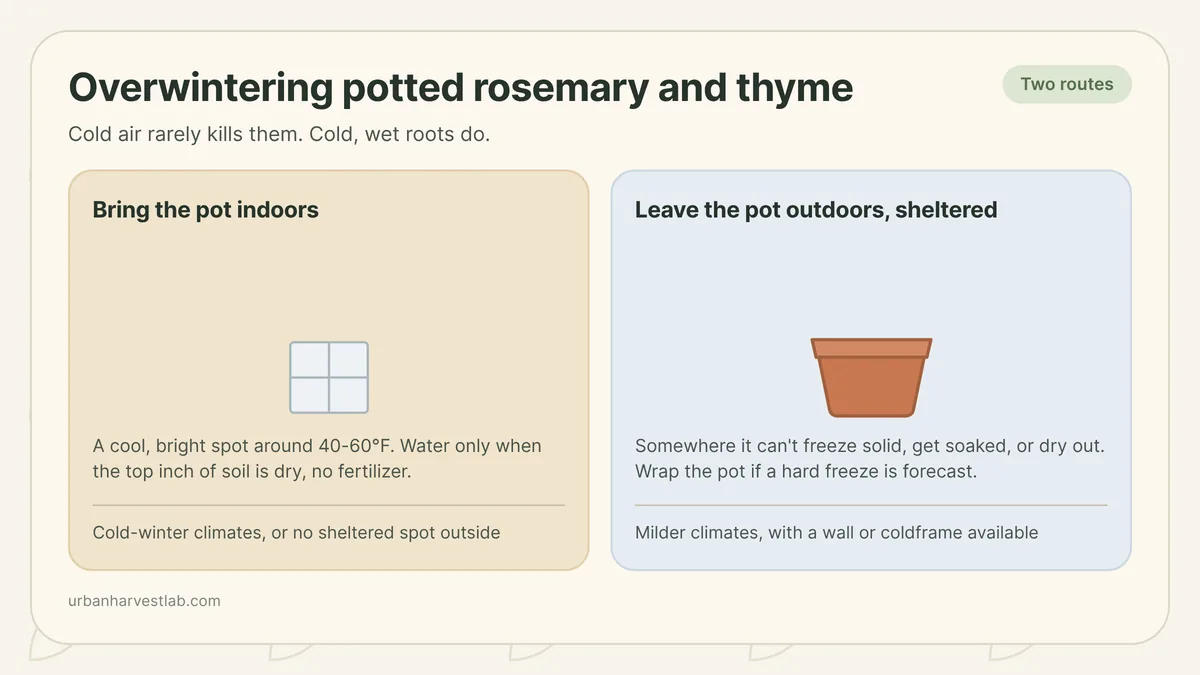
How to overwinter rosemary and thyme in pots
Winter kills more potted rosemary and thyme through mistimed watering and cold-wet roots than through cold air alone. Here is what to do indoors and out.

Plants dropping leaves after moving indoors: light, dry air, and what to do
A plant that sheds leaves in the weeks after moving inside is mostly adjusting to much weaker light. Dry winter air, drafts and carried-over watering habits add to it.