
What three institutions say about sowing and spacing chervil
| Detail | RHS | NC State Extension | University of Georgia |
|---|---|---|---|
| When to sow | April to August outdoors, in light shade | Early spring or fall, in the ground or in pots | Early spring or late summer |
| Spacing | Thin to 6 in. (15 cm) apart | 15 in. apart | 9 to 12 in. |
| Light | Cool, lightly shaded spot | Partial to full sun, cool weather | Light shade |
| Seed cover | About 1 cm (1/2 in.) of compost | Seeds need light to germinate | Not specified in the table |
Sow chervil straight into a pot at least 10 inches (25 cm) deep and wide, put it in light shade, keep the mix evenly moist and resow every few weeks. The RHS describes it as a plant that does best in a cool, lightly shaded spot, in the ground or in a container. Heat is its enemy: it flowers fast and the leaves go with it.
Chervil looks like a delicate parsley and tastes of mild aniseed. The RHS calls it a biennial that is usually grown as an annual, and NC State Extension says the same. Treat each sowing as a short crop and plan the next one before the first runs out. If you are choosing a spot, the small-space herb gardening hub shows how it fits with the rest of a herb pot collection.
Sow it where it will live
Chervil sets a taproot, and that decides how you start it. The RHS says plants should be in their final growing position as soon as possible, before the taproot starts to form. NC State Extension puts it more bluntly: chervil does not transplant well. A pot sown in place avoids the problem altogether.
The RHS says chervil can be sown directly into containers outside, which suits a small balcony. It asks for a container at least 25 cm (10 in.) deep and wide, filled with peat-free multi-purpose compost. Sow thinly and cover the seed with about 1 cm (1/2 in.) of compost.
The sources differ slightly on cover. NC State Extension says the seeds need light to germinate. Both can be respected by keeping the covering shallow, at the thin end of what the RHS gives, and pressing it down gently. Seedlings can take up to three weeks to emerge depending on outdoor temperatures (RHS), so do not give up on a pot after a week.
If you buy small plants or start them indoors, the RHS says to set them out once they are about 5 cm (2 in.) tall and before the long taproot grows. Harden them off first and disturb the roots as little as you can.
When to sow
The RHS gives April to August for outdoor sowing, ideally in a lightly shaded area. NC State Extension says early spring or fall, in the ground or in pots, and the University of Georgia’s herb table lists early spring and late summer. Put those together and you get two windows: spring, before the weather heats up, and late summer into fall, when it cools off again.
Late-summer sowings can run into early winter. The RHS says to sow in late summer for harvests into autumn and early winter, and to cover with cloches or keep plants in a coldframe or greenhouse. It also says pots still growing well in autumn can be moved into a greenhouse. Where winters are mild, the herbs to plant in fall covers how that window works for other cool-season herbs.
Seed does not keep well. The RHS says chervil seeds remain viable for about a year, so buy fresh packets rather than saving last year’s.
Light shade, not a sun trap
The RHS says chervil is best planted in light shade, especially in summer, because hot sun can cause premature flowering. The University of Georgia’s herb table lists light shade as the light requirement. NC State Extension is wider, saying partial to full sun, with a preference for cool weather. These agree once you read them together: the cooler it is, the more sun chervil tolerates.
On a balcony, that means a spot that loses the afternoon sun, or a pot you can move. The RHS notes that chervil sown in a pot can be moved into a shadier area in hot, sunny weather. A pot beside a south-facing wall in July is the wrong place for it. The herb sunlight chart helps you match each herb to a part of the balcony.
Humid climates add a second problem. The University of Georgia warns that chervil, along with French tarragon, cilantro, cumin and chamomile, is particularly susceptible to humid southern springs and summers and may grow best in containers under more carefully controlled conditions.
Water evenly
The RHS asks you to keep the compost consistently moist but not waterlogged. In hot, dry weather chervil is prone to bolting, but regular watering can delay it. Pots need particular attention because compost can dry out very quickly in warm weather.
Press a finger into the mix every day in warm weather and water when the top starts to dry. Drainage holes matter, since waterlogging is the other half of the RHS warning. The herb watering chart shows how chervil’s steady-moisture habit differs from the dry-between-waterings herbs you might share a balcony with.
Spacing in a pot
The three institutions give three figures. The RHS thins seedlings in the ground to 15 cm (6 in.) apart in rows 30 cm (12 in.) apart. The University of Georgia lists 9 to 12 inches. NC State Extension says 15 inches. They describe plants grown to full size in a bed, while a pot of chervil that you cut young holds more plants. Thin to the closest of those figures if you want a thick pot of young leaves, and use the wider ones if you are leaving plants to mature.
NC State Extension calls chervil a good companion for radishes and lettuces. The succession planting guide is the place to plan what follows each crop.
Harvest early and often
The RHS says you can start harvesting young leaves about eight weeks after sowing, once plants are at least 10 cm (4 in.) tall. Choose soft young leaves and take only a few from each plant, so the plants stay productive and attractive.
If you need a lot at once, the RHS says to remove all the stems down to 5 to 7.5 cm (2 to 3 in.), and that healthy plants should produce another flush of growth. Use the leaves fresh. The RHS says the delicate anise flavor does not withstand cooking, so add chervil to salads and hot dishes just before serving.
The harvest has a limited life. The RHS says that leaves become less palatable when the plant starts to flower, and advises removing plants when they begin flowering, or letting a few plants flower to collect seed. Chervil will readily self-seed given suitable conditions, so a pot left to flower may produce volunteers.
Stagger sowings to keep leaves coming
Chervil is short-lived and flowers fairly quickly, which cuts leaf production short (RHS). The RHS answer is to sow new batches every few weeks for a fresh supply over several months. In practice, that means a second pot, or a second patch in the same wide container, started before the first is cut hard. The same logic applies to cilantro bolting, which is the closest parallel among common herbs.
The RHS also names ‘Vertissimo’ as a variety that is slow to bolt. Look for it if your balcony runs warm.
Pests
The RHS says chervil’s delicate foliage is vulnerable to aphids. NC State Extension says to watch for slugs. Check the underside of stems and leaves, the pot rim and the drainage holes after rain.
Sources
Cool-season herbs and sowing rhythm
Timing, shade and staggered sowings for herbs that bolt in heat.
Common questions
How do you grow chervil in pots?
Sow the seed thinly straight into a pot at least 10 inches (25 cm) deep and wide, covered with about half an inch (1 cm) of compost (RHS). Put it in a cool, lightly shaded spot, keep the mix consistently moist but not waterlogged, and start picking about eight weeks after sowing.
Can you grow chervil indoors on a windowsill?
The RHS says chervil can be started on a sunny windowsill from early spring, but that plants should reach their final position before the taproot starts to form. It also says chervil does best in a cool, lightly shaded spot, so a warm, sunny sill is a poor long-term home.
Why does my chervil keep flowering?
Chervil is short-lived and flowers fairly quickly, especially in hot, dry weather (RHS). Light shade, regular watering and fresh sowings every few weeks slow the problem, and the RHS names 'Vertissimo' as a variety that is slow to bolt.
How far apart should chervil plants be?
The sources differ. The RHS thins in-ground rows to 6 inches (15 cm) apart, UGA gives 9 to 12 inches, and NC State Extension says 15 inches. In a pot, the closer figures leave room for more plants.
Related guides
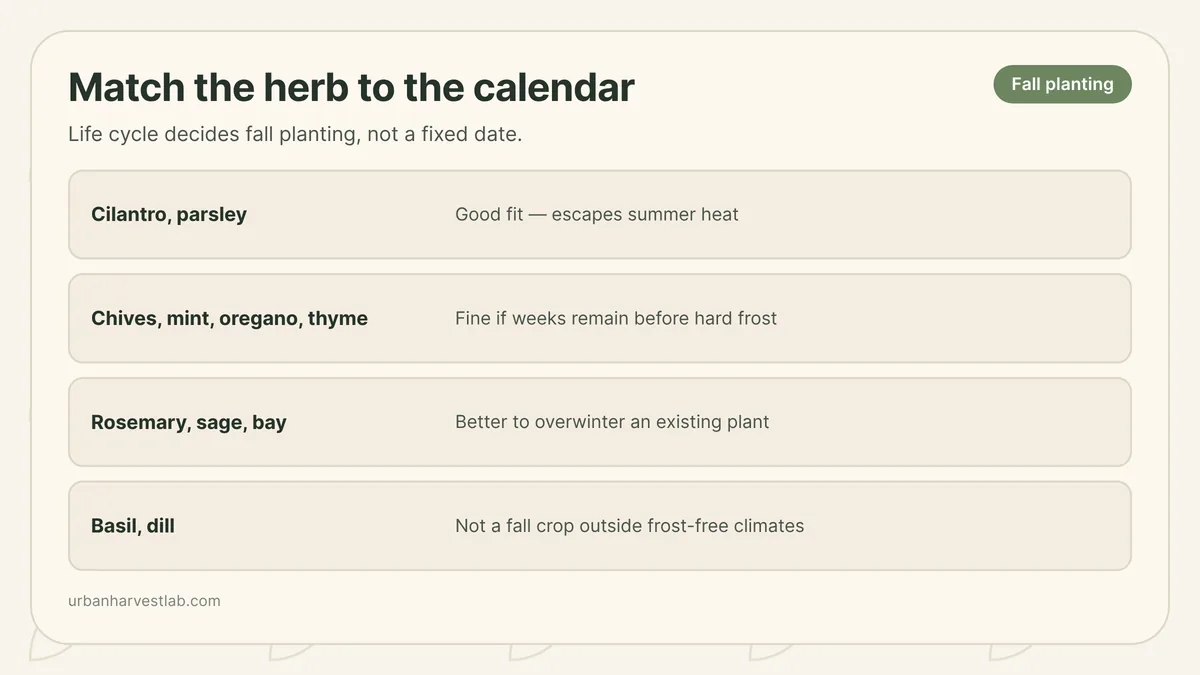
Herbs to plant in fall: what to sow now and what should wait
Fall planting suits herbs by life cycle and climate, not by calendar date. Cool-season herbs, cold-hardy perennials, and heat-loving annuals each answer the question differently.
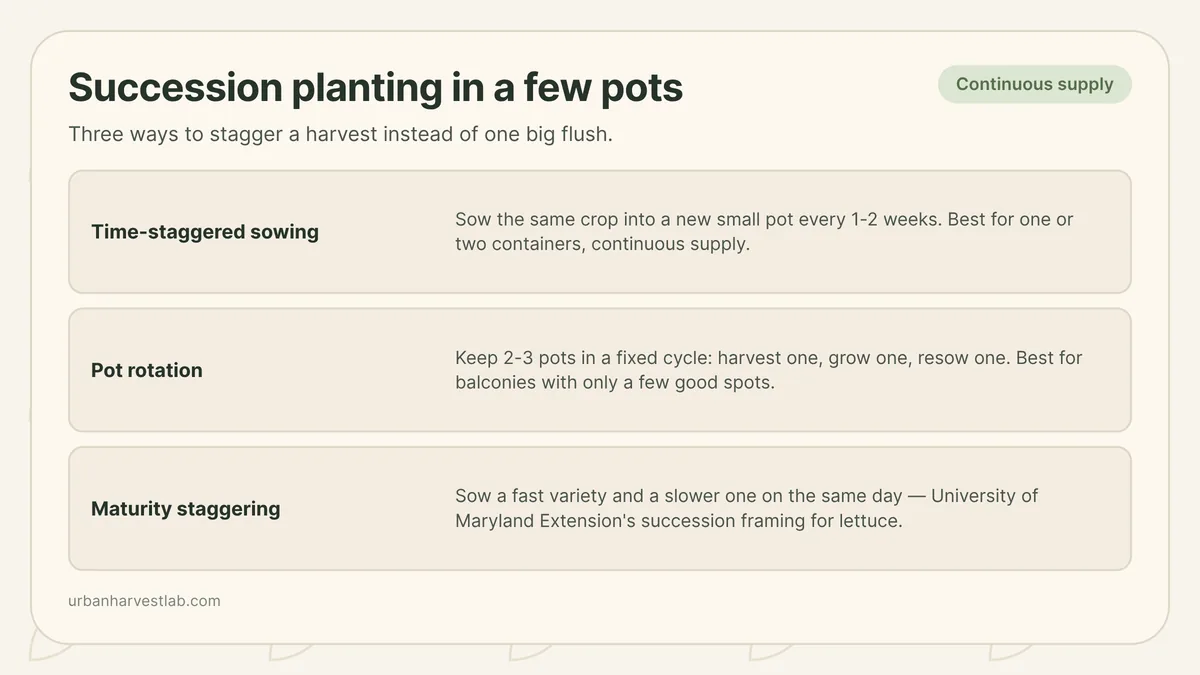
Succession planting in containers: how to stagger a harvest from a few pots
Succession planting in containers is a sowing rhythm: a few pots restarted on a schedule keep producing, where one large planting ripens together and then quits together.
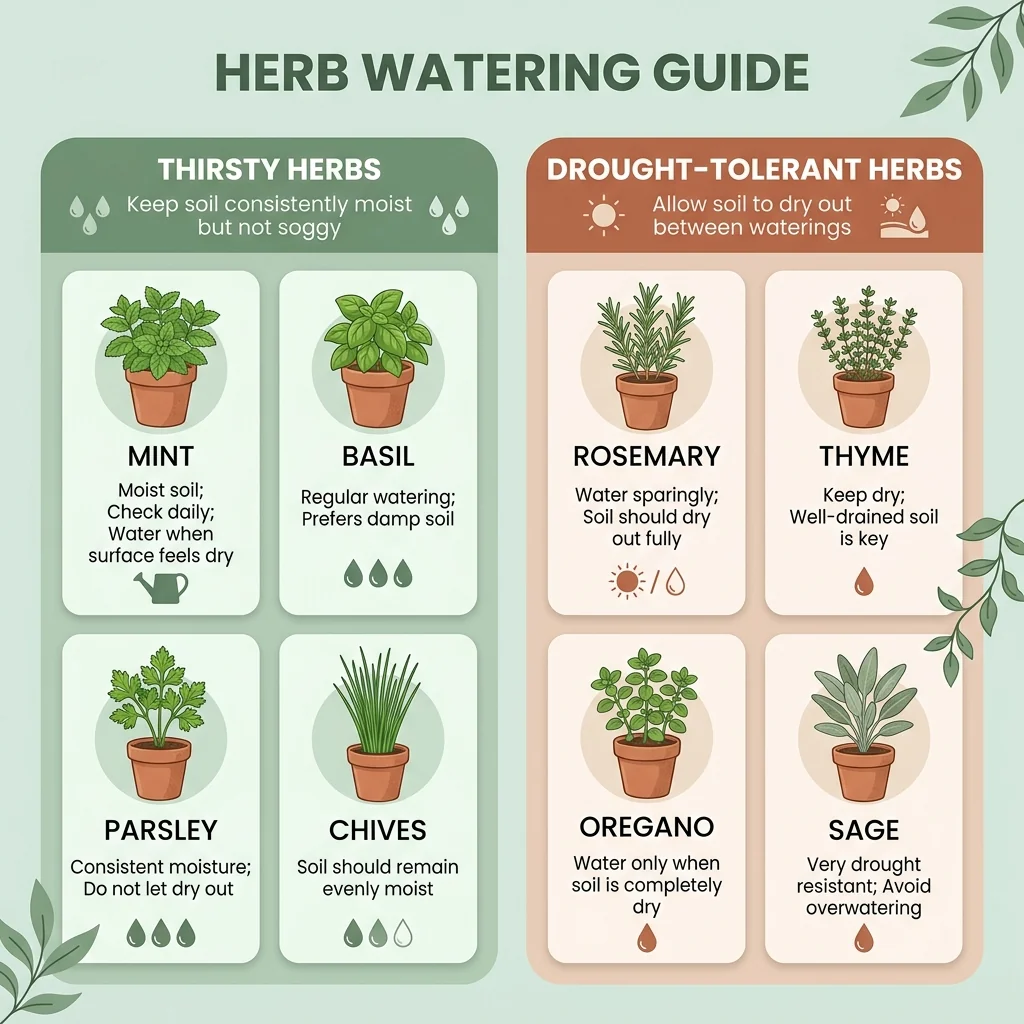
Watering a mixed herb collection: which pot to check first
How to water several potted herbs at once: which camp each herb belongs to, which pot to check first, and how to tell a dry wilt from a wet one.