Chitting at a glance, by source
| Detail | RHS | University of Minnesota (IPM blog) |
|---|---|---|
| Light | Bright location | Diffuse light |
| Temperature | Frost-free, cool | 55-60 °F |
| Duration | Four to six weeks | 2-12 weeks, with problems after about 10 |
| Plant when | Sprouts about 5 cm (2 in); about 3 cm (1 in) in a second RHS piece | Sprouts turn green or purple |
| Effect on tubers | Earlier crop | More tubers per plant, but smaller |
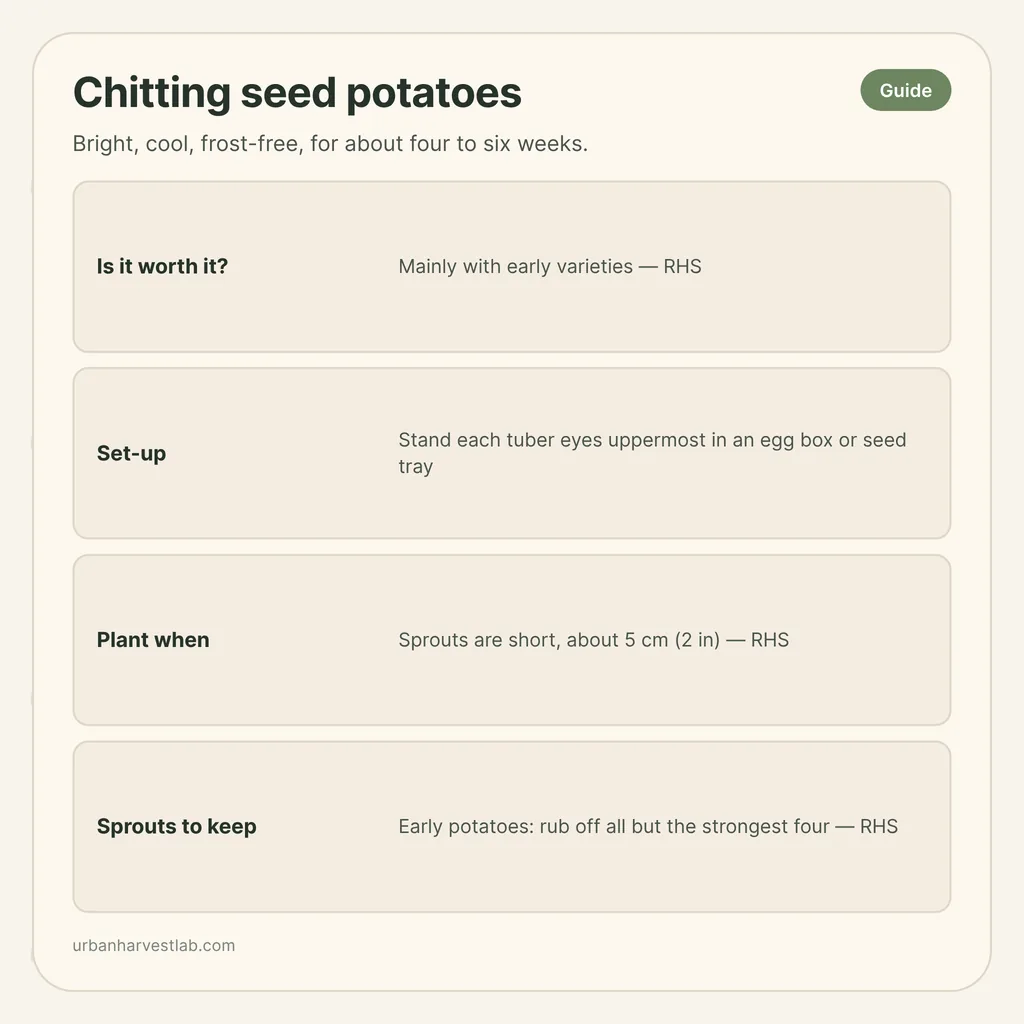
Chitting means sprouting seed potatoes in a bright, cool, frost-free place for about four to six weeks before you plant them. Stand them eyes-up in an egg box and plant when the shoots are short. It is optional, and it pays off mainly with early varieties.
The tubers then go into a bag or pot, which is covered in growing potatoes in grow bags. Before that comes the step here: getting the tuber ready.
Is chitting worth doing?
The RHS says chitting “isn’t essential” but is worthwhile with early varieties, because they crop earlier. Without it they still grow perfectly well and take a few weeks longer. For maincrop varieties the RHS sees no real advantage, since they grow over a much longer period.
Its explanation: chitting increases the physiological age of the seed potato, which leads to quicker growth, earlier tuber formation, more rapid swelling and earlier maturity.
If you only have room for one tray on a windowsill, give it to first earlies.
Light, temperature and timing
The two main sources give slightly different numbers, and both are workable.
The RHS asks for a bright, frost-free, cool place for four to six weeks. The University of Minnesota IPM blog gives diffuse light, 55-60 °F and 40-50% relative humidity, for anywhere from 2 to 12 weeks.
Both ask for light and moderate temperatures. The University of Maryland describes a two-step version called green sprouting: keep whole tubers in the dark at room temperature until they sprout, then expose them to light to keep the sprouts short.
Minnesota adds a limit: after around 10 weeks other problems can occur (University of Minnesota). So do not start in November for a May planting.
For timing, count back from planting day. The RHS advises starting in late January in milder parts of the UK and up to early March in colder spots, because the process takes four to six weeks. On a balcony, the planting day is set by your frost dates, so check your first and last frost dates first. The RHS cautions that young potato shoots are susceptible to frost damage, and that potatoes in containers should stay in a frost-free place such as a greenhouse until the risk of frost has passed.
Setting up the tray
- Use an egg box or shallow tray. The RHS recommends egg boxes or seed trays.
- Stand each tuber with the eyes uppermost. The RHS puts it as buds, or eyes, uppermost.
- Put it somewhere bright, cool and frost-free. Keep it clear of frost.
- Plant when sprouts are short. The RHS gives about 5 cm (2 in) as the target, and a second RHS page plants out at about 3 cm (1 in). Minnesota’s rule of thumb is to plant when the sprouts turn green, or in some cases purple.
How many sprouts to keep
For early potatoes, the RHS standard advice is to rub all but the strongest four sprouts off. Guy Barter’s reasoning, relayed by the RHS, is that with only a few strong shoots the tuber uses its energy to form new potatoes. Second earlies and maincrops need no rubbing off.
Other sources push in the same direction from the other side. Minnesota notes that chitted plants tend to produce more tubers per plant, but smaller ones. University of Maine Extension, writing about seed age, says that seed with just a few sprouts gives a plant with few stems, and larger but fewer tubers would be expected.
So the trade is simple. Fewer sprouts: fewer, larger potatoes. More sprouts: more, smaller ones. The RHS number applies to early varieties; a gardener who prefers more, smaller potatoes can follow Minnesota’s observation and leave the sprouts on.
Weak, branched shoots are a different matter. University of Maine Extension says old seed develops branched sprouts that can appear hairy, and these are weak and do not produce a vigorous plant. If a tuber looks like that, plant a different one.
Which potatoes to chit
Buy certified seed potatoes. Supermarket potatoes are the usual temptation, and the sources are consistent against them:
- North Dakota State University Extension says potatoes from a grocery store are not suitable, because most have been treated with sprout inhibitors.
- University of Florida IFAS says the same, adding that grocery potatoes may carry harmful potato diseases.
- The University of Maryland says supermarket potatoes can be infected with diseases without exhibiting any symptoms, and advises buying certified seed that is firm and un-sprouted.
That last point matters if your seed arrives already sprouting. Maryland states that wilted and sprouted potatoes have reduced vigor, so choose firm tubers at purchase and let the chitting happen at home, where you control it.
From tray to pot
The RHS suggests a container at least 30 cm (12 in) wide and deep, half-filled with 15 cm (6 in) of peat-free multi-purpose compost, with one seed potato per 30 cm (12 in) of pot diameter. Container sizing is covered in growing potatoes in grow bags.
For an extra-early crop, the RHS plants chitted early varieties at the beginning of March into large containers in a frost-free greenhouse. Most balconies are not that. A glazed one may be; see growing on a glazed balcony.
The RHS notes earthing up keeps tubers from sunlight so they do not turn green, and green tubers are poisonous; what to do with ones that have greened is in green potatoes. Once lifted, the crop keeps best as described in storing onions, garlic and potatoes.
Sources
- RHS: How to grow potatoes
- RHS: Growing potatoes, secrets of success
- University of Minnesota Extension: Crop planning deep dive, pondering potatoes
- University of Maryland Extension: Growing potatoes in a home garden
- University of Maine Cooperative Extension: Potato Facts, selecting, cutting and handling potato seed
- North Dakota State University Extension: Potatoes from garden to table
- UF/IFAS Extension: Potatoes in the home garden
From sprouted tuber to harvest
Plant the chitted tubers in a bag, keep the crop from greening, and store what you lift.
Common questions
What does chitting seed potatoes mean?
It means letting seed potatoes sprout short shoots before planting. The RHS describes standing the tubers in egg boxes or seed trays with the eyes uppermost in a bright, frost-free place for a few weeks, which gives a head start and an earlier crop.
Do potatoes need light to chit?
Yes, for sturdy sprouts. The RHS specifies a bright place and the University of Minnesota specifies diffuse light at 55-60 °F. The University of Maryland describes sprouting in the dark at room temperature and then moving the tubers into light to keep sprouts short.
How many sprouts should I leave on a seed potato?
For early potatoes the RHS advises rubbing off all but the strongest four. Second early and maincrop potatoes need no thinning. Minnesota notes chitted plants tend to give more tubers per plant, but smaller ones, while University of Maine Extension says a plant from seed with just a few sprouts has few stems and would be expected to give larger but fewer tubers.
Can I chit potatoes from the supermarket?
It is not recommended. North Dakota State says grocery potatoes are not suitable because most have been treated with sprout inhibitors, and the University of Maryland warns they can carry disease without symptoms. Buy certified seed potatoes.
Related guides
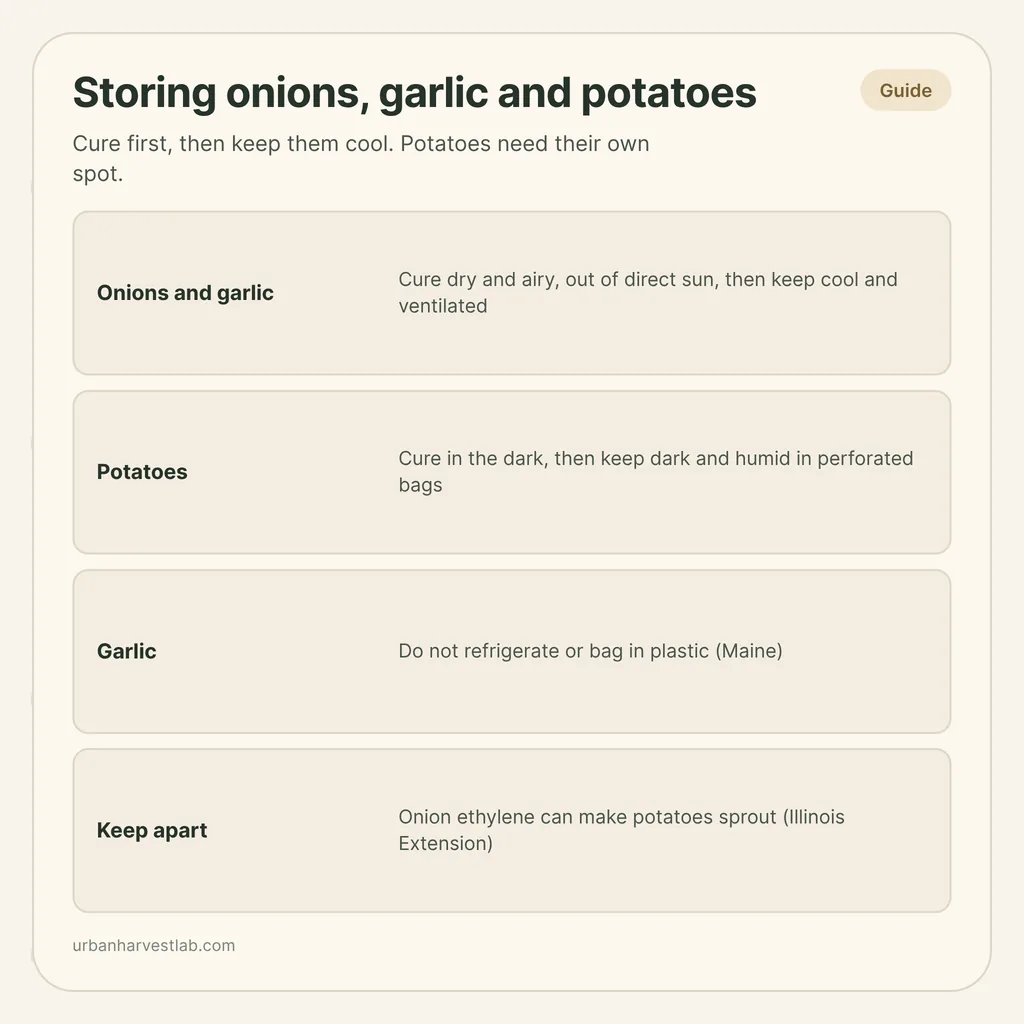
Storing onions, garlic and potatoes at home after harvest
Onions and garlic keep dry and airy, potatoes keep dark and humid, and onions near potatoes is a bad pairing. Curing times, temperatures and a small-space layout from extension sources.
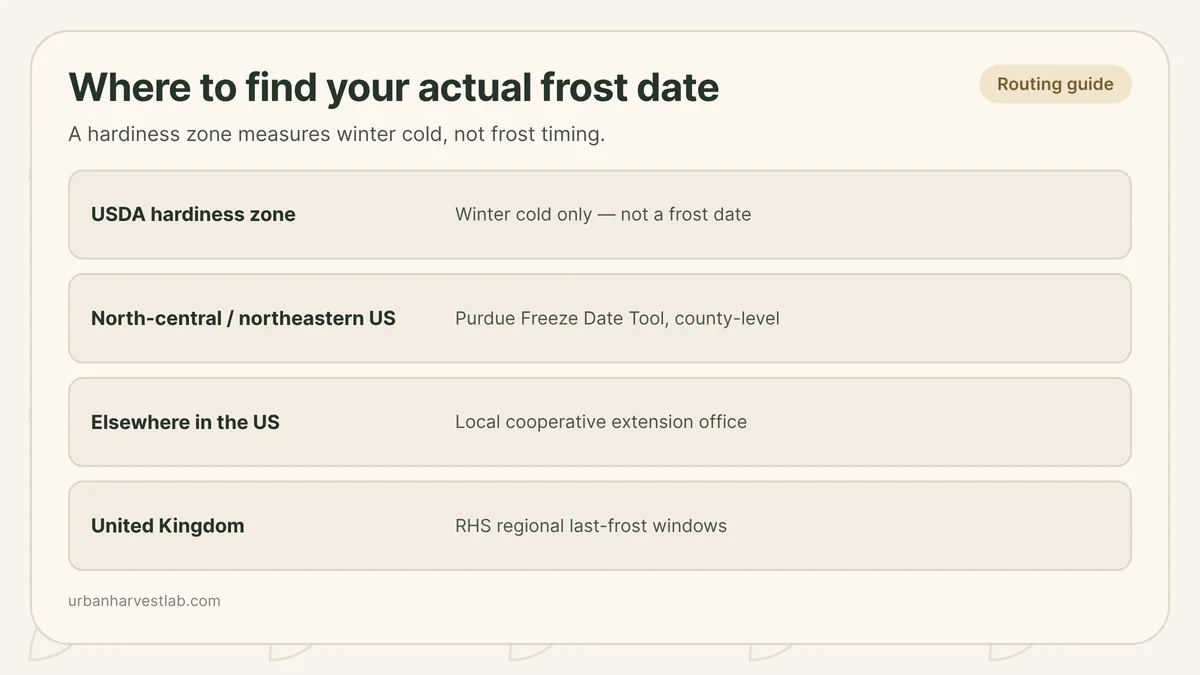
First and last frost dates for a balcony: start with your zone
Your hardiness zone tells you how cold winter gets, not when frost starts or ends. Look up the zone's temperature band, then use the tools built to answer the date question directly.
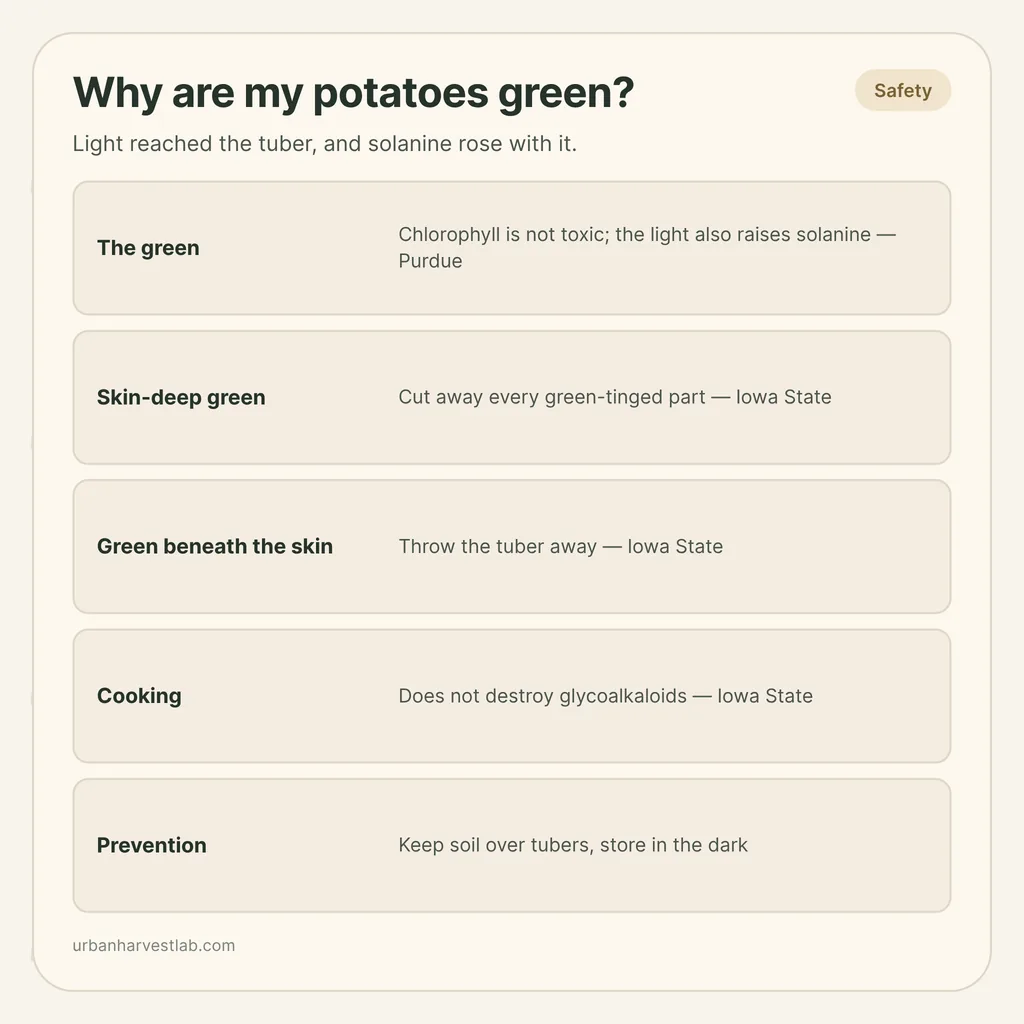
Why are my potatoes green? Light, solanine and what to do with them
Green on a potato is chlorophyll from light exposure, and solanine rises alongside it. Here is how to judge a green tuber, what to cut or throw out, and how to stop it next time.