What a glazed balcony suits, season by season
| Season | What the space is doing | Good candidates | The management job |
|---|---|---|---|
| Late winter to spring | Warming early, frost buffered, light still low | Chard, kale, spinach, lettuce, chives, parsley, hardened-off transplants | Vent on bright days; the space heats faster than the season suggests |
| Summer | Solar gain with poor air exchange | Basil, mint and other heat-tolerant herbs; tomatoes and peppers only with low-and-high venting plus external shade | Shade outside the glass, keep a low and a high opening, check pots daily |
| Autumn | Falling light, useful residual warmth | Second sowings of chard, kale, mustard greens, cilantro | Reduce shading as the RHS advises, keep venting on sunny days |
| Winter | Frost buffer with cold, dim conditions | Hardy greens holding for cut-and-come-again harvest; dormant rosemary, thyme, bay | Water sparingly, keep pots off the cold floor, still vent on bright days |
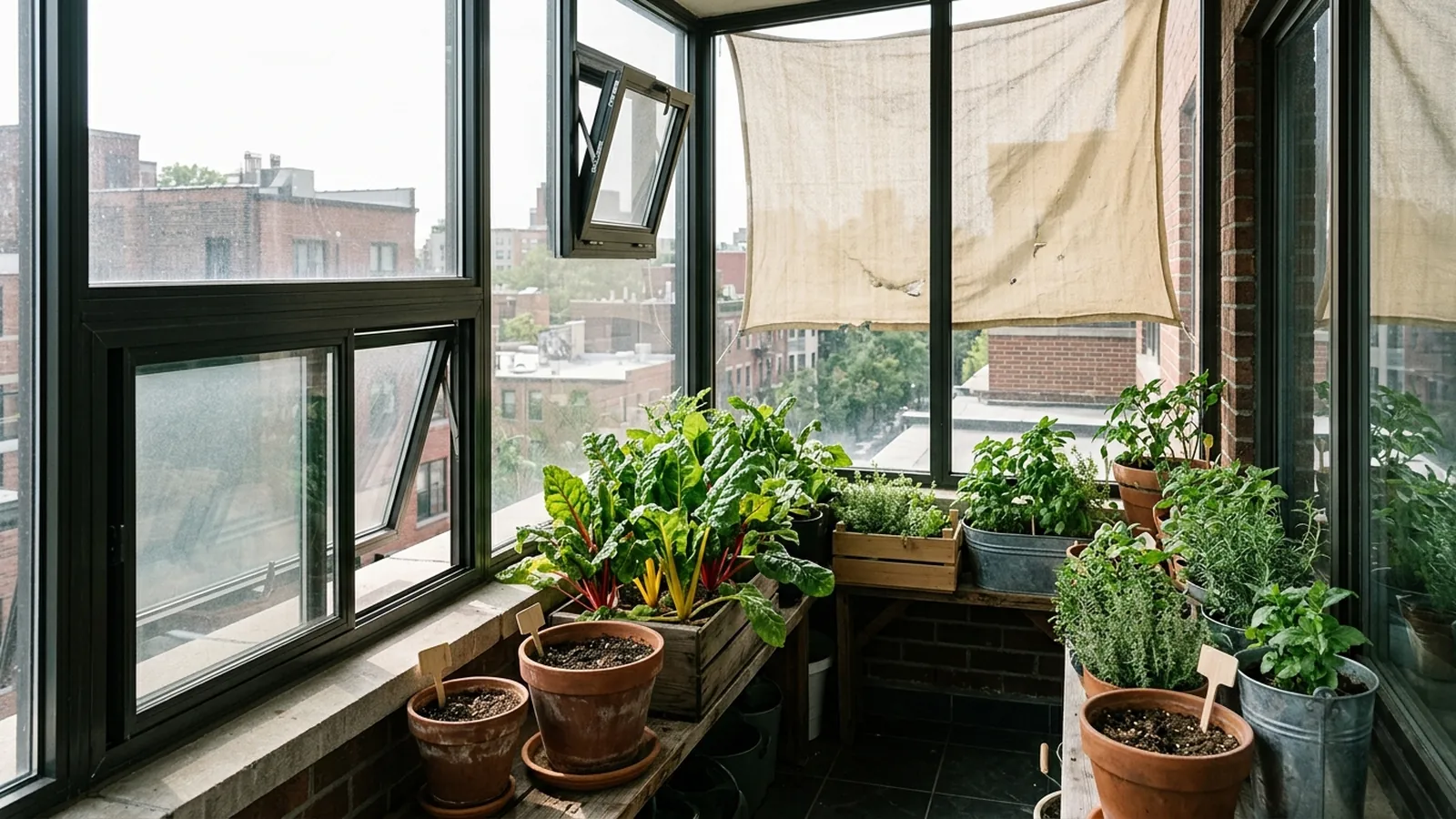
Glaze in a balcony and you have built a small greenhouse attached to your living room. The comparison is worth making precisely, because an enclosed balcony behaves like a greenhouse with generous side glazing and no ridge vent — heat collects under the ceiling with nowhere to leave, and the fix is an opening low plus an opening high rather than one bigger opening. Advice written for an open balcony assumes wind and rain that are no longer reaching the pots. Advice written for a windowsill assumes a single pane and a room behind it to absorb the heat. Inside the glass, both miss.
Start with the number the rest of it hangs on. Glazing, frames, dirt on the panes and the solid parapet under the glass all take a bite out of what reaches the shelf, and a balcony that felt blazing when it was open can land somewhere quite different once it is enclosed. Track the hours on the shelf itself, with the balcony sun estimator as the starting point, before you decide what the space can carry.
Quick answer
Manage a glazed balcony the way a greenhouse grower manages a structure with too little roof ventilation: get air moving from a low inlet to a high outlet, put shade on the outer face of the glass, and pick crops that match how hot the space actually gets rather than how bright it looks. Then use the season the glass gives you at the other end of the year, which is where enclosed balconies genuinely beat open ones.
The one-opening problem
The RHS puts a number on what a greenhouse needs: for larger glasshouses, one square metre of ridge ventilation for every five square metres of floor area — 20 percent — gives the capacity for a complete air change every two minutes, and smaller greenhouses should ideally have a higher percentage still. The same guidance is blunt about the alternative: side ventilation, commonly by louvres, is less effective than roof vents.
A glazed balcony is the extreme case of that trade. It has an enormous area of side glazing and, in most builds, nothing at the top at all. The sliding panels run along one horizontal band at chest height, which is exactly the geometry the RHS describes as the weaker option.
What is missing is the vertical route. A greenhouse ventilation guide from the University of Connecticut and University of Vermont Extension describes the mechanism plainly: heavy cool air near the floor becomes lighter as it is heated and rises towards the roof, and if sidewall vents are open, cool replacement air enters and drops to floor level while the heated air escapes from the top. Two things have to be open, at two different heights, for that loop to close.
There is a catch worth knowing before you count on convection alone. The University of Connecticut and University of Vermont Extension guide notes that on cool days the large temperature difference creates excellent air exchange, but on hot days the difference can be only 5 or 10 degrees and the buoyancy effect is almost nonexistent. Wind does most of the real work on those days — the same guide gives 2-3 miles per hour as enough to provide 80 percent or more of the maximum possible ventilation. On a still July afternoon, the day you most need the balcony to shed heat, you have the least buoyancy and the least wind. That is the case to plan a fan around.
For reference on how generous the openings would be in a purpose-built structure: the American Society of Agricultural Engineers recommends that combined sidewall vent area should equal combined ridge vent area, with each at 15 to 20 percent of floor area, as cited in the same University of Connecticut and University of Vermont Extension guide. No balcony glazing is built to that, which is the point — you are working with a deficit and compensating for it.
| Opening arrangement | What actually moves | Practical effect |
|---|---|---|
| One sliding panel part-open | Air exchanges only in the band the wind pushes through | The baseline to beat; the layer under the ceiling stays put |
| Two panels open at the same height | Cross-flow along one horizontal band, wind-driven | Noticeably better on a breezy day, little help on a still one |
| Low opening plus a high one (top hopper, transom, gap above the frame) | Warm air leaves high, cooler air is drawn in low | The closest a balcony gets to the low-inlet, high-outlet pattern extension guidance describes |
| Low opening plus a fan exhausting through a high gap | Forced exchange that does not depend on wind | The workaround when the glazing has no high opening |
| Balcony doors thrown open to the flat | Balcony heat moves into the living space | Cools the glass at the cost of heating the home |
If your glazing has any top-hung hopper pane, a transom light, or even a trickle vent in the upper frame, that is the high outlet and it is worth keeping open through summer. If it has none, a small clip fan aimed to push air out through the highest gap you have, with a low panel open as the inlet, reproduces the same path mechanically.
Shade belongs on the outside of the glass
This is the fix people get backwards most often, and the physics is not subtle. The RHS describes external blinds as giving shade and providing the maximum cooling effect by preventing the sun’s rays from passing through the glass, and says internal blinds do not have the same cooling effect since sunlight is allowed to pass through the glass. Once radiation has come through the pane it has already been absorbed by whatever it lands on and re-emitted as heat inside the enclosure. Shading at that point protects leaves from direct sun; it does much less about the temperature of the air around them.
Shade paint is the same principle in cheaper form. The RHS describes it as diluted in water and painted onto the outside of the glass in spring, then washed and brushed off in early autumn. On a balcony, the practical options for the outer face are an awning above the glazing, an exterior roller blind, or a shade wash on the panes you can safely reach. Where only the inside is accessible, a pale reflective blind fitted close to the glass beats a dark curtain hung deep in the space, because a dark fabric inside absorbs the radiation and becomes a heater in its own right.
Use the minimum that does the job. The RHS advises shading from mid-spring until early autumn and only as much as is needed to hold temperatures below about 25-27°C (77-81°F), warning that plant damage can occur once temperatures build past roughly 27°C/81°F. It also advises reducing shading gradually from September and removing it as soon as ventilation alone controls overheating, which matters more on a balcony than in a garden greenhouse, since autumn light indoors is already scarce.
Two related problems are worth borrowing solutions from. The open-balcony version of a heat emergency — grouping pots, watching the root zone, timing water — is covered in the guidance on protecting container plants during a heatwave, and most of it transfers. And the energy-in, heat-out arithmetic inside a small enclosure is the same problem lamp growers solve, which is why the approach to managing grow light heat reads as familiar once you have spent a summer behind glass.
Why heat, not light, decides your crop list
On a bright enclosed balcony the limiting factor in July is rarely photons. It is what the accumulated heat does to flowering and fruit set.
Purdue University gives the optimum temperatures for tomato as 60-75°F at night and 60-90°F during the day, and reports that exposing plants to three-hour periods above 104°F on two successive days may cause fruit set failure. There is a delay built into the damage: Purdue notes that high temperature affects pollen development, which happens about nine days before the flowers open, so a hot spell shows up as dropped flowers a week and a half later and the wrong week gets blamed. The University of Missouri gives lower thresholds for trouble starting — pollination suffers when daytime temperatures exceed 85°F or nighttime temperatures exceed 70°F, and nighttime temperatures below 55°F promote blossom drop too.
A glazed balcony with one mid-height opening will run through those thresholds on a summer afternoon in most climates. That does not rule out tomatoes and peppers; it ranks them. With a low and a high opening, external shade and a fan, fruiting crops are reasonable. Without those, leafy crops and herbs are the better bet, because you are harvesting the part of the plant that heat does not sterilise. Basil and mint handle warmth well. Lettuce and cilantro bolt early in it, so treat them as spring and autumn crops here rather than summer ones.
If you are already thinking in terms of a sealed box with controlled airflow, the same instincts apply at a smaller scale in a compact grow tent for herbs — inlet low, exhaust high, and the fan sized to the volume.
Air movement does more than cool
Ventilation on a balcony is not only a temperature control. The RHS points out that airflow reduces temperature, replenishes the gases plants absorb, and keeps down fungal diseases such as grey moulds, and that air movement over leaf surfaces has a cooling effect in its own right. Still, humid air in a sealed glass box is an invitation to botrytis on a crowded shelf.
Watering changes too, in a way that catches people out in the first season. Rain does not reach the pots any more, so whatever the mix loses has to be replaced by hand. Iowa State University Extension’s container rule is to water when the potting mix is dry at a depth of 1 to 2 inches, and it gives a frequency range that swings from once or twice a day in a small container in hot, windy weather to once or twice a week in a large container in cool weather. Behind glass, the hot end of that range arrives earlier in the year than it does outside.
Winter is the half most balconies leave empty
Everything that makes an enclosed balcony difficult in July makes it valuable in November. The mechanism is the one Iowa State University Extension describes for a cold frame: the ground and the frame are heated by the sun during the day and radiate that heat at night, keeping the inside warmer. Iowa State puts the payoff at two to four weeks of extra growing season in both spring and autumn for a cold frame. A glazed balcony is the same device at room scale, with a heated wall on one side of it.
Whether yours actually stays frost-free depends on the glazing, the building, the orientation and the winter, and there is no substitute for finding out: a min-max thermometer left on the shelf for a fortnight in December answers the question for your space and costs almost nothing.
If it does stay above freezing, the crop list is generous. Clemson Extension’s winter vegetable list for season extension includes spinach, kale, collards, mustard greens and Swiss chard, alongside cool-season herbs such as chives, cilantro and parsley, and notes that crops planted between mid-October and early November can be harvested through December and sometimes into early spring in a mild winter. Cut-and-come-again is the right harvest mode: take outer leaves, leave the crown, and let slow winter growth refill.
Two winter jobs are easy to forget. Vent on bright days — Iowa State advises raising a cold frame sash once the air inside rises above 85°F and closing it before sunset to retain heat, while Clemson’s cold frame guidance is to ventilate on sunny days to hold temperatures below 60°F. A closed glass box on a clear February morning warms up faster than the outside temperature leads you to expect. And water far less than in summer, checking the mix rather than the calendar.
For the woody herbs, the glazed balcony is often exactly the shelter they want. Illinois Extension’s band for overwintering tender perennials indoors is 40-60°F with bright light, watering when the top inch of soil is dry and no fertiliser while the plant is not actively growing — which is close to what a frost-free enclosed balcony gives you for free. The RHS’s advice for containers left outside is to put them where they cannot be frozen, saturated by rain or allowed to become too dry, and a glazed balcony satisfies all three conditions at once. The detail on overwintering rosemary and thyme in pots applies directly, with the glass doing the sheltering.
Sources
- RHS, “Greenhouse ventilation and shading”
- John Bartok Jr. (University of Connecticut) and Vern Grubinger (University of Vermont Extension), “Greenhouse Ventilation”, Farm Energy / eXtension
- Chris Callahan, UVM Extension Ag Engineering, “Ventilation in Greenhouses and High Tunnels”
- Wenjing Guan, Purdue University Vegetable Crops Hotline, “Understanding High Temperature Effects on Fruit Set of Tomatoes”
- David Trinklein, University of Missouri Integrated Pest Management, “Understanding Tomato Fruit Set”
- Aaron Steil, Iowa State University Extension and Outreach, “All About Cold Frames”
- Clemson Cooperative Extension HGIC, “Extending the Growing Season in South Carolina”
- Iowa State University Extension and Outreach, “How to Care for Plants Growing in Containers”
- University of Illinois Extension, “Overwintering Tender Plants”
- RHS, “Growing herbs in containers”
Measure the space, then manage the heat
Sun tracking, heatwave response and the same energy-in, heat-out problem in a lit indoor setup.
Common questions
Is an enclosed balcony indoors or outdoors for growing purposes?
Neither, and that is the practical problem. It takes far more solar radiation than a windowsill because the glazing is floor to ceiling and often wraps around a corner, but it has none of the open balcony's free air exchange. The closest working model is a small greenhouse with generous side glazing and no ridge vent, which is why greenhouse ventilation and shading guidance transfers better than houseplant advice.
Should the shade cloth go inside or outside the glass?
Outside, where it can be fitted safely. The RHS describes external blinds as giving the maximum cooling effect because they stop the sun's rays passing through the glass, and says internal blinds do not have the same cooling effect since the sunlight is allowed through. Shade paint is the same idea: the RHS describes it as diluted in water and painted onto the outside of the glass in spring, then washed off in early autumn.
Why does opening both windows not cool my glazed balcony down?
Because both openings are probably at the same height. A greenhouse ventilation guide from the University of Connecticut and University of Vermont Extension describes cool air entering low and dropping to floor level while heated air leaves at the top, and notes that on hot days the inside-to-outside temperature difference can be only 5 or 10 degrees, so buoyancy alone does very little and wind does most of the work. Two openings on the same horizontal band give the hot layer under the ceiling no route out.
Can I grow tomatoes on a glazed balcony?
Yes, with ventilation and shade in place, but heat is the limiting factor rather than light. Purdue University gives optimum tomato temperatures of 60-75 F at night and 60-90 F during the day, and reports that three-hour periods above 104 F on two successive days may cause fruit set failure. Leafy crops and herbs are the lower-risk choice for a balcony you cannot vent well in midsummer.
Related guides

How to protect container plants during a heatwave
Watering more is only one piece of getting containers through a heatwave. This is the wider plan: cutting the heat load, grouping and staging pots, and reviving one that has already dried out.
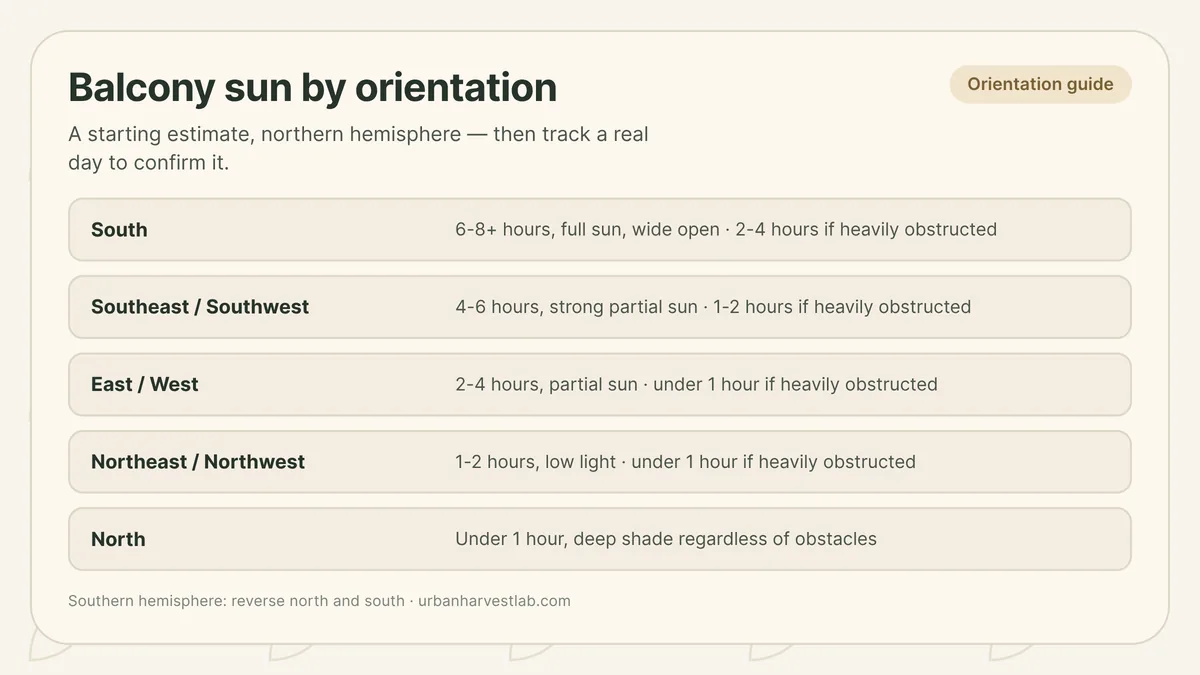
How much sun does my balcony get: an orientation estimator and one-day tracking method
Compass direction and nearby obstacles give a starting range for how much sun a balcony gets. One day of tracking turns that range into a real number.
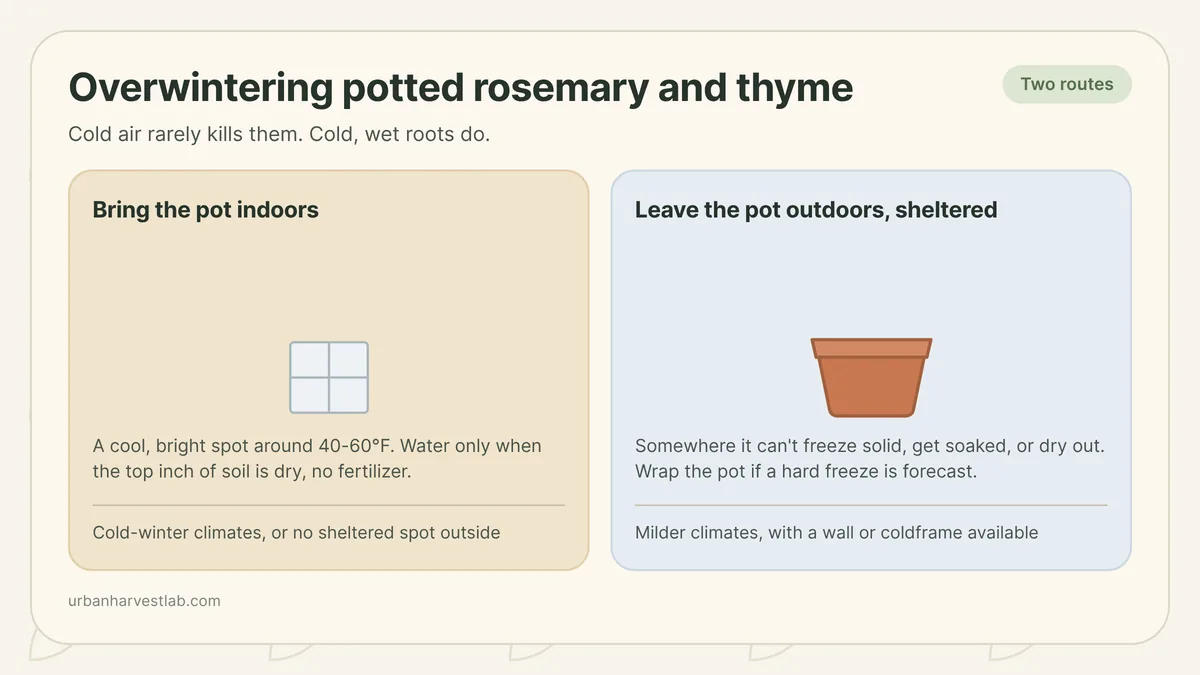
How to overwinter rosemary and thyme in pots
Winter kills more potted rosemary and thyme through mistimed watering and cold-wet roots than through cold air alone. Here is what to do indoors and out.