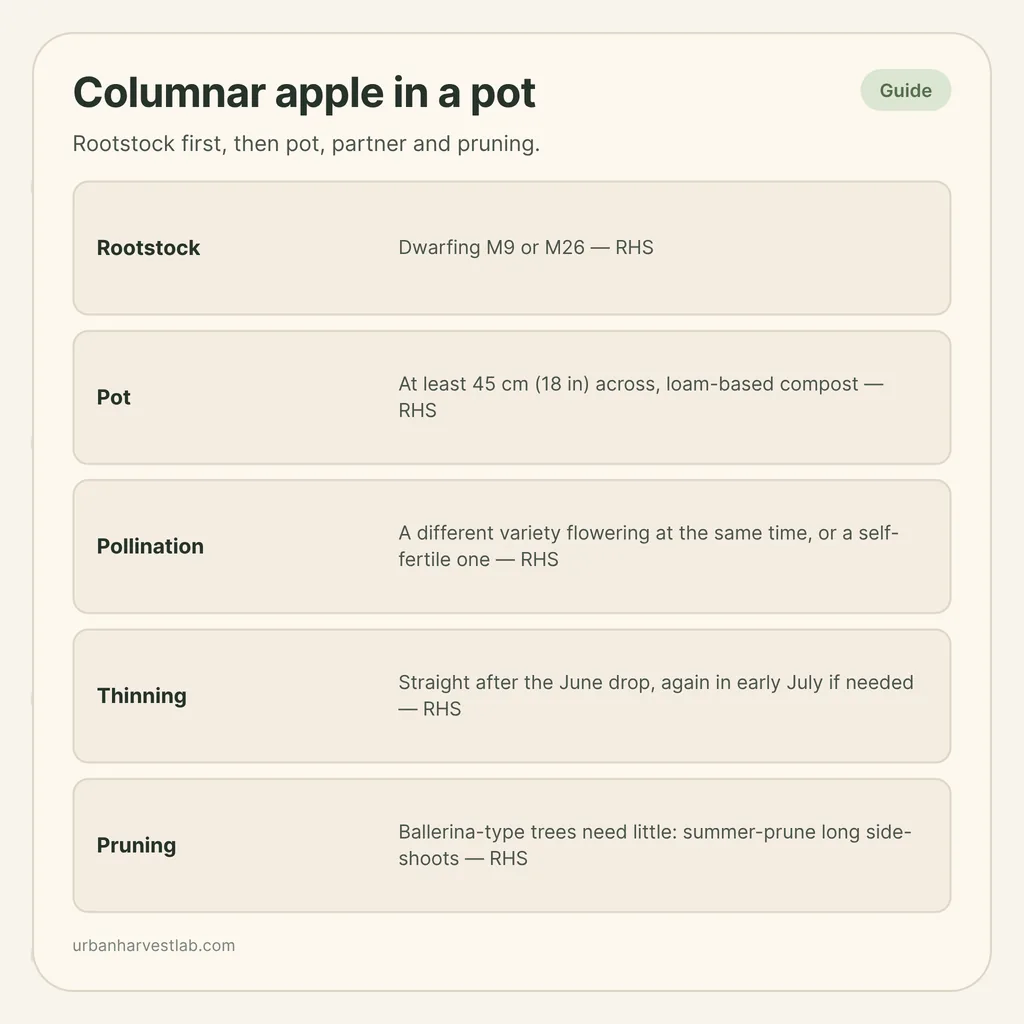
Columnar apple in a pot: what the sources say
| Question | Guidance | Source |
|---|---|---|
| Rootstock | Dwarfing M9 or M26; MM106 grows up to 4 m (13 ft) | RHS |
| Pot | At least 45 cm (18 in) across, loam-based compost | RHS |
| Position | Warm, sunny, sheltered, such as a south or west-facing patio | RHS |
| Pollination | A second variety with overlapping bloom, or a self-fertile variety | RHS, Iowa State Extension |
| Feeding | Organic high-potassium liquid feed every fortnight in the growing season | RHS |
| Thinning | Straight after the June drop; more in early July if needed | RHS |
| Pruning | Ballerina type: not routine; summer-prune long shoots, thin spurs in winter | RHS |
| Winter | 20 to 45°F (about -7 to 7°C) in an unheated structure, or bury the pot | Iowa State Extension |
A columnar apple does well in a pot if the tree is on a dwarfing rootstock, the container is at least 45 cm (18 in) across and a second apple flowers at the same time. That is the RHS setup for apples in containers: an M9 or M26 rootstock, loam-based compost and a warm, sunny, sheltered spot. Thin the fruit after the June drop and prune very little.
A columnar apple is a single upright stem with short fruiting spurs along it. The RHS describes one columnar example as non-branching, about 3 m tall and 1 m wide, bearing flowers and fruit from short shoots all along the main trunk. For a balcony that shape is the draw. It takes the footprint of a large shrub and still asks for a pollination partner, a pot that will not tip and a winter plan.
Other fruit in pots has different rules. A fig sets fruit without pollination and wants a dormant winter; the fig tree in a container guide covers it. A blueberry needs acidic mix and a different feeding routine, set out in blueberries in containers.
Start with the rootstock, not the shape
“Columnar” describes how the tree grows. The rootstock controls how big it gets, and it is the rootstock you are really buying. The RHS says apples are grafted onto a rootstock that controls vigour and size, and that dwarfing rootstocks such as M9 or M26 are best for small gardens, pots and trained forms. Semi-dwarfing rootstocks such as MM106 produce larger trees, up to 4 m (13 ft) tall.
The label or the catalogue description should name the rootstock. If it does not, ask before you buy. A tree sold as “compact” on an unnamed rootstock can outgrow a pot.
Columnar types also differ in how they are pruned later. The RHS groups Minarette, Supercolumn and Ballerina trees as vertical cordons, and says only the naturally compact Ballerina types skip regular summer pruning. Check which kind you have.
The pot, the compost and the spot
The RHS says the container should be at least 45 cm (18 in) in diameter and filled with good quality, loam-based compost, such as peat-free John Innes No 3. It puts the tree in a warm, sunny, sheltered spot, for example a south or west-facing patio. On a balcony, shelter matters twice: the RHS also says apples want a site that is not prone to late frosts, which can damage the flowers. If your last frost is late, see first and last frost dates for a balcony.
A wide pot of wet loam-based compost with a tree in it is heavy. Work out the load before you carry it up the stairs, using the balcony weight limit calculator.
Watering and feeding are where pots differ from the ground. The RHS says trees in containers need a steady supply of moisture throughout the growing season, and that the aim is evenly moist compost. It recommends an organic, high-potassium liquid fertiliser every fortnight in the growing season, or a handful of granular general-purpose fertiliser each spring. Every few years, the RHS says to repot into a larger container in spring. Once moving up a size is impractical, repot into the same pot, replacing loose compost and lightly trimming the roots. In the years between, replace the top layer of compost with fresh.
Pollination on a balcony
This is the step that decides whether the tree fruits. Iowa State Extension calls apples self-unfruitful. Most varieties set a small crop with their own pollen, but for maximum production it advises at least two varieties with overlapping bloom periods.
The RHS gives two routes: have another tree of a different variety nearby that flowers at the same time, or choose a self-fertile variety that sets fruit on its own. Its plant profile for one columnar apple says “not self-fertile, in pollination group C”, so the pollination status is listed per tree. Read it on the label, not from the word “columnar”.
Bloom timing is the catch. Iowa State Extension says early and mid-season bloomers overlap, and so do mid and late, but early and late bloomers may not, which gives poor pollination. When you pick a partner, match the flowering group, not just the fruit you like.
The partner does not need to be another pot you own. Iowa State Extension says most flowering crabapples will pollinate nearby apple trees if they bloom at the same time, which opens the door to a neighbour’s tree or a shared courtyard. For two varieties that need each other it recommends planting them within 50 to 100 feet (15 to 30 m) of one another. Pots on the same balcony fall well inside that.
Thinning the fruit
Apple trees often set more fruitlets than they can carry. The RHS says they shed the excess naturally in early summer, known as the June drop, and that planned thinning should be done straight after it. Removing more young apples in early July can improve the size and quality of the ones that stay.
For a young tree the RHS is firmer. Remove any developing fruit in the year after planting and let only a couple remain in the second year, so the tree puts its energy into roots and crown.
How little to prune
The RHS says a Ballerina-type columnar apple has a natural columnar shape with very short side-shoots, so pruning is not routinely needed. It lists three exceptions:
- If a tree produces longer side-shoots, summer-prune as for a traditional cordon. The RHS method is to find new shoots over 20 cm (8 in) and cut them back to one leaf beyond the basal cluster, leaving shorter ones because they usually end in fruit buds.
- If the fruiting spurs become overcrowded, thin them out in winter.
- Once the tree reaches the height you want, prune the top of the main stem each May.
The RHS says a Ballerina tree can potentially reach about 3 m (10 ft) after ten years. Decide your ceiling early: under a balcony ceiling or a pergola, the May cut at the top starts sooner.
Winter in a pot
A pot holds the roots above ground, exposed to air temperature. Iowa State Extension suggests two ways to protect container trees. One is an unheated structure at 20 to 45°F (about -7 to 7°C), which keeps plants dormant. Check the soil often there, because it may need water as often as every two to three weeks when temperatures are above freezing.
The other is to bury the pot. Iowa State Extension says soil is a good insulator, and that you should set the pots in the ground after the plants go dormant but before the soil freezes, then add 6 to 12 inches of straw, pine needles or other loose mulch. Buried pots drain less readily and likely need less watering. For ceramic and terracotta pots that stay outside, see why pots crack in winter.
Sources
Fruit trees in pots
Other fruit for containers, plus the weight and winter questions that come with a big pot.
Common questions
Can you grow a columnar apple tree in a pot?
Yes. The RHS says to choose a tree on a dwarfing M9 or M26 rootstock, plant it in a container at least 45 cm (18 in) in diameter filled with loam-based compost, and put it in a warm, sunny, sheltered spot such as a south or west-facing patio. Feed it regularly and keep the compost evenly moist.
Do I need two columnar apple trees to get fruit?
Usually you need a second variety that flowers at the same time. Iowa State Extension calls apples self-unfruitful: most varieties set a small crop with their own pollen, but for maximum production it advises at least two varieties with overlapping bloom periods. The RHS says the alternative is to choose a self-fertile variety, and its profile of one columnar apple lists it as not self-fertile, so check the label.
When do I thin the fruit on a potted apple?
The RHS says planned thinning is done straight after the June drop, when the tree naturally sheds excess fruitlets, and that removing more in early July can improve the size and quality of what remains. On a young tree, remove all fruit in the year after planting and leave only a couple in the second year.
How much pruning does a columnar apple need?
The RHS says Ballerina-type columnar trees have very short side-shoots, so pruning is not routinely needed. Summer-prune any longer side-shoots, thin overcrowded fruiting spurs in winter, and once the tree reaches your required height prune the top of the main stem each May. Trees of other columnar types sold as Minarette or Supercolumn are pruned each summer like cordons.
Related guides

How to grow a fig tree in a pot: size, pruning and winter
A fig in a container needs a big pot, strong sun, regular water and a dormant winter in an unheated, frost-free spot. Here is how to size, prune and overwinter it.

How to grow blueberries in pots: acidic mix, a second variety and the right water
Blueberries are fussy about acidity, not about space. Here is the pot size, the mix, the pollination partner and the watering that keep a container bush fruiting.
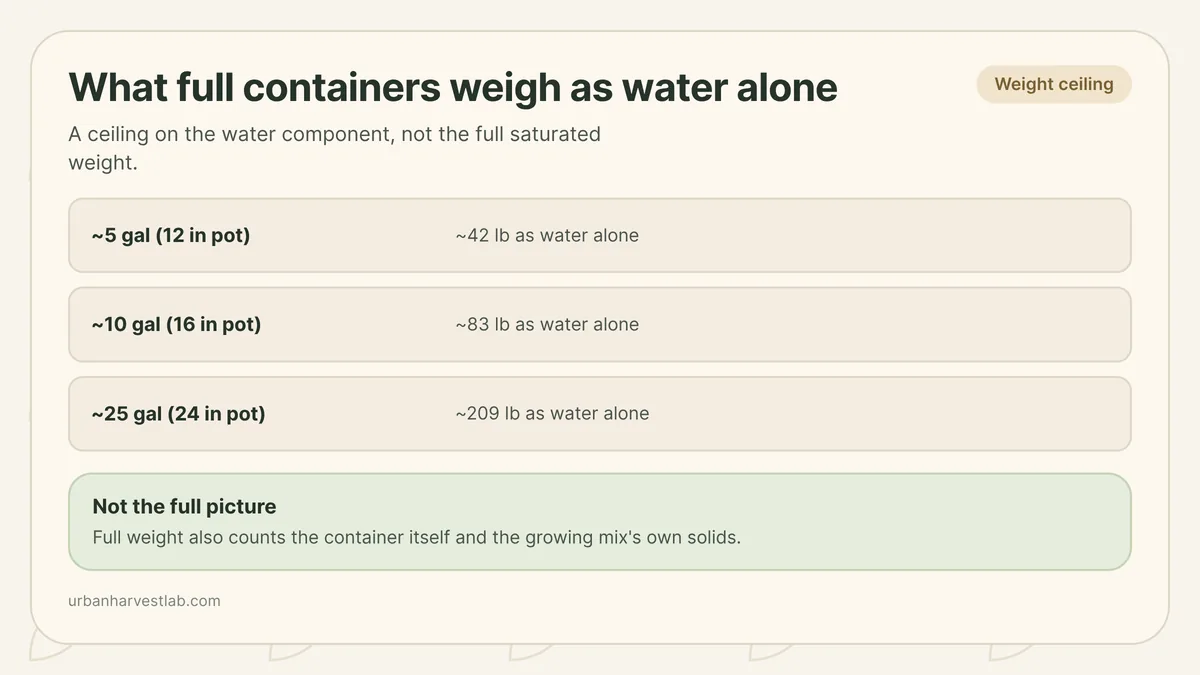
Balcony weight limit: calculate what your container garden really weighs
A balcony's real weight allowance comes from its own structural documentation, not a one-size figure online. What you can calculate yourself is exactly how much your containers weigh once every one of them is soaked through.