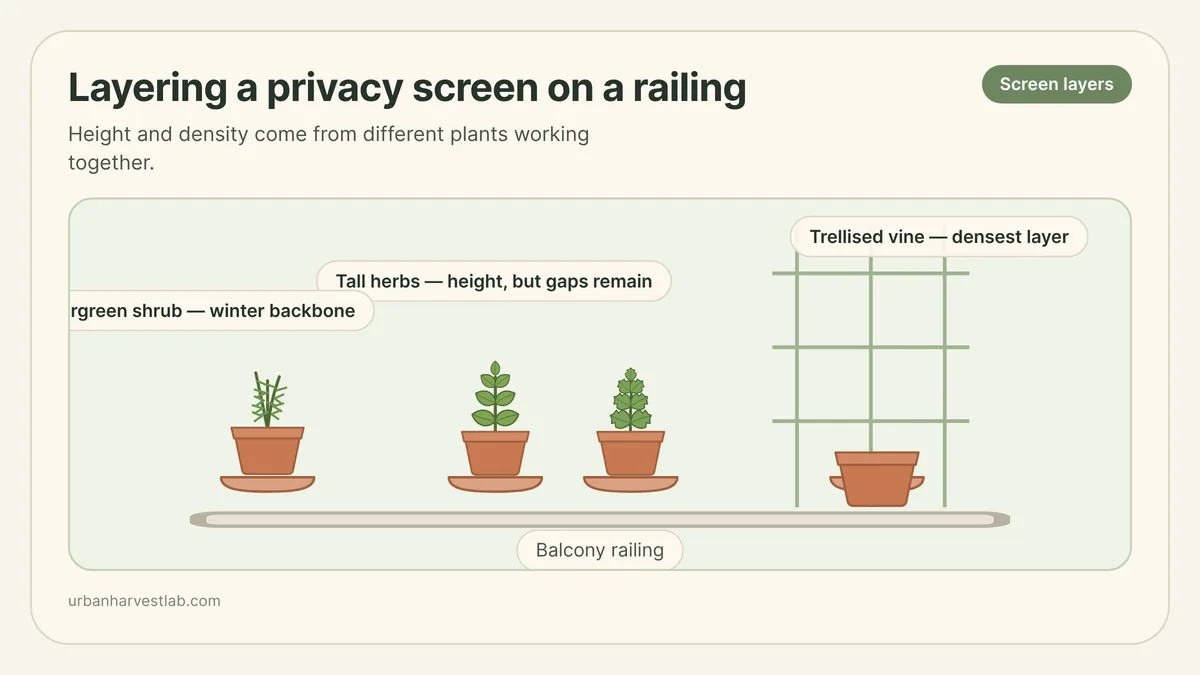
Edible options for a balcony privacy screen, by density and persistence
| Plant type | Height and habit | Screening density | Life cycle |
|---|---|---|---|
| Trellised vining edible (pole beans, cucumbers, peas) | Climbs the height of its support rather than its own stem | Dense, continuous cover once established | Annual, regrown from seed each season |
| Tall upright herb in a large pot (basil, mint) | UGA: basil "1-3 ft Upright" spaced 1-2 ft; mint "2-3 ft Upright" spaced 1 ft | Adds height but leaves visible gaps | Basil annual; mint herbaceous perennial (Clemson) |
| Feathery tall herb used at height (dill, fennel) | Airy, upright growth rather than solid foliage | Textural screen, not opaque | Dill annual; fennel biennial or perennial by type (Clemson) |
| Evergreen shrubby herb (rosemary, sage) | Branches densely with age; slower to reach height. UGA: lavender "18-36 in. Upright, shrubby," spaced 18-24 in. | Thin at first, thickens as it grows | Perennial evergreen shrub (Clemson); Illinois Extension lists both among herbs commonly overwintered indoors |
An edible privacy screen needs height and density working together, and no single potted herb supplies both at once. A trellised vining crop such as a pole bean, cucumber, or pea gets closest, because a support carries it as tall as the structure itself and it fills in leaf by leaf along the whole run. A row of tall herbs in pots adds height without much density, and a low, bushy planting adds density without height. Most balcony arrangements that look photogenic in a single shot fail at actual screening because they solve only one half of that problem. Building a trellis without drilling covers the structural half of that vine; what follows is which edible choices genuinely close a sightline, and which ones only look like they will.
Why a pot arrangement is not automatically a screen
A privacy screen has one job a decorative planting does not: it has to stay opaque enough, at eye level, across the width you are trying to cover, for most of the season you actually use the balcony. A single large basil plant or a cluster of small pots reads as a garden from three feet away and as gaps between stems from ten. The plants that actually close a view share one trait — they either climb a structure that carries their height, or they branch densely enough on their own that light does not pass straight through the middle of the plant.
That distinction matters more than any single plant’s reputation for looking lush. A tall, leggy annual can look full in a photograph taken straight on and still leave a clear line of sight the moment someone is standing at an angle to it. Judging a candidate by whether it blocks a view from the seat you actually use, not from a catalog photo, is the more useful test.
Trellised vining edibles: the densest option available
A vining crop trained up a support fills space differently than any free-standing plant can, because the trellis, not the stem, is doing the structural work. Pole beans, cucumbers, and peas all keep extending and branching along a support for as long as the season allows, covering a vertical run with overlapping leaves rather than a single stalk’s worth of foliage. That is the mechanical reason a trellised vine reads as a wall where a potted herb reads as a plant: the support lets the crop keep adding leaf area upward instead of the stem eventually running out of its own strength to stand up straight.
None of that works without a support that can actually hold the crop once it is loaded with foliage and, for a fruiting vine, developing pods or fruit. A container has no ground to sink a post into, so getting a trellis to stand up at all takes a different approach than a yard would. Building a trellis without drilling covers tension-mounted poles, in-pot tripods and obelisks, and free-standing frames that carry a vining crop’s weight without touching a wall or railing, which is the structural half of this project and worth settling before choosing which vine to plant on it. For the crop side, best vegetables for small balconies sorts which vining and compact vegetables actually suit a limited footprint in the first place.
A vining edible screen is also, by nature, an annual project. Beans, peas, and most trellised cucumbers complete their life cycle in one growing season and have to be started again from seed the following year, which means the densest part of the screen is only fully filled in for part of the year and needs replanting rather than pruning to bring it back.
Tall herbs add height, but not much density on their own
Some herbs are genuinely tall growers rather than low mounds, and it is tempting to use them as a screen the same way a hedge would be used. UGA Extension’s cultivation table codes basil’s mature size as “1-3 ft Upright” and mint’s as “2-3 ft Upright,” both grown free-standing rather than supported. That is real height for a potted plant, and both fill a large container’s footprint respectably by midsummer. What neither does is branch densely enough, at that height, to close a sightline the way overlapping vine foliage does. UGA Extension’s own spacing figures show why: basil goes 1 to 2 feet apart and mint 1 foot apart, so a stand of either reads as a cluster of upright stems with real gaps between them at that spacing, not a solid plane.
Getting either to that 1-3 ft or 2-3 ft ceiling at all also depends on the light they get, since falling short on sun produces a leggier, thinner plant rather than a fuller one. Clemson HGIC’s baseline for the herb bed is at least six hours of direct sun a day, matching Penn State Extension’s own six-hour figure, and best herbs for a sunny balcony covers which herbs actually make good use of a full-sun spot rather than just tolerating it. Life cycle is the other variable worth knowing before committing a season to one of these as a screen component: Clemson’s own table lists basil as an annual, while mint sits in the herbaceous perennial group alongside catnip, oregano, and thyme, meaning a mint screen can be cut back hard over winter and come back from the same root system, where a basil screen has to be restarted from seed.
Feathery tall herbs: texture, not a wall
Dill and fennel both grow tall and are sometimes planted for exactly this reason, but their growth habit works against them as screening material. Both have an airy, finely divided foliage structure rather than broad, overlapping leaves, so even a mature plant lets a good deal of light and shape through. They read as a textured backdrop, useful for softening a hard railing line or breaking up a view rather than closing it outright. Clemson HGIC lists dill as an annual, restarted from seed each year, while fennel is grown as either a biennial or a perennial depending on the type planted — worth checking on the seed packet or plant tag before deciding whether a fennel screen is a one-season or multi-year commitment.
Treating either as a decorative layer in front of or behind a denser element, rather than as the screen itself, matches what they actually do well. A row of fennel alone in front of a railing adds height and movement; it does not substitute for the vine or the shrub doing the actual blocking.
Evergreen shrubby herbs: slow, but the only ones that hold their shape in winter
Rosemary and sage are the outliers in this list because Clemson HGIC classifies both as a “perennial evergreen shrub,” a separate category from the herbaceous perennials and annuals discussed above. That classification describes the plant, not a guarantee for exposed container roots through a real winter: Illinois Extension lists rosemary and sage among the herbs commonly overwintered indoors, which is the more reliable route for a potted screen in a cold climate. Where a mild winter or a sheltered spot does let a mature rosemary or sage keep its branch framework and leaves outdoors, a screen built partly around one of these does not go bare the moment the annual vines finish their season. Overwintering rosemary and thyme in pots covers both the indoor and sheltered-outdoor routes.
The tradeoff is speed. Neither shrub reaches useful screening size in a single year the way a trellised bean does, and how long it takes depends on the plant and the growing conditions. Lavender is a related option with an actual sourced size to judge against: UGA Extension gives it “18-36 in. Upright, shrubby” with 18 to 24 inch spacing, though UGA’s table gives no comparable mature-size row for rosemary or sage specifically. That makes them a poor choice as the entire solution for someone who wants privacy this summer, and a strong choice as the permanent backbone a faster annual vine can be layered in front of while the shrub itself is still filling out.
Putting the layers together
None of the options above fully solves the problem alone, which is the practical reason a working edible privacy screen is usually a combination rather than a single plant choice. A shrubby evergreen backbone of rosemary or sage provides the part of the screen that survives winter without replanting. A trellised annual vine — pole beans, peas, or a cucumber — fills in the tallest, densest layer during the growing season, on a support built to carry it. Tall herbs like basil or mint, and feathery ones like dill or fennel, add height and texture in front of or beside the other two rather than carrying the screening load by themselves. Built this way, the planting has some structure standing through winter even though its densest, most opaque season is still the warm months when the vine is fully grown.
Wind changes the math once a screen is actually tall
A planting built to block a view is, almost by definition, tall and set at the edge of a balcony where it catches more wind than a low arrangement further back would. A dense, leafy screen also behaves differently in wind than an open, gappy planting does, since a solid wall of foliage has more surface for a gust to push against than a plant with visible space between its leaves. Windproof balcony garden covers how container weight, plant habit, and windbreak design interact at height, and it is worth reading before, not after, a trellis and a season’s growth are both fully committed to one spot on an exposed railing.
Large planters built to support a tall vine or a maturing shrub also add up in weight fast once their growing mix is fully saturated, which matters on any balcony rather than only a windy one. Balcony weight limit covers how to work out what a saturated container garden actually weighs against what a specific balcony can carry, which is worth checking before several large, screen-sized planters go up rather than after.
Sources
Building and protecting the structure behind the screen
These guides cover the trellis itself and the wind exposure a tall planting has to survive.
Common questions
What plants actually give balcony privacy?
A trellised vining edible such as a pole bean, cucumber, or pea trained up a support gives the densest, most continuous cover, because the structure carries the plant's weight the whole way up rather than the stem holding itself upright. Tall, free-standing herbs like basil and mint add height but leave more visible gaps, and evergreen shrubby herbs like rosemary and sage add structure that keeps its leaves through a mild winter outdoors, once they have had a few seasons to fill out — though a potted plant's exposed roots mean many growers bring rosemary and sage indoors for winter rather than counting on them outdoors.
Can potted herbs alone block a view?
Not fully in one season. UGA Extension's habit table puts basil at "1-3 ft Upright" and mint at "2-3 ft Upright," which adds useful height but still leaves a plant that reads as separate stems and leaf clusters rather than a solid wall. Herbs work best layered with a denser trellised vine rather than carrying the whole screen on their own.
Do I need a permanent structure for an edible privacy screen?
No. Several reversible supports carry a vining crop without drilling, and how to pick and build one is covered in this site's guide to trellising a plant without drilling a single hole.
Does a tall privacy planting need extra wind protection?
Yes. A tall planting is more exposed to wind than a low one, and a dense, leafy screen can catch more wind load than an open, gappy planting does. Wide, heavy containers and a plan for breaking the wind rather than standing flat against it both matter more once a planting is actually tall and full enough to screen a view.
Related guides
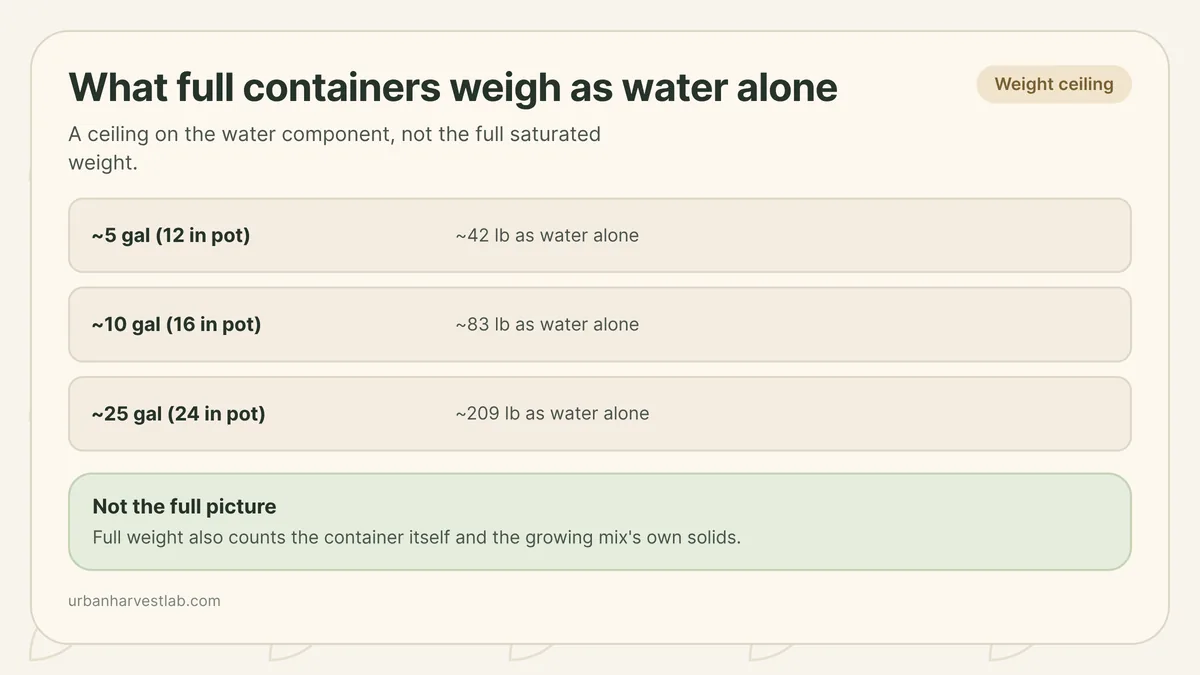
Balcony weight limit: calculate what your container garden really weighs
A balcony's real weight allowance comes from its own structural documentation, not a one-size figure online. What you can calculate yourself is exactly how much your containers weigh once every one of them is soaked through.
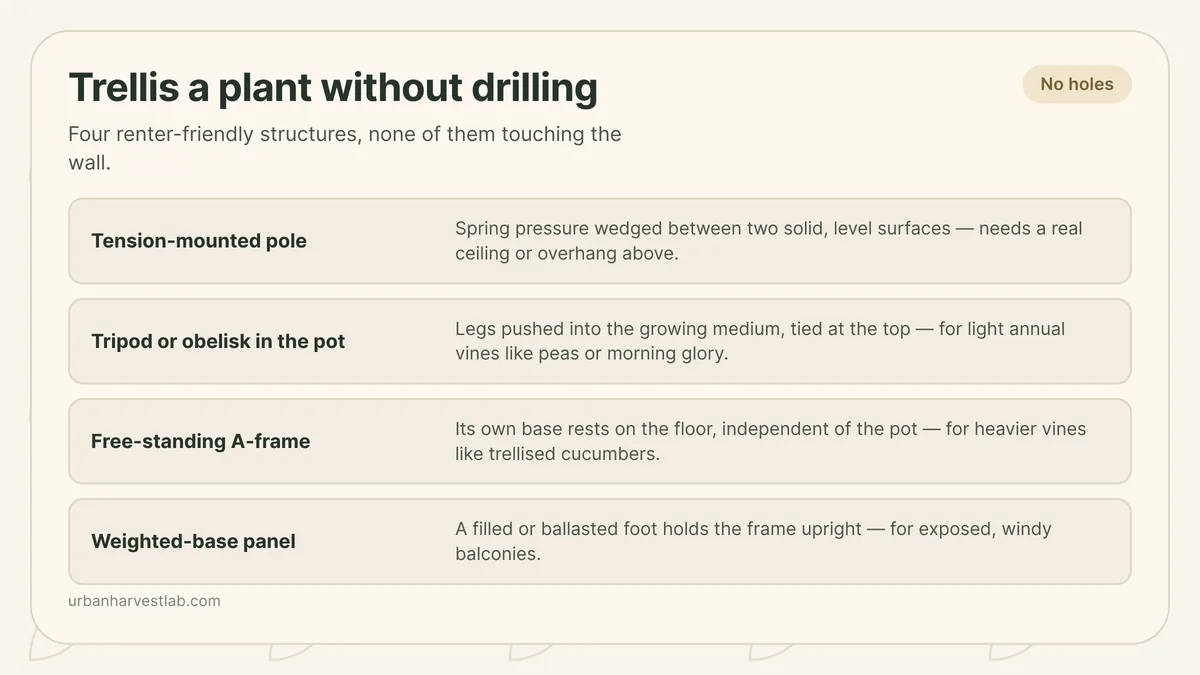
How to trellis a plant without drilling a single hole
A container has no ground to sink a post into, so a renter-friendly trellis has to get its stability from somewhere else. Four approaches do that without touching a wall, railing, or ceiling.
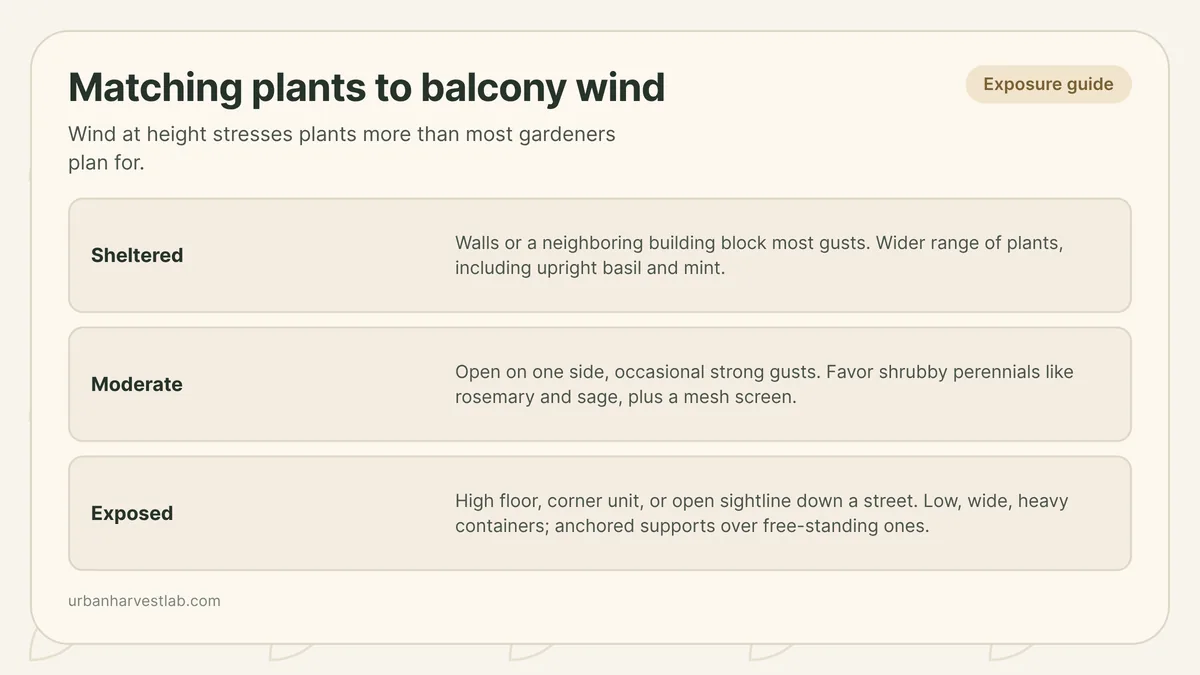
Windproof balcony garden: anchoring, plant choice, and windbreaks
A balcony catches wind differently than a yard does, and the fix is not one trick but three working together: heavier containers, plants suited to an upright or shrubby habit, and a windbreak that softens gusts instead of stopping them dead.