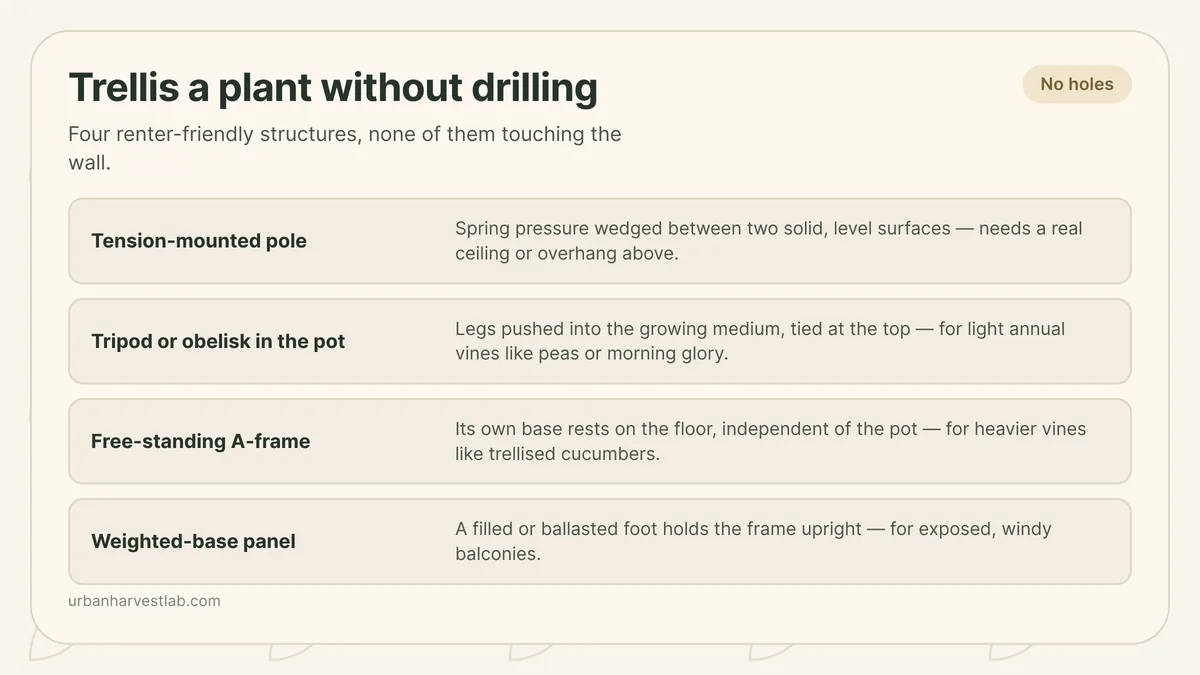
Renter-friendly trellis options at a glance
| Structure | How it stays up | Best fit | Main limitation |
|---|---|---|---|
| Tension-mounted pole | Spring pressure wedged between two solid, level surfaces | A covered balcony, alcove, or recess with a real ceiling or overhang overhead | Needs a genuine second surface; rated load varies by product |
| Tripod or obelisk in the pot | Three or four legs pushed into the growing medium, tied at the top | Light annual vines: peas, sweet peas, morning glory, nasturtium | Only as stable as the pot it is set in |
| Free-standing A-frame | Its own base rests on the floor; does not depend on the pot at all | Heavier fruiting vines such as trellised cucumbers | Takes up more floor footprint than a pot-set structure |
| Weighted-base panel | A filled or ballasted foot holds the frame upright on its own | Exposed, windy balconies where any tall structure needs extra ballast | The weighted base itself has to be carried and stored somewhere |
A climbing plant can be trellised without drilling by using a tension-mounted pole wedged between two solid surfaces, a tripod or obelisk pushed straight into the potting mix, a free-standing A-frame that carries its own weight on the floor, or a weighted-base panel that ballasts itself instead of the pot. None of the four touches a wall, a railing, or a ceiling, and all four come down again as easily as they went up. Which one fits depends less on personal preference than on how much the vine actually weighs once it is loaded with foliage and fruit — the same sizing logic covered in a beginner’s apartment vegetable garden plan for the container itself.
Why a container changes the whole problem
Every conventional trellising method extension services describe starts in open ground. Virginia Tech Cooperative Extension’s guide to vertical gardening has support posts driven “at least 18 to 24 inches into the ground using a mallet or post driver,” and the University of Wisconsin-Madison Division of Extension’s own trellising instructions set posts “about 2 feet into the ground about 12 to 20 feet apart” with tops standing roughly 6 feet above the soil surface. A balcony, patio, or windowsill has none of that: no 18 to 24 inches of undisturbed earth to sink anything into, and usually no permission to make a hole even where the material underneath would allow it.
Take that anchorage away and a trellis has three other places to get its stability from: friction against two building surfaces, the pot’s own mass and footprint, or a base of its own that stays independent of the container entirely.
Tension-mounted poles: the fastest reversible option
A tension pole holds itself up with spring pressure rather than a fastener. Extend it between two solid, level, parallel surfaces — most commonly the floor and a ceiling on a covered balcony, or the floor and the underside of a deep overhang — and the internal spring pushes outward hard enough to wedge the pole in place. No screws, no anchors, no marks left behind.
The catch is that this only works where a genuine second surface exists to push against. Many balconies have a railing and open sky overhead, not a ceiling, which rules a tension pole out entirely unless there is a covered section, an alcove, or a recessed doorway to use instead. Load capacity is the other variable worth checking before buying rather than after: it swings widely between products, and a spec printed on one manufacturer’s packaging does not carry over to a different pole. Treat a tension setup as suited to a lighter annual climber — sweet peas, a small clematis, a modest bean vine — rather than to a fruit-heavy crop until you have confirmed what a specific pole is actually rated to hold.
Tripod and obelisk structures set into the pot
A tripod turns the pot itself into the anchor. The University of Wisconsin-Madison Division of Extension describes the ground version of this shape directly: “three or four stakes can be grouped and secured at the top,” built from what it specifies as “5- to 6-foot wooden, metal, or plastic stakes,” with wooden stakes “at least 1 inch square” — close to the tomato stake Virginia Tech Cooperative Extension gives as “one inch thick, five feet long.” In open ground those stakes go roughly two feet deep; in a pot, the legs go into potting mix instead, so the usable height above the rim ends up shorter than the stake’s full length once enough of it is buried to hold the tripod upright. Three or four legs spread out that way, then tied, clamped, or bolted together near the top, and the structure stands on the same footprint the plant is already rooted in.
Because the pot is doing the anchoring, the pot’s own stability sets the ceiling on what the tripod can carry. A wider, heavier container gives the legs more to press against and a lower center of gravity for the whole assembly; a small, light pot with a tall obelisk in it is a top-heavy combination even before a vine fills in. Cucumber container size covers exactly that tradeoff for one specific vining, fruiting crop, where the container decision and the support decision have to be made together rather than the trellis added as an afterthought.
Free-standing A-frames: taking the load off the pot entirely
An A-frame or ladder trellis straddles the container instead of standing inside it. Two angled sides meet at a ridge, each leg resting its own weight on the balcony floor, deck boards, or patio slab — the pot underneath holds roots and nothing else. This is the option worth reaching for once a vine is carrying real weight, because the fruit load pulls against the frame’s own base rather than against the potting mix.
Virginia Tech’s guide notes that cages built for heavy fruit sometimes need a sling made from “old t-shirts and mesh bags” attached directly to the structure to cradle a fruit too heavy for the vine’s own stem — the same logic applies to an A-frame carrying melons, larger squash, or a fully loaded cucumber vine. The frame handles the vine’s weight; a sling handles the individual fruit’s weight, and the two are not the same job.
Weighting the base so wind does not undo the whole setup
A free-standing structure that is not screwed to anything has to resist wind entirely on its own, and University of Illinois Extension’s guidance on container stability applies here even though it was written about pots, not trellises: “Square pots are the most stable,” while “traditional pots (sliced off inverted cones) tip over easily,” and in general “look for a base broader than pot’s height to minimize overturning if that is a concern.” The same source is direct about what to do once a planting gets top-heavy — “strap or anchor tall plants in place” — and names balconies, rooftops, and decks specifically as the locations where this matters most.
A weighted-base panel applies that same logic to the trellis rather than the pot: a hollow foot filled with sand or gravel, a paver set over the base, or a second, heavier planter used purely as ballast all lower the structure’s center of gravity and widen its effective footprint without a single fastener. On an exposed, wind-prone balcony, that ballast is not optional extra credit — it is the difference between a trellis that stays upright through a storm and one that goes over onto a neighbor’s space below. Windproof balcony garden covers assessing that exposure and building a windbreak, and balcony weight limit covers whether the ballast itself fits inside what the floor can carry.
Matching the structure to what is actually climbing it
Not every vine needs the same amount of structure, and reaching for a full trellis by default sometimes solves a problem that is not there. A compact, determinate variety bred to stay short — dwarf tomatoes grown in pots on a small balcony are the clearest example — usually needs only a short interior stake to keep loaded branches from bending, not a tripod, an A-frame, or anything reaching overhead. A genuinely vining crop that keeps extending all season, like a trellised cucumber, is the case where the fuller structures earn their footprint. Matching the support to the plant’s actual growth habit, rather than to whichever trellis looked most impressive in a store, keeps the setup both lighter to store and easier to size correctly.
For a broader crop list sorted by what fits a small balcony in the first place, best vegetables for small balconies is the starting point before any of these support decisions.
Fitting it into a reversible setup
None of these approaches needs a landlord’s sign-off for the drilling itself, since none of them involves a drill, but a tall structure on a shared balcony is still worth mentioning to a property manager before it goes up, particularly if it will be visible from outside the unit or attached to a shared railing rather than free-standing. That conversation, along with the rest of what makes a rented outdoor space genuinely give-back-the-keys reversible, is covered in the renter’s garden checklist, which this trellis approach is one piece of rather than the whole picture.
Sources
- Virginia Tech Cooperative Extension, “Vertical Gardening Using Trellises, Stakes, and Cages” (HORT-189/SPES-450)
- University of Wisconsin-Madison Division of Extension, “Trellising, Staking and Caging – Vertical Gardening Techniques for Vine-Type Vegetables”
- University of Illinois Extension, “Container Size”
Choosing what to grow, and keeping the setup reversible
These guides cover the crop-specific case for a trellis and the wider reversible-setup approach it fits into.
Common questions
How do you trellis a plant without drilling any holes?
Four approaches avoid drilling entirely. A tension-mounted pole wedges between two solid, level surfaces using spring pressure. A tripod or obelisk pushes its legs into the potting mix, so the pot itself is the anchor. A free-standing A-frame rests its own weight on the floor. A weighted-base panel does the same with a ballasted foot instead of a wide frame. None of the four attaches to the pot, the wall, or the railing.
Will a tension-mounted pole hold up a heavy vine?
It depends on the pole and on what is actually growing on it. A tension pole only works where a real second surface exists to press against, such as a covered balcony ceiling, and its rated load varies a great deal between products, so check the manufacturer's own weight rating rather than assuming one figure applies across brands. A light annual vine is a safer match for this method than a heavy fruiting one.
What is the best free-standing trellis for a pot?
It depends on what is climbing it. A tripod or obelisk anchored directly in the growing medium suits a light vine such as peas, sweet peas, or morning glory. A heavier, fruiting vine such as a trellised cucumber does better on a standalone A-frame with its own base on the floor, since that keeps the fruit load off the pot rather than pulling against it.
Do climbing plants on a balcony need a full trellis?
No. Virginia Tech gives six-foot stakes driven two feet deep as sufficient for determinate tomato types and eight-foot stakes for indeterminate types — a pot cannot take two feet of stake, so a determinate or dwarf variety such as a patio tomato needs a proportionally shorter stake set into the mix rather than a full trellis structure.
Related guides
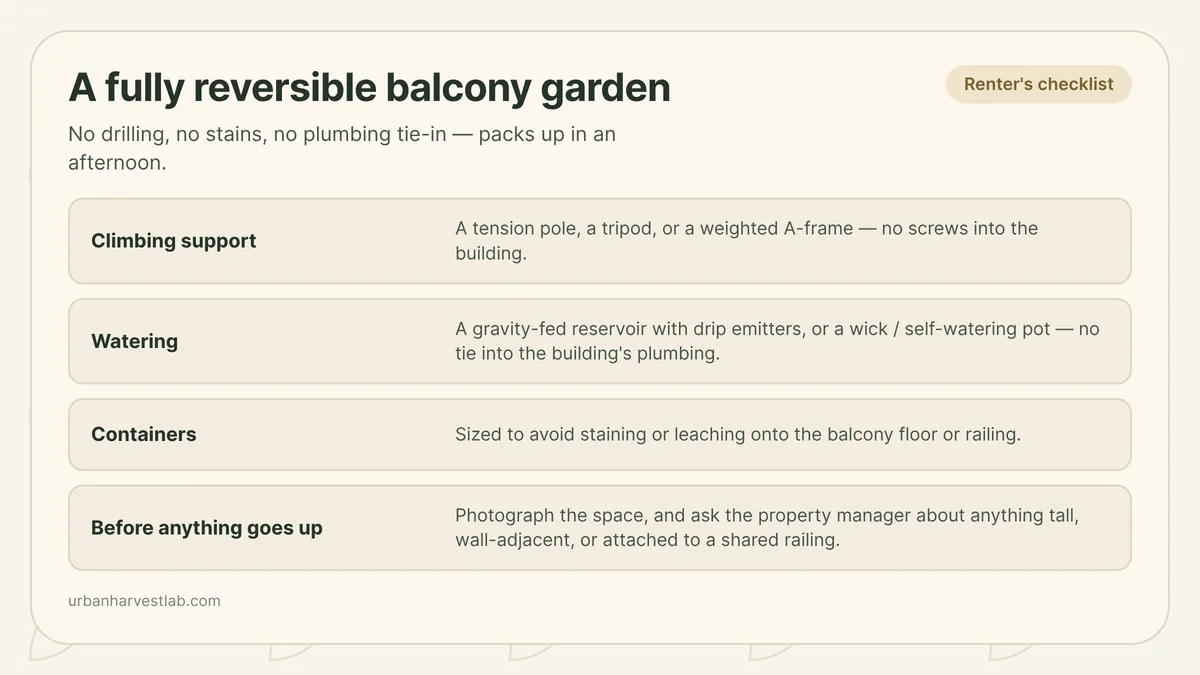
A renter's checklist for a fully reversible balcony garden
A rental garden holds up under a lease when nothing in it is drilled, stained, or plumbed in permanently -- the container, support, and watering choices that keep it that way, in one before-you-start checklist.
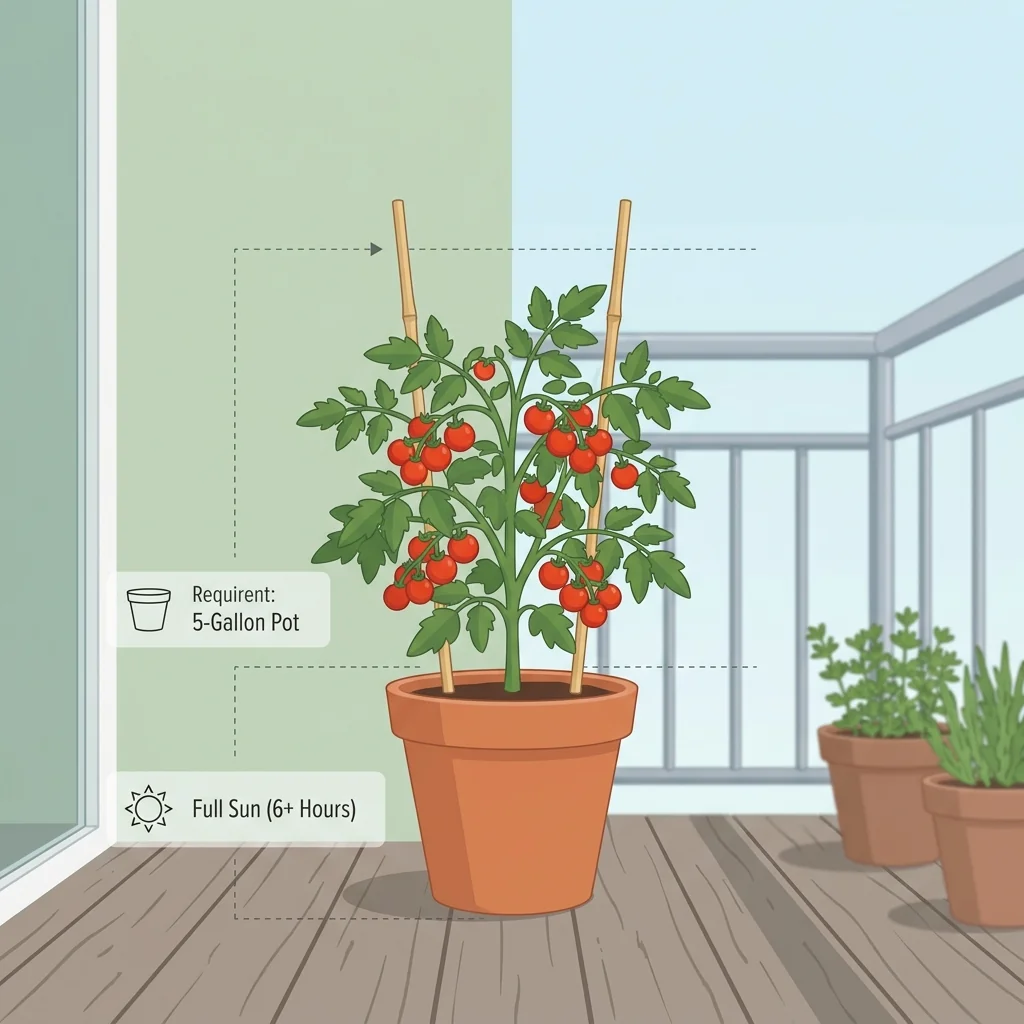
How to grow dwarf tomatoes in pots on a small balcony
Traditional tomato plants grow into massive, untameable 8-foot jungle vines that require giant cages and take over your entire balcony. But with modern 'micro-dwarf' or patio tomato varieties, you can grow heavy yields of sweet cherry tomatoes on a plant that stays under 2 feet tall. Here is the dwarf tomato container blueprint.
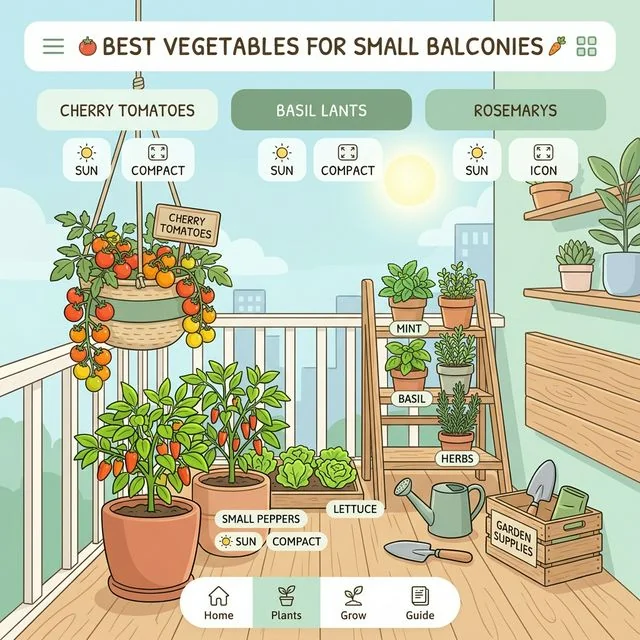
Best vegetables for small balconies: what produces well in tight spaces
Not every vegetable belongs on a balcony. These are the crops most likely to reward limited square footage without turning watering and support into a daily headache.