
Sealed tent versus open shelf for a home herb setup
| Factor | Sealed grow tent | Open shelf |
|---|---|---|
| Heat | Concentrates around the fixture unless actively vented | Dissipates into the room on its own |
| Light spill and mess containment | Contained by design | Visible to the room; compost and splashes land nearby |
| Photoperiod control | Its main engineering purpose — mostly irrelevant when herbs are harvested for leaf before flowering matters | Not needed for the same reason |
| Reflective benefit from wall material | Real, because walls sit close to the canopy | Limited; stray light has nowhere nearby to bounce off |
| Setup complexity | Extra structure, plus a ventilation plan to get right | Just a shelf and a fixture |
Search “grow tent for herbs” and most of what comes back assumes the answer is yes before it has asked the question. Herbs mostly do not need a grow tent — the enclosure was engineered for a different set of problems, and for basil, mint or parsley on a windowsill shelf it usually adds more heat than benefit. There is a real case for one, but it is narrower than the marketing suggests, and it has almost nothing to do with light performance.
If you have not settled on a fixture and space yet, the apartment grow light guide is a better starting point than a tent purchase — it covers what actually fits a small home space before you decide how to house it.
Quick answer: does a herb setup need an enclosure?
For most kitchen herbs grown at home, no. A grow tent’s reflective, light-sealed walls exist to solve problems that culinary herbs largely do not have, and a sealed space with no airflow plan trades a modest lighting benefit for a real heat problem. The exception is genuine: if light spilling into a shared room, mess, or curious pets is the actual issue you are trying to solve, a tent addresses that directly and an open shelf does not.
What a grow tent was actually built to do
Grow tents are built around light-tight seams, a reflective interior and a fan port — features that matter for crops whose growth stage depends on uninterrupted darkness, and for keeping smell and spill inside the enclosure. Those seams and that interior are not decorative: for some crops, a few minutes of stray light reaching the canopy at the wrong time changes how the plant develops.
Neither of those goals maps cleanly onto a basil plant on a kitchen shelf. Culinary herbs are grown for their leaves and stems, not carried through a light-triggered flowering stage the way photoperiod-sensitive crops are. A tent’s headline feature is mostly wasted on the crop you are actually growing.
What an enclosure genuinely gives you
None of that makes a tent useless for herbs — it means the reasons to use one are different from the reasons the product exists.
Reflection works better inside a tent. A reflective surface can only return light that would otherwise be lost, and how much it helps depends heavily on how close the reflective wall sits to the canopy — the same geometry an enclosure naturally provides. On an open shelf, stray light disperses into the room with nothing nearby to catch it; inside a tent, nearly all of it hits a wall a short distance away. The physics and the failure modes — creasing, dust, hot spots from a wrinkled liner — are covered in full on reflective materials for a grow shelf. A reflector can only redirect light the fixture is already producing, so the gain is capped by how much was missing the plants in the first place — that cap is the whole of what an enclosure buys you here.
Containment matters more than people admit. A grow light left running in a studio flat throws light into a room where someone is trying to sleep, and a tray of seed-starting mix and watering splashback is not something everyone wants sitting in the open. A tent solves both directly: it is a light-and-mess boundary, not a growing tool. If your setup lives in a bedroom or a shared space, this is worth weighing on its own terms rather than dismissing as marketing.
The case against, and why it is the stronger one for herbs
Heat is the real cost, not an inconvenience. A sealed enclosure holds warm air near the fixture instead of letting the room absorb it, and that shift changes the daily light total a herb actually does best at — not the same way for every herb, so a hotter tent is not simply worse or simply better, just harder to judge by feel. Managing heat around a grow light covers what that shift means in practice and what actually helps.
Herbs do not need the light discipline a tent is built around. The light-tight seams that make a tent good at containing a photoperiod-sensitive crop’s schedule are solving a problem you do not have when you are cutting leaves long before anything flowers. You are not protecting a flowering trigger from stray light; you are mostly just adding a layer of structure around a shelf that did not need sealing in the first place.
An unventilated tent is worse than an open shelf. This is the failure mode that undoes the whole idea. An open shelf gets whatever air the room already has moving through it, for free. A tent gets none of that unless someone deliberately builds an airflow path in and out of it, and a sealed tent cannot build that path with vents alone — it needs a fan doing the work. Zip a tent shut around a lit fixture with no fan running and no air moving, and you have built an environment that is warmer than the room, with none of the airflow the room would have provided anyway — the worst of both options at once. If a tent is going to be used, treat the fan and its vents as part of day one setup, not something to revisit later if plants start looking stressed.
A sealed glass display cabinet runs into a related but different problem. A tent’s fabric vents and fan port are built with airflow in mind, but a fan is what actually moves air through them rather than the vents doing that work on their own; a glass-fronted cabinet has no such path built in at all and holds humidity along with heat, which is why it suits humidity-loving houseplants and cuttings far better than it suits herbs — the tent’s case rests on containment, not on trapping moisture.
Where the comparison actually lands
For most home herb growers, an open shelf that the room ventilates on its own is simpler, cooler and easier to get right on the first try, and it costs less in complexity even before running costs enter the picture — those are covered separately in grow light electricity cost and do not move much either way between a tent and a shelf. A multi-tier open rack is a reasonable default setup for exactly this reason, and the four-tier herb rack page compares the shelf options tier by tier.
A tent earns its place when the problem you are actually solving is containment, not light performance. That is a legitimate reason to choose one. It is just a different reason than the one the product’s own design suggests.
Setting one up so it earns its place
If containment is the reason you are using a tent, the setup still needs to work as a growing space, not just a box. Hang the fixture at the same distance from the canopy you would use on an open shelf — measure from the leaves, not from the tent’s roof, since the enclosure adds height you would not otherwise account for. Run the cord and the driver out through the cable port rather than coiling them inside the sealed space; a driver sitting in warm, still air ages faster than one left in the room. Plan for a fan before you plan for vents: a tent is sealed enough on every side that opening mesh panels does not on its own get air moving, so managing heat around a grow light is worth reading before you set one up. Once a fan is in place, the vents give it somewhere to draw from and push to — open one low, near the floor, as the intake, and one high, near the top, for the fan to push warm air out through, rather than treating the two as interchangeable holes. In the first week, check the top of the canopy before the rest of the tray — that is where heat collects first and where a herb that is struggling with the new environment shows it earliest.
Common mistakes
- Buying the tent before checking what it is replacing. If the current setup is an open shelf that is working, sealing it into a tent without a ventilation plan usually makes things worse, not better.
- Assuming reflective walls are the main event. They are a real but modest bonus on top of a fixture that is already delivering enough light — not a substitute for getting distance and daily light integral right in the first place, covered on the DLI targets page.
- Leaving vents closed “to keep the heat in for the plants.” A closed tent does not just get warmer, it changes the daily light total each herb does best at — and not in the same direction for every herb, so trapped heat makes the setup harder to judge rather than kinder to the plants.
- Treating the tent as a fix for weak growth. If herbs are leggy or pale, that traces back to light and setup basics covered in growing herbs indoors under a grow light, not to whether the shelf has walls around it.
Sources
- Walters, Tarr & Lopez (2023), “Modeling purple basil, sage, spearmint, and sweet basil responses to daily light integral and mean daily temperature,” PLoS One — the basis for how a herb’s daily light optimum shifts with growing temperature.
- MSU Extension, “Daily light integral defined” — background on daily light integral as the measure that matters for plant growth.
- University of Minnesota Extension, “Lighting for indoor plants and starting seeds” — general guidance on home indoor lighting setups.
Compare your enclosure options
A tent is one way to house a herb setup. These cover the open-shelf alternative, the reflective-surface question, and the running costs that don't change much either way.
Common questions
Do herbs need the light discipline a grow tent provides?
Not in the way the tent was designed for. Grow tents earned their light-sealed walls because some crops change their growth stage based on uninterrupted darkness, so a stray streetlight or a hallway lamp reaching them at night can throw that off. Basil, mint, parsley and the other kitchen herbs people grow indoors are harvested for leaf and stem, not carried through to a light-triggered flowering stage, so a few stray lumens reaching the tray at night is not the same kind of problem.
Will a tent make herbs grow faster than an open shelf with the same light?
Not on its own. Growth tracks the light actually reaching the canopy and the temperature the plant is growing in, not whether walls surround the setup. An enclosure can help a fixture's output go further by reflecting some stray light back, covered in more depth on the reflective-materials page, but it can just as easily hurt growth if it traps heat the open shelf would have let go.
I already own a tent — should I use it for herbs anyway?
Use it, but treat the fan as the first setup task, not an optional upgrade — a sealed tent does not move air on its own the way an open shelf does. A tent with no airflow running warmer than the room around it is a worse environment than an open shelf, because it adds heat without adding anything herbs need in return. A fan moving air through the vents, not the vents by themselves, is what turns a tent from a liability into a reasonable enclosure.
Is a tent worth it just for containing light spill and mess?
That is the strongest real case for one. If the setup sits in a bedroom or a shared living space and the light or the compost mess is the actual complaint, a tent solves that directly in a way an open shelf cannot. It is a containment decision at that point, not a growing decision, and it is worth being honest with yourself about which one you are actually making.
Related guides

Grow light heat management: what actually matters on a shelf
A warm top shelf is not just a comfort problem. It changes the light your herbs want and wears the fixture down faster, and the fix is usually smaller than a fan.

Do reflective materials actually help a grow light shelf?
Foil, mylar, and white paint can return some of the light that would otherwise land on a wall. Whether that is worth doing depends more on your shelf than on the material.
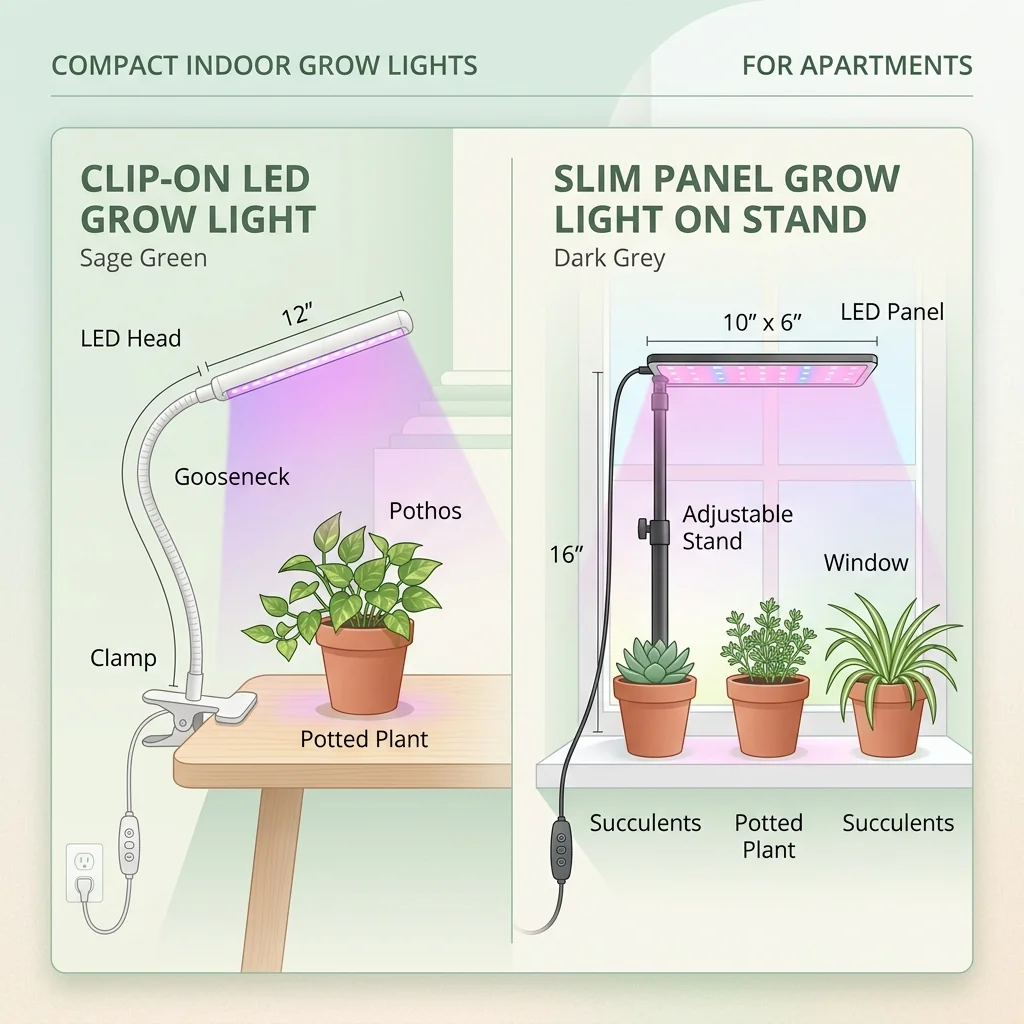
Best grow lights for apartments and windowsills
Apartments need grow lights that fit a small space and look acceptable in a living room. Here are the best compact LED types and what to check before buying.