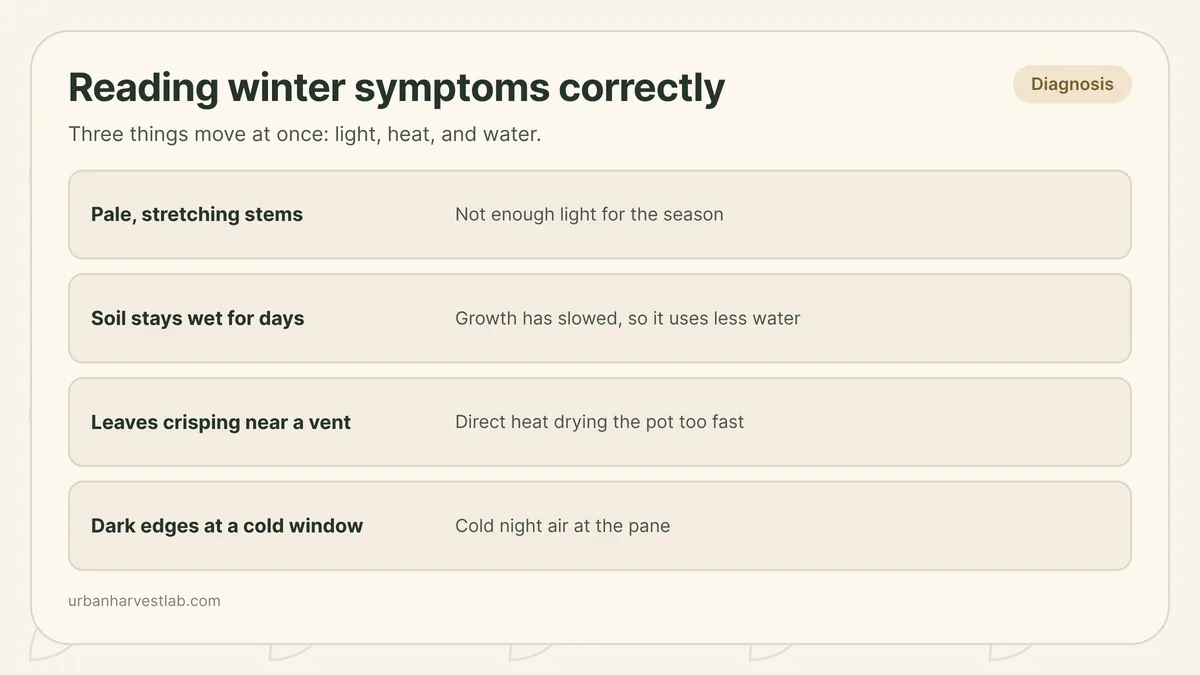
Winter symptoms and what usually causes them
| Symptom | Likely cause | What to do |
|---|---|---|
| Stems stretching toward the window, new leaves pale | Not enough light for the season | Move to the brightest window or add a grow light |
| Soil staying wet for days after watering | Growth has slowed, so the plant is using less water | Check the mix 1 to 2 inches down before the next watering |
| Leaves crisping or curling near a vent or radiator | Direct heat drying the pot and the foliage faster than the room | Move the pot at least a few feet from any direct heat source |
| Leaf edges darkening near a cold window at night | Cold air at the pane; Penn State notes basil discolours below 40 degrees F | Pull pots back from the pane after dark or add a barrier |
Winter indoor herb care comes down to three things moving at once: less light, drier air from heating, and a plant that is growing more slowly and needs less water. Treat any one of them alone and the other two keep working against the pot. The starting point is small-space herb gardening, and this is the seasonal layer on top of that setup once the days get short.
Why the same windowsill stops working in November
A spot that carried basil and mint all summer can start looking thin within a few weeks of the clocks changing, and it is rarely one single cause. A window that delivered eight or nine hours of usable daylight in July can be down to three or four by December even facing the same direction, because the sun sits lower in the sky and less of its light reaches leaves sitting back from the glass, not just because the clock hours of daylight shrank. Heating systems switch on, which changes how fast a small pot dries out compared with the same pot in summer. And the plant itself, responding to less light, grows more slowly and needs less water to support that growth. None of the three problems announces itself clearly on its own — a leggy, pale plant that is also sitting in soggy soil is showing the light problem and the watering problem at the same time, and treating only one of them leaves the other unresolved. If you have not built the basic indoor setup yet — containers, drainage, and where in the home to put them at all — indoor herb garden setup for apartments without outdoor space covers that groundwork; this is what changes on top of it once the season turns.
Give herbs enough light through the darkest months
Light is usually the first thing to fail in winter, and it sets a floor under everything else. Penn State Extension puts the baseline for most herbs at 6 hours of direct sunlight a day, indoors or out. University of Georgia Extension gives a lower indoor figure specifically, at least 4 to 6 hours, so the two sources bracket a similar range rather than disagreeing outright. Not every herb needs the same amount: Penn State names lemon balm, chives, and cilantro as the herbs that tolerate the low end, managing on as little as 2 to 6 hours. Thyme, rosemary, and oregano generally want the fuller 6-hour figure and struggle harder when a window falls short of it. Basil wants more still — Penn State’s own basil page asks for at least six to eight hours of full sun — which is why basil is usually the first herb on a windowsill to fail once the days shorten. For the herbs that actually cope with a weaker winter window, the best herbs for low-light kitchens and windowsills covers the selection side of this in more depth.
When a window cannot supply that on its own, Penn State’s fallback is a simple fluorescent setup: two 40-watt cool-white bulbs held 6 to 12 inches from the foliage, run for 14 to 16 hours a day. That figure is a starting point rather than the only workable setup — modern LED grow lights cover the same job with different specifications, and matching a fixture’s coverage and output to a particular shelf is its own decision. Growing herbs in winter: why grow lights become necessary covers that decision, including how to read a fixture’s numbers and where to position it once the natural light in a room has genuinely run out.
What heated indoor air does to soil and leaves
Forced-air heat changes the room in a way that is easy to miss because the air does not feel obviously different. Moving air dries a container faster than still air at the same temperature, which is part of why Iowa State University Extension’s watering frequency for container plants swings across such a wide range — from once or twice a day in small pots during hot, windy weather, down to once or twice a week for a large container in cool weather. A furnace or radiator running through a room does not make it hot, but it does keep air moving past the leaves and the soil surface, which pushes a small pot’s drying rate toward the faster end of that range even when the thermostat reads a mild, comfortable number.
The practical response is not to water more automatically, since growth is also slowing at the same time for a different reason. Instead, watch the pot itself. Group several pots together rather than spacing them out, since a cluster of plants raises the humidity immediately around the leaves compared with one pot standing alone in dry, moving air. Keep foliage clear of the airflow from a vent or the direct radiant heat of a radiator; both dry a nearby pot much faster than the ambient room temperature would explain, and direct heat can also scorch leaf tissue that sits too close. On the opposite side of the same window, cold glass at night can chill leaves that touch it — Penn State Extension notes that basil’s leaves discolor below 40°F, which is a plausible night-time temperature for the few inches of air right against a cold pane even in a warm room. Pulling pots back from the glass after dark, or adding a thin barrier such as a curtain liner, avoids that chill without needing to move the plant across the room.
The same dry, warm air that speeds up drying is also the environment several common indoor pests prefer, so a plant that stayed clean all summer can pick up a new problem once heating season starts. Preventing pests on indoor herbs covers the early signs to check for and how to head them off before an infestation sets in, which is worth a quick read the same week you move plants closer to a heat source or start running a grow light nearby.
Cut back on watering as growth slows
Winter growth for most kitchen herbs is real but reduced, since less light means less new leaf tissue being built and less water pulled through the plant to build it. Keeping a summer watering schedule into winter is one of the more common ways a healthy plant ends up with wet, stressed roots. Iowa State’s guidance for container plants generally is to water when the potting mix is dry at a depth of 1 to 2 inches, checked by finger rather than by the calendar, and to fully remoisten a container that has dried out completely by standing it in a tub of water for 20 to 30 minutes. That test works the same way in winter as it does in July; what changes is how often the mix reaches that dry point, not the test itself.
Clemson Cooperative Extension makes an important point that applies directly here: the symptoms of over-watering and under-watering are similar, and both lead to poor root health and eventual decline. A wilting, unhappy indoor herb in January is not automatically thirsty — it is just as likely to be sitting in mix that has stayed wet since the last watering. Checking the root zone directly, rather than reading the leaves alone, is the only way to tell the two apart. For the fuller day-to-day routine, including feeding, potted herb care covers watering and pruning together, and the by-herb rhythm for the plants most commonly grown in a kitchen setup lives on the herb watering chart.
Feeding should slow down along with watering. Iowa State’s fertilizing guidance for container plants is built around the active summer growing season, at roughly every 1 to 3 weeks with a 1:2:1 nitrogen-phosphorus-potassium ratio product. An indoor herb growing slowly through the darker months is not building the leaf tissue that guidance is written for, so keeping the same feeding rhythm mostly adds unused fertilizer salts to a mix that is already staying wet longer between waterings. Stretching the interval out, or pausing altogether for a herb that has clearly stopped putting out new growth, matches the feeding to what the plant is actually doing rather than to the calendar.
Annual herbs keep growing; perennials slow down differently
Not every herb responds to winter the same way, and the difference comes down to its life cycle rather than anything about your setup. Clemson’s own classification splits the common kitchen herbs into annuals (basil, cilantro, dill, among others), a biennial (parsley), and perennials, including the herbaceous group (chives, mint, oregano, thyme) and the evergreen shrub group (rosemary, sage). An annual herb brought indoors and kept lit and watered correctly simply keeps growing through winter as an indoor plant; it has no dormant season built into it, so a struggling indoor basil in December is a setup problem, not a natural winter decline. Parsley, the biennial in that list, behaves like an annual through its first winter and keeps producing usable leaves; the decline that eventually follows is tied to its second-year flowering rather than to the season, so a first-year indoor parsley plant does not need the perennial routine below.
Perennial herbs behave differently, and not all the same way. Clemson groups rosemary and sage as evergreen shrubs and thyme, oregano, mint, and chives as herbaceous perennials — both groups slow down over winter even with reasonable light, but only the herbaceous group is expected to look visibly reduced at the top, since an evergreen shrub holds its foliage through a mild winter in a way the herbaceous perennials do not. Treating either kind of slowdown as a setup failure leads to overwatering exactly the plants that need it least right then. University of Illinois Extension’s guidance for overwintering these tender perennials indoors calls for a cooler spot in the 40-60°F range — its general figure for a tender perennial overwintered indoors, not a minimum published for rosemary, sage, or thyme individually — watering only once the top inch of soil has dried, and no fertilizer at all while the plant is not actively growing. That is a different routine from the one an actively growing annual needs, and running both routines the same way is a common reason a perennial herb looks worse indoors in February than it did in October. Overwintering rosemary and thyme in pots covers that woody-perennial routine in full, including how to bring a plant in from outdoors before the first hard frost.
A short checklist for the season
Run through this once when the heating switches on, and again if a plant that was doing fine suddenly starts looking off:
- Measure your actual light before assuming the spot has failed: track when direct sun reaches the leaves over a few typical days, rather than judging by how bright the room feels.
- Add a grow light once a window genuinely cannot cover 6 hours for a full-sun herb, or 2 to 6 hours for a tolerant one like chives or cilantro.
- Keep pots a few feet from radiators and heating vents, and back from cold glass at night.
- Check the mix 1 to 2 inches down before watering, instead of following a fixed schedule.
- Treat perennial herbs like rosemary and sage differently from annuals like basil once winter sets in — cooler, drier, unfed, rather than business as usual.
Sources
- Penn State Extension: Growing Herbs Indoors
- Penn State Extension: Basil, a Summer Favorite
- University of Georgia Extension Bulletin 1170: Herbs in Southern Gardens
- Iowa State University Extension: How to Care for Plants Growing in Containers
- Clemson HGIC: Herbs
- Clemson HGIC: Indoor Plants – Watering
- University of Illinois Extension: Overwintering Tender Plants
Winter herb care, piece by piece
These guides cover the light setup, the watering routine, and the woody perennials that need their own winter plan.
Common questions
Can herbs survive winter indoors?
Most kitchen herbs can, but the setup that worked in summer usually needs adjusting. Light is the biggest constraint: Penn State Extension puts most herbs' need at 6 hours of direct sun, with lemon balm, chives, and cilantro tolerating as little as 2 to 6 hours, and a windowsill delivers fewer hours and weaker light through the coldest months. Heated indoor air also dries pots out on a different rhythm than summer heat does.
Do indoor herbs need less water in winter?
Often yes, because growth slows with the shorter days and the plant is using less water to build new leaves. The safer approach is Iowa State University Extension's test — check whether the mix is dry 1 to 2 inches down and water then, rather than on a fixed schedule — since a warm, dry, forced-air room can still pull moisture out of a small pot quickly.
Why are my indoor herbs leggy and pale in winter?
This is usually a light shortfall rather than a feeding or watering problem. Stretched stems and pale new leaves are the classic signs that a spot which worked in summer is no longer delivering enough hours or intensity, and the fix is more light, not more fertilizer.
Should I keep herbs near a heating vent or radiator in winter?
No. Direct heat from a vent or radiator dries out a small pot much faster than the room's general warmth does, and it can stress or scorch leaves that sit close to it. Keep pots a few feet clear of direct heat sources even if that spot is otherwise convenient.
Related guides
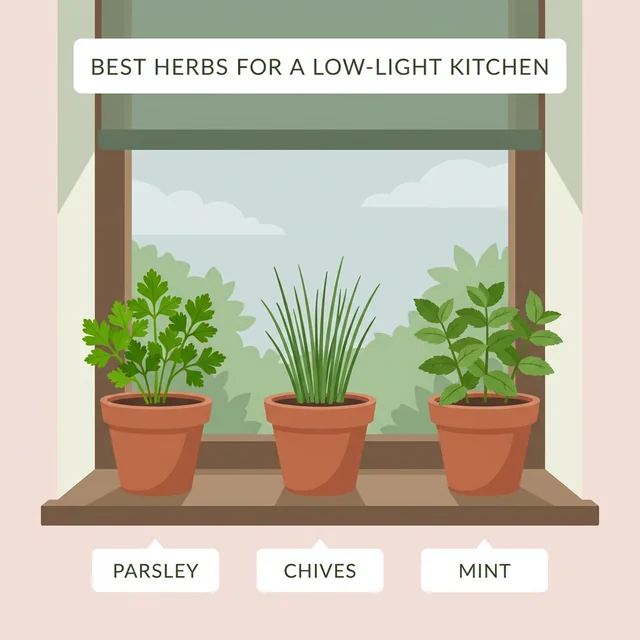
Best herbs for low light: what actually grows on a windowsill
Stop trying to force basil to grow in the dark. If your kitchen gets limited indirect light, stick to these forgiving herbs like parsley, chives, and mint.
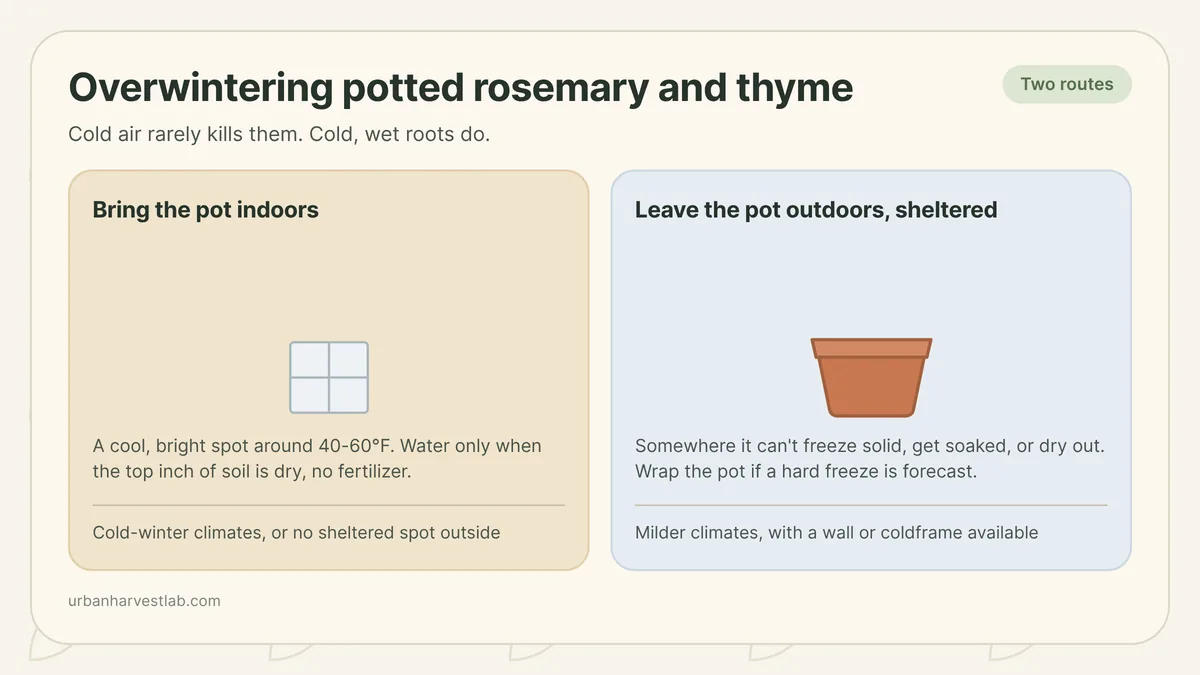
How to overwinter rosemary and thyme in pots
Winter kills more potted rosemary and thyme through mistimed watering and cold-wet roots than through cold air alone. Here is what to do indoors and out.
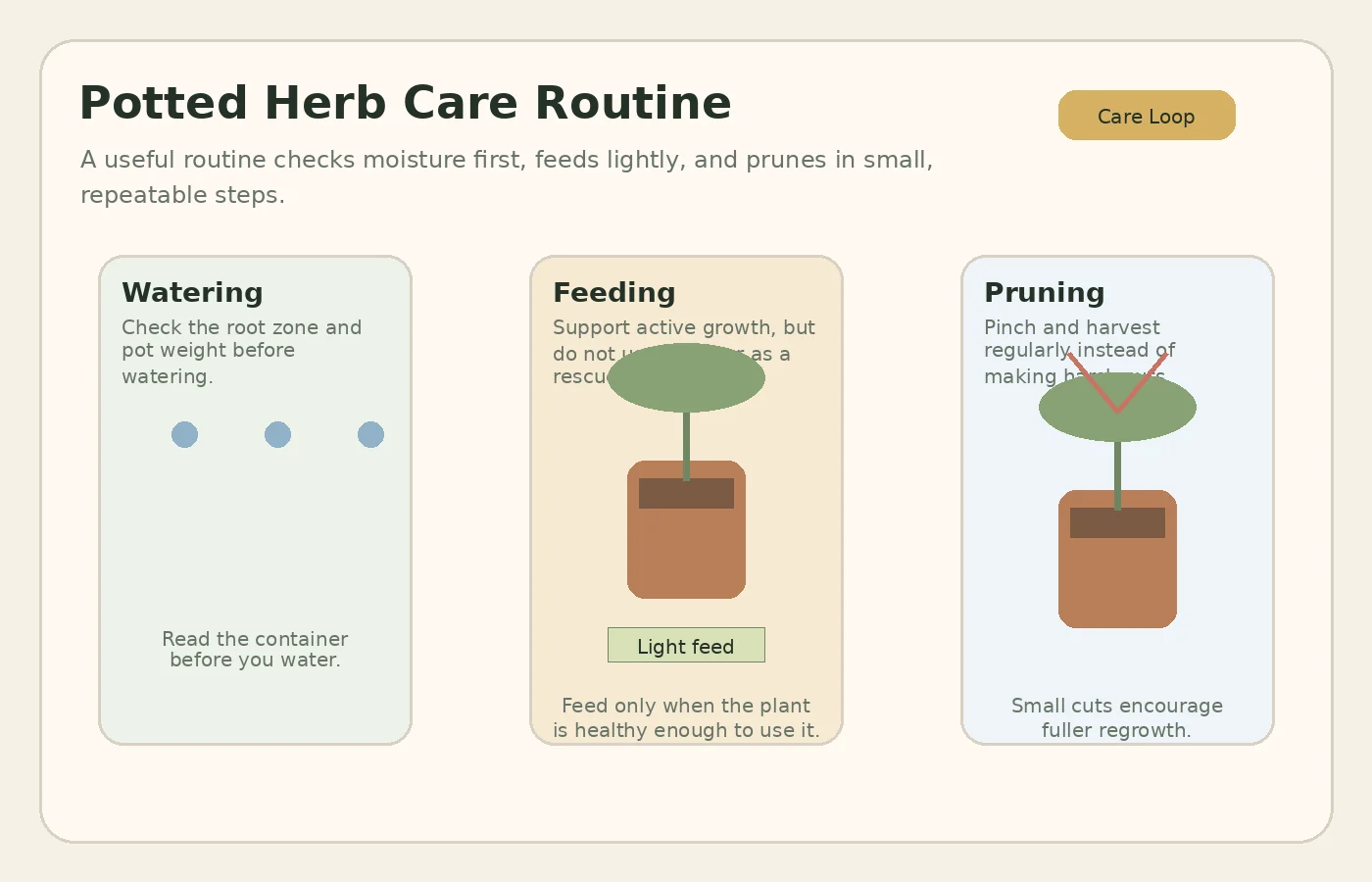
Potted herb care: watering, feeding, and pruning without guesswork
A practical guide to keeping basil, parsley, mint, thyme, and chives healthy by matching watering, feeding, and pruning to the setup.