
Winter light problems and the smallest useful fix
| Symptom | Likely cause | What to try first |
|---|---|---|
| Herbs that grew fine all summer are now stretching or fading | Fewer daylight hours and a lower sun angle through the same window | Add a grow light beside the window rather than swapping the window out entirely |
| Growth has stalled even though a grow light is already running most of the day | Photoperiod may already be near the useful ceiling, or the schedule and placement just have not been checked | Check the current runtime against the 12 to 16 hour range and the fixture's distance from the leaves before buying a stronger one |
| A herb on a cold windowsill looks worse than the same herb on a warmer shelf under an identical light | A fixture kept further back to avoid a cold, drafty pane can end up delivering less light there than the same fixture would on a warmer shelf | Move the light as close as the crop allows before assuming the cold air itself is the cause |
Winter is a light problem before it is anything else. Shorter days and a lower sun angle cut both the number of hours a window delivers light and how strong that light is while it lasts, so the exact spot that grew basil well in June often cannot do the same job in December. That is a seasonal delivery fact, not a sign that a technique failed or a plant got weaker. Once that is clear, the fix is usually a grow light added to the setup you already have, not a rebuilt one — see how much light herbs need if you have not yet worked out your baseline.
Why winter changes the math, not just the mood
A window’s light output depends on how long the sun is up and how directly it hits the glass, and winter cuts both at once: fewer daylight hours, and a lower sun angle that meets the same pane of glass at a shallower, less useful angle for longer stretches of the day. Purdue Extension puts outdoor DLI at northern latitudes between December and March at 5 to 30 mol·m⁻²·d⁻¹, well below the 5 to 60 range the same source gives across the full year, and Purdue notes that glazing, structure and shading on top of that cut the delivered DLI by a further 40 to 70%, with the low cases landing at 1 to 5 mol·m⁻²·d⁻¹. Those are outdoor and greenhouse measurements, not a windowsill’s own number, but they size the seasonal drop and the cut any glass takes out of it. That double cut, not a single problem, is why a spot that looked “bright enough” all summer stops working once the season turns — the fuller comparison between a sunny window and a grow light lives on grow lights vs sunlight.
The unit that actually survives a season change
Daily light integral, or DLI, folds hours and intensity into one number, which is why it is more useful than either alone once both are moving through the year. Michigan State University Extension sets the floor for leafy herbs and greens at 12 mol·m⁻²·d⁻¹, with quality dropping off measurably below 10 — DLI targets for herbs and leafy greens covers where each herb sits above that floor, and PPFD and DLI for indoor herbs covers measuring your own shelf rather than guessing from how bright it looks.
Supplementing the window, not necessarily replacing it
Most winter herb setups start as a window that used to be enough, which is a different starting point from building a grow-light station from scratch. A fixture placed near an existing window adds to real daylight rather than competing with it on a clear day, so the two work together instead of one making the other redundant.
The lever a windowsill grower actually has in winter is hours, not intensity — you cannot make the sun sit higher or stay up longer, but you can extend the lit period with a fixture on a timer. The practical question through autumn is how many extra hours to add, and at which end of the day. A window still delivers usable, if weaker, light for as long as the sun is actually up; the shortfall to fill is what happens before sunrise and after sunset, so add the supplemental hours at whichever end the household’s own routine needs — earlier for a kitchen shelf seen at breakfast, later for one checked in the evening. The daily total and an uninterrupted dark block are what matter, so the fixture can extend either end as long as the lit period stays continuous with the daylight.
Position follows the same logic. Put the fixture where it fills in the hours and angle the window is missing, close enough to the herbs to matter but not stacked directly against the glass, where it would block the daylight still arriving for free — grow light distance for seedlings covers working out how close is close enough by measuring rather than by a fixed number. On a run of heavily overcast days, the window’s contribution drops sharply, and a schedule built around “the window handles midday” stops holding — treat those stretches as though there were no window at all and let the fixture cover the fuller range. As days lengthen again into spring, the window starts covering more of that range on its own, and the supplemental hours can come back down to match.
How to grow herbs indoors under a grow light covers getting that combined setup running end to end, and if the window itself is the weaker element in a low-light home rather than just the season, windowsill herb garden for low-light homes and growing herbs in a low-light apartment cover the placement side of that problem.
How long to run the light
Illinois Extension puts seedlings at 12 to 16 hours of light a day after germination, and that is the range most home herb setups run on too — how many hours grow lights should run for herbs covers the schedule in full, and the range does not change just because it is winter. What changes is how much of that total the window can still contribute for free on a clear day, against how much the fixture needs to cover once the sky stays overcast or the afternoon goes dark early.
A basic plug-in timer is the difference between guessing at that schedule each evening and running it consistently; best grow light timers covers simple options if the fixture does not already have one built in. Pushing well past the upper end of that range is not a shortcut: herbs still need a dark period, and the extra hours mainly add to the running cost covered on grow light electricity cost.
The split between window and fixture is not one number for the whole season, either. In early autumn the window is still carrying most of the day, and a fixture only needs to nudge the total up toward that range. By December and January, when the days are shortest, the window’s usable hours have shrunk further and the fixture ends up covering more of that same range. Moving the timer’s start or end time a little earlier or later every week or two, in step with local sunrise and sunset, keeps the schedule matched to what the window can still do. A schedule set once in October is wrong by the solstice.
A cold room is not only a low-light problem
Winter also brings colder air near a window. A 2023 modeling study by Walters, Tarr and Lopez found the light level that produces the best growth in culinary herbs is not fixed — it shifts with growing temperature — but the study tested mean daily temperatures of 24 to 32 °C, a warm-to-hot range, not the cold end a windowsill reaches in January. What a shelf that genuinely runs warmer or cooler than the room changes about a herb’s light target is on managing grow light heat, and the numbers behind the temperature study are on DLI targets for herbs and leafy greens.
Common mistakes
- Judging winter light by how bright the room looks to a person, rather than by how many hours and how much intensity the window is actually delivering that week.
- Extending the photoperiod past 16 hours to compensate for weak intensity, instead of moving the fixture closer or checking its output.
- Positioning a fixture too far back from a cold, drafty windowsill and blaming the cold air itself, rather than the extra distance, for weaker growth.
- Upgrading to a stronger fixture as the first move, before confirming the current one is not already close to enough.
Sources
- Michigan State University Extension — Daily light integral defined
- Michigan State University Extension — Lighting Greenhouse Vegetables
- Michigan State University Extension — How low can you go? Low daily light integrals impact young plant quality and production time
- Walters, Tarr & Lopez (2023), “Modeling purple basil, sage, spearmint, and sweet basil responses to daily light integral and mean daily temperature,” PLOS ONE 18(11):e0294905
- Purdue Extension HO-238-W — Measuring Daily Light Integral in a Greenhouse
- Illinois Extension — What’s wrong with my seedlings? Troubleshooting seed starting problems
Getting the winter setup right
These guides fill in the schedule, the target number, and the heat question that a winter grow light setup depends on.
Common questions
Do herbs need a grow light in winter?
Often, yes, even in a window that carried herbs fine over the summer. Winter cuts both the number of daylight hours and the intensity the sun delivers through glass, so a spot that supported basil or mint in June commonly cannot support the same herbs through December and January without help.
Can I just leave the grow light on longer to make up for winter?
Longer hours help up to a point, but running a light around the clock is not the fix. Herbs respond to a daily light total rather than an open tap, and stretching the photoperiod cannot substitute for a fixture that is too weak or sitting too far from the leaves in the first place.
Should a winter grow light replace the window or sit next to it?
For most home setups, next to it. A window keeps contributing real light on clear winter days, so pairing a fixture with the window it already has usually gets a grower further than treating the light as the sole source and ignoring the glass.
Does a cold room change how much light herbs need?
Not enough to change your light schedule. A modeling study found the light level producing the best growth shifts with growing temperature, but it was tested across a warm 24 to 32°C span, not a cold January windowsill. What a shelf running warmer or cooler than the room actually changes is covered on grow light heat management.
Related guides

DLI targets for herbs and leafy greens: what to aim for
A single DLI number does not fit every herb. Here is the general target for leafy greens, and what published research on basil, sage, and mint actually measured.

Grow lights vs sunlight: what actually decides the comparison
Sunlight and a fixture are not competing technologies. They are two ways of delivering the same thing, and the comparison runs on three axes.
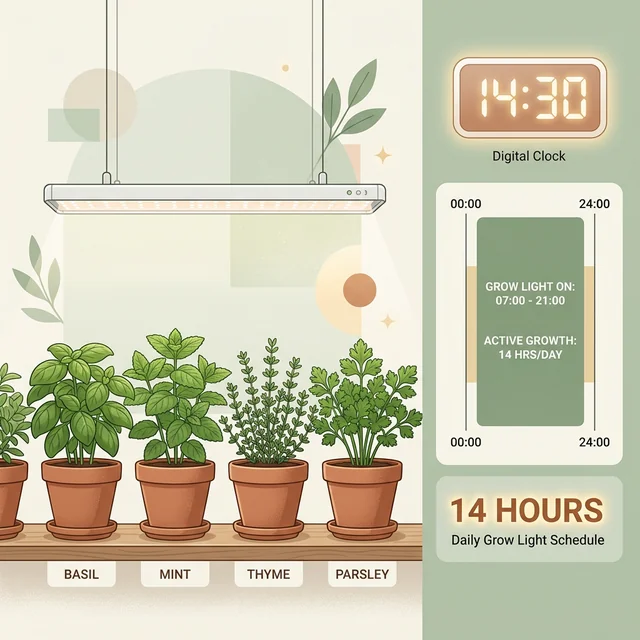
How many hours should grow lights run for herbs? 12-16
Most herb grow lights should run about 12 to 16 hours per day, but intensity, distance, and a stable dark period matter as much as the timer itself.