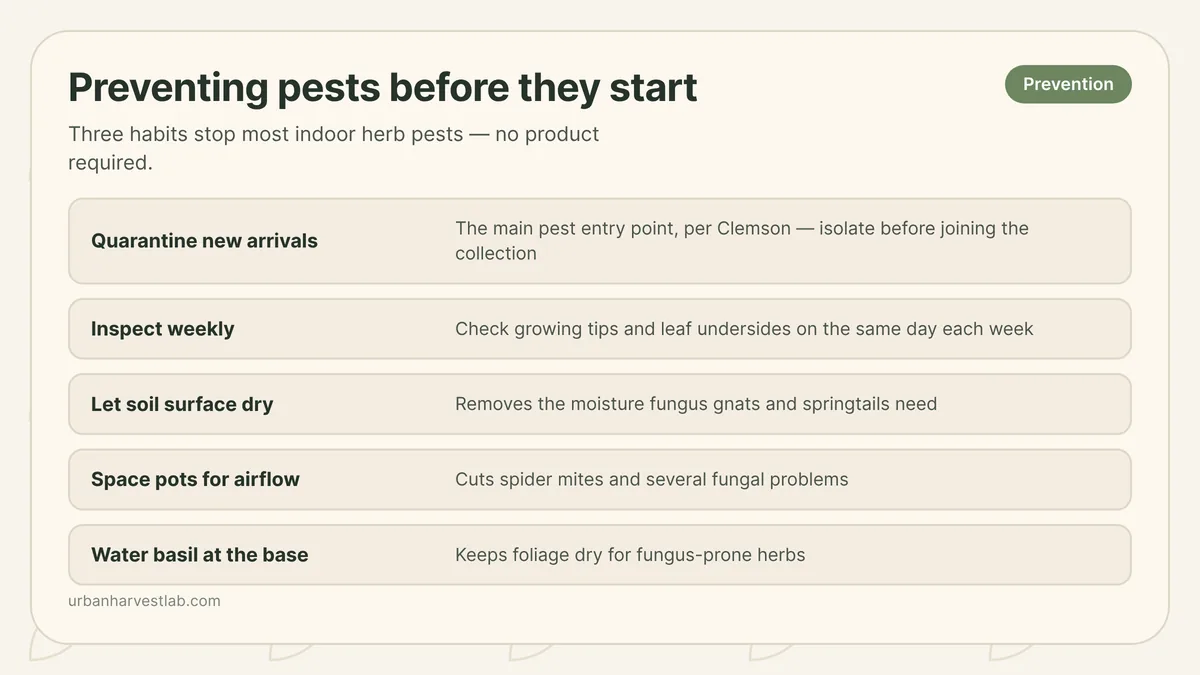
Most indoor herb pests get in on a new plant or one that spent the summer outdoors, so isolating anything new, checking every plant weekly, and keeping the soil and air from favoring pests are the three habits that prevent an infestation rather than treat one. None of the three requires a product. All three are routine, which is exactly why they get skipped.
If you already have an insect, a web, or a strange mark on a leaf, matching the sign to the pest first will save time; the herb pest identification chart sorts webbing, honeydew, stippling, tunnels, and cottony masses into the pest that made them. What follows is what to do before any of those signs show up.
New and returning plants are the real entry point
Clemson Cooperative Extension’s framing for houseplant pests is the one worth building a routine around: infestations “most often come into the home on newly purchased plants or on those that have been outside for the summer.” That covers two very different moments that get treated as low-risk — bringing home a nursery herb, and carrying a container plant back indoors as the weather turns — and both are, per Clemson, the main way pests arrive in the first place.
The same source adds a detail that explains why prevention keeps paying off after the first check: stressed plants “tend to be more susceptible to pests.” A herb that has been underwatered, kept too dark, or shocked by a move is an easier target the week after it arrives than a plant settled into stable light and a steady watering rhythm. Prevention, in other words, is not only about keeping pests out; it is about not handing them an easy plant once they find their way in.
Quarantine as a habit, not a fixed number
Neither Clemson nor UC IPM publishes a quarantine length for a new or returning herb; what they establish is the practice, not a number: separate a new arrival from the rest of the collection, inspect it repeatedly, and only move it in once repeated checks come back clean.
In practice that means a spot where leaves cannot touch other plants, a note of the date it arrived, and a check every few days rather than one look at purchase. A plant that came from a garden center display table, sat on a porch all summer, or was a gift from another grower’s collection is exactly the case Clemson describes, and it deserves the same isolation whether or not anything looks wrong on day one. Something that looked clean in the store can still be carrying eggs or a first-instar crawler too small to see without a hand lens.
Close the loop before assuming the plant is safe: check the newest leaves as they expand, not just the ones already present when it arrived, since curled or stippled new growth is the first sign several pests leave behind.
Make the weekly check a habit, not a reaction
The routine that actually prevents an infestation from becoming a colony is short and repeatable: move the plant into bright light, tip the pot if needed to see the underside of lower leaves, and look at growing tips, leaf axils, and the soil surface. Do this on the same day each week for every plant, new arrivals included, rather than only when a leaf already looks wrong.
What to look for during that check:
- Clustered insects or sticky residue on tender growth points toward aphids, soft scale, or mealybugs, all of which excrete honeydew.
- Fine silk across a stem or leaf axil is the discriminator for spider mites, which UC IPM notes are otherwise easy to miss until webbing appears.
- Silvery or pale stippling next to tiny dark specks points toward thrips; the specks of dried excrement are the tell that stippling alone does not give you.
- Small dark flies rising from the soil surface rather than the leaves are fungus gnats, a soil-moisture problem rather than a foliage one.
Those four cover most of what a weekly check turns up first. For the rest — whiteflies, scale, leafminers, and matching a less obvious sign to its cause — the herb pest identification chart sorts the full set. Finding any of these signs early, while confined to a single tip or leaf, is a different problem than finding it after it has spread across the plant, and it is the weekly check, not a stronger product, that makes that difference.
Manage soil moisture and airflow — the shared prevention for two different groups
Two separate groups of pest and disease problems on indoor herbs trace back to the same underlying condition, and each responds to the opposite fix.
Wet soil favors fungus gnats and springtails. UC IPM’s prevention advice for fungus gnats is to let the surface of the container soil dry between waterings, and its springtail pest note gives the same direction: reducing moisture and excess organic matter is the control that matters, since springtails’ continued presence indoors is itself an indicator of excess moisture. Clemson lists overwatering as the shared explanation for both insects showing up in a pot. Watering on a schedule dictated by the calendar rather than by checking the soil is the single most common way growers create exactly the conditions these two pests need.
Dry, still, crowded air favors spider mites and several fungal diseases. UC IPM warns against keeping soil saturated as a way to raise humidity around mite-prone plants, because that trades a mite problem for a root-zone one. On the disease side, UC IPM’s guidance for powdery mildew is air circulation and a sunny position, and separately notes that water on plant surfaces for extended periods actually inhibits and kills the fungus’s spores, which is the opposite of how growers usually think about disease and moisture. Basil handles this differently again: Penn State Extension’s basil guidance calls for sunlight, air movement, and avoiding overhead watering specifically because leaf wetness and humidity are what drive basil’s fungal problems. The powdery mildew page covers that condition’s identification and control in full, and the same airflow-and-dry-leaf-surface habit is part of managing basil downy mildew, a different fungal disease with its own vein-limited yellowing and underside fuzz. Mint’s own fungal problem, mint rust, does not respond to the same airflow fix once established — the RHS states that no fungicides with activity against mint rust are available for use on mint or other herbs grown for eating, so removing infected plants and rhizomes and starting again from clean stems is what is left. Grey mould is the other disease airflow actually controls rather than just slows: the RHS gives better ventilation and avoiding overcrowding as its control, since the fungus takes hold on dying and damaged tissue in humid, still conditions — see gray mold on herbs.
UC IPM describes mites building up in warm, dry indoor air without giving a humidity target to aim for. Keep the soil surface drying between waterings, give pots enough space that air moves between them, and choose a watering method — overhead or at the base — based on which herb and which risk you are managing. A basil plant prone to fungal leaf problems benefits from base watering that keeps its leaves dry; a herb struggling with dry indoor air and mites does not benefit from a saturated pot, since that only changes which problem shows up first.
A prevention routine at a glance
| Habit | What it addresses | How often |
|---|---|---|
| Quarantine new or recently outdoor plants | The main entry point for pests, per Clemson | Before joining the rest of the collection |
| Inspect growing tips and leaf undersides | Early colonies of aphids, mites, thrips, whiteflies, scale, and mealybugs | Weekly, every plant |
| Let the soil surface dry between waterings | Fungus gnats and springtails | Every watering cycle |
| Space pots so leaves do not touch and air can move | Spider mites, powdery mildew, and other fungal problems | Ongoing, at placement |
| Water basil at the base rather than overhead | Fungal leaf disease that needs free moisture on foliage | Every watering, for susceptible herbs |
| Keep plants on a steady light and watering routine | Reduces the plant stress Clemson links to greater pest susceptibility | Ongoing |
Common mistakes
- Treating a plant with a product before confirming which pest or disease is actually present.
- Assuming a clean-looking leaf today means the plant is clear; new growth, not old leaves, is what to judge by.
When prevention is not enough
A weekly check and a sensible watering routine catch most problems while they are still small, but they will not undo an infestation that has already established itself. If a check turns up live insects, webbing, honeydew, or a tunnel inside a leaf, move from prevention to identification: the herb pest identification chart sorts the common signs, and common potted herb problems covers the yellowing, wilting, and weak growth that overlaps with pest damage but often has nothing to do with an insect at all. Confirming the cause before treating anything saves a healthy plant from an unnecessary spray and saves you from missing the actual problem.
Sources
- Clemson Cooperative Extension HGIC: Common Houseplant Insects & Related Pests
- UC Statewide IPM Program: Fungus Gnats (Pest Notes 7448)
- UC Statewide IPM Program: Springtails (Pest Notes 74136)
- UC Statewide IPM Program: Spider Mites (Pest Notes 7405)
- UC Statewide IPM Program: Powdery Mildew on Ornamentals (Pest Notes 7493)
- Penn State Extension: Basil, A Summer Favorite
- RHS: Mint Rust — Causes & Treatment
- RHS: Grey mould — Causes, Symptoms & Control
Already seeing a pest?
Skip ahead if you can already see the insect or its damage — these pages cover identification and control for what you have found.
Common questions
How long should I quarantine a new herb before it joins my other plants?
There is no fixed rule for this. Keeping a new or recently outdoor plant separate for a week or two, checking it under bright light every few days, and moving it in only once repeated checks come back clean is the practice the sources support.
How often should I inspect my indoor herbs for pests?
A quick check under bright light once a week is enough to catch most problems early. Clemson Cooperative Extension notes that stressed plants are more susceptible to pests and that prevention is easier than eliminating an infestation once it is established, so look at growing tips and leaf undersides on a schedule rather than waiting for visible damage.
What humidity level keeps pests away from indoor herbs?
The pest notes used here describe conditions in relative terms rather than a target percentage: spider mites build up faster in warm, dry air, while fungus gnats and springtails follow excess soil moisture. Letting the soil surface dry between waterings and avoiding a constantly damp, still corner addresses both directions without needing a specific humidity number.
Does grouping plants closely together cause pests?
Crowding is not itself a pest, but it cuts airflow and makes an early check harder to do properly, and several fungal problems on indoor herbs are managed partly through better ventilation and spacing. Leave enough room between pots to see the undersides of leaves during normal watering.
Related guides
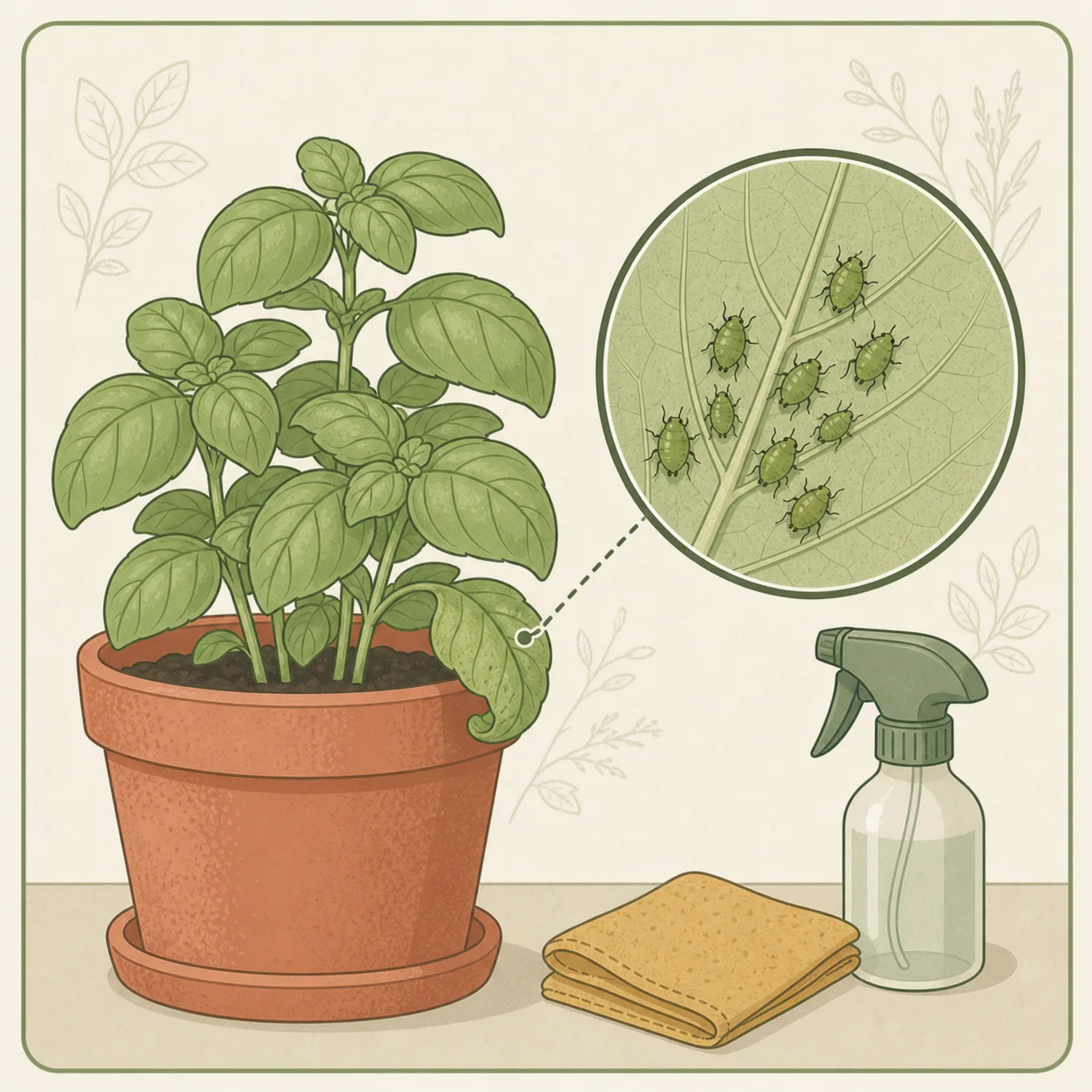
Aphids on indoor herbs: identify, isolate, and control them
Aphids are manageable when you find the colony, isolate the plant, remove most insects physically, and repeat inspections through the next generation.
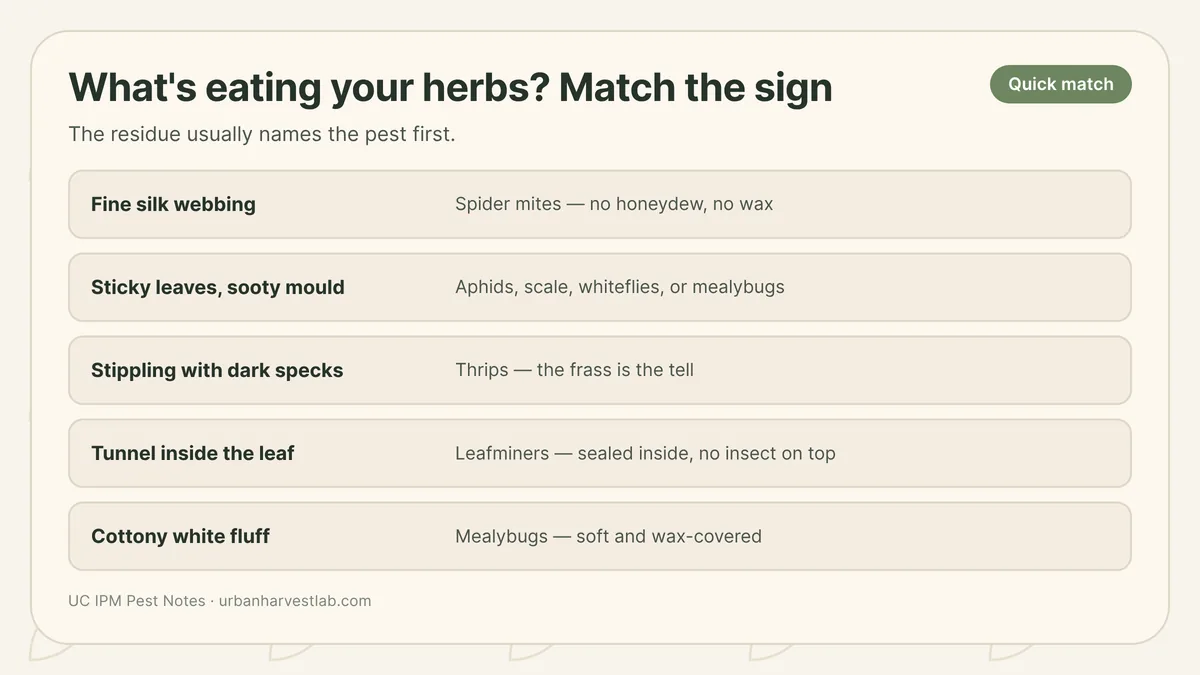
What's eating your herbs? Match the signs to the pest
Every common herb pest leaves its own tell before you ever spot the insect itself. Pick out what you are actually seeing, then go straight to the page that treats it.
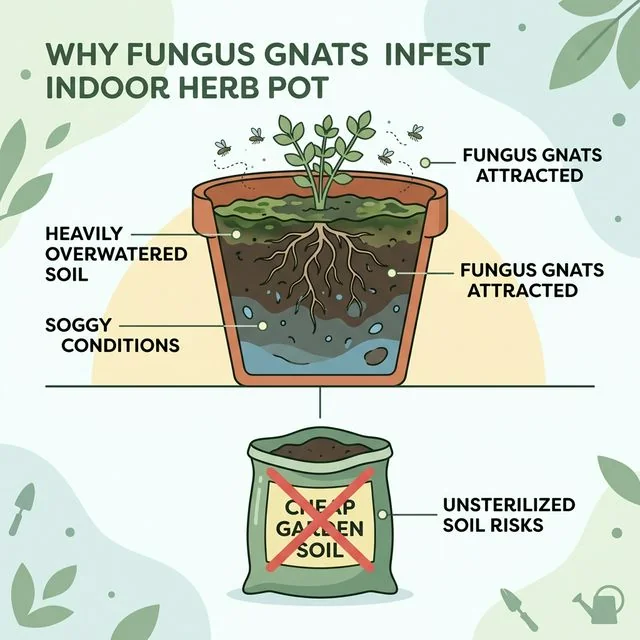
Why fungus gnats keep coming back in herb pots
Fungus gnats are the absolute bane of indoor gardeners. If a cloud of tiny black flies eradicates your peace every time you walk past your basil plant, you are treating the symptom, not the cause.