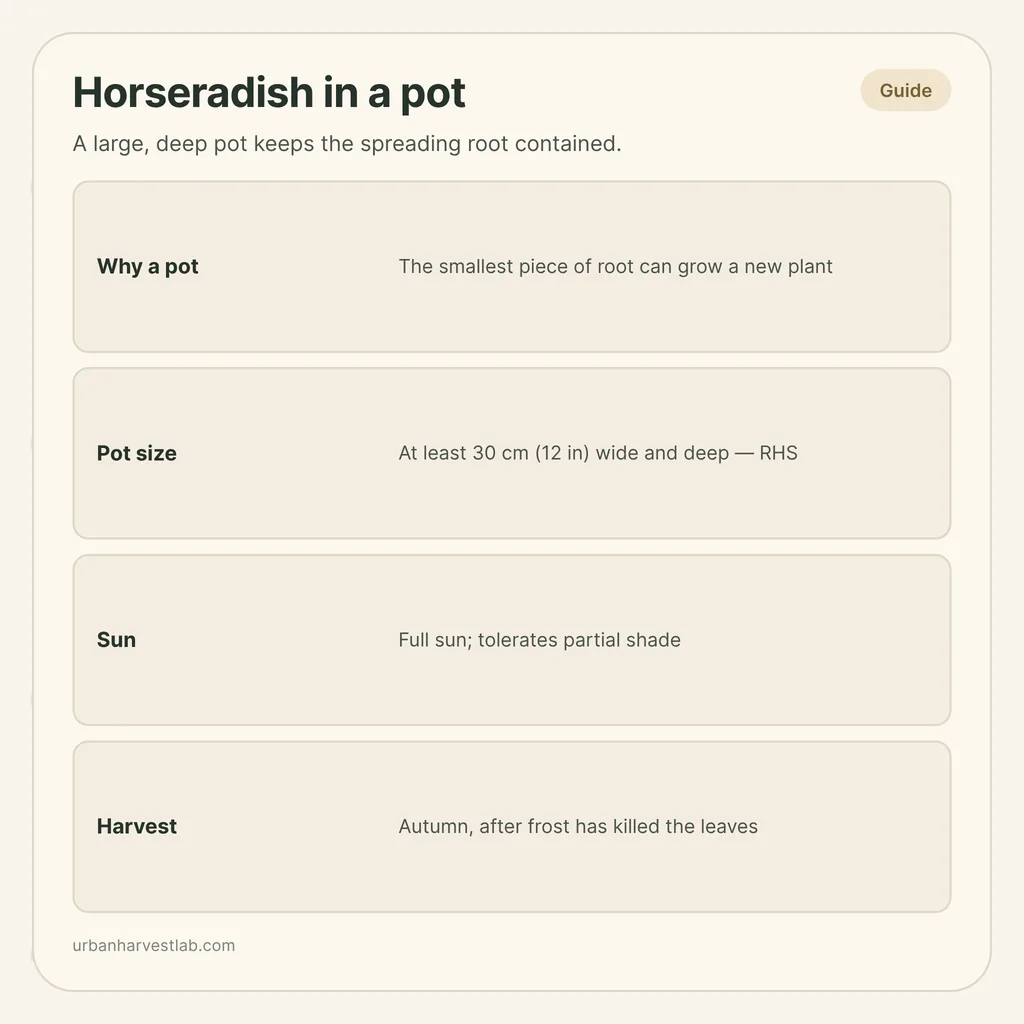
Horseradish grows well in a large, deep pot, and a pot is the better choice because any piece of root left in the ground grows a new plant. Start from a root piece or a young plant, give it sun and steady water, let it grow through the season, and dig after frost has killed the leaves.
Why it belongs in a pot
University of Wisconsin Extension says horseradish is hardy in zones 2-9 and “may be difficult to eradicate once established because the smallest piece of root can grow a new plant.” University of Illinois Extension describes the same habit: over the summer the plant spreads underground well beyond where it was planted.
The Royal Horticultural Society (RHS) draws the practical conclusion. It does not recommend open ground, because horseradish forms a vigorous spreading clump that is hard to control or remove, and says to grow it in a large pot instead. For mint, which is also kept in pots to contain it, see the mint pot size guide. Rhubarb is the other big perennial root crop that suits a pot, though it wants a very different winter.
Horseradish is not wasabi. Wisconsin Extension calls Japanese horseradish “a totally different plant”, an aquatic grown in cool running streams, so a pot of horseradish will not give you the real thing.
Pot and mix
The RHS minimum is a container at least 30 cm (12 in) wide and deep, filled with multi-purpose compost, holding one young plant or up to three roots. Treat that as the floor. Wisconsin Extension plants root pieces 8-12 inches long, so a deeper pot gives a long piece room to sit at an angle without the tip touching the bottom.
Oregon State University asks for deep, well-drained loam or sandy loam and says shallow soils over hard subsoil are poor for production. In a pot, that translates to a deep container with drainage holes and an open mix. The RHS adds that roots rot in waterlogged soil.
Put the pot in full sun if you can. Wisconsin Extension says horseradish does best in full sun but tolerates partial shade. A pot this size gets heavy when watered, so check the load before you park it on a balcony. If you are buying a pot for this, look for one that is deep rather than wide; browse deep garden planters on Amazon to compare depths.
Planting a root piece
| Source | Piece | Orientation | Top of the root |
|---|---|---|---|
| Wisconsin Extension | 8-12 in segment | Vertical, or up to a 45 degree angle | At or just slightly below soil level |
| Oregon State | 8-12 in, square cut at the top, slanted cut at the bottom | About 45 degrees | In furrows 3-5 in deep |
| RHS | Long root (thong) | Vertical | 2 in (5 cm) below the surface |
Wisconsin sells these as “divisions or root cuttings”, which you can buy from a nursery or garden center. The RHS says they are sold in spring as long pieces of root, and that young potted plants work too and establish quickly.
Cut your own piece the way Oregon State describes: square across the top and slanted at the bottom, so you can tell which end goes up. Oregon State says to use planting stock trimmed from main roots at harvest, and the same agency says the 45 degree angle is “very important for vigorous establishment and growth.” Make a deep hole with a dibber or trowel handle, drop the root in, firm the compost and water well, as the RHS describes.
The RHS plants in spring or early summer. Wisconsin says fall or spring both work. A fall planting in a pot is only worth trying where you can carry it through winter; the overwintering guide for perennial edibles covers that part.
Water and feeding
Pots dry out faster than ground. The RHS says plants in containers need watering through the growing season, especially in warm, dry weather, and that “the leaves may flop if the plant gets too dry.” Keep the mix evenly moist. In hot, sunny weather you can move the pot into some shade to cut the watering.
For feeding, the RHS recommends an organic-based general-purpose liquid fertiliser every few weeks from mid-spring to late summer, or a granular feed sprinkled on the compost in spring. Oregon State says horseradish makes its greatest growth in late summer and early fall, which is when the root is bulking up, so a pot that dries out in August costs you the most.
Straighter roots
Wisconsin Extension has a trick for the long, straight roots that suit the kitchen: when the leaves are about a foot tall, carefully pull the soil back from the crown, cut off all the side roots and leave only two or three sprouts forming leaves. Repeat 4-6 weeks later. In a pot this is easy, because there is less soil to move. Skip it if you only want enough root for a few jars; it is a refinement, not a requirement.
Wisconsin lists imported cabbageworm larvae and flea beetles as the pests that chew holes in the leaves. The RHS considers horseradish rarely troubled by diseases or insects.
When the first harvest comes
Do not expect root in the first autumn. Oregon State says about a year is needed to produce a crop, and Wisconsin says spring-planted roots probably will not be ready to harvest by the first fall; most gardeners dig the following spring or fall. The RHS says young plants can be lightly harvested in their second autumn.
The autumn dig
The RHS says roots are best harvested in autumn or early winter and are generally considered to have a better, stronger flavour after frost. Wisconsin gives the cue: fall, after frost has killed the leaves, or early spring before growth resumes. Oregon State, which describes the commercial crop, also waits for a frost to kill the tops, and says that if bad weather prevents a fall harvest the roots can be dug the following spring. University of Illinois Extension puts harvest at about the first frost.
To dig a pot:
- Tip the plant out of its container.
- Remove up to half of the roots (the RHS limit), keeping the thickest for the kitchen.
- Replant the rest in the container with fresh potting compost.
- Keep pieces for next year: the RHS suggests roots about 15 cm (6 in) long, and Oregon State describes planting stock about half an inch thick and 10-14 inches long, with a slanting cut at the bottom and a straight cut at the top.
Wisconsin says the main root is harvested while the offshoots are replanted, and that year-old roots have the most flavor. Older roots turn woody, pithy or hollow. That is the reason to dig and refresh the pot every year rather than leave it for years. If you have more roots than you need, dividing perennial herbs shows how to handle a crowded clump.
Using and storing the root
The pungency comes from mustard oils released when the root is cut or grated, Wisconsin Extension explains. They break down quickly and turn bitter unless used right away or mixed with vinegar. The RHS says horseradish is best raw because cooking removes much of its flavour, and grated root should be used quickly because it discolours.
Whole roots keep. Wisconsin says intact roots stay in a cool, dark, humid place such as a plastic bag in the refrigerator for a few months. The RHS suggests a cool, dark, frost-free spot in damp sand, or an airtight container in the fridge for up to several months. The RHS also says young leaves picked in spring and summer taste like the root and can go in salads or be cooked as a leafy vegetable.
Sources
Perennial edibles in pots
Other vigorous perennials that behave better in a container, and how to carry them through winter.
Common questions
Can you grow horseradish in a pot?
Yes. The Royal Horticultural Society recommends a large pot over open ground, because horseradish forms a vigorous spreading clump that regrows from any root left behind. University of Wisconsin Extension also lists a large, deep container for gardeners worried about escape.
How big a pot does horseradish need?
The RHS gives a minimum of 30 cm (12 in) wide and deep, with one young plant or up to three roots per pot. Wisconsin Extension describes the root pieces it plants as 8-12 inches long, so a deeper pot gives a long piece more room.
When do you harvest horseradish from a container?
The RHS says autumn or early winter, and that the roots are generally considered stronger in flavour after frost. Wisconsin Extension and Oregon State both start once frost has killed the leaves. Spring-planted roots usually are not ready by the first autumn.
Can you replant horseradish after harvesting?
Yes. The RHS says to tip the plant out, remove up to half the roots and replant the rest in fresh potting compost. Root pieces about 15 cm (6 in) long taken at harvest can be potted up as new plants.
Related guides

How to grow rhubarb in a pot: size, cold and the leaf warning
A rhubarb planting stays productive for 8 to 15 years, according to Michigan State Extension, so the pot, the winter and the patience matter more than any feeding trick. Here is what a container changes, and what it does not.
Overwintering perennials in pots: the two-zone rule for herbs and fruit
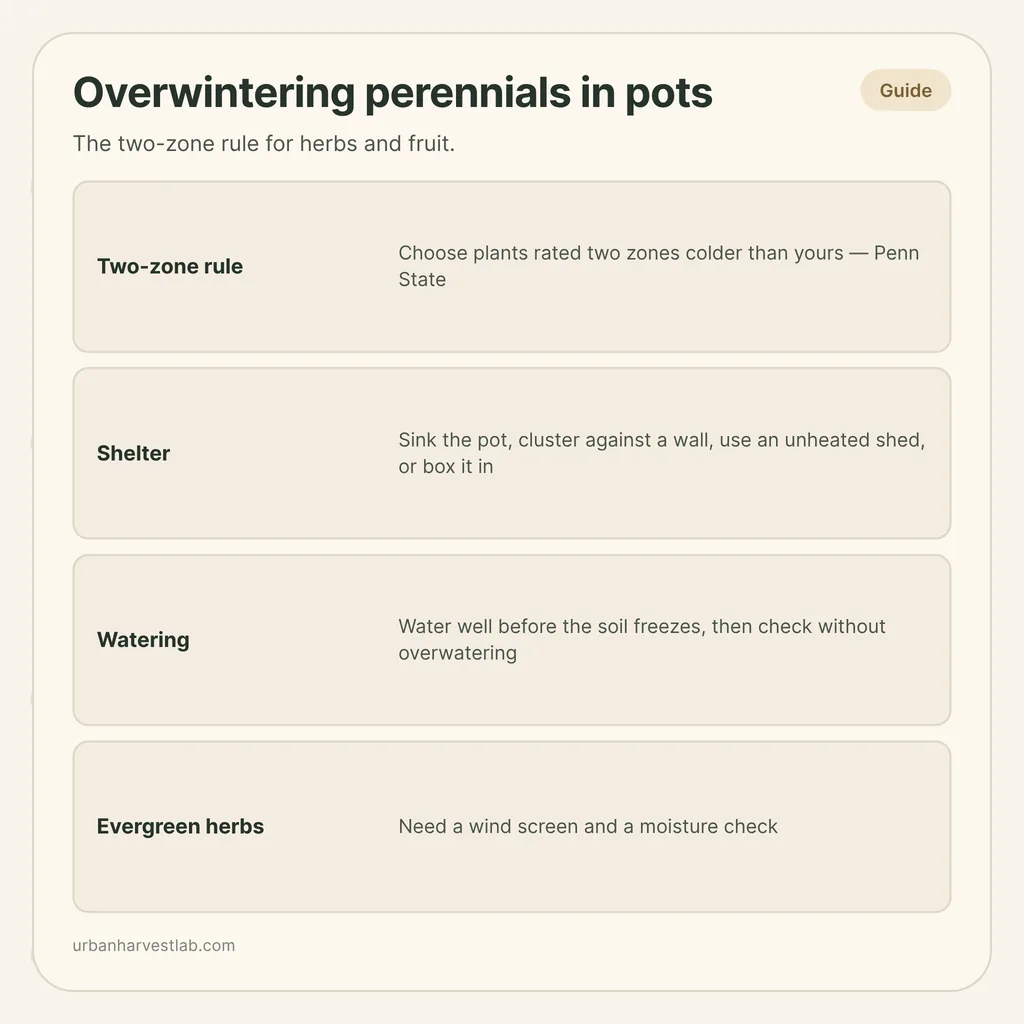
The hardiness zone on a plant tag assumes the roots are in the ground. In a pot they are not, so the rule, the shelter and the winter watering all change.

How to divide chives, mint and oregano in pots
A crowded perennial herb does not need a bigger pot. Split the clump, discard the tired centre, and replant the healthy sections in fresh mix.