
When and how often to divide common potted herbs
| Herb | Best time | How often | Source |
|---|---|---|---|
| Chives | Early spring (or autumn) | Every 2 to 4 years | Illinois Extension, RHS |
| Mint | Spring (or autumn) | Yearly to every few years | UConn, RHS |
| Oregano | Spring, or after flowering in late summer | About every third year | RHS, UConn |
| Thyme | Spring or autumn, once established | When the plant is 2 to 3 years old or older | RHS |
| Tarragon | Spring, as new shoots emerge | Every 2 to 4 years | Utah State, UConn |
Divide a crowded perennial herb in early spring (autumn also works) by lifting the whole clump, cutting it into sections that each have roots and shoots, discarding the dead centre, and replanting the healthy pieces straight away in fresh potting mix. Chives, mint and oregano all take well to it, and one tired pot becomes two or three productive ones.
Signs a clump is ready
A potted perennial that has filled its container tells you in a few ways. The pot dries out faster than it used to. Roots show at the drainage holes. Growth thins out in the middle while the edges stay lively, and the leaves come in thinner. The signs of a root-bound herb are the same ones that call for division.
Division is also the right move on a schedule, before the problem shows. The sources disagree a little on how often; the shorter interval suits a small pot that fills quickly.
When and how often, herb by herb
Chives. Illinois Extension says chives are most commonly propagated by dividing clumps in early spring, and advises dividing every 2 to 3 years to keep plants vigorous. The RHS allows spring or autumn and gives every three or four years. A pot fills faster than open ground, so the shorter end of both ranges is the safer guess for a small container. Our chive pot size guide covers the container itself.
Mint. UConn Extension says to divide mint each spring so it does not overrun the garden. The RHS is more relaxed for pots: mint has spreading rhizomes, so it needs repotting regularly, typically every few years depending on container size, either into a larger pot or by dividing and putting a section back in the same one. Pick the annual end if the pot is small or the mint is vigorous. See what size pot mint needs for the container side.
Oregano. The RHS says to divide clumps in spring, or soon after the plant has finished flowering in late summer or early autumn. UConn Extension gives about every third year.
Thyme. The RHS describes division as a good method for creeping, mat-forming thymes, in spring or autumn, on established plants that have been in place two or three years. For plants you would rather multiply another way, see regrowing herbs from cuttings.
Tarragon. Utah State Extension says to divide in spring just as new shoot tips are emerging and to renovate French tarragon every 2 to 3 years; UConn Extension gives every 3 to 4 years. More on that plant in growing tarragon in a pot.
Spring is the default because the plant is about to put on growth and recovers quickly. Autumn is the sources’ second choice, and the autumn herb planting guide covers what else to do then.
How to divide a potted clump
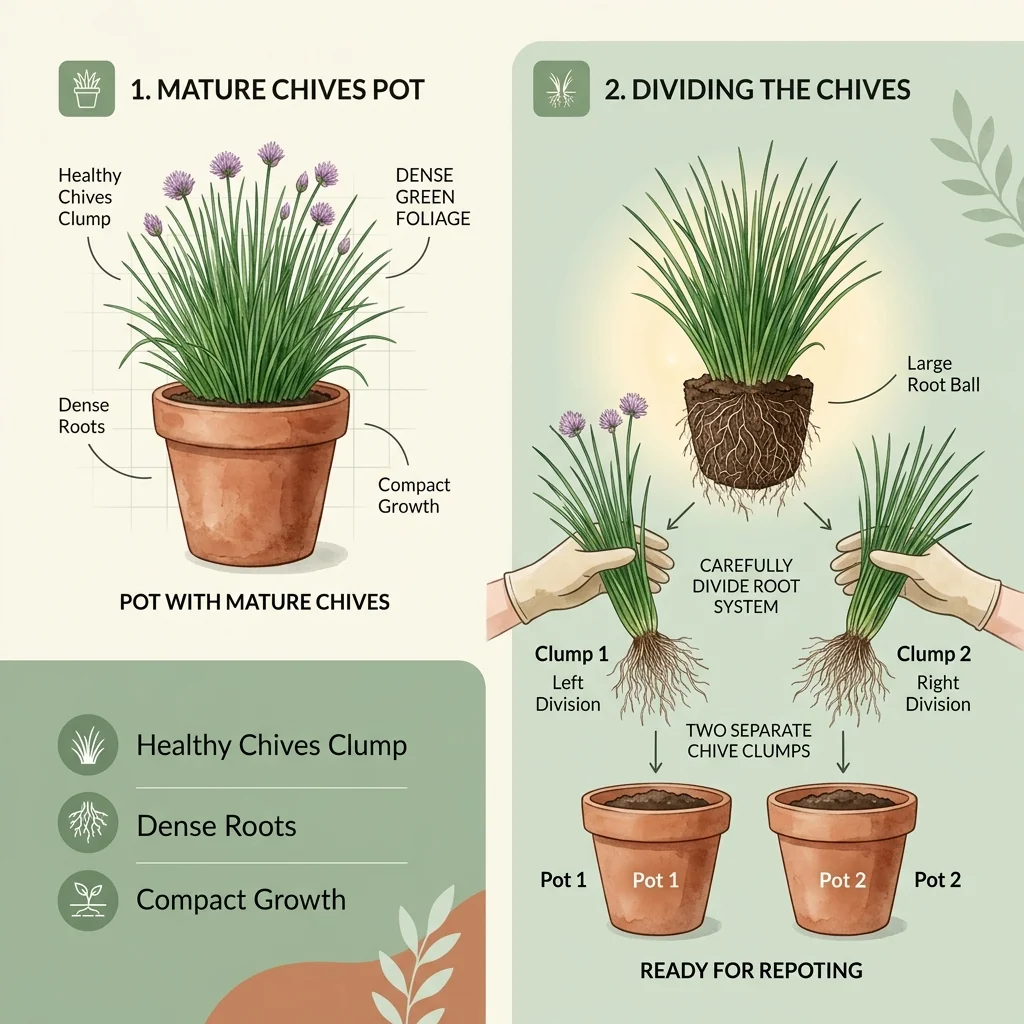
- Lift the whole plant out. Tip the pot on its side and ease the root ball free. If it is stuck, run a knife around the inside edge rather than pulling on the stems.
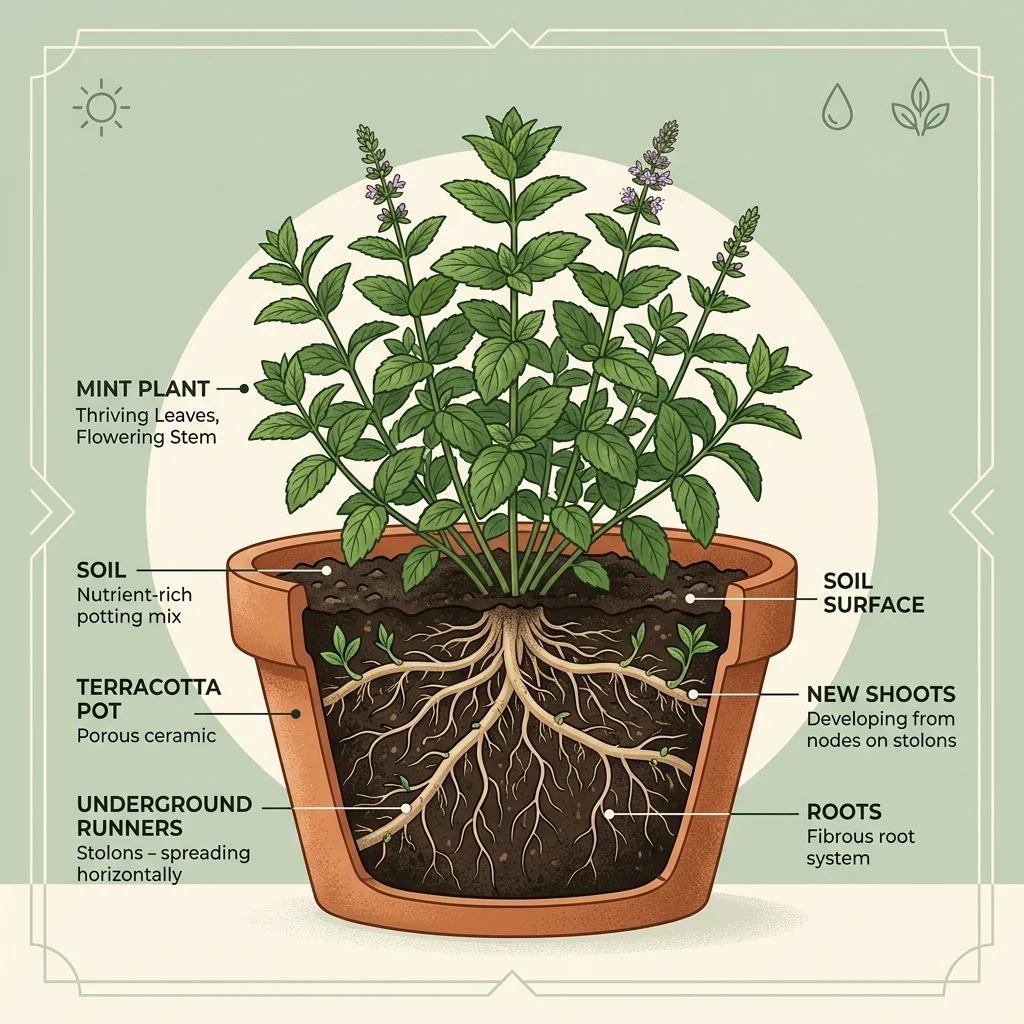
- Look at the structure. Mint and oregano spread on rhizomes, so you will see a matted network with the oldest growth in the middle. Chives grow as a cluster of small bulbs.
- Split it. For mint, the RHS says to cut the root ball into several smaller sections with secateurs, a knife or a spade. Chives often pull apart by hand. Illinois Extension says each chive clump should contain about 4 to 6 bulbs, which is a useful size to aim for. Make sure every section has both roots and shoots.
- Discard the old centre. The RHS says to throw away any old dead parts in the middle of the clump. Keep the vigorous outer sections.
- Replant straight away. The RHS stresses replanting chives immediately. Pot each section up in fresh potting mix, in a container with drainage holes.
- Water until it runs out of the bottom. Clemson HGIC’s general guidance is to water until water drains from the pot, then empty the saucer. That settles the mix around the new roots.
Dividing is a form of repotting, so the shock-limiting habits in how to repot herbs without slowing growth apply here too.
Division or root pruning?
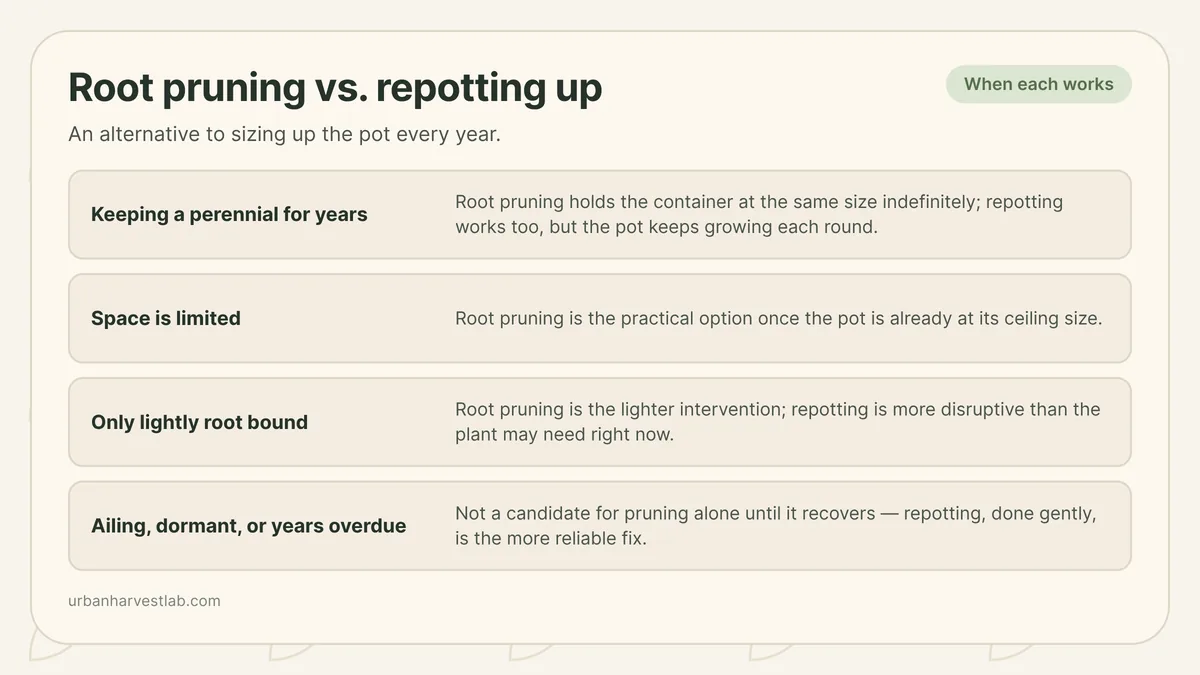
Division gives you more plants, and the original clump ends up as several. Root pruning trims the root mass of one plant so that it can stay in the same pot. If you want to keep one plant and do not need spares, root pruning fits. If you want to give plants away, fill more windowsill pots, or the centre has died out, divide.
For mint, there is an extra reason to divide each year: it is the cleanest way to keep a plant that wants to spread inside its pot. UConn Extension also mentions sinking mint, in a container, into the ground as a way of containing it, using a bottomless five-gallon bucket with the top couple of inches left above the soil. On a balcony, a well-divided pot achieves the same thing without digging.
After dividing
New divisions look smaller than the plant you started with, and that is normal. Resume regular harvesting once fresh growth appears; the guide to pruning basil, mint, parsley and chives explains how to cut so the plant keeps producing.
Sources
Keeping potted herbs healthy
Division is one of several ways to renew a crowded herb. These guides cover the others and the pots that suit each herb.
Common questions
When is the best time to divide chives and mint?
Early spring, just as growth restarts, is the safest choice. The RHS gives spring or autumn for both, and Illinois Extension names early spring for chives. UConn recommends dividing mint each spring.
How often should potted chives be divided?
Illinois Extension says every 2 to 3 years, and the RHS says every three or four years. Divide sooner if the pot is packed solid and the clump has stopped producing thick new leaves.
How often should I divide oregano?
UConn Extension advises dividing oregano every third year. The RHS suggests spring, or soon after flowering in late summer or early autumn.
Can I divide a herb that is dying in the centre?
Yes, and that is the best reason to do it. The RHS tells you to discard any old dead parts in the centre of a mint clump and pot up the healthy outer sections.
Related guides
Root pruning potted herbs: an alternative to sizing up every year
A bigger pot is not the only answer to a root-bound herb. Trimming the root mass and refreshing the soil can hold a perennial in the same container for years, for the herbs it actually suits.
What size pot do chives need? A compact-pot guide
Chives are one of the easiest herbs to pot because their roots stay compact. A 6 inch pot is enough, and dividing the clump gives you free plants over time.
What size pot does mint need? Give it its own
Mint is a vigorous spreader that will crowd out anything it shares a pot with. Give it a roomy container of its own, 8 to 12 inches wide, and you will get years of growth.