
Kale timing in a pot, by season
| Season | What to do | Why |
|---|---|---|
| Spring | Sow or transplant 4-5 weeks before your last frost date (Utah State) | Plants mature before summer heat |
| Summer | Mulch the pot surface above 80°F and keep moisture even; give shade if leaves turn bitter | Heat cuts growth and quality (Utah State) |
| Fall | Choose an early variety so harvest begins 2-3 weeks after the first fall frost (Utah State) | Frost improves flavour |
| Winter | Shelter the pot; check moisture | Pot roots are less hardy than ground roots (University of Illinois) |
To grow kale in a pot, use a container at least 6 to 8 inches deep (University of Kentucky Extension), put one plant in about a 12-inch-wide pot, give it sun, and sow in the cool end of the year. Kale is among the easiest greens for a balcony because it takes cold, and you pick leaves for weeks rather than harvesting the plant once.
Grown in soil in a pot, kale is a different job from growing it in a hydroponic system, where nutrient strength and pH are the concerns. In a pot, timing, temperature and moisture matter most.
Choose the pot and the plant count
University of Kentucky Extension lists kale among vegetables for which a container at least 6 to 8 inches deep is adequate, alongside beets, lettuce and Swiss chard. That is a floor, not an ideal. A larger pot holds moisture longer, which suits a crop that Utah State Extension says turns tough when moisture swings.
Utah State spaces kale 12 to 18 inches apart in the ground, with rows 2 feet apart. Translating that to a pot is our judgement, not a published container figure: give each plant roughly a 12-inch-wide pot, or space plants about that far apart in a long trough. Crowding shades the lower leaves you want to pick.
Use a fertile, well-drained mix. Utah State describes kale as a crop that prefers “fertile, well-drained soil” and a sunny spot, so a pot with drainage holes and a sunny balcony or sill is the target.
Sow or transplant at the right time
Utah State says to plant out 4-5 weeks before the last frost, and that seeded kale may go in at the same time. Your own date depends on your climate; the frost date page shows how to find it.
Seeds go in ¼ to ½ inch deep, and Utah State thins seedlings when they have 3-4 true leaves. If you buy or start transplants, Utah State wants 4-6 mature leaves and a well-developed root system, which takes 5-6 weeks to grow.
For a fall crop, pick an early-maturing variety and count back from the date you want to start picking. Utah State sets the target maturity at about 2-3 weeks after the first fall frost and suggests starting 50-75 days before that date. Starbor, Red Russian and Scarlet are the varieties it names for production, eating quality and cold hardiness, at 55, 50 and 55 days respectively. Fall is also when kale pairs well with the other salad greens for containers.
Handle the cold
Utah State reports that young plants are not seriously damaged by temperatures down to 25°F and that mature plants are extremely hardy. Frost also improves the flavour of a fall crop.
A pot changes the picture for the roots. University of Illinois Extension notes that container roots are less cold-hardy than roots in the ground. For a hard freeze, Colorado State University Extension suggests clustering pots in a protected site with the larger pots on the outside, then mulching heavily over the top. University of Illinois Extension adds moving pots into an unheated garage or shed, and keeping the mix moist because moist medium freezes more slowly than dry. Fabric covers protect seedlings and transplants from frost as well as insects, says Utah State.
Handle the heat
Utah State says kale grows best when temperatures do not exceed 75°F and that high summer temperatures reduce growth, decrease quality and cause bitter or off flavours. In a pot on a sunny balcony, that means a spring crop picked before midsummer, then a fall crop. If you must keep it through summer, move the pot to afternoon shade and mulch the surface; Utah State recommends organic mulch once temperatures go above 80°F.
Water evenly
Utah State recommends deep, infrequent watering that keeps soil moisture even, and warns that moisture fluctuations make leaves tough with off flavours. Pots dry faster than ground, so check by touch rather than by calendar; the container vegetable watering page covers how volume and crop stage change the interval.
Pick by the leaf
Utah State says to harvest kale when leaves reach full size, stripping the older leaves first so the young leaves can continue to grow. Work from the bottom up and leave the centre intact. A plant treated this way keeps producing as long as the weather stays cool. To stagger the harvest, start a second pot a few weeks behind the first, using the approach in succession planting in containers.
Protect it from caterpillars and other pests
Utah State lists three problems for kale: aphids on leaf undersides, flea beetles on seedlings, and cabbage worms and loopers that chew holes in leaves. Caterpillars are the one most likely to ruin a balcony harvest. The identification and what to do once you find them are in cabbage worms on kale.
To prevent them, cover the pot. University of Maryland Extension states that floating row cover prevents egg-laying, and Utah State notes fabric covers protect transplants from insects. Check the covered plants anyway, since a cover only keeps out what is not already inside.
Sources
- Utah State University Extension: How to Grow Kale in Your Garden
- University of Kentucky Extension: Vegetables Grown in Containers Improves Accessibility
- University of Illinois Extension: Overwintering potted plants
- Colorado State University Extension, PlantTalk Colorado: Overwintering Container Plants
- University of Maryland Extension: Imported cabbageworm
Around container greens
Timing, watering and the neighbouring pages for leafy crops in pots.
Common questions
How big a pot does kale need?
University of Kentucky Extension lists kale among vegetables for which a container at least 6 to 8 inches deep is adequate. Utah State spaces kale 12 to 18 inches apart in the ground, so one plant per pot about 12 inches wide is a sensible starting point.
Can kale stay outside in winter in a pot?
The leaves are very hardy, but a pot has no soil mass to buffer the roots. University of Illinois Extension says pot roots are less cold-hardy than roots in the ground, and suggests an unheated garage or shed and a moist mix, which freezes more slowly than dry. Colorado State University Extension suggests clustering pots with the larger ones outside and mulching heavily.
How do I harvest kale so it keeps growing?
Strip the older, lower leaves first and leave the young leaves at the centre, as Utah State Extension describes. Pick when leaves have reached full size.
Why is my kale bitter?
Heat is the usual cause. Utah State Extension says high summer temperatures reduce growth and cause bitter or off flavours, and that uneven moisture makes leaves tough. Frost improves the flavour of a fall crop.
Related guides
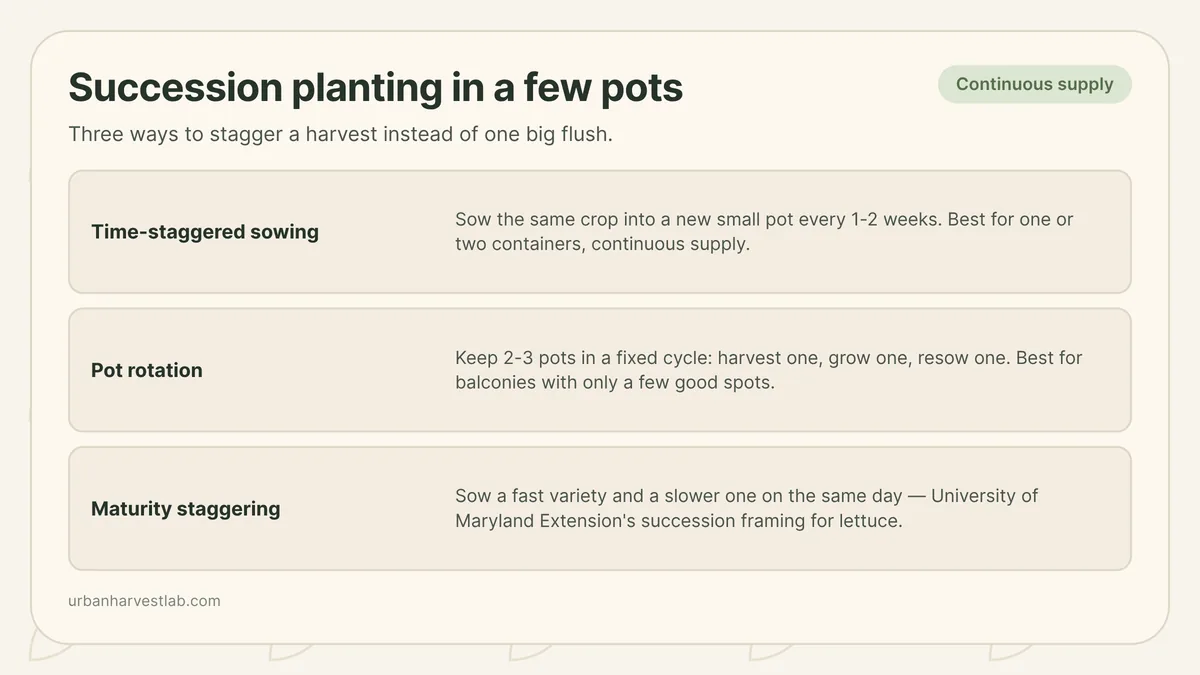
Succession planting in containers: how to stagger a harvest from a few pots
Succession planting in containers is a sowing rhythm: a few pots restarted on a schedule keep producing, where one large planting ripens together and then quits together.
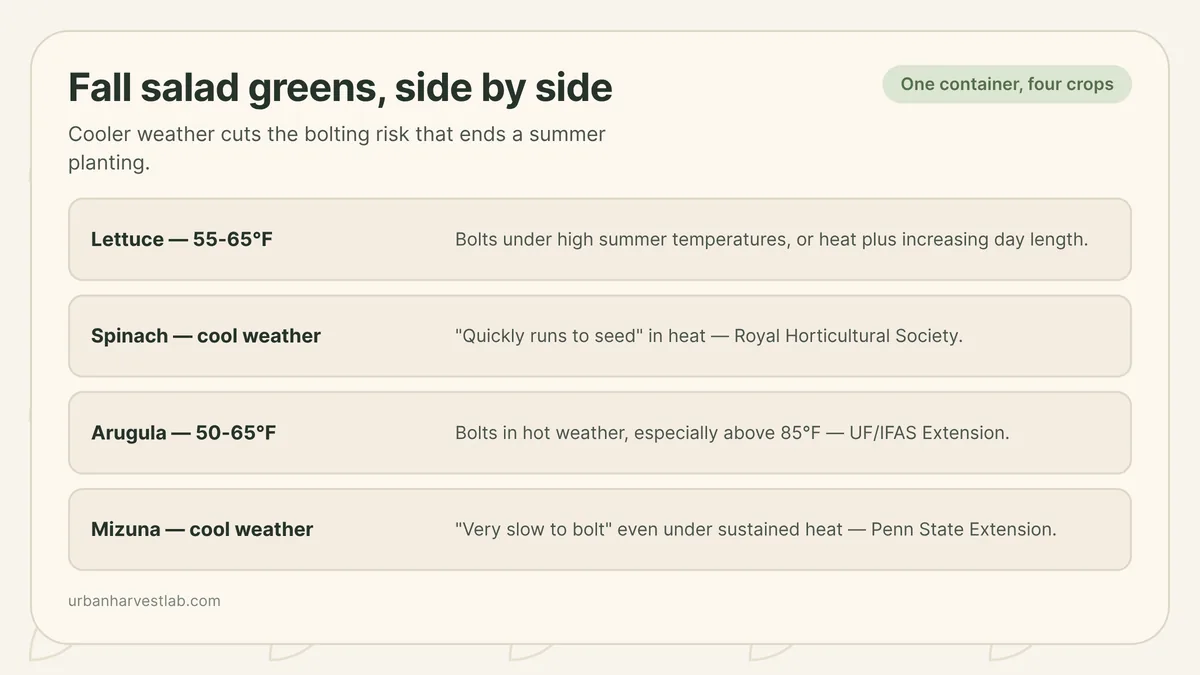
Growing salad greens in containers this fall
Lettuce, spinach, arugula, and mizuna all share the same summer problem and the same fall fix. Here is how to grow them together once the heat breaks.

Green caterpillars on kale: which cabbage worm it is and how to stop it
Three look-alike green caterpillars feed on kale, and a white butterfly fluttering round the pot is the early warning. Here is how to tell them apart and what actually protects a container crop you plan to eat.