
Troubleshoot the system before you change the inputs.
Symptoms
- Holes in kale leaves that start small and smooth and keep growing until only the midrib is left.
- Dark green or brown droppings on the leaves, or on the soil and pot rim beneath the plant.
- Small white butterflies visiting the pots, or pale elongated eggs on the undersides of leaves.
Possible causes
- Imported cabbageworms: slow, velvety green larvae that rest along the midrib and are easy to miss.
- Cabbage loopers: green larvae that arch their bodies as they walk, feeding first on the underside of leaves.
- Diamondback moth larvae: very small, active caterpillars that rasp the leaf underside and may feed at the growing point.
Quick fixes
- Check the undersides of leaves and the midribs in daylight, and pick off every caterpillar you find.
- Cover the pot with a lightweight floating row cover so the butterflies and moths cannot lay more eggs.
- If you decide to spray, treat while the caterpillars are small, and read the label to confirm it lists the crop you are growing.
Three green caterpillars on kale, told apart
| Clue | Imported cabbageworm | Cabbage looper | Diamondback moth |
|---|---|---|---|
| Size and look | Velvety green, one thin yellow stripe down the back, about 1 1/4 inches at most | Pale green with white side stripes, up to 1 1/2 inches | Tiny, up to 0.3 inch, widest in the middle and tapering at both ends |
| How it moves | Slow and sluggish, rests on the midrib | Arches its middle into a loop as it crawls | Wriggles fast, or drops off on a silk thread when touched |
| Damage | Small smooth holes that grow until only the midrib is left | Windowpane scraping on the underside, then ragged holes in the leaf centre | Rasped undersides, then small holes, often at the growing point |
| Adult | White butterfly with black spots | Mottled brown-grey moth | Small moth |
Velvety green caterpillars chewing kale, broccoli or cabbage in a pot are usually imported cabbageworms, the larvae of the white cabbage butterfly. A cabbage looper or a tiny diamondback moth larva can look similar at a glance, and all three are managed the same way: remove what you can see, stop new eggs, and treat only if you have to.
Holes in leafy crops have other culprits too, and the holes in leaves guide shows how to separate caterpillars from slugs and earwigs. If the damage is on kale specifically and you are still choosing what to grow, the kale in containers guide covers the crop itself.
Is it a cabbage worm? What to look for
University of Maryland Extension describes the imported cabbageworm as a velvety green caterpillar with a single yellow stripe down the centre of the back and yellow spots or a broken yellow line along each side. Full grown, it is about 1 1/4 inches long. UC IPM adds that it moves slowly and is sluggish compared with other caterpillars, which is useful: a green caterpillar that sits still on a midrib is probably this one.
The damage follows a pattern. Maryland Extension says feeding starts as small, smooth holes that soon enlarge until the entire leaf is consumed, leaving only the midrib. Dark green droppings pile up on and under the plant. UC IPM warns that the larvae are hard to spot because their green colour blends into the leaf, and recommends looking toward the centre of the plant, where they often feed near the midrib.
Eggs are the stage most people miss. UC IPM says females lay whitish, elongated eggs singly on the undersides of leaves. The adults give the game away first: Maryland Extension suggests watching for small white butterflies flitting among cole crops. The butterflies only feed on nectar and do no harm to the plant, but each visit can leave eggs behind.
The two look-alikes
The cabbage looper is the one that arches. Maryland Extension calls it a “measuring” worm that arches its body up into a loop as it crawls. It is pale green with distinct white stripes down each side, and it reaches 1½ inches at maturity. The young feed on leaf undersides, creating windowpane patterns, and later stages chew ragged holes in the leaf centres and leave moist, brown droppings. Loopers are the moth, not butterfly, side of the family: UC IPM describes the adults as mottled brownish or gray.
The diamondback moth larva is small. UC IPM gives up to 0.3 inch, wider in the middle and tapering at both ends. When disturbed it wriggles rapidly or attaches itself to a leaf by a silken thread and drops off. The young rasp the leaf underside, and older larvae chew small holes or feed at the growing point of young plants. Illinois Extension calls it green and very active, which is the opposite of the sluggish cabbageworm.
The table above sets the three side by side. In practice you do not need a firm identification before acting, because the first steps are the same for all of them.
How bad is it, really?
Kale is a host for all three. New Hampshire Extension rates kale as less susceptible than cabbage, collards, Brussels sprouts and broccoli, and Maryland Extension lists kale among the plants cabbageworms favour less. Less favoured is not immune: a small plant in a pot has few leaves to lose.
UC IPM’s commercial cole-crop guidelines say that between transplanting and heading, cole crops tolerate considerable damage from caterpillars eating leaves. Those guidelines are written for crops grown for heads, and kale is harvested as leaves, so a leaf with holes is still the product. A few holes on an established plant can be tolerated; a seedling or a plant stripped to the midribs cannot. Act early on young plants and on any plant whose growing point is being eaten.
Stop them without spraying
Start with the options that do not involve a product.
- Pick them off. Maryland Extension lists handpicking among its controls. Check in daylight, lift the leaves, and run along every midrib. Look at the pot rim and nearby surfaces as well: the University of Maryland notes the pupae hang from the plant or from nearby objects by silken threads.
- Cover the plants. A floating row cover keeps the butterflies from laying eggs, according to Maryland Extension. Illinois Extension points out that cole crops do not need pollinating, so the cover can stay on until harvest. New Hampshire Extension recommends putting netting on immediately after planting or transplanting and burying the edges; for a pot, that means a cover pinned or tied snug around the rim. It also warns not to cover soil that has carried an earlier brassica crop, because you may be trapping overwintered pests underneath, and that row covers are not recommended for summer brassicas, so watch heat and humidity under the fabric.
- Clear the debris. Illinois Extension says cabbageworms overwinter as pupae in crop debris, and Maryland Extension recommends removing plant debris after the season. Empty the pot and its leaf litter at the end of the crop.
Repeat the checks weekly. Illinois Extension gives a life cycle of about five weeks and 3 to 6 generations a year, so the eggs you remove this week are replaced by next week’s visitors.
If you decide to spray
Insecticidal soap is the wrong tool. Colorado State University Extension says larger insects such as caterpillars, sawflies and beetle larvae are generally immune to soap sprays.
Bacillus thuringiensis (Bt) is the option extension sources name for caterpillars. Illinois Extension says younger, smaller caterpillars are easier to manage than older, larger ones, and New Hampshire Extension says Bt works best on young caterpillars. UC IPM’s home-garden page lists Bt and spinosad as very effective. The National Pesticide Information Center explains that Bt toxins are not activated when people eat the spores, and no harm occurs. It also says the aizawai and kurstaki strains control the caterpillars of moths and butterflies, so a sprayed leaf is lethal to any butterfly larva that eats it. Spray the infested plants only, and not plants nearby that host caterpillars you want to keep.
Brassica leaves are slick, and Maryland Extension advises adding a spreader-sticker to the spray. NPIC notes that sunlight breaks down Bt spores quickly, and New Hampshire Extension notes that heavy rain can wash small caterpillars off leaves, so check again after weather.
What you may spray on kale you plan to eat is a label question. NPIC puts it plainly: if your fruit or vegetable is not listed on the label, you cannot apply the product to it. Choose a product that lists kale or leafy brassicas, read the label for the waiting time before harvest, and follow it. The guide to choosing a pest treatment for edible plants walks through that ladder, and the neem oil guide covers what a label does and does not allow on edible leaves.
Harvesting kale with caterpillar damage
UC IPM warns that the larvae drop greenish-brown fecal pellets onto the edible parts of the leaf. Harvest the damaged outer leaves first, shake each leaf, and rinse it. Check the midrib and the curled edges, because that is where the green caterpillars rest. Keep the plant picked clean on the next round so eggs that hatch later are caught while the larvae are still small.
Common mistakes
- Waiting for a firm identification before picking anything off.
- Checking only the top of the leaf. Eggs and young larvae sit on the underside.
- Spraying soap and expecting it to touch caterpillars.
- Leaving a cover loose around the rim, so moths walk in or the butterflies lay on leaves pressing against the fabric.
- Using a product whose label does not list the crop.
- Spraying large caterpillars. Bt works best while they are small.
If the holes do not match any of these, the herb pest identification chart covers the wider range of chewing and sucking pests, and the slugs and snails guide covers the smooth-edged night chewers. A very similar pattern on tomatoes usually means hornworms, covered in caterpillars on tomato plants. Other brassicas grown in pots, such as bok choy and arugula, draw the same insects.
Sources
- University of Maryland Extension, Imported Cabbageworm on Vegetables
- University of Maryland Extension, Cabbage Looper on Vegetables
- Illinois Extension, Cabbageworm
- UC IPM, Imported Cabbageworm (Home and Landscape)
- UC IPM, Imported Cabbageworm (Cole Crops pest management guidelines)
- UC IPM, Cabbage Looper (Cole Crops pest management guidelines)
- UC IPM, Diamondback Moth (Cole Crops pest management guidelines)
- University of New Hampshire Extension, Caterpillar Pests of Brassica Crops in New Hampshire
- National Pesticide Information Center, Bacillus thuringiensis General Fact Sheet
- National Pesticide Information Center, Preharvest Interval
- Colorado State University Extension, Insect Control: Soaps and Detergents
Sort out the rest of the damage
Caterpillars are one cause of holes in leafy crops. These guides cover the other chewers and how to treat edible plants.
Common questions
What are the green caterpillars on my kale?
Most often imported cabbageworms: velvety green, up to about 1 1/4 inches long, with a thin yellow stripe down the back. University of Maryland Extension describes them that way. The other two common kinds are the cabbage looper, which arches its body as it crawls, and the diamondback moth larva, which is under half an inch and wriggles or drops on a thread when touched.
Is kale with caterpillar damage safe to eat?
The caterpillars and droppings are the problem, not the holes. UC IPM notes the larvae leave greenish-brown fecal pellets on edible parts of the leaf. Pick the caterpillars off, rinse the leaves and check the folds and midrib before you cook or serve them. If you have sprayed anything, follow the waiting period on that product label before harvesting.
How do I get rid of cabbage worms without spraying?
Pick them off by hand, looking along the midrib and in the centre of the plant, and cover the plants with a lightweight floating row cover so the butterflies cannot lay eggs. University of Maryland Extension lists both. Illinois Extension notes that cole crops do not need pollinating, so the cover can stay on until harvest.
Will Bt harm other caterpillars or butterflies?
Yes. The National Pesticide Information Center says the kurstaki and aizawai strains control the caterpillars of moths and butterflies, which means any butterfly or moth larva that eats a sprayed leaf is affected. Keep it off plants that host caterpillars you want to keep, and spray only the plants that have the problem.
Related guides

Caterpillars eating tomato leaves: find them and stop them
Hornworms are green, up to 3 inches long, and nearly invisible among the leaves. The droppings give them away, and hand removal is the first and often only fix a balcony needs.
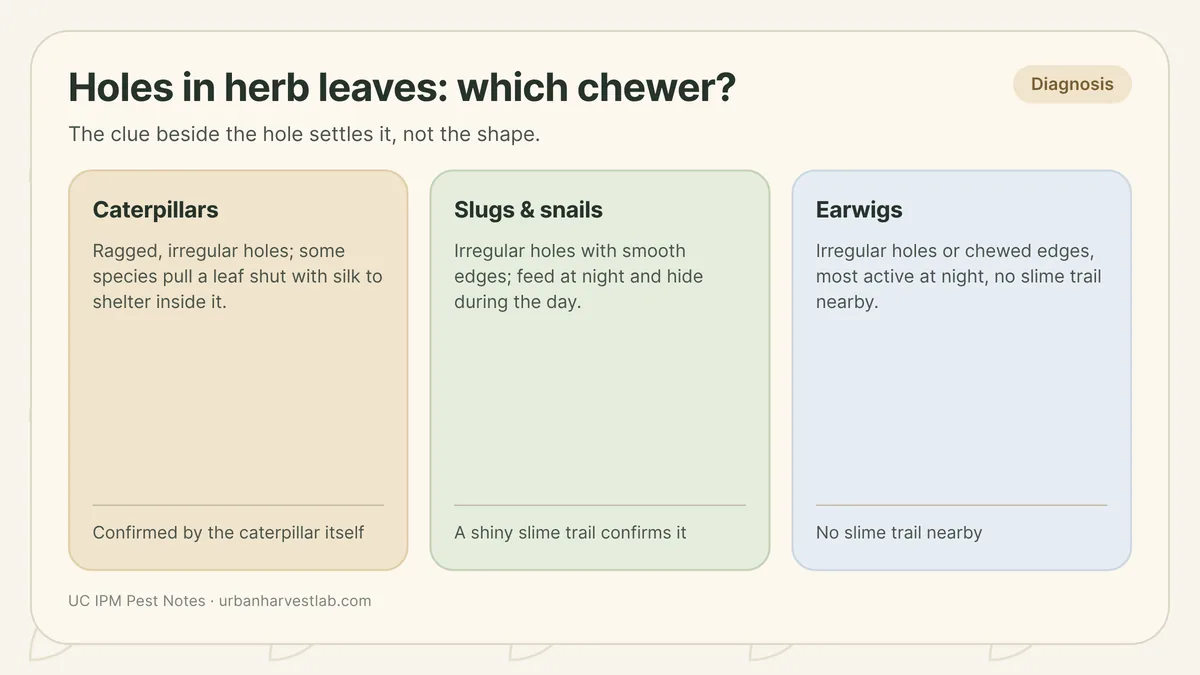
Holes in basil leaves: what's actually chewing them
Three insects punch actual holes through a herb leaf: caterpillars, slugs and snails, and earwigs. Each leaves its own clue, and the clue matters more than the shape of the hole.
Choosing a pest treatment for plants you are going to eat
Once you know which pest you have, the next question is what you can treat it with without compromising the food. The answer is a ladder of methods, and the label on any product you buy sets the legal limits of the top rung.