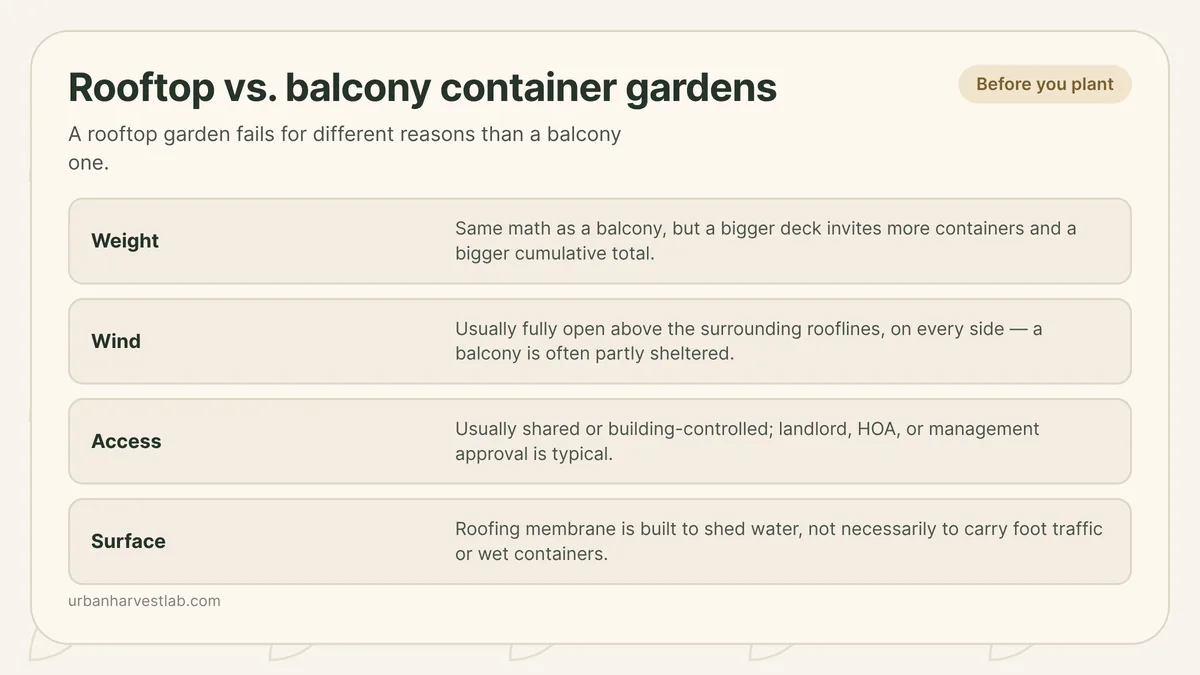
What changes between a balcony and a rooftop container garden
| Factor | Balcony | Rooftop |
|---|---|---|
| Weight | One structure, usually a handful of containers to total | Same math, but a bigger deck invites more containers and a bigger cumulative total |
| Wind | Often partly sheltered by the building or a neighboring unit | Usually fully open above the surrounding rooflines, on every side |
| Access | Private to the unit; often no outside sign-off needed | Usually shared or building-controlled; landlord, HOA, or management approval is typical |
| Surface | Balcony floor is built to be walked and used | Roofing membrane is built to shed water, not necessarily to carry foot traffic or wet containers |
A rooftop container garden is not just a bigger balcony. Three things behave differently up there: the weight question becomes the one that cannot be skipped, the wind is typically worse than anything a balcony sees, and getting up there at all usually means someone else has to say yes first. None of that means a roof cannot support a productive garden — plenty do — but the planning has to start from those three facts rather than from the crop list. The balcony weight math and balcony wind protection techniques both carry over directly; what follows is what changes once the same containers move up onto a roof.
Weight is the one number you cannot skip
A roof’s carrying capacity is a fact about that specific structure, not a number that transfers between buildings. What changes on a roof is not the math, it is the temptation. A balcony’s railing and floor plan put a natural ceiling on how many containers fit; a rooftop deck often has enough open space that a gardener keeps adding pots long after the same instinct would have stopped on a balcony. The cumulative total is what a roof’s structural design actually has to carry, and that total grows every time another container goes up.
The way to check it is the same saturated-weight calculation used for a balcony: each container’s own weight, plus its growing mix and the water it holds once fully soaked, added up across every container on the roof. Balcony weight limit: calculate what your container garden really weighs walks through that math step by step and includes a calculator for running it on your own containers. Do that math for the whole roof, not just for one representative pot, and compare the total against the roof’s own structural documentation or a structural engineer’s assessment — the same route a balcony owner would take, just applied to a bigger, often shared, structure.
Raised beds and large planter boxes are worth flagging specifically here: they are common on rooftop decks because the open space makes them look reasonable, and they concentrate far more saturated weight in one footprint than a cluster of pots the same size would if spread out. A large planter box is exactly the kind of addition that deserves the weight math before it goes up, not after. Container material adds its own weight tradeoff on a roof: the RHS’s mix for herbs needing sharp drainage runs up to 25 percent coarse grit or perlite by volume, and grit is the heavy option where perlite is not — a real choice between drainage and load once every pound on the roof has to be accounted for.
Wind exposure is usually worse than on a balcony
A rooftop typically sits above the surrounding rooflines, exposed on every side, where a balcony is at least partly recessed into the building and often has a neighboring wall, an upstairs unit, or an adjacent structure breaking the wind on one or two sides. That difference in shelter is the main reason rooftop wind tends to be the harder problem: there is usually less of the building left to hide behind.
Air moving faster across an exposed pot pulls water out of it faster. Iowa State University Extension puts container watering frequency anywhere from once or twice a day in a small, hot, windy spot to once or twice a week in a large container in cool weather, and that faster end of the range tends to be the more constant state on an open roof than on a partly sheltered balcony, simply because there are fewer corners on a roof where the air actually slows down.
The fix is the same set of decisions either way — wide, heavy containers with weight held low, plants chosen for a shrubby or low growth habit in the most exposed spots, and a mesh screen or lattice windbreak rather than a solid barrier — just applied with less natural shelter to lean on. University of Illinois Extension’s container-stability guidance names the same shapes that matter here: “square pots are the most stable,” and the advice is to “look for a base broader than pot’s height to minimize overturning if that is a concern.” That guidance names balconies, rooftops, and decks specifically as the places this matters most, and tells growers to “strap or anchor tall plants in place.” Windproof balcony garden: anchoring, plant choice, and windbreaks covers the full technique, including how to anchor a container or a trellis without drilling into a rented structure. On a roof, plan for the fully exposed end of that guidance rather than the sheltered end, and check for gaps between buildings or a high, open sightline that can funnel wind harder than the floor plan suggests.
Roof access is rarely a private decision
A balcony belongs to one unit, and the person who lives there usually decides what goes on it without asking anyone else. A roof is different. Even a roof that looks unused is almost always part of the building’s shared structure, and getting up there for gardening typically requires permission from a landlord, a condo or HOA board, or a building manager before anything else happens.
That approval process usually exists for reasons that matter to the garden itself, not just as a formality. Building management is generally the party with access to the roof’s structural documentation, which is the same paperwork the weight math above depends on. They also typically control who has physical access to the roof hatch or stair, what insurance covers if something goes wrong, and whether a fire code or building code sets rules about keeping walkways and emergency access paths clear of containers, hoses, or windbreak structures. Starting the conversation early, before buying containers, tends to go better than presenting a finished setup and asking for retroactive approval.
Water access is worth raising in that same conversation. A roof rarely has a garden spigot the way a yard does, and hauling water up by hand for a large planting quickly becomes the routine’s weakest link. Balcony drip irrigation: sizing your emitters and reservoir covers reservoir and emitter sizing that applies just as well once water has to be carried or piped up to a roof rather than reached from an indoor tap.
Protect the roof surface, not just the plants
A roofing membrane is built to shed water, not to carry foot traffic or support wet containers sitting directly on it for a season. Pads, risers, or a section of decking under every container keep the pot’s base off the bare membrane and let water drain rather than pool underneath it.
Roof drains and scupper openings need to stay completely clear of soil, fallen leaves, and any root growth that finds its way toward them. A drain blocked by gardening debris does not just back up water on the roof deck; it can send water somewhere the building was not designed to handle it, which turns a container garden into a maintenance and liability problem fast. Food-safe containers for growing vegetables and herbs covers the container-material side of a rooftop setup, and the same drainage-first thinking that applies to an individual pot’s saucer applies at the scale of a whole roof deck’s drains.
Anything that needs anchoring rather than just weight — a trellis, a tall support, a windbreak panel — should attach to something solid without penetrating the roofing membrane itself, the same rule that applies to a rented balcony railing. How to trellis a plant without drilling a single hole covers hardware that clips or clamps into place instead of piercing a surface that is not yours to alter.
Where to start
Work the weight math first, for every container you plan to add, and get it in front of whoever controls the roof before you buy anything large. Then plan for wind at the exposed end of the scale rather than the sheltered end — a roof surface also runs hotter than a balcony floor and drives the same faster drying; protecting container plants during a heatwave covers that response. Confirm access, water, and drainage rules as part of the same conversation, and put a pad or riser under every container from day one rather than retrofitting protection after the membrane already shows wear. None of that is more complicated than a balcony setup — it just has to happen in a different order, because on a roof, someone else usually has to agree to the plan before the plants do.
Sources
Work through the rooftop-specific decisions
These guides cover the load math, wind technique, and container choices that a rooftop setup depends on.
Common questions
Is a rooftop container garden heavier than a balcony one?
Not automatically, but the total across a whole roof usually climbs faster, because a roof deck offers more open floor area and tempts a gardener into more containers than a single balcony railing ever could. The math for any one container is the same either way: its own weight plus its growing mix and water at full saturation. Running that math for every container and checking the total against the roof's documented load allowance is the only reliable way to know where you stand.
Is wind worse on a rooftop than on a balcony?
Usually, yes. A rooftop typically sits above the surrounding rooflines with open exposure on every side, while a balcony is at least partly recessed into the building and often has a neighboring wall or unit breaking the wind on one or two sides. The same anchoring, container, and windbreak techniques apply on a roof, but they need to work harder because there is less shelter to begin with.
Do I need permission to start a rooftop container garden?
Almost always, if the roof serves a building you do not own outright. A landlord, a condo or HOA board, or a building manager typically controls roof access and needs to sign off before containers, planters, or a windbreak structure go up, partly because of the weight and drainage questions and partly because a roof usually has its own liability and maintenance rules.
What protects a roof surface from container gardening?
Pads, risers, or a layer of decking under every container keep the pot off the bare membrane and let water drain instead of pooling under it. Keeping every roof drain and scupper completely clear of soil, leaves, and root growth matters just as much, since a blocked drain can send water where it was not designed to go.
Related guides
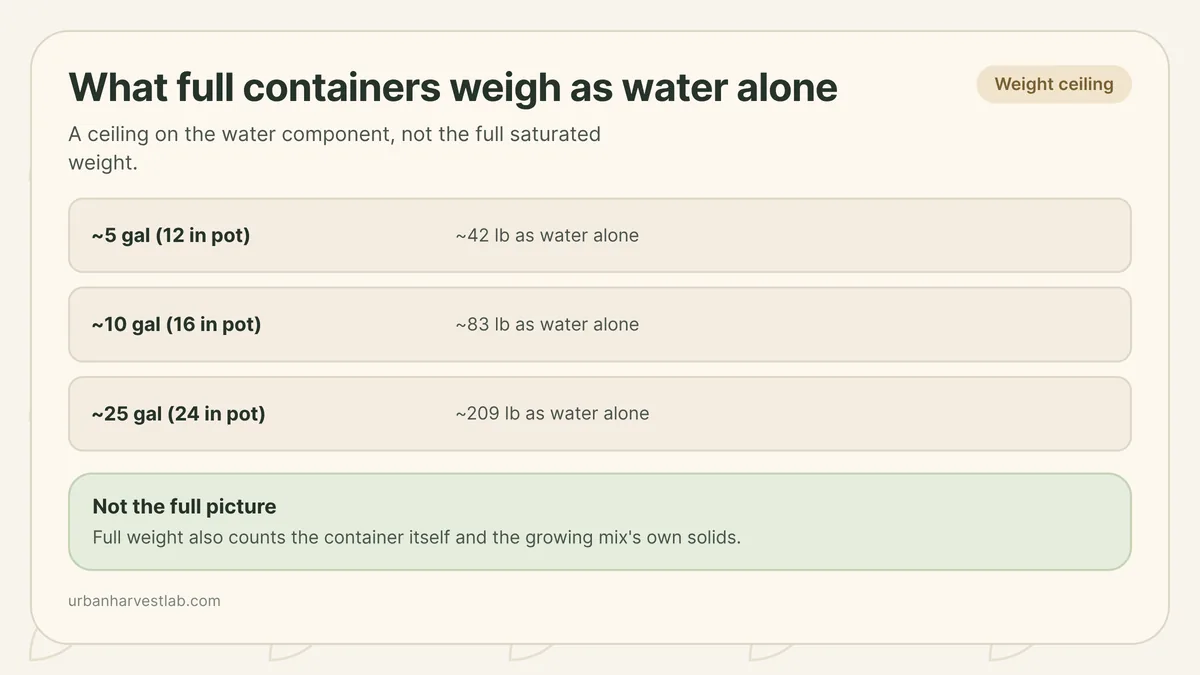
Balcony weight limit: calculate what your container garden really weighs
A balcony's real weight allowance comes from its own structural documentation, not a one-size figure online. What you can calculate yourself is exactly how much your containers weigh once every one of them is soaked through.
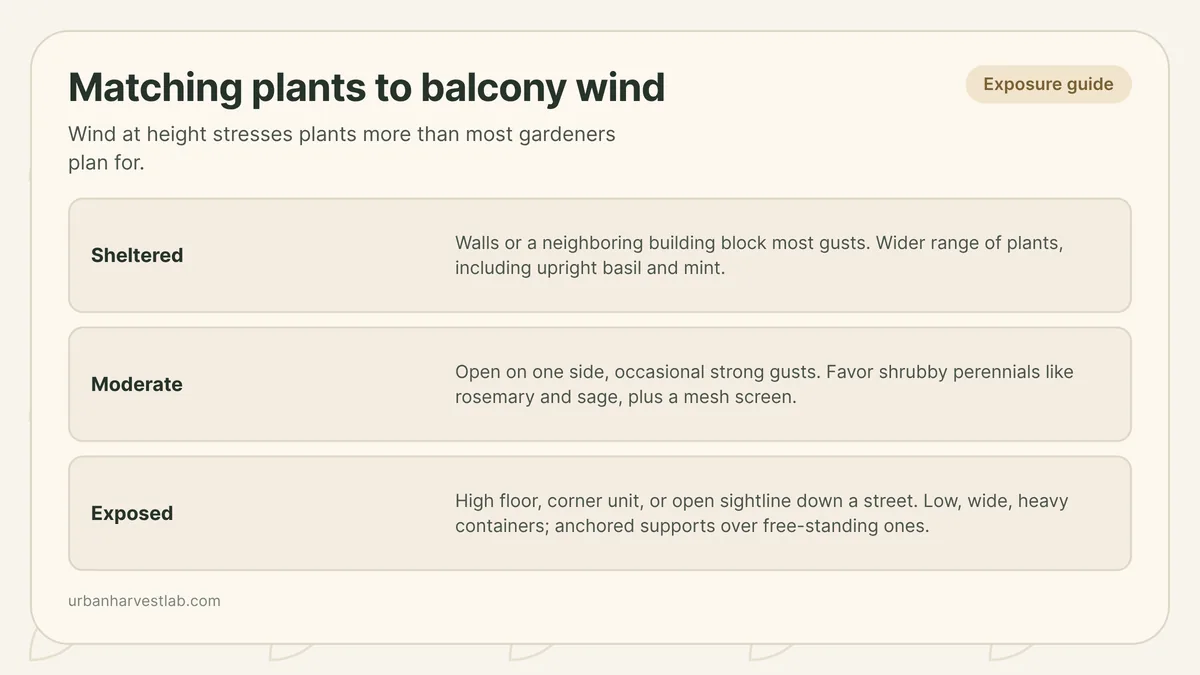
Windproof balcony garden: anchoring, plant choice, and windbreaks
A balcony catches wind differently than a yard does, and the fix is not one trick but three working together: heavier containers, plants suited to an upright or shrubby habit, and a windbreak that softens gusts instead of stopping them dead.
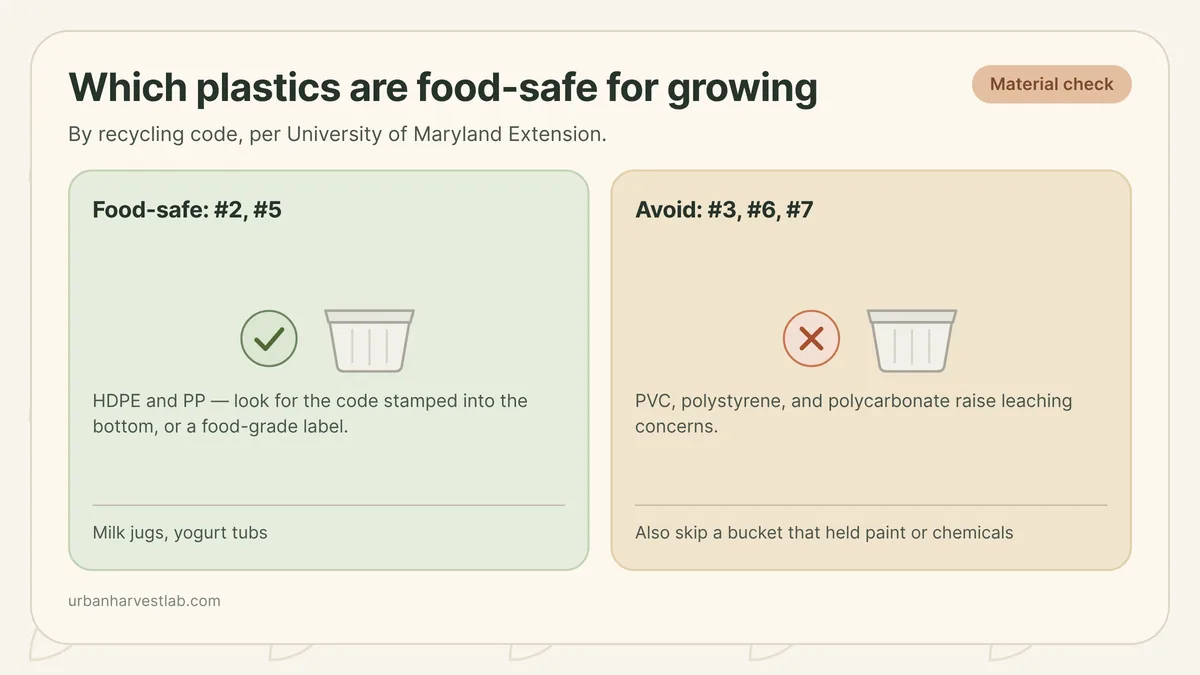
Food-safe containers for growing vegetables and herbs
A container's recycling code and its history both decide whether it's safe to grow food in -- and the two questions have different answers.