Which support fits which potted tomato
| Support | Best for | Size given by extension sources | Watch out for |
|---|---|---|---|
| Wire cage | Determinate types; Vermont also suggests them for containers | Iowa State: 20 to 24 in across, 4 to 5 ft tall; Clemson: at least 6 in between wires | A short cage is outgrown by an indeterminate plant |
| Single stake | Indeterminate types trained to one stem | Iowa State: 7 to 8 ft long; Clemson: 6 ft tall, 1.5 to 2 in wide | Iowa State advises against it for determinate types |
| Tall cage plus a stake | Indeterminate types in a pot | Iowa State: 4 to 5 ft tall, with 1 or 2 stakes fastened to it | Overgrown cages can topple (Vermont) |
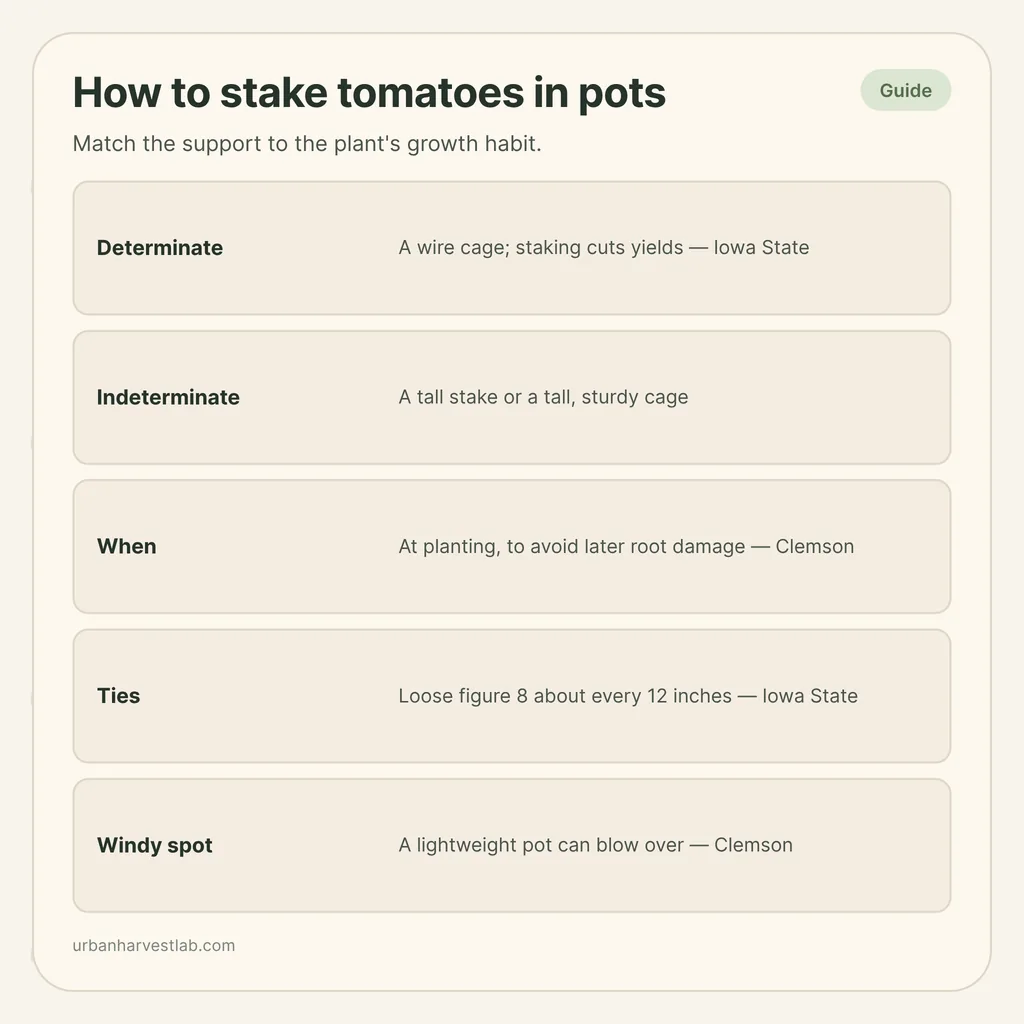
Match the support to the plant’s growth habit: a wire cage for a determinate tomato, a tall stake or a tall, sturdy cage for an indeterminate one, and set it up when the plant goes into the pot. The ties matter as much as the frame. Loose and soft, and checked as the stem thickens.
Find out which kind of tomato you have
The tag or seed packet usually says. Clemson Extension describes determinate plants as growing “to a certain size, set fruit, and then decline,” and indeterminate plants as continuing “to grow and produce for an extended season,” with fruit possible until the first frost. Seed packet words like patio, dwarf and determinate are worth decoding before you buy, because the support follows from the habit.
University of Vermont Extension puts the practical gap plainly: determinate varieties are bushy and compact, and indeterminate ones can reach more than 7 feet tall. A dwarf tomato bred for pots may need little more than a short cage.
Put the support in at planting
Do it on planting day or soon after. Clemson Extension’s container guide says that if cages, stakes or other supports are needed, provide them “when the plants are very small to avoid later root damage.” Iowa State Extension gives a window of two weeks after planting for a stake, and warns that roots may be injured if stakes go in later in the season. Both are about roots. In a pot, the likely reason is that the root ball fills the container, so a late stake has little room to miss it (our inference, not stated by either source).
Iowa State puts the stake 3 to 4 inches from the plant, and Clemson 4 to 6 inches. The extension guides cover in-ground planting. In a pot, the logical adaptation (our inference) is to set the stake to one side of the root ball rather than through it and push it down toward the bottom, but a pot may not hold a stake as firmly as soil does, so check that it stands steady. The extension depths of 1 to 2 feet are for open ground; a pot is shallower, so a stake that is 6 to 8 feet long will stand well above the rim.
Determinate tomatoes: a cage
Iowa State Extension says staking is not recommended for determinate cultivars, “as yields will be drastically reduced,” and that a wire cage or the weave system suits them better. Vermont agrees that standard cages work well for these plants.
Size is the part that goes wrong. Iowa State calls a cage 20 to 24 inches across and 4 to 5 feet tall “excellent”. Clemson asks for at least 6 inches between wires so a hand can get in to harvest; Virginia Tech says 4-inch mesh is wide enough to reach through. Check that the cage fits inside the rim of your pot (our inference, as the guides assume open ground). Iowa State drives one or two stakes into the ground beside a cage and fastens the cage to them; whether a stake in a pot can do the same job is something to test, not a sourced fact.
Indeterminate tomatoes: a tall stake, or a tall cage
Two routes work.
A single tall stake. Iowa State uses 7 to 8 feet, Clemson 6 feet and 1.5 to 2 inches wide, and the University of Wisconsin-Madison 5 to 6 feet, with wooden stakes at least 1 inch square and no chemically treated wood. Virginia Tech notes that tomatoes can be tied singly to individual stakes. Training to a single stem means removing side shoots, which pruning container vegetables covers. Iowa State notes the trade: single-stem staking gives an earlier crop but a lower total yield, and fruit is more prone to sunscald and blossom end rot because there is less leaf cover.
A tall cage. Vermont’s advice for container growers is to buy high-quality, tall cages, and to consider determinate varieties to avoid cages being outgrown or toppled. Virginia Tech calls caging a common approach for the long vines of indeterminate tomatoes. If you are choosing one, browse tall tomato cages on Amazon and check the height and the gap between wires against the figures above.
If the pot sits on a balcony where a stake cannot be fixed to anything, anchoring a trellis without drilling covers the options.
Tie without strangling
For a staked plant, Iowa State recommends stretch ties, or strips of old nylon hose or cloth, about every 12 inches up the stem. Make a loose figure 8, with the stake in one loop and the stem in the other. Clemson’s in-ground advice is heavy twine or strips of cloth at every 10 inches of height.
The sources name soft, stretchy or cloth materials, and a stem thickens through the season, so check ties as the plant grows and loosen any that have started to bite. A plant in a cage needs none of this: Iowa State says to place wayward stems back inside the cage as the plant grows.
Keep the pot upright
A support turns a pot into a sail. Clemson notes that if a container is lightweight, a strong wind can blow plants over. The fix is in the container, not the stake: choosing a tomato pot covers the volume and the stability a tall plant needs.
Sources
- Clemson Cooperative Extension, “Container Vegetable Gardening”
- Clemson Cooperative Extension, “Tomato”
- Iowa State University Extension, “How to Train Tomatoes in the Home Garden”
- University of Vermont Extension, “Alternatives to the Standard Tomato Cage”
- University of Wisconsin-Madison Division of Extension, “Trellising, Staking and Caging”
- Virginia Tech Cooperative Extension, “Vertical Gardening Using Trellises, Stakes, and Cages”
Container tomato support
Pot size, anchoring without drilling, and pruning for a staked plant.
Common questions
When should I put the stake or cage in a potted tomato?
At planting, or within two weeks. Clemson Extension says to provide supports in containers when the plants are very small to avoid later root damage, and Iowa State Extension says roots may be injured if stakes go in later in the season.
How tall should a tomato stake be?
Iowa State Extension uses a 7 to 8 foot stake for single-stake training, Clemson Extension a 6 foot stake, and the University of Wisconsin-Madison 5 to 6 feet. Those lengths assume the stake is driven into the ground, so in a pot the height above the rim is shorter than the length you buy.
How do I tie a tomato to a stake without hurting it?
Use soft material such as stretch ties or strips of old nylon hose or cloth, about every 12 inches up the stem, in a loose figure 8. Iowa State Extension puts the stake in one loop and the stem in the other.
Do I tie tomatoes growing in a cage?
Mostly no. Iowa State Extension says plants grown in wire cages do not need to be tied to the cage or pruned; you place wayward stems back inside as the plant grows.
Related guides
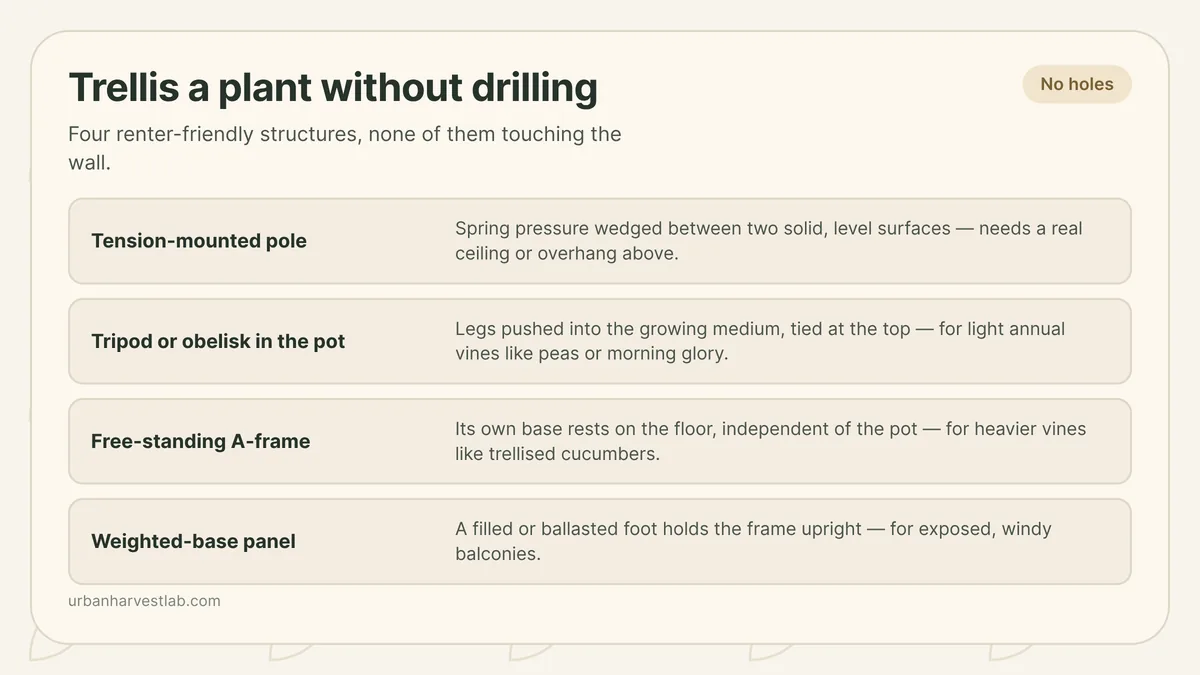
How to trellis a plant without drilling a single hole
A container has no ground to sink a post into, so a renter-friendly trellis has to get its stability from somewhere else. Four approaches do that without touching a wall, railing, or ceiling.
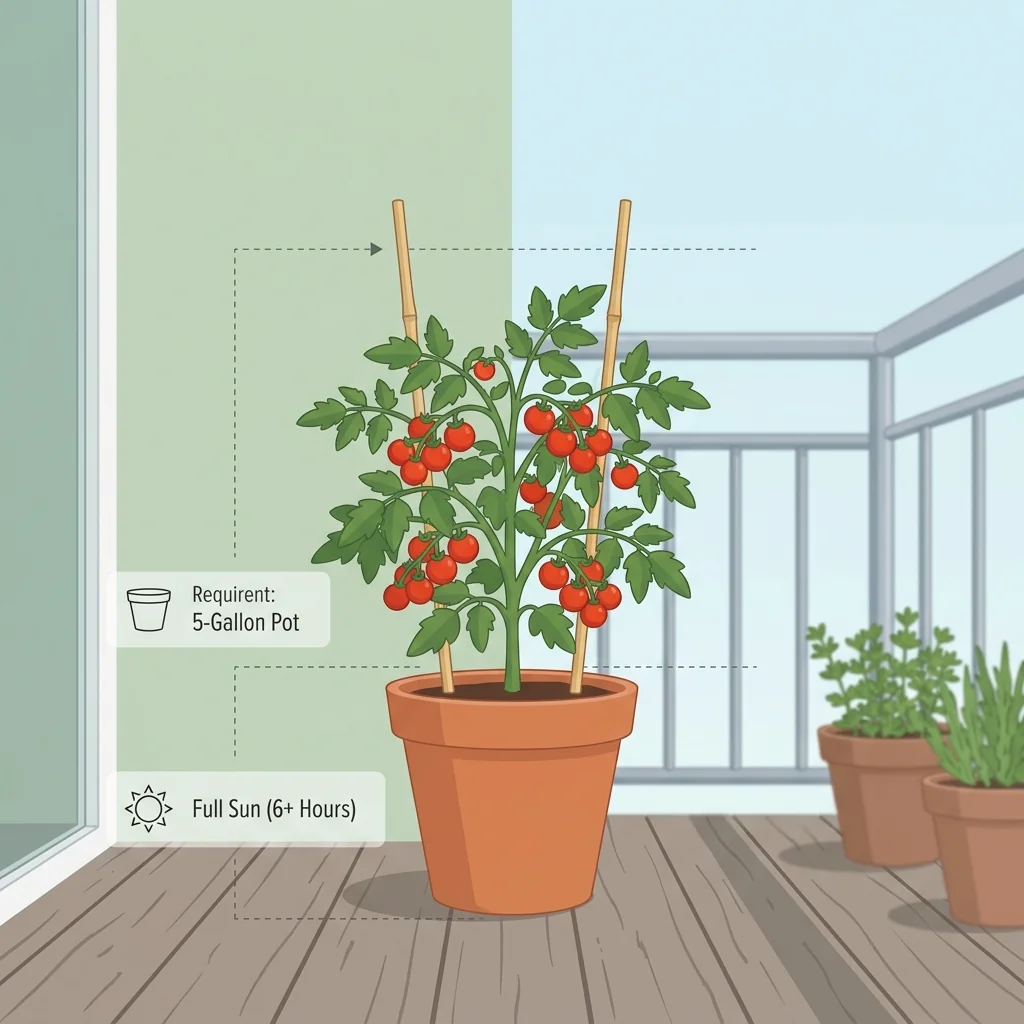
How to grow dwarf tomatoes in pots on a small balcony
Traditional tomato plants grow into massive, untameable 8-foot jungle vines that require giant cages and take over your entire balcony. But with modern 'micro-dwarf' or patio tomato varieties, you can grow heavy yields of sweet cherry tomatoes on a plant that stays under 2 feet tall. Here is the dwarf tomato container blueprint.
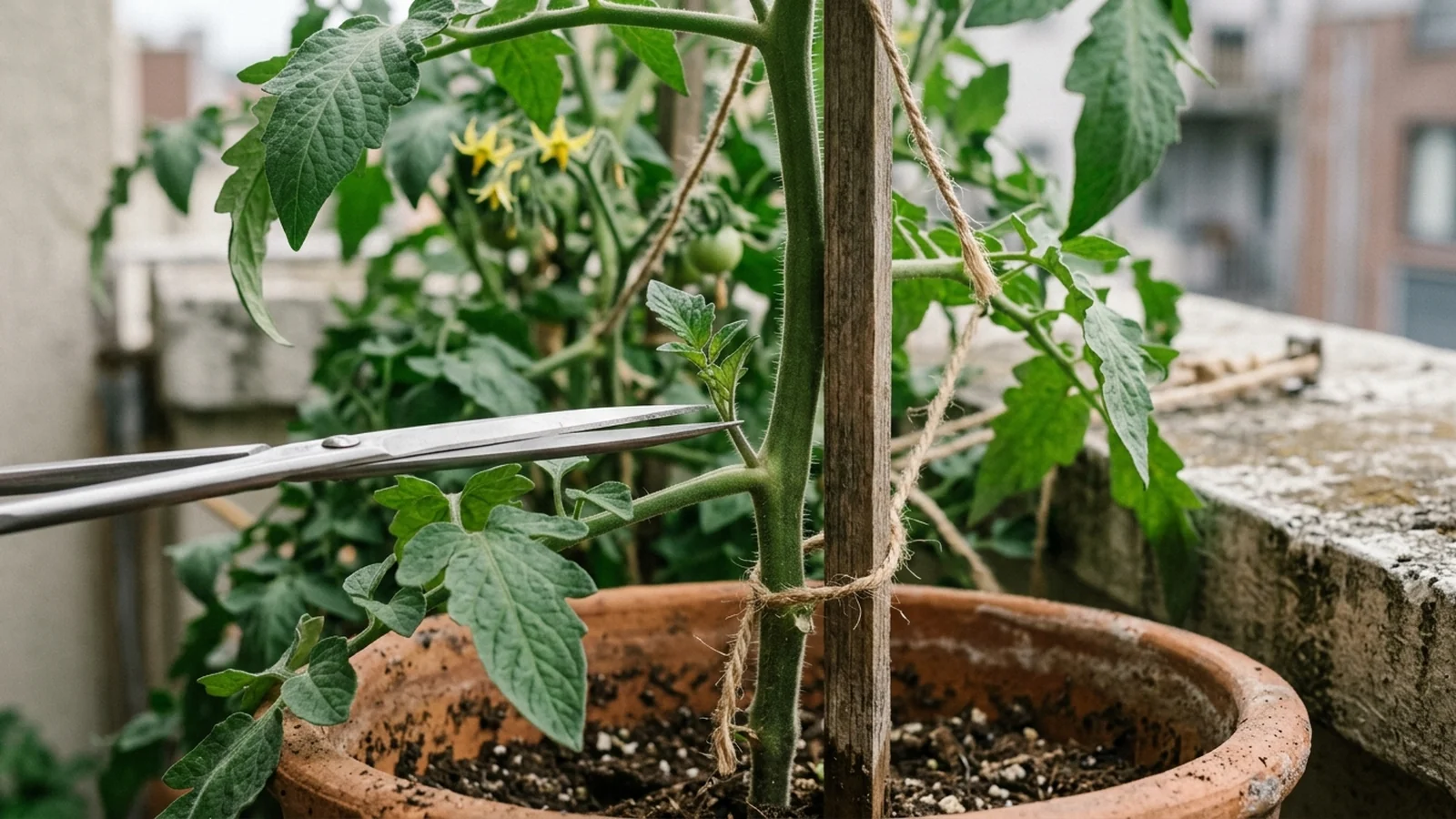
Pruning container vegetables: what to cut, what to leave alone
Cut a leafy herb and it branches back thicker. Cut a container tomato the same way and you are managing how much plant a bucket of potting mix can actually support. Same scissors, opposite goal.