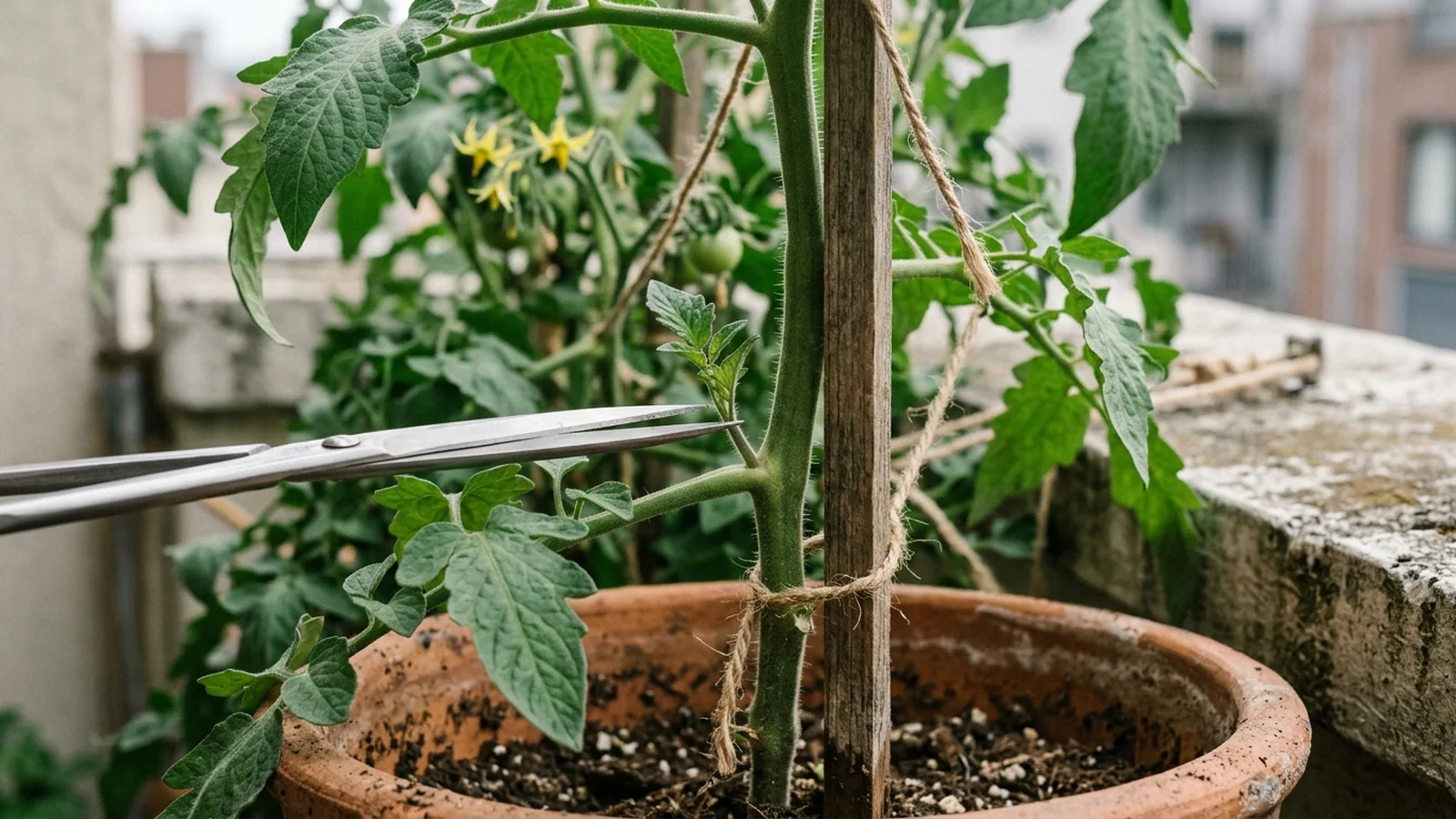
A container tomato that looked fine on Tuesday can be limp by Thursday afternoon, and the cause is often not a missed watering at all — it is a plant carrying more leaf than the pot underneath it can keep supplied between waterings. That is the problem pruning actually solves in a container, and it is a different problem than the one pruning solves on a leafy herb.
Cut a basil plant or a mint stem back and it branches from the cut, sending up two shoots where there was one — you are multiplying the growing points you harvest from. Cut a side shoot off a container tomato and you are doing the opposite: removing a stem the plant would otherwise have to feed, in a pot that cannot expand to find more water or nutrients the way garden soil can. Same tool, same motion, opposite goal. Once that distinction is clear, most of what follows is just working out which crops need which kind of cut, and which don’t need cutting at all. How often to water container vegetables covers the other half of that same trade-off — pot volume and crop stage setting the interval you’re pruning to protect.
Quick answer
In a container, pruning is a water-management decision as much as a shaping one: less leaf means less transpiration, which means less demand on a fixed volume of potting mix on the day you’re late with the watering can. Indeterminate tomatoes get their side shoots removed all season to keep that demand in check; determinate tomatoes mostly don’t, because their fruit grows on stems that suckering would remove. Peppers and eggplant get an early pinch that is more of a vigor habit than a settled rule. Zucchini and cucumber lose their oldest, most shaded leaves for airflow, not appearance. And a stressed, wilted, or heat-struck plant is not a good pruning candidate on any of those crops until it recovers.
Why a container changes what pruning is for
A tomato planted in open ground can send roots out sideways and down as far as the soil lets it, pulling water and nutrients from a volume that keeps expanding with the plant. A tomato in a pot cannot do that. Its root system stops at the container wall, and everything above ground — every leaf, every stem, every truss of fruit — draws on whatever water and nutrients are already inside that fixed volume of mix, refilled only when you refill it.
Colorado State University Extension’s guide to container vegetable gardening makes the same point about spacing that applies to leaf mass: crowding cuts yields and increases disease potential, because a crowded, leafy plant in a small volume of mix is fighting itself for light, airflow, and root room at the same time it’s fighting the pot for water. Penn State Extension’s container guidance underlines why the margin is thin to begin with — most container vegetable gardens need watering at least once a day during hot summer months, precisely because there is so little mix to buffer a dry afternoon. Every leaf you leave on the plant adds to what that daily watering has to cover. Every leaf you remove takes a small amount of pressure off it.
None of this means a bare, heavily stripped plant. It means the question worth asking before a cut is not “does this look tidy” but “does the pot underneath this plant have enough reserve to carry what I’m about to leave on it.”
Indeterminate tomatoes: taking out the suckers
An indeterminate tomato keeps growing and setting new flower trusses until frost, rather than stopping at a set size, and left alone it also keeps producing suckers — the side shoots that form in the notch between the main stem and each leaf branch. A sucker left in place grows into a full second stem, with its own leaves, flowers, and fruit, which is exactly how one tomato plant becomes a sprawling multi-stem thicket by midsummer.
Purdue University’s Vegetable Crops Hotline gives the practical reasoning for removing them: taking out suckers improves airflow through the plant, which helps control foliar disease, and in a container that airflow argument sits on top of the water argument — fewer stems means less total leaf area pulling on the same reservoir of mix. Purdue’s timing guidance is specific: the best time to prune a sucker is when the first flower cluster starts to bloom, done in the morning on a dry, sunny day, while the shoot is still small. Wait until it has grown large and removing it leaves a big wound that gives pathogens an easier way in, which is the same logic Iowa State University Extension gives for the cut itself — snap or cut the sucker cleanly rather than leaving a jagged wound, and make the cut during dry weather to keep the risk down.
Suckering an indeterminate tomato usually means training it to one or two main stems and then checking every week to ten days for new shoots forming in the leaf axils, snapping them out while they’re still small enough to remove with your fingers. Late in the season, that same restraint shifts to a different cut: Iowa State recommends topping the plant — removing the growing tip of the main stem — about four to six weeks before the average first fall frost, so the plant stops setting new flowers it has no time left to ripen and redirects its remaining energy into the fruit already on the vine.
Determinate tomatoes: why you don’t sucker them the same way
A determinate tomato grows to a set size, sets most of its fruit in a compressed flush, and then tapers off — it does not need the season-long stem management an indeterminate variety does, and pruning it the same way costs more than it saves.
Iowa State University Extension’s rule for determinate tomatoes is narrower than the indeterminate one: remove suckers only up to the first flower cluster, and leave every sucker that forms above that point. Purdue’s Vegetable Crops Hotline explains why that boundary matters — the sucker growing just below the first flower cluster develops into a strong shoot that carries a large share of the plant’s fruit, and removing it along with everything below simply costs yield for no return. Prune a determinate tomato as if it were an indeterminate one, all season, and you strip out the stems the plant was counting on to produce its one main harvest.
Peppers and eggplant: an early pinch, not a season-long job
Peppers and eggplant don’t sucker the way tomatoes do, so their pruning question is really about timing rather than which stems to remove. University of Maryland Extension recommends pinching out early flower buds and small fruits on young pepper plants to produce stronger, more prolific growth before the plant shifts into fruiting — the idea being that a transplant that starts setting fruit immediately is diverting energy toward that fruit at the exact point it should be building roots and canopy in its new pot.
That guidance is clear enough to follow: pinch off the first flush of buds for the first couple of weeks after transplanting, then let the plant fruit normally. What’s less settled is how much difference it makes by the end of the season, once the plant has filled out its container regardless. The advice reads as a vigor habit worth doing on a small, freshly potted transplant, not a rule with the same weight as suckering an indeterminate tomato — and it matters least on a plant that’s already established and cropping well. Eggplant gets grouped with peppers in the same early-pinch logic for the same reason: both are nightshades that carry the same transplant-shock trade-off between rooting in and fruiting early.
Zucchini and cucumber: removing leaves for airflow, not looks
Zucchini and cucumber don’t get suckered or pinched the way tomatoes and peppers do — their canopy grows from a central crown rather than multiple competing stems — but they do accumulate large, shaded lower leaves as the season goes on, and those leaves are worth removing for a specific reason.
University of Maryland Extension’s cucumber disease guidance is direct about what crowded, poorly ventilated foliage does: avoid crowding plants too closely, and allow good air circulation so leaves dry faster after rain, since standing moisture on foliage is what lets fungal disease take hold. A container’s dense zucchini or cucumber canopy creates the same crowded, damp microclimate a garden row does when it isn’t thinned, just at a smaller scale. Taking off the oldest, most shaded leaves near the base — the ones already losing the light competition to newer growth above them — opens that crown back up without touching the leaves actually feeding the plant. It’s a disease-prevention cut, not a cosmetic one, and it leaves the productive canopy alone.
When not to prune
Pruning adds a wound and removes leaf area the plant was using, and there are a few conditions where that trade stops being worth it.
A plant that’s already stressed. A container vegetable that’s wilted from missed watering, freshly repotted, or otherwise struggling has less reserve to spend healing a cut. Hold off until it’s recovered and growing normally again.
Extreme heat. SDSU Extension flags a specific risk here for tomatoes: leaves that have been shading ripening fruit suddenly expose it to direct sun when removed, and that sudden exposure can cause sunscald even at temperatures that wouldn’t otherwise damage the fruit. A heavy prune in the middle of a heatwave trades a small airflow gain for a real sunscald risk.
A large wound in wet weather. Iowa State’s guidance to cut cleanly and work in dry weather applies most where it costs the most: a big cut made while foliage is wet, or left to heal in humid conditions, is a longer-open door for the pathogens that crowding and poor airflow already favor. Small, frequent cuts to shoots while they’re still young avoid this almost entirely — it’s the large, late cut on a wet day that carries the real risk.
Pruning at a glance
| Crop | What you cut | What you leave | Why it matters in a pot |
|---|---|---|---|
| Indeterminate tomato | Side shoots (suckers) in the leaf axils, all season, while small | The main stem or two you’ve chosen to train | Fewer stems draw less water from a fixed volume of mix |
| Determinate tomato | Suckers below the first flower cluster only | Every sucker above that cluster | That upper growth carries most of the plant’s one main fruit flush |
| Pepper / eggplant | Early flower buds and small fruit, first 2-3 weeks after transplant | The plant’s leaf canopy | Redirects a young transplant’s energy to roots before fruiting |
| Zucchini / cucumber | Older, shaded leaves near the base | Young leaves and the growing crown | Opens the canopy for airflow, cutting fungal disease pressure |
Whichever crop is in the pot, the same check is worth running before any cut: is this plant already stretched thin by its container, or does it have room to spare? A well-watered plant in a generously sized pot — see tomato pot size, pepper pot size, and container depth for tomatoes, peppers, and herbs for the volumes each crop actually needs — has more slack to absorb a cut than the same crop crammed into a pot that was already too small. Dwarf and compact varieties change that math further; growing dwarf tomatoes in pots on a small balcony covers varieties bred to stay manageable without the same season-long suckering routine. Once fruit is on the plant, knowing when container vegetables are ripe is the other piece of timing worth having settled.
Common mistakes
- Treating every tomato like an indeterminate one. Suckering a determinate variety all season removes the stems it needs for its main fruit flush.
- Pruning on a whim instead of on a schedule. Checking for new suckers every week to ten days catches them small, before the cut leaves a large wound.
- Reaching for pruners during a heatwave. Removing shade leaves from a stressed, wilted, or overheated plant adds a wound on top of a plant already struggling to keep up with water demand.
- Cutting wet. A cut made on damp foliage, or left to heal in humid weather, stays open to disease longer than the same cut made on a dry morning.
- Pulling a lot of leaf off a squash plant for looks. Removing anything beyond the oldest, most shaded leaves costs photosynthesis without adding meaningful airflow.
Sources
- Colorado State University Extension, CMG GardenNotes #724: Vegetable Gardening in Containers
- Purdue University Vegetable Crops Hotline: Prune Determinate Tomatoes
- Iowa State University Extension and Outreach, Yard and Garden: Pruning Tomatoes in the Home Garden
- University of New Hampshire Extension: Pruning Tomato Plants
- University of Maryland Extension: Growing Peppers in a Home Garden
- University of Maryland Extension: Key to Common Problems of Cucumbers
- Penn State Extension: Container Vegetable Gardening — Four Keys to Success
- SDSU Extension: Heat Causes Problems With Garden Produce
Size the container before you decide how much to cut
Pruning only matters as much as the pot underneath it. These guides cover the volume each crop actually needs.
Common questions
What is a tomato sucker and why does it matter more in a pot?
A sucker, or side shoot, is the new stem that forms in the axil where a leaf branch meets the main stem. Left alone on an indeterminate tomato it grows into a full stem with its own leaves and fruit, which in open ground just means a bigger plant. In a container, every extra stem is drawing water and nutrients from the same fixed volume of potting mix, so a plant left to sucker freely outgrows what the pot can keep supplied, especially between waterings.
Should I remove suckers from a determinate tomato?
Not the way you would on an indeterminate variety. Iowa State University Extension recommends removing suckers only up to the first cluster of flowers on a determinate tomato and leaving everything above that point alone, since the plant sets a predictable, roughly one-time flush of fruit and stripping the upper suckers removes the stems that flush grows on.
Does pinching the first flowers off a pepper or eggplant actually help?
University of Maryland Extension recommends pinching out early flower buds and small fruits to build a stronger plant before it starts fruiting, and that guidance is easy to follow on a young transplant. It reads more like a vigor habit than a rule with a measured yield outcome behind it, and it matters far less once the plant already fills its container.
When should I leave a container tomato or pepper alone?
Skip pruning on a plant that is already wilted, mid-heatwave, or has just been repotted or moved, since a fresh cut adds a wound on top of whatever it is already coping with. SDSU Extension also flags a specific risk with tomatoes: removing leaves that were shading ripening fruit can expose it to sudden direct sun and cause sunscald, so a heavy prune on a scorching afternoon can do more harm than the extra airflow is worth.
Related guides
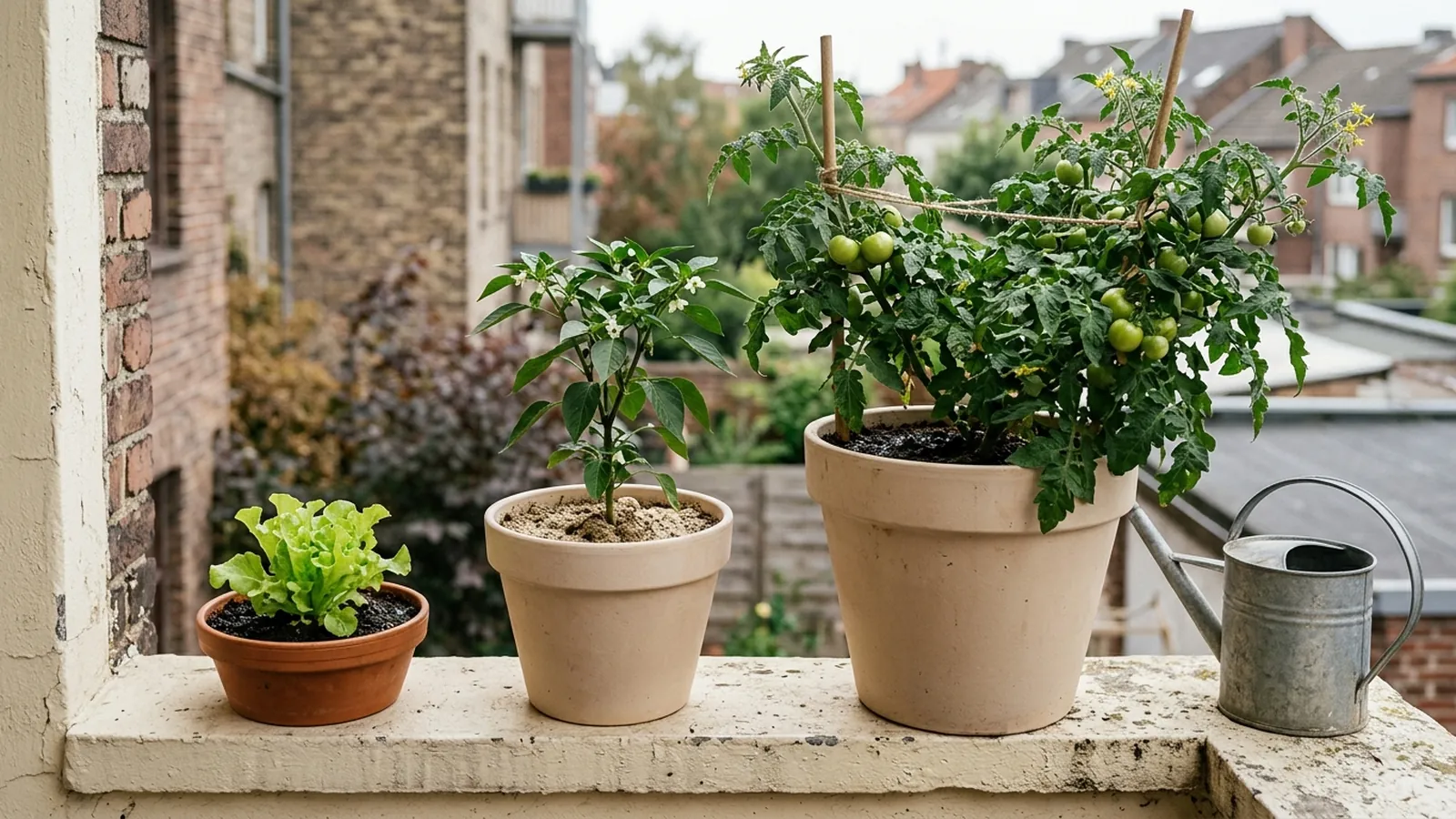
How often to water container vegetables: volume and crop stage set the interval
A pepper in a 2-gallon pot in May and the same pepper in the same pot in August are two different watering problems. Once you can see why, the question stops being how often and becomes how much mix you gave the plant, and what it is carrying right now.
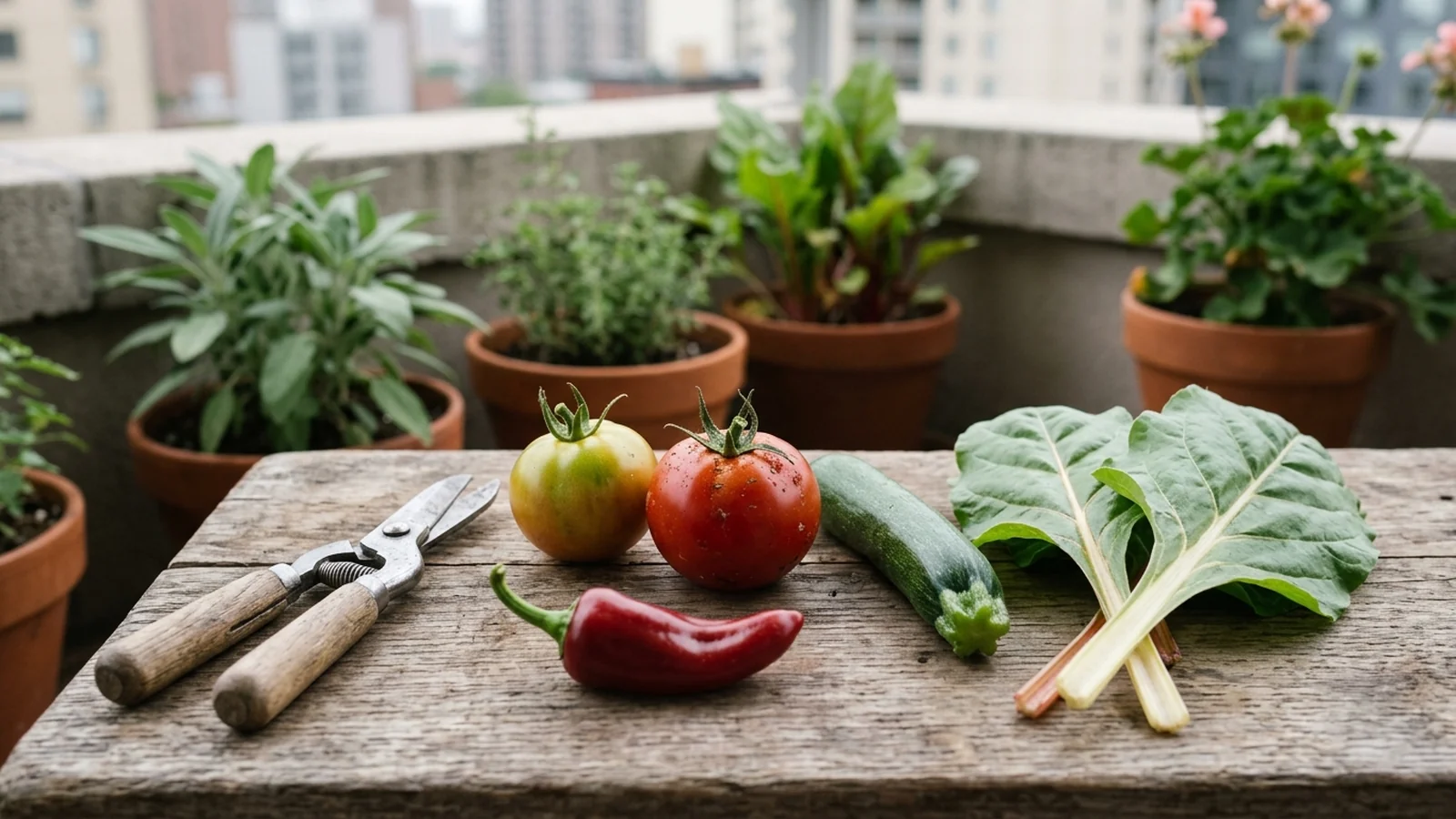
When container vegetables are ripe, crop by crop
A tomato tells you it's ready with color and give. A zucchini tells you with size and how easily it lets go. The signal is different for every crop, and waiting costs more when the plant only has a pot's worth of reserve behind it.
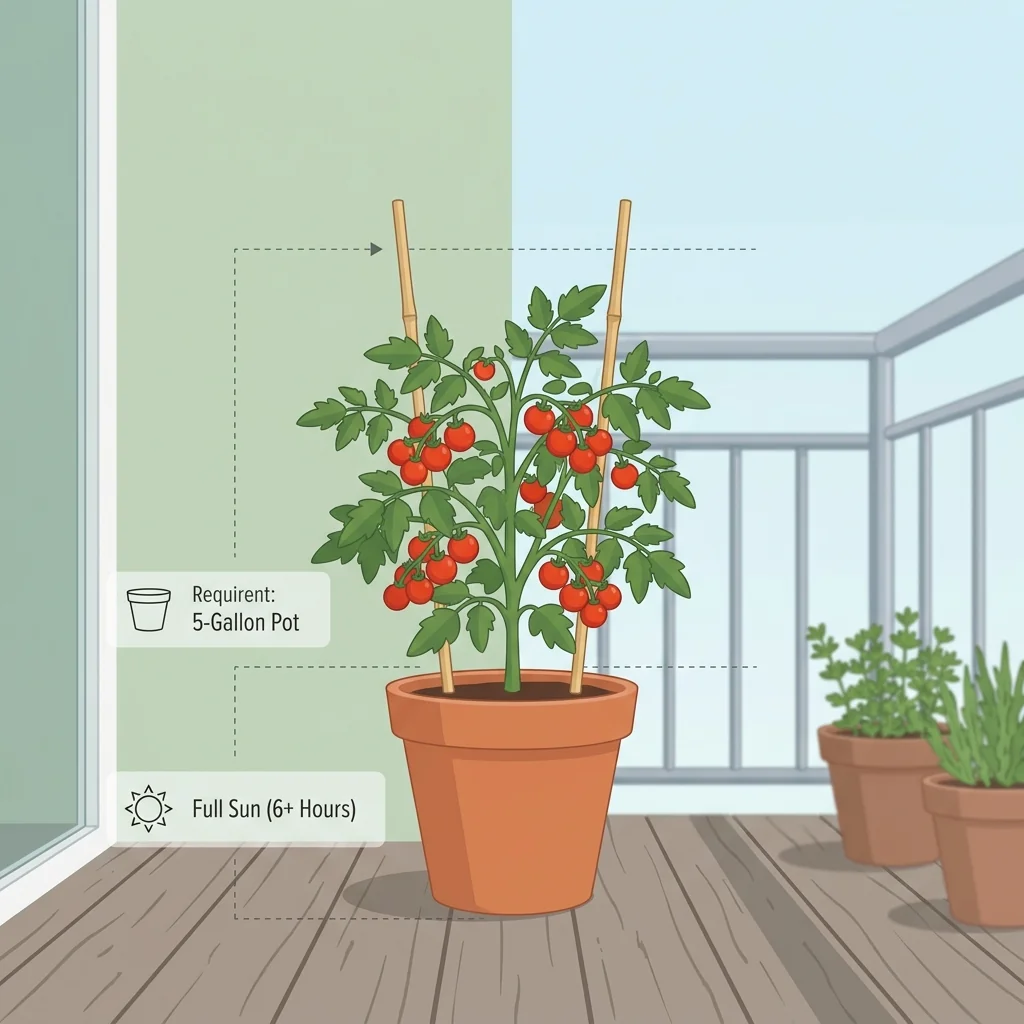
How to grow dwarf tomatoes in pots on a small balcony
Traditional tomato plants grow into massive, untameable 8-foot jungle vines that require giant cages and take over your entire balcony. But with modern 'micro-dwarf' or patio tomato varieties, you can grow heavy yields of sweet cherry tomatoes on a plant that stays under 2 feet tall. Here is the dwarf tomato container blueprint.