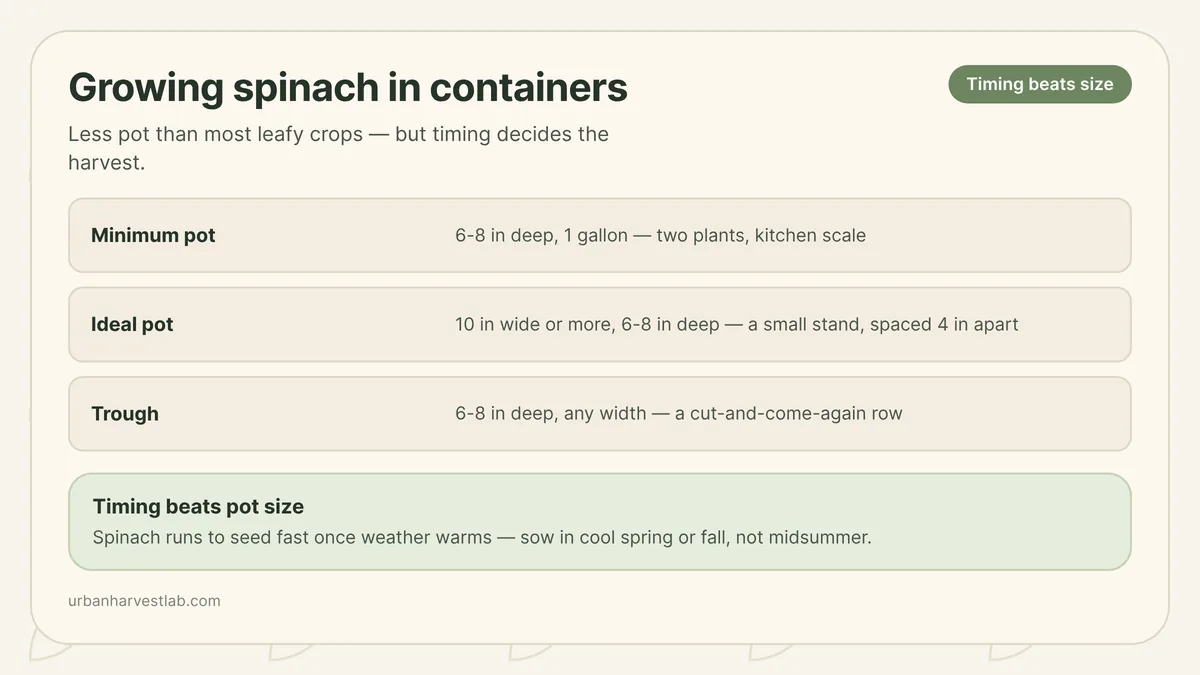
Spinach container size at a glance
| Container | Size | Best for |
|---|---|---|
| Minimum pot | 6-8 in deep, 1 gallon | Two plants, kitchen scale |
| Ideal pot | 10 in wide or more, 6-8 in deep | A small stand, spaced 4 in apart |
| Trough | 6-8 in deep, any width | A cut-and-come-again row, sown in cool weather |
Spinach needs less container than most leafy crops: Texas A&M AgriLife Extension gives 1 gallon of soil for two plants, and University of Kentucky Cooperative Extension puts the minimum useful depth at 6 to 8 inches. Space plants about 4 inches apart, the spacing the Royal Horticultural Society recommends, rather than growing one per pot, and the container side of the job is mostly done. The part that actually decides how much you harvest is timing: spinach runs to seed fast once the weather warms, so a container sized correctly and sown at the wrong time of year still runs to seed before it has produced much, while the Royal Horticultural Society’s February sowing is expected to keep going until it is replaced with a warm-season crop in June. For how spinach’s numbers sit next to other container crops, best containers for herbs covers the drainage and material questions that apply across the cluster.
How much pot spinach actually needs
Texas A&M AgriLife Extension’s container-vegetable table gives spinach 1 gallon of soil for two plants, with no cultivar-specific adjustment. University of Kentucky Cooperative Extension answers a different question with a different unit: it groups spinach with beets, kale, lettuce, onions, radish, chard, and turnip as crops where 6 to 8 inches of soil depth is adequate, rather than giving a volume figure. University of Illinois Extension gives a third figure, at least 10 inches in diameter for leafy greens, which on Illinois’s own conversion table is roughly 3 gallons — three times Texas A&M’s per-pair figure. These are not in conflict; they measure different things, and a pot at least 10 inches wide and 6 to 8 inches deep satisfies all three at once. Green onion sits in that same University of Kentucky depth group for the same reason — a shallow, fibrous root system rather than a deep taproot — and the green onion container guide walks through how that shallow-rooted logic plays out for a different crop.
Depth beyond 6 to 8 inches mostly adds soil the roots rarely reach, which then holds water longer than the plant can use it. Width is the more useful thing to add if you want more spinach, not depth. The Royal Horticultural Society’s general container advice on the same page points the other way — aim for at least 45 cm (18 in) of depth and width, because anything smaller needs more frequent watering and feeding. That is a watering-workload argument rather than a root-space one, and it is the trade-off you are accepting with a shallow pot.
Growing medium matters here as much as the container itself. Texas A&M AgriLife Extension recommends a soilless mix of peat moss, perlite, or vermiculite for container vegetables generally, spinach included, because that combination drains freely while still holding moisture and nutrients. A dense, poorly aerated medium has far less room to buffer a bad watering in a shallow 6- to 8-inch pot than the same mix would in a deeper container. Potting mix vs. raised bed soil covers why garden soil behaves differently once it is confined to a pot.
Sow a stand, then thin it
The Royal Horticultural Society recommends sowing spinach with about 4 inches (10cm) between plants. That is closer in spirit to how a stand of leafy greens is grown than how a single tomato or pepper plant is grown: you are not filling a pot with one specimen, you are filling it with a cluster of plants harvested together, a few leaves at a time. Texas A&M’s 1-gallon-per-two-plants figure works out to roughly the same spacing logic at a small scale. A wider trough or window box just repeats that same 4-inch spacing across more row, which is the simplest way to scale up a harvest without changing the depth at all.
Why timing beats pot size for keeping it leafy
This is the part a correctly sized pot cannot fix on its own. The Royal Horticultural Society’s own container guidance sows spinach starting in February and plans to replace it with a warm-season crop by June, noting plainly that spinach “quickly runs to seed” once the weather turns. That sowing-to-bolt window is short by design, not by accident: spinach is being treated as a crop that finishes before summer heat arrives, not one that is expected to hold through it.
The practical version of that pattern in most temperate climates is two windows rather than one: an early spring sowing that finishes before the hottest weeks, and a second sowing once temperatures drop again later in the year, when the same cool conditions that suit a spring crop return from the other direction. A midsummer sowing into the same well-sized pot is fighting the plant’s own clock, and no amount of depth or spacing fixes that. Cilantro runs on a similar heat-triggered countdown for different underlying reasons, covered in why cilantro bolts, if it helps to see the same failure mode play out in a different crop.
Once a flower stalk has already started, there is no way to push a plant back into leaf production; the correction is in the next sowing’s timing, not in anything done to the one that has already turned.
Reusing the same pot between sowings
Because a spinach planting turns over faster than a tomato or pepper growing all season in the same pot, the same container is likely to get replanted several times a year, and that habit brings its own rules. Texas A&M AgriLife Extension advises against reusing the same soil for a second season of production once a crop is finished, since infected soil can carry disease into the next planting unless it has been properly composted first — worth knowing before tipping a spent spinach root ball straight back into the same pot for the next round.
A repurposed food container is a common choice for a small spinach pot, and if that is what you are reaching for, it is worth checking first. University of Maryland Extension gives plastics stamped #2 (HDPE) or #5 (PP), or labeled “food grade” or “FDA approved,” as the safe choices for growing something you plan to eat, while #3 (PVC), #6 (polystyrene), and #7 (polycarbonate) should be avoided. A bucket or tub that once held paint, solvent, or cleaning chemicals is not food-safe again regardless of its plastic type, even if it is stamped #2.
Container material matters more once the countdown starts
Because spinach is already working against a heat-driven deadline, the container’s own contribution to root-zone temperature is worth a second look. University of Illinois Extension notes that dark-colored and metal containers absorb more heat than lighter ones, which warms the root zone and can stress the plant directly. For a crop that is trying to stay cool, that is one more variable working in the wrong direction. A lighter-colored pot kept out of intense afternoon sun buys a little more time before the same heat that ends a spinach planting outdoors also builds up inside the container itself. Plastic vs. terracotta for herbs covers how material changes drying speed and heat retention in more detail.
Spinach tolerates more shade than the crops sharing its pot
Texas A&M AgriLife Extension groups spinach with lettuce, cabbage, and parsley as leafy crops that tolerate more shade than fruiting vegetables such as tomatoes, peppers, and cucumbers, which need the most sun of the crops it covers. That gives a spinach pot somewhere useful to go once summer arrives: a partly shaded spot that would leave a tomato leggy and unproductive still keeps spinach growing.
A different way to sidestep the season entirely
Growing spinach hydroponically removes the soil and the seasonal weather from the equation, replacing them with a reservoir you can keep cool on purpose. Hydroponic spinach EC, pH, and temperature guide covers the target ranges for that setup.
Sources
- Texas A&M AgriLife Extension, “Vegetable Gardening in Containers”
- University of Kentucky Cooperative Extension, “Vegetables Grown in Containers Improves Accessibility”
- Royal Horticultural Society, “Vegetables in containers”
- University of Illinois Extension, “How to Grow Fruits, Vegetables, Herbs in Container Gardens”
Growing spinach in a container? Keep reading
These guides connect spinach's container needs to material choice, a heat-triggered bolting problem in a related crop, and growing the same crop without soil at all.
Common questions
What size pot does spinach need?
A 1-gallon container holds two spinach plants, according to Texas A&M AgriLife Extension, and University of Kentucky Cooperative Extension puts the minimum useful depth at 6 to 8 inches. A wide, shallow pot works better than a narrow, deep one.
How far apart should spinach be spaced in a container?
About 4 inches (10cm) apart, per the Royal Horticultural Society. Spinach is usually grown as a small stand of plants rather than one specimen per pot, so width buys more harvest than depth does.
Why does my container spinach keep bolting?
Heat is the main trigger. The Royal Horticultural Society notes that spinach quickly runs to seed once warmer weather arrives, which is why a spring sowing in a temperate climate is usually finished well before summer. Once a flower stalk appears, the leaves turn bitter and there is no way to reverse it; harvest what you can and start a fresh, cooler-weather sowing instead.
Does spinach need full sun in a container?
Less than fruiting crops do. Texas A&M AgriLife Extension groups spinach with lettuce, cabbage, and parsley as leafy crops that tolerate more shade than tomatoes, peppers, or cucumbers, which is useful for placing a pot somewhere that runs a little cooler during the warmer parts of the season.
Related guides
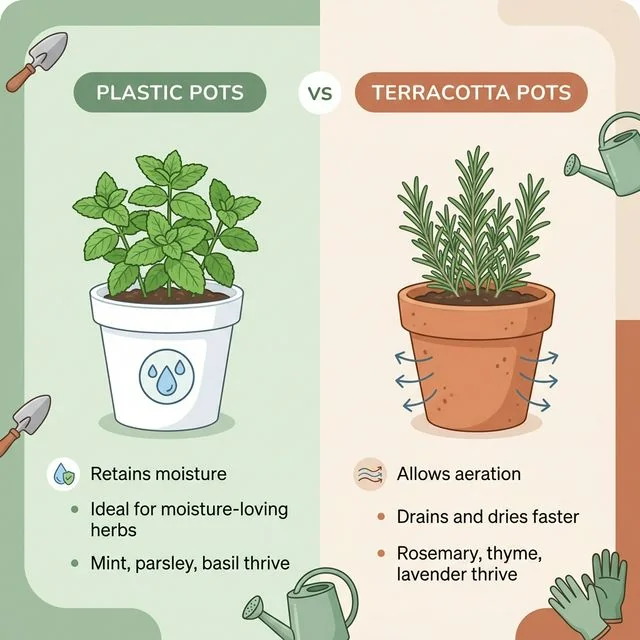
Plastic vs. terracotta pots for herbs: which makes care easier?
The material of your pot dictates how fast your soil dries out. If you put a thirsty mint plant in unglazed terracotta, you will be watering every single day. If you put rot-prone rosemary in a plastic pot, you must be extremely careful.
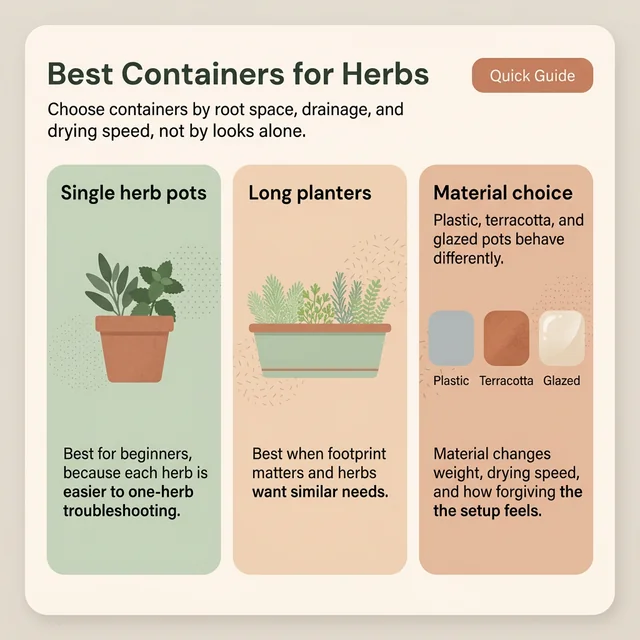
Best containers for herbs: drainage, pot size, and materials that work
A practical guide to herb containers that explains which pots work best, why drainage matters, and how material changes the way containers dry.
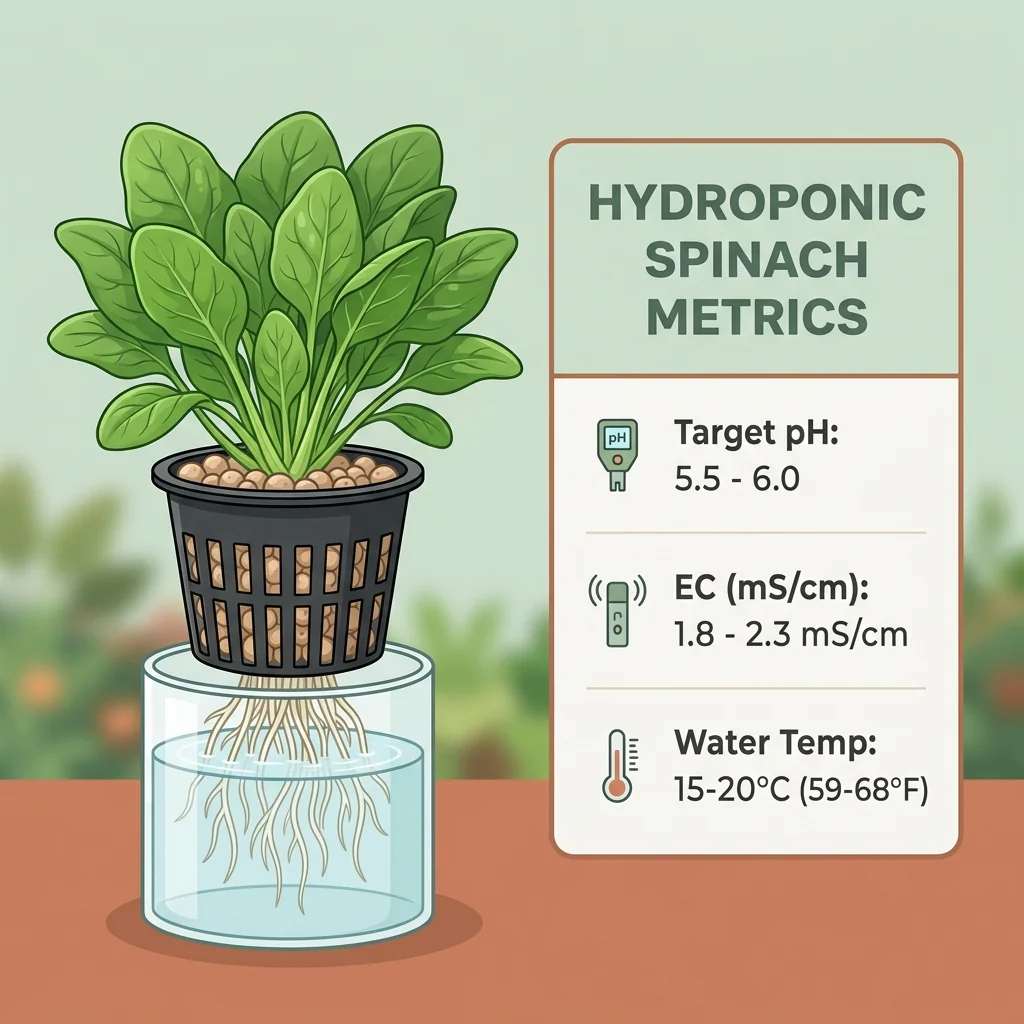
Hydroponic spinach: EC, pH, and temperature guide
Spinach is a cool-season hydroponic crop that bolts in heat. Get the EC, pH, and especially the temperature right and it stays leafy and productive.