
What actually happens under an ordinary white LED bulb
| Setup | Likely outcome | What is limiting it |
|---|---|---|
| Bright bulb kept a few inches from a leafy herb, run long hours | Often genuinely usable growth | Little — this is close to what a dedicated fixture does anyway |
| Same bulb in a normal lamp, on for a few evening hours | Slow, stretched growth | Photoperiod: a few hours a day rarely adds up to a useful daily total |
| Bulb mounted well overhead for general room lighting | Weak, pale, leggy growth | Intensity falls off fast with distance, even from a bright bulb |
| Fruiting or high-light crop under any single household bulb | Usually disappointing | The daily light target is higher than one ordinary bulb can deliver at a livable distance |
Yes, an ordinary white LED bulb can grow plants, and the reason has little to do with buying a special kind of light. A plain white LED already emits across the whole 400 to 700 nanometer band that photosynthesis runs on. What decides whether the bulb in your desk lamp actually grows something worthwhile is how much of that light reaches the leaf, and for how many hours a day — not whether the packaging says “grow light.”
That distinction matters because it points at a different fix than most people reach for. Can herbs grow indoors without direct sunlight? covers whether a plant can survive on window light alone. This is the narrower question underneath it, for anyone who has already decided to add some kind of light: will the bulb already sitting in a lamp do the job, or do you actually need something built for the purpose? For the broader picture of how much light herbs want in the first place, How much light do herbs need? is the right starting point.
Quick answer
Ordinary white LED bulbs are not missing the right kind of light. They are usually missing enough of it, delivered close enough, for long enough. A bulb positioned a few inches from a leafy herb and left on for most of the day can produce real growth. The same bulb screwed into a lamp three feet overhead, running a few hours in the evening, usually cannot — not because the light is the wrong color, but because too little of it reaches the plant, for too short a time.
Why an ordinary bulb usually isn’t a spectrum problem
Photosynthesis runs on light between roughly 400 and 700 nanometers, the band measured as PAR. A white LED bulb, whatever its exact color temperature, spreads its output broadly across that band rather than concentrating it in a narrow slice. That is different from the marketing built around “full spectrum” fixtures, red-blue “blurple” panels, or specific ratios of red to blue — questions worth separating out on their own — Grow light spectrum explained covers them.
For a plain white bulb, the practical point is simpler: spectrum is rarely the reason a houseplant under a lamp fails to thrive. In most cases the reason sits somewhere else — usually intensity, sometimes duration, occasionally both at once.
The real bottleneck: how much light actually reaches the leaf
Leafy greens and herbs grown in controlled conditions generally want a daily light total, or DLI, of around 12 mol per square meter per day or more, according to Michigan State University Extension, and quality drops off noticeably once daily totals fall below 10. That single number reframes the whole question. It is not “does this bulb count as a grow light.” It is “does enough light land on the leaf, often enough, to add up to something in that range.”
A bulb that is bright right at the surface but drops off fast a few inches away can still fail this test, because a plant integrates light over the whole day, not over one glance at the fixture. Per-herb targets vary — basil, mint, and other common crops do not all want exactly the same daily total; DLI targets for herbs and leafy greens breaks them down crop by crop.
Checking your own bulb with a phone
You do not need a PAR meter to get a rough sense of where a given bulb stands. A phone lux app gives a rough starting point under a white LED bulb: for white LED light specifically, illuminance in kilolux multiplied by about 15 gives a working estimate of PPFD in micromoles per square meter per second — a figure from Sharakshane’s 2018 regression over 205 white-LED spectra, published as a bioRxiv preprint rather than a peer-reviewed paper, so treat it as a sanity check rather than a measurement. It does not carry over to red-blue “blurple” panels, fluorescent tubes or HPS lamps. Lux vs. PPFD explains more about what the reading converts to and why it only works for white light.
PPFD and DLI for indoor herbs walks through turning that reading into a daily total you can compare against a real target.
Distance and hours: where household bulbs usually come up short
Two variables do almost all the damage once spectrum is off the table.
The first is distance. Light intensity falls away quickly as a bulb moves farther from the canopy, which is exactly why a bulb mounted for general room lighting rarely performs the same job as one positioned deliberately close to a plant. There is no single safe distance that applies to every bulb and every crop — it depends on the bulb’s actual output, not its wattage. Grow light distance for seedlings walks through measuring your own setup against the canopy.
The second is duration. Seedlings generally need roughly 12 to 16 hours of light a day after germination, per University of Illinois Extension, and stretch toward the light source when a fixture sits too far away — long, thin, weak stems are the giveaway. UMass Amherst adds the other cause worth ruling out — plants also stretch when the temperature is too warm, which is why grow light heat management is the check to run before assuming the bulb is the problem. A desk lamp clicked on for a few hours in the evening, even a bright one, rarely reaches that kind of daily total. How many hours should grow lights run for herbs? covers the runtime side in more depth, including how photoperiod and intensity trade off against each other. Stack the two together — a distant bulb on a short evening schedule — and the shortfall compounds instead of adding up.
Where a regular bulb genuinely works
The case that tends to work is narrow but real: a leafy herb, kept close to a bright white LED bulb, run for most of the day. Basil, mint and similar leafy crops can do reasonably well under that arrangement once the bulb’s distance and hours have actually been checked rather than assumed — how much each of them actually wants is in DLI targets for herbs and leafy greens.
Why purpose-built grow lights exist anyway
None of this makes dedicated grow lights pointless. What they mostly solve is not a magic kind of light a household bulb lacks, but the practical mechanics around it: mounting hardware that keeps a fixture at a consistent, close distance without balancing a lamp awkwardly over a pot, and a spread of light wide enough to cover a shelf or tray rather than one small hot spot under a bulb. Best grow lights for herbs goes through what actually matters when comparing fixtures, and How to grow herbs indoors under a grow light covers setting one up once you have decided a dedicated fixture is worth it.
Common mistakes
The first is buying or judging a bulb by its color temperature or a “full spectrum” label, when the actual gap is usually intensity or hours, not spectrum.
The second is trusting a bulb that’s bright enough to read by at arm’s length, without checking what actually lands at the pot. A reading at leaf height catches the drop-off that an impression of the room misses.
FAQ
Does an LED bulb need to be labeled as a grow light to work?
No. A grow light label mostly signals a fixture built with plants in mind — mounting hardware and a spread of light sized for a shelf or tray. A plain white LED bulb emits light in the same band plants use; the label itself adds nothing to the photons reaching the leaf.
Can a regular LED bulb replace a grow light for starting seedlings?
Sometimes, if it can be positioned close to the seedlings and left on for the hours they need. A single household bulb mounted well above a tray, on a normal lamp schedule, usually cannot keep up, which shows up as pale, leggy stems.
How do I know if my LED bulb is bright enough for a plant?
Brightness as your eyes judge it is not a reliable guide. A phone lux meter app gives a rough estimate for white LEDs specifically, and comparing that against a daily light target is more useful than judging by how the room feels.
Why does a plant still stretch under a bulb that looks bright?
Usually because the bulb is farther from the leaves than it looks, or because it only runs for a few hours a day. Both cut the total daily light well below what a leafy plant needs, even under a bulb that seems strong. A too-warm spot produces the same stretch, so rule out room temperature before moving the bulb.
Sources
- Michigan State University Extension: Daily light integral defined
- Michigan State University Extension: Lighting Greenhouse Vegetables
- Michigan State University Extension: How low can you go? Low daily light integrals impact young plant quality and production time
- University of Illinois Extension: What’s wrong with my seedlings? Troubleshooting seed starting problems
- UMass Amherst CAFE: Starting Seeds Indoors: Caring for Your Seedlings
- Sharakshane (2018), bioRxiv preprint: An easy estimate of the PFDD for a plant illuminated with white LEDs
Work out what your bulb is really delivering
These guides help you measure your setup against a real target instead of guessing from brightness alone.
Common questions
Does an LED bulb need to be labeled as a grow light to work?
No. A grow light label mostly signals a fixture built with plants in mind — mounting hardware and a spread of light sized for a shelf or tray. A plain white LED bulb emits light in the same band plants use; the label itself adds nothing to the photons reaching the leaf.
Can a regular LED bulb replace a grow light for starting seedlings?
Sometimes, if it can be positioned close to the seedlings and left on for the hours they need. A single household bulb mounted well above a tray, on a normal lamp schedule, usually cannot keep up, which shows up as pale, leggy stems.
How do I know if my LED bulb is bright enough for a plant?
Brightness as your eyes judge it is not a reliable guide. A phone lux meter app gives a rough estimate for white LEDs specifically, and comparing that against a daily light target is more useful than judging by how the room feels.
Why does a plant still stretch under a bulb that looks bright?
Usually because the bulb is farther from the leaves than it looks, or because it only runs for a few hours a day. Both cut the total daily light well below what a leafy plant needs, even under a bulb that seems strong. A too-warm spot produces the same stretch, so rule out room temperature before moving the bulb.
Related guides
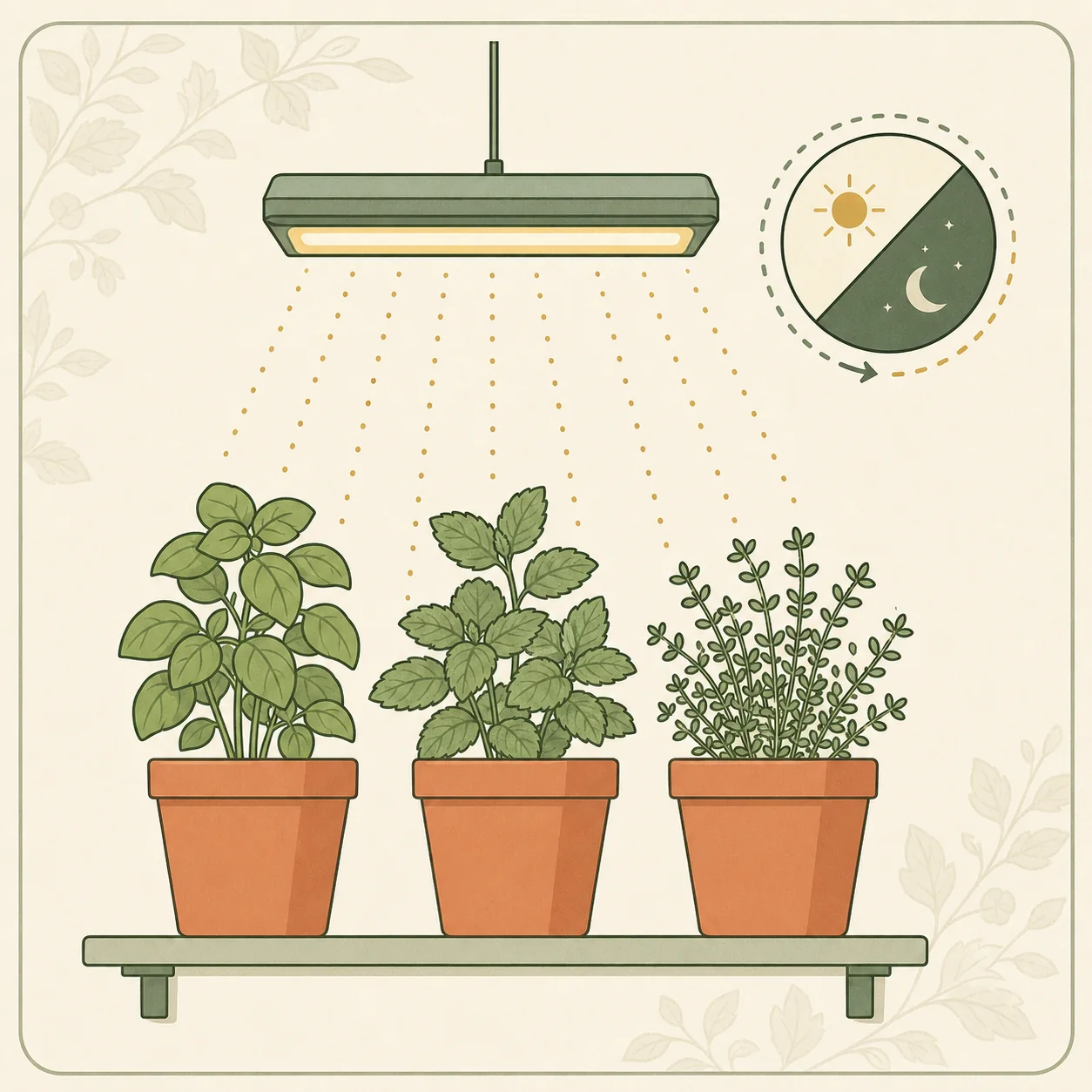
PPFD and DLI for indoor herbs: a practical measuring guide
PPFD is a snapshot; DLI is the daily total. Used together, they turn grow-light setup from a distance rule into a measurable map.
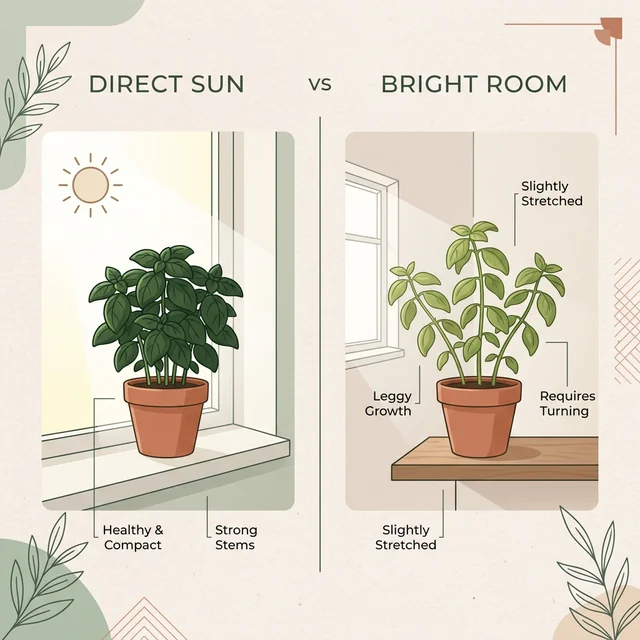
Can herbs grow indoors without direct sunlight? Yes, but bright windows matter
A realistic answer to a common indoor-herb question, with clear expectations for growth, herb choice, and when a grow light becomes the cleaner solution.
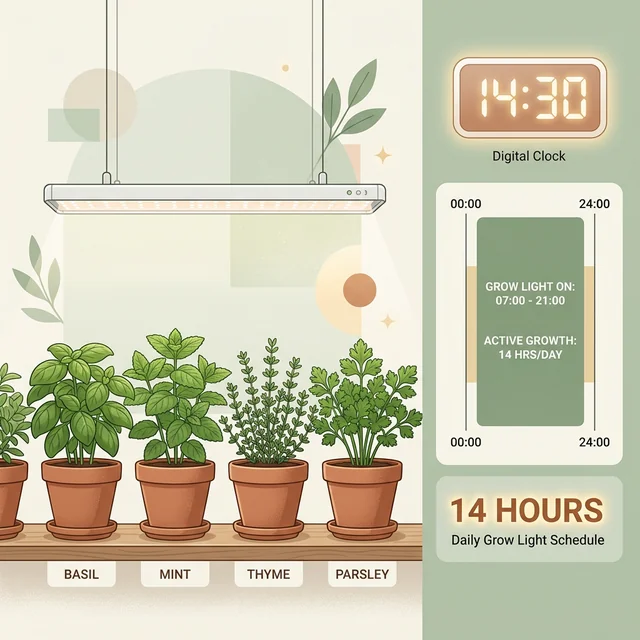
How many hours should grow lights run for herbs? 12-16
Most herb grow lights should run about 12 to 16 hours per day, but intensity, distance, and a stable dark period matter as much as the timer itself.