
Daily photoperiod and years to reach the 25,000-hour L70 mark
| Daily photoperiod | Days of continuous use to reach 25,000 hours | Roughly this many years |
|---|---|---|
| 12 hours a day | about 2,083 days | about 5.7 years |
| 14 hours a day | about 1,786 days | about 4.9 years |
| 16 hours a day | about 1,563 days | about 4.3 years |
An LED grow light rarely dies the way a lightbulb does. It does not usually flicker, pop, or go dark one day. Instead it fades, quietly, for years, while still looking and switching on exactly the way it did the day you bought it. That is the detail most buying advice skips, and it is also why the real question is not “does it still light up?” but “how much light is it still putting out?” Once a fixture is chosen — LED versus fluorescent grow lights covers that decision — this is the maintenance question sitting underneath it: how long the light you bought keeps doing the job you bought it for.
Quick answer: how long do LED grow lights last?
ENERGY STAR sets a design goal of at least 25,000 hours of operation before an indoor luminaire’s output drops by 30 percent — the point the lighting industry calls L70. That is not a shutoff; the fixture keeps running well past it, just dimmer. Translated into a home schedule, 25,000 hours at a 12 to 16 hour photoperiod is somewhere between roughly four and six years of daily use, and the exact figure is arithmetic you can do yourself once you know your own routine.
LEDs do not fail outright. They fade — and L70 is how that is measured
ENERGY STAR’s Program Requirements for Luminaires do not set one lifetime for every fixture. They set at least 25,000 hours to L70 — the point at which light output has fallen to 70 percent of its initial level, a 30 percent decline — for an indoor luminaire, which is what a home grow light is, and higher thresholds for outdoor and for inseparable luminaires. So a 50,000-hour figure on a box is not the standard for a shelf fixture.
Manufacturers get to that figure in two steps. First, sample diodes run for thousands of hours under a test method called IES LM-80, with their output measured and recorded at intervals. Second, a separate method, IES TM-21, projects that measured curve forward to the point where it crosses 70 percent, since actually running a light for 25,000 hours in a lab before selling it is not practical. ENERGY STAR requires a TM-21 projection report as part of certifying a luminaire, which is a useful thing to know in its own right: an L70 figure backed by an LM-80 and TM-21 report was arrived at from measured data, not picked because it sounded reassuring on a box.
Turning 25,000 hours into years on your own shelf
Hours, not years, is the unit L70 is actually measured in, and that distinction matters because two people running an identical fixture on different schedules will use up that clock at very different rates. Illinois Extension puts seedlings at roughly 12 to 16 hours of light a day once they are up and growing — the range most home herb shelves run on too, and one how many hours to run grow lights for herbs covers in more detail. Plug that range into 25,000 hours and the years fall out directly, assuming the fixture runs every day of the year at that photoperiod. The table above shows the common range.
Run a fixture fewer hours a day, take it offline for part of the growing season, or move a crop outdoors in summer, and every one of those choices stretches the calendar further. None of it changes the hour count the fixture is actually accumulating — it only changes how many years that count spreads across.
Why the fade is invisible day to day
A 30 percent drop in light output sounds like something a person would notice. In practice, it rarely gets noticed, for roughly the same reason a room does not seem to dim as dusk falls until it suddenly has: eyes adjust continuously to slow changes in brightness, discounting them so the world looks stable from one moment to the next. An LED sheds its output on a timescale measured in years, which is an even easier change to miss than a sunset.
What tends to get noticed instead, if anything does, is the plant. Seedlings stretching more than they used to. Growth that has quietly slowed with no obvious cause. A tray or shelf that used to sit compact and dense now reaching and thinning out. Those are downstream symptoms of reduced delivered light, not a description of the fixture itself — which is exactly why they usually get blamed on watering, feeding, or a difficult variety long before anyone thinks to question the light.
The only real way to check: measure, do not guess
Because eyesight cannot be trusted to catch a change this slow, a fixture’s actual output has to be measured rather than judged by looking at it. PPFD and DLI for indoor herbs covers the measurement approach — what a PAR meter reads at canopy height, and how that reading rolls up into the daily light total a crop is actually receiving. Taking that same measurement every year or two, at the same distance and in the same spot, is the only way to catch a decline before the plants have already told you about it through their growth. A single reading says what the fixture delivers today; a repeated reading, taken the same way each time, is what actually shows the trend.
What to do when output has genuinely dropped
If a measurement — or a crop that has started stretching or slowing with nothing else obviously wrong — points to reduced output, there are two responses worth trying, and the first one costs nothing. Moving the fixture closer to the canopy raises the intensity reaching the plants without buying anything; grow light distance for seedlings sets out how close is workable before heat or hot spots become the next problem. Once the fixture is already at the closest sensible distance and output is still short of what the crop needs, replacement is the option left — and it is worth treating that as a decision about delivered light, not a verdict on whether the unit is broken. A fixture past L70 still works in every sense a warranty cares about. It is simply not the same light source it was when new.
Running the fixture longer each day to compensate for lower output is not really a fix either — it spends more electricity for a smaller gain, and grow light electricity cost is where that running-cost trade-off actually gets worked out.
Heat is the variable a grower can actually control
L70 assumes the LED operates within the temperature range it was built for. Run it hotter — a sealed grow tent with weak airflow, several fixtures crowded onto one shelf, a driver mounted somewhere it cannot shed heat — and the same decline curve moves faster, reaching 70 percent sooner than the rated hours suggest. That makes heat one of the few real levers a grower has over a number that is otherwise fixed by the diodes and the driver at the point of manufacture. What that takes in practice — a real air gap above the fixture, a driver mounted off the surface it sits on, nothing stacked on top — is covered in managing grow light heat.
The bottom line
An LED grow light is not a component to wait on failing. It is one that quietly does less over years of use, on a schedule set mostly by the hours it runs and the heat it runs at. Twenty-five thousand hours at a typical indoor photoperiod covers several years of daily growing — long enough that most home setups will change crops, shelving, and habits before the light itself becomes the limiting factor. But when a shelf starts underperforming for no clear reason, the fixture’s age in hours, not its age on the wall, is worth checking first.
Sources
- ENERGY STAR — “Program Requirements for Luminaires”
- Illinois Extension — “What’s wrong with my seedlings? Troubleshooting seed starting problems”
Wondering if your light is still doing its job?
These guides cover how to measure what a fixture actually delivers, how close to keep it, and what heat does to its working life.
Common questions
How many years does an LED grow light actually last?
There is no single number, because L70 is measured in operating hours, not years. ENERGY STAR's design goal for an indoor luminaire is at least 25,000 hours, and dividing that by the actual photoperiod gives a rough figure: run a fixture 14 hours a day, every day, and 25,000 hours works out to a little under five years. Run it fewer hours a day, or only part of the year, and it stretches further.
Can you tell an LED grow light is fading just by looking at it?
Not reliably. Human vision adjusts to gradual changes in brightness, so a fixture that has drifted well down toward its L70 point can still look normal to the eye. The real check is a light meter reading, or watching whether the crop starts stretching or slowing down for no other obvious reason.
What does L70 mean on a spec sheet?
L70 is the number of hours an LED can run before its light output falls to 70 percent of what it produced when new, a 30 percent decline. It is measured under a test method called IES LM-80 and projected forward using IES TM-21, and ENERGY STAR requires that TM-21 projection report as part of certifying a luminaire.
Does heat shorten how long an LED grow light lasts?
Yes. Running an LED hotter than it is designed for speeds up the same output decline that L70 describes, which is one practical reason ventilation matters on a crowded shelf, especially where several fixtures run close together.
Related guides
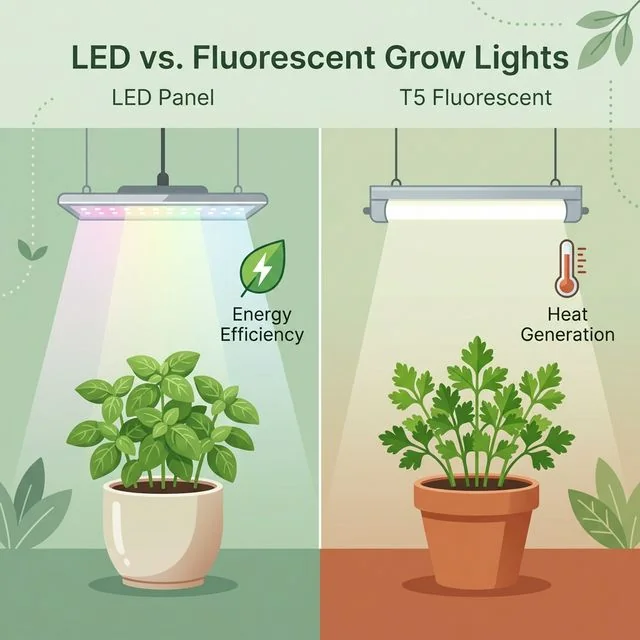
LED vs. fluorescent grow lights for herbs: which is better?
Fluorescent tubes used to be the gold standard for indoor gardeners, but modern LEDs have changed the game. Find out which technology is right for your space and budget.
Grow light electricity cost: calculate the real monthly bill
The monthly cost of a grow light is a four-input calculation. Measure wall power when possible, then compare cost per useful growing area—not labels alone.
PPFD and DLI for indoor herbs: a practical measuring guide
PPFD is a snapshot; DLI is the daily total. Used together, they turn grow-light setup from a distance rule into a measurable map.