Aeroponics against DWC, as described by UF/IFAS Extension
| Factor | Aeroponics | DWC |
|---|---|---|
| Root environment | Suspended in humid air, misted intermittently | Roots sit in an aerated nutrient solution |
| Core hardware | Specialized pumps, misting nozzles and timers | Buckets or bins, an air pump and net pots |
| Setup | Complex and expensive | Easy to set up and operate |
| If delivery stops | Roots can dry quickly if misting fails | The air pump matters differently; see the pump failure plan |
| Routine upkeep | Filtered water, nozzle checks, sterilising the root chamber | pH and EC checks, solution change every 1-2 weeks |
Aeroponics is hydroponics with the water taken away from the roots: they hang in humid air and a pump mists them with nutrient solution on a timer. For most home growers a simpler format is the better first choice. Aeroponics makes sense once you can inspect it often and keep the pump running through a power cut.
If you are still choosing a format, start with NFT vs DWC vs Kratky for beginners. Swapping standing or flowing water for mist changes what you buy, what you check and what breaks.
What aeroponics actually changes
In a Frontiers in Plant Science study, the authors put the difference this way: aeroponics differs from NFT and deep-flow systems because roots are suspended in a humid air space and receive nutrient solution as droplets. NASA Spinoff describes the same idea as intermittently misting the roots with a nutrient solution.
The appeal is real. UF/IFAS Extension lists extremely efficient nutrient uptake, rapid growth rates, minimal water usage and space-saving vertical systems among its advantages. A 2023 study on Artemisia annua found that high-pressure aeroponics, with roots in darkness, increased root hair length compared with water culture. That is a plant response in one medicinal species, not a promise about your lettuce.
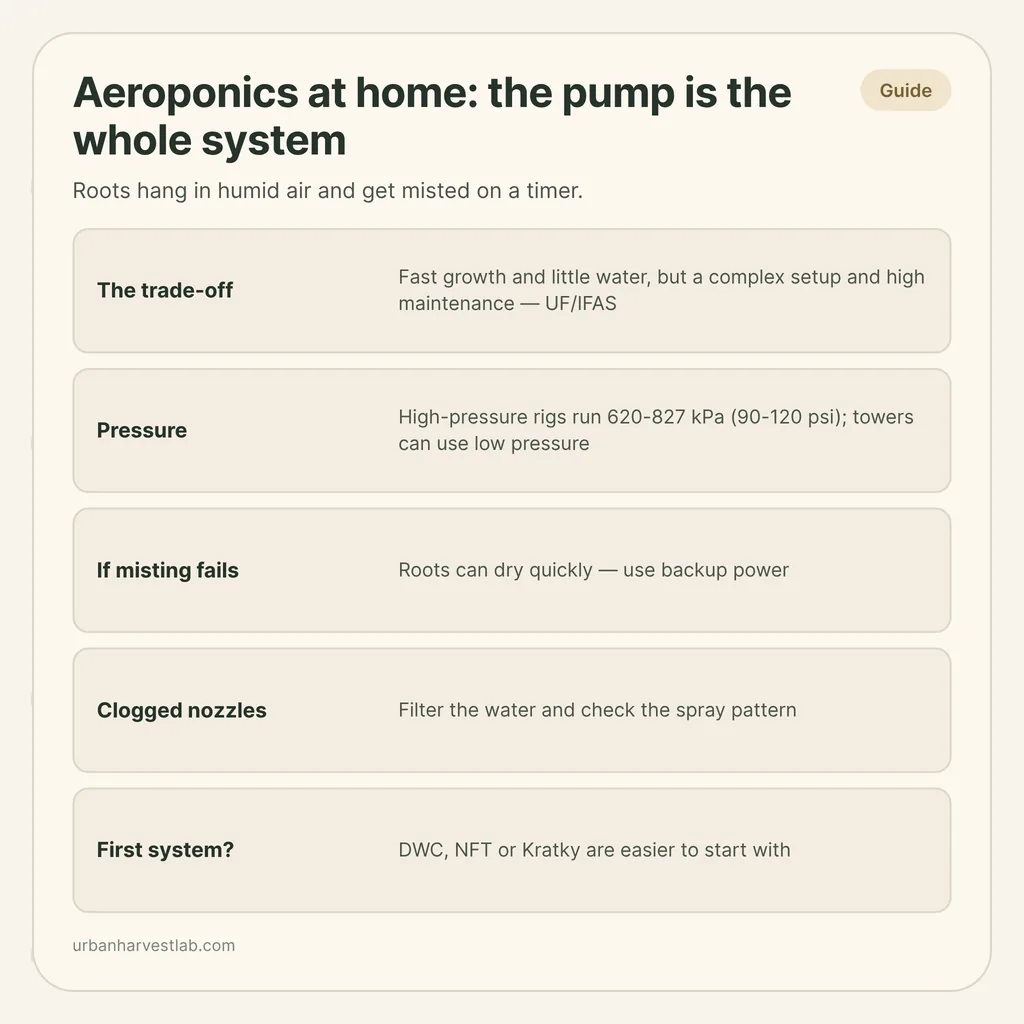
The cost sits on the same page. UF/IFAS lists the downsides as a complex and expensive setup, roots that can dry quickly if misting fails, and high maintenance with technical oversight. It adds that aeroponic systems need specialized pumps, misting nozzles and timers, which raises setup and running costs.
Low pressure, high pressure and what “mist” means
Pressure is a spectrum rather than two boxes. A 2024 Scientific Reports paper describes aeroponics as ranging from no-pressure waterfall tower setups to extreme-pressure “fogponics”. Its own rig sat at the high-pressure end: it describes high-pressure aeroponics as typically supplying 620-827 kPa (90-120 psi) to spray nozzles to produce an average droplet size of 10-100 microns. That rig used a diaphragm pump set to 827 kPa (120 psi), a 0.75 L pressure accumulator tank, solenoid valves on digital cycle timers, and 0.1 mm nozzles that the researchers checked or replaced every 2-3 days.
The low-pressure end looks different. A 2026 HardwareX paper describes an open-source 24-plant tower with recirculating low-pressure irrigation, a mesh filter, an embedded scheduler and solar power with battery storage. It watered basil on a cycle of 0.5 minute on and 29.5 minutes off. Its authors also note that both low- and high-pressure irrigation appear among commercial vertical aeroponic towers.
Do not read “fine” on a nozzle listing as “mist”. In a 2026 Frontiers in Plant Science trial on Centella asiatica, six nozzle classes were measured with a laser-diffraction analyzer at 4.0 bar. The finest class, labelled very fine, had a Sauter mean diameter of 115.3 microns and a volume median diameter of 141.2 microns; the coarsest measured 647.9 and 732.7 microns. The finer classes gave the highest dry-mass production efficiency, and the 5 min × 288 events per day schedule performed best across nozzle classes. The authors caution that nozzle effects are combined root-zone effects rather than droplet size alone, and the result comes from a medicinal herb in a greenhouse, not a kitchen tower.
The pump is the whole system
In DWC the roots sit in a reservoir, and the format has some slack. In aeroponics the water arrives in pulses, so everything that makes the pulse is a single point of failure: pump, timer, nozzle, filter and the power supply behind them.
NASA Spinoff reports that NASA and many indoor growers have eschewed aeroponics because it can be risky: if misting is disrupted for even a few hours, a whole batch of crops can be lost. The company quoted there calls aeroponics fragile, with a lot of potential points of failure. UF/IFAS says to employ backup power solutions to mitigate misting system failure. A battery unit is one route; browse battery backup units on Amazon and check the wattage rating against your pump’s label.
Clogging is the quieter failure. In the Centella trial the smallest nozzle class clogged approximately once per crop cycle under the tested filtration, while the larger classes showed little or no clogging. The authors recommend fine filtration, a spray-pattern check at least once per crop cycle, and cleaning immediately when flow or pattern changes. UF/IFAS adds filtered water, regular sterilising of the root chamber to prevent biofilm, and close monitoring of misting intervals, adjusted for temperature and humidity.
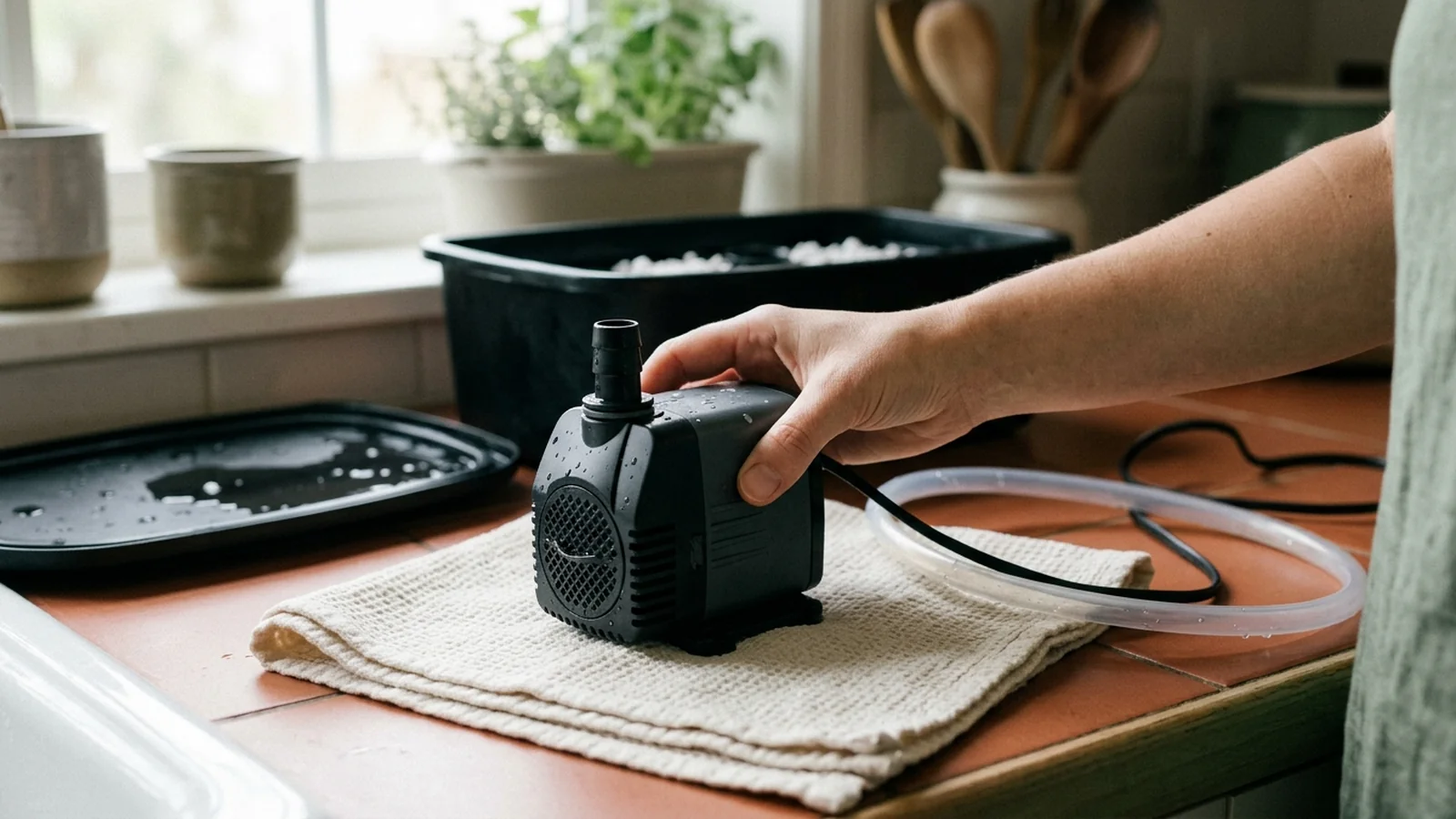
For the general procedure when a pump stops, see the hydroponic pump failure plan. If the question is whether air pumps are needed in water systems at all, do you need an air pump for hydroponics covers it.
Who it suits, and who should skip it
Aeroponics fits you if most of these are true:
- You can look at the nozzles and the spray pattern on a regular schedule, not only when something looks wrong.
- The pump can sit on battery backup, or you are home to notice a failure within hours.
- You want a vertical layout, which UF/IFAS lists as possible with aeroponics. Vertical hydroponic towers covers what towers grow and where they fail.
- Tinkering with timers and filters is part of the appeal.
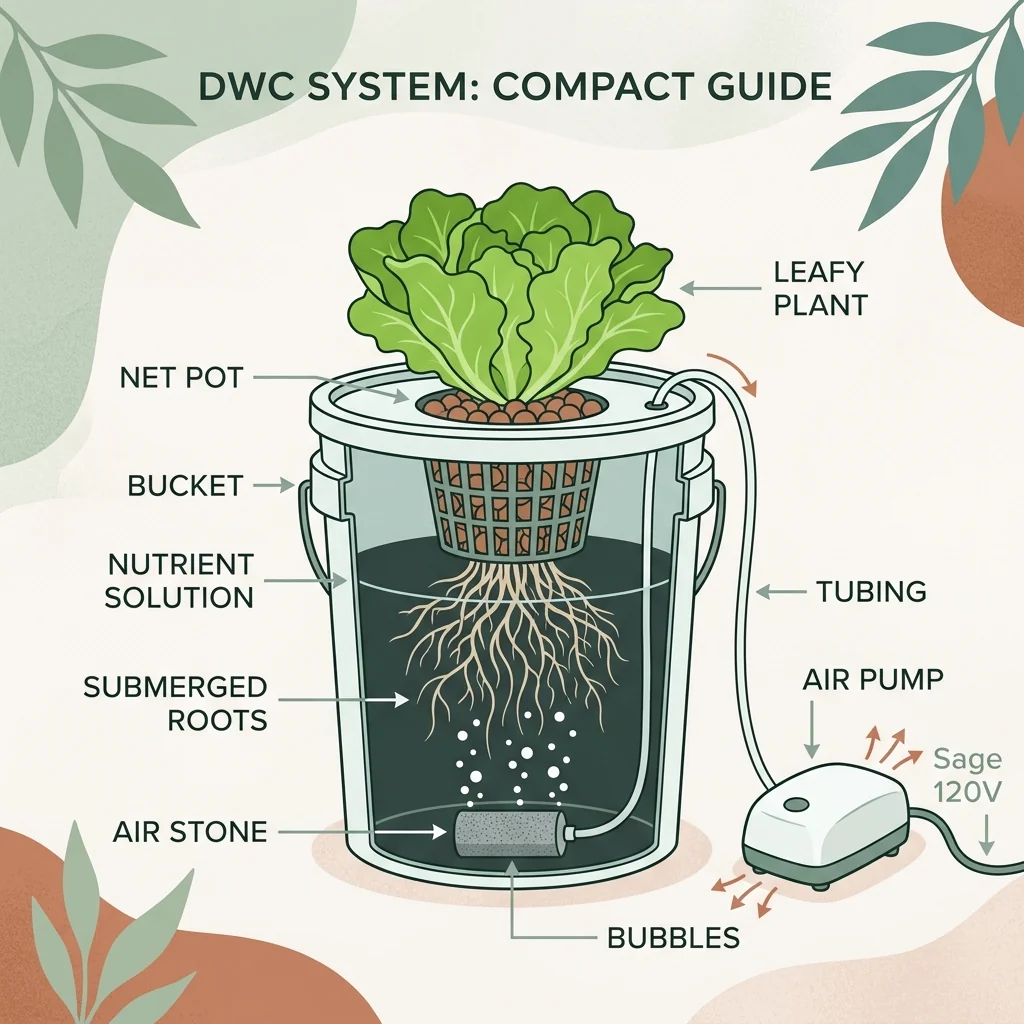
A simpler format fits better if you travel, if you want a first system that forgives mistakes, or if one dead pump should not cost the crop. UF/IFAS describes DWC as easy to set up and operate and ideal for beginners, built from buckets, an air pump and net pots. DWC for small spaces shows the build, and the Kratky method removes the pump entirely.
When a kit promises “twice the speed”, ask which system, crop and conditions it was measured against. The Frontiers nozzle comparison, for one, was a greenhouse medicinal herb.
Sources
- UF/IFAS Extension Lee County: Hydroponic Production Methods, Part 1
- NASA Spinoff: Astronaut Life Support for Earth Families
- Scientific Reports (2024): aeroponic approach for nondestructive root exudate collection, cotton
- Frontiers in Plant Science (2026): fine droplet misting in closed-loop aeroponic Centella asiatica
- HardwareX (2026): TOTEM, a low-cost solar-powered aeroponic system
- Frontiers in Plant Science (2023): light exposure of roots in aeroponics, Artemisia annua
Compare formats and plan for pump trouble
Pick a beginner format, see how towers fit, and prepare for a pump failure.
Common questions
What is the difference between aeroponics and hydroponics?
Aeroponics is a form of hydroponics in which the roots hang in a humid air space and receive nutrient solution as droplets, as a Frontiers in Plant Science study puts it. Other formats such as DWC keep roots in aerated solution. UF/IFAS Extension describes aeroponics as intermittent misting of suspended roots.
What is the difference between low-pressure and high-pressure aeroponics?
A Scientific Reports paper describes high-pressure aeroponics as typically supplying 620-827 kPa (90-120 psi) to spray nozzles for droplets averaging 10-100 microns, and notes that aeroponics also spans no-pressure waterfall towers. A 2026 HardwareX paper built a low-pressure tower that waters basil on a 0.5 minute on, 29.5 minute off cycle.
What happens if an aeroponic pump fails?
UF/IFAS Extension warns that roots can dry quickly if misting fails and advises backup power. NASA Spinoff reports that if misting is disrupted for even a few hours, a whole batch of crops can be lost.
Is aeroponics a good first hydroponic system?
UF/IFAS Extension calls DWC easy to set up and operate and ideal for beginners, and lists aeroponics as a complex, expensive setup needing high maintenance and technical oversight. Most first-time growers are better served by DWC, NFT or Kratky.
Related guides
Hydroponic pump failure: what happens and what to do
A stopped pump does not threaten every hydroponic system the same way. Here is the mechanism behind each one, and the plan to run when yours goes quiet.

Vertical hydroponic tower: what it grows well and where it fails
A tower grows many more plants per square foot of floor than a flat system, but plants at the base get less light and yield less. Light and pump head decide whether one suits you.
What is DWC? Deep water culture for small spaces
DWC suspends roots in aerated nutrient solution for fast growth. It is one of the best active systems for a small space, as long as you manage oxygen and heat.