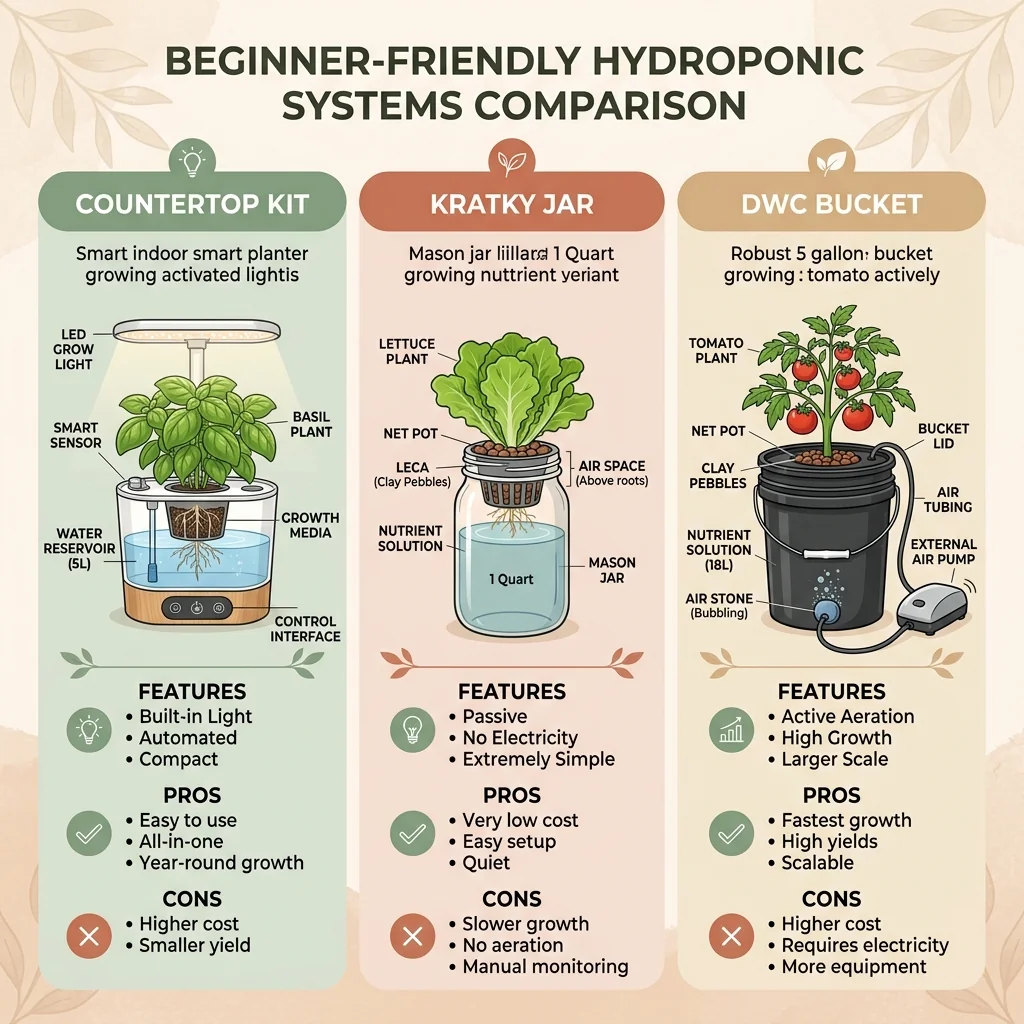
Beginner hydroponic systems compared
| System | Best for | Needs a pump/light? |
|---|---|---|
| All-in-one countertop kit | Easiest start, kitchen use | Light and pump included |
| DIY Kratky jar | Cheapest start, 1-2 plants | No pump; add light indoors |
| Small DWC bucket | Fast growth, a few plants | Air pump; add light indoors |
Editorial note: Retailer links are untracked shopping references; Urban Harvest Lab does not currently receive a commission from them. Recommendations are based on stated features and suitability criteria, not on undocumented hands-on testing.
You do not need an expensive, complicated rig to start growing hydroponically. As a quick answer: an all-in-one countertop kit is the easiest first system, a DIY Kratky jar is the cheapest, and a small DWC bucket is the best value for fast growth. Which one is right depends on your space, budget, and what you want to grow. For how the underlying methods differ, read NFT vs DWC vs Kratky first.
1. Easiest: an all-in-one countertop kit
Countertop kits bundle the light, pump, reservoir, and timer into one appliance. They reduce assembly, but still require cleaning, crop spacing, top-ups, pruning, and nutrient management. Treat reminders as prompts, not measurements.
Browse countertop hydroponic kits on Amazon
- Best for: total beginners, herbs and greens on a counter.
- Watch for: running costs of proprietary pods; refillable pods are cheaper long-term.
How to run one well is covered in countertop hydroponic herbs for beginners.
2. Cheapest: a DIY Kratky jar
The Kratky method needs no pump or electricity, just a jar, a net cup, and nutrient solution. It is the lowest-cost way to try hydroponics and grows lettuce and herbs surprisingly well.
Browse net cups and mason jar lids on Amazon
- Best for: the cheapest possible start, one or two plants.
- Watch for: it is not for large or long-season crops; see the Kratky method.
3. Best value for growth: a small DWC bucket
A single deep water culture bucket adds active aeration and is easy to inspect. Growth depends on light, crop, temperature, oxygen, and solution management; DWC is not automatically more productive than every passive setup.
Browse DWC bucket kits on Amazon
- Best for: fast growth in a small footprint.
- Watch for: keep the water cool and aerated; see DWC for small spaces.
How to choose
- Want plug-and-play? Countertop kit.
- Want cheapest? Kratky jar.
- Want fast growth and a little DIY? DWC bucket.
Whatever you choose, the part that actually decides success is the nutrient solution and light, not the brand of the box. Start with hydroponic nutrient basics and add a grow light if your spot is not very bright.
Compare maintenance before purchase price
| System | Weekly work | Single-point failure | Consumable risk |
|---|---|---|---|
| Countertop kit | Top up, prune, inspect roots, clean deck | Proprietary pump/light/controller | Pods, baskets, nutrient refills |
| Kratky | Inspect level, roots, temperature, algae | Lost air gap or undersized reservoir | Net cups and nutrient |
| DWC | Check aeration, level, roots, EC/pH | Air pump, tubing, or power | Air stones, pump parts, nutrient |
Before buying a kit, confirm that the pump, baskets, sponges, and light are replaceable without discarding the appliance. Check maximum growing height and reservoir access with mature roots in place. Count usable mature plants, not pod holes: filling every opening can create shade and airflow problems.
Price the first year honestly
Add system price, seeds, nutrient, meters or test method, replacement media, electricity, and proprietary parts. Divide by crops successfully harvested only after keeping a record; advertised pod capacity is not yield. A DIY system may demand more learning but be easier to repair, while an integrated kit may justify a premium through lower setup friction.
A pre-purchase rejection checklist
Do not buy when the reservoir cannot be scrubbed, replacement parts are unavailable, electrical connections sit where leaks collect, the light lacks input-power or coverage information, or the seller promises “maintenance free” harvests. Begin with fewer leafy plants than the maximum and complete one clean-and-replant cycle before scaling.
Sources and further reading
Before and after you buy, read these
These guides explain how each system works and how to run the nutrients once it arrives.
Common questions
What is the best hydroponic system for beginners?
An all-in-one countertop kit is the easiest, because it bundles the light, pump, and reservoir and needs little setup. If you want the cheapest start, a DIY Kratky jar works with no pump or power. A small DWC bucket sits in between.
How much does a beginner hydroponic system cost?
A DIY Kratky jar can cost a few dollars, a small DWC bucket build is modest, and all-in-one countertop kits range from budget to premium depending on size and lighting. Start small and scale once you know you enjoy it.
Do I need a grow light with a hydroponic system?
Indoors, yes, unless the system sits at a very bright window. Countertop kits include a light; with a Kratky jar or DWC bucket you add your own. Light is usually the limiting factor for indoor growth.
What can I grow in a beginner hydroponic system?
Lettuce, leafy greens, and herbs do best in all beginner systems. Large fruiting crops like tomatoes need bigger, more involved setups, so leave those until you have experience.
Related guides
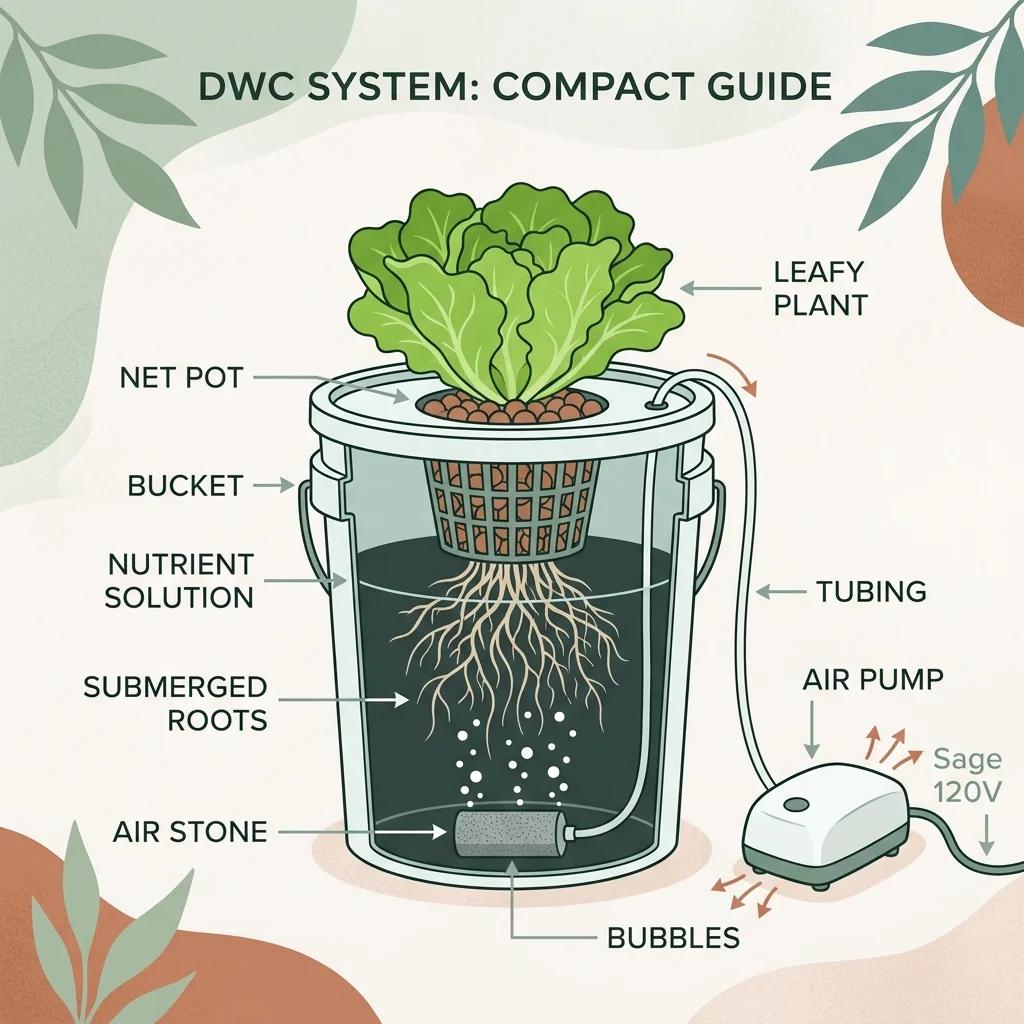
What is DWC? Deep water culture for small spaces
DWC suspends roots in aerated nutrient solution for fast growth. It is one of the best active systems for a small space, as long as you manage oxygen and heat.
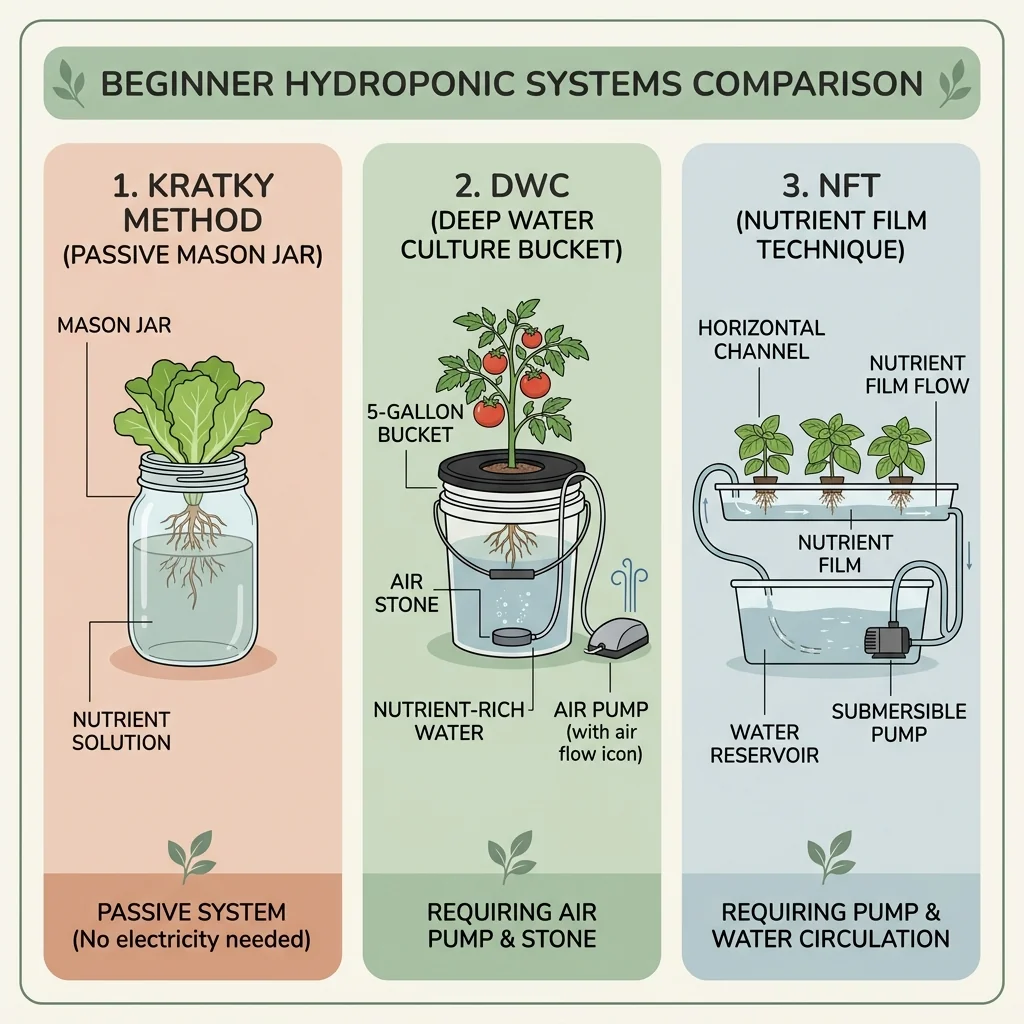
NFT vs DWC vs Kratky: which should a beginner pick?
Three systems dominate small-space hydroponics: Kratky, DWC, and NFT. This comparison shows how they differ and which one a beginner should actually start with.
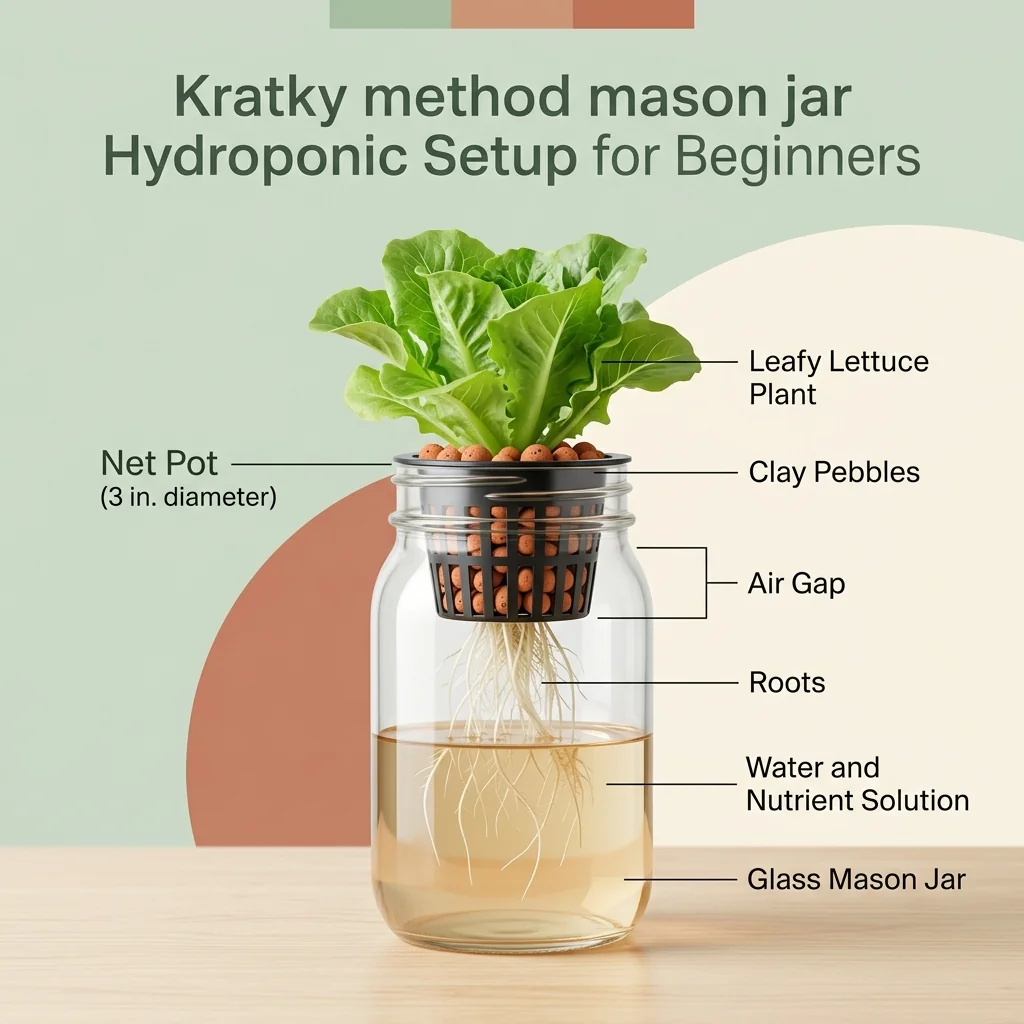
The Kratky method: passive hydroponics for beginners
The Kratky method is the simplest way into hydroponics: a container of nutrient solution, a net pot, and no pump or power. Here is how it works and its limits.