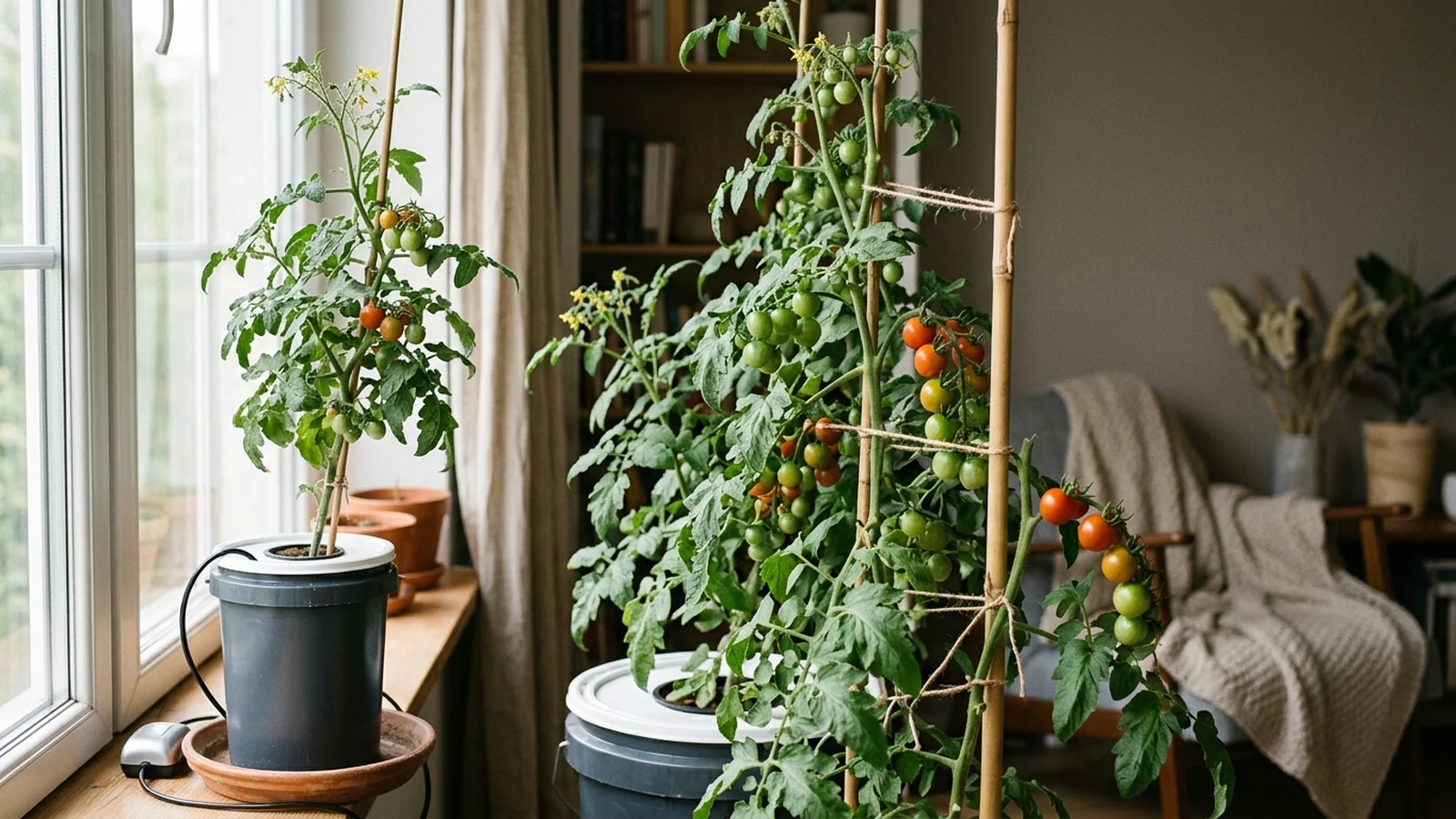
Quick answer: hydroponic tomatoes indoors need a bigger, sturdier system than lettuce, a nutrient solution that starts weak and gets stronger as the plant sets fruit clusters (Oklahoma State University Extension’s whole-crop range is EC 2.0 to 4.0 mS/cm, pH 6.0 to 6.5), hand pollination for every open flower cluster, and considerably more light than a leafy crop. Treat it as the hardest thing on a hydroponic shelf, not the next logical step after lettuce.
Tomatoes are usually the first fruiting crop a hydroponic grower tries after herbs and greens, and the jump is bigger than the marketing on a countertop kit suggests. The NFT vs DWC vs Kratky comparison is built around lettuce and herbs for a reason — its own guidance is that none of those three beginner systems handles a large fruiting crop well in a small footprint, and tomatoes are exactly that crop.
Choosing a system that can actually carry a tomato plant
A tomato plant outgrows the reservoirs, air pumps, and net pots sized for lettuce. University of Kentucky’s deep water culture specification calls for a frame at least 12 inches deep, an EPDM or HDPE liner, foam rafts, an air pump, and air stones — dimensions written for leafy production, and a tomato’s root mass wants at least that much room, not less. Virginia Cooperative Extension describes pond depths of 4 to 12 inches built from dimensional lumber and a liner, which is the kind of build a tomato needs rather than a single 5-gallon bucket meant for one lettuce head.
Deep water culture for small spaces covers building a bucket system that size, and it is a workable starting point for one or two tomato plants provided the bucket and its air supply are sized up, not borrowed directly from a lettuce build. Substrate-based systems are the other route: UF/IFAS Extension states that its hydroponic tomato systems in Florida, grown in perlite, rockwool, or NFT, run 10 to 20 irrigation cycles a day to maintain about 20% leachate, and adds the general rule that a system irrigating less often needs a more concentrated nutrient solution to compensate. Whichever system is used, a tomato plant also needs a trellis, stake, or string support that a lettuce or herb setup rarely has to plan for — factor that into the footprint before committing to a system.
Tomatoes and lettuce also do not belong in the same reservoir. University of Minnesota Extension’s own rule is to keep crops that need different fertilizer programmes — its example is tomatoes and lettuce — in separate containers, and to only share a reservoir between crops that want the same feed, such as lettuce and kale on one teaspoon-per-gallon regimen. A tomato plant on a nitrogen programme that climbs through the crop would either starve or overfeed a lettuce sharing its water.
EC and pH by growth stage, not one number for the whole crop
The single most useful figure for this crop is UF/IFAS Extension’s stage-by-stage nutrient solution programme for hydroponic tomatoes grown in perlite, rockwool, or NFT in Florida. It is built around five stages, running from transplant to the first fruit cluster through to the fifth cluster and beyond, and it explicitly states that the same programme is “a suitable base when determining a nutrient solution plan for cucumbers and peppers” — with the caveat that cucumbers need more nitrogen early in the season than tomatoes because they grow faster.
| Stage | Nitrogen (ppm) | Potassium (ppm) | Phosphorus, calcium, magnesium, sulfur |
|---|---|---|---|
| 1 — transplant to 1st cluster | 70 | 120 | P 50, Ca 150, Mg 40, S 50 (held constant or near-constant across all stages) |
| 2 | 80 | 120 | Mg 40, S 50 |
| 3 | 100 | 150 | Mg 40, S 50 |
| 4 | 120 | 150 | Mg 50, S 60 |
| 5 — 5th cluster to termination | 150 | 200 | Mg 50, S 60 |
Phosphorus stays at 50 ppm and calcium at 150 ppm through every stage; iron, copper, manganese, zinc, boron, and molybdenum stay constant too, at 2.8, 0.2, 0.8, 0.3, 0.7, and 0.05 ppm respectively. UF/IFAS sets the final delivered solution’s pH at 5.8 to 6.2, a touch more acidic than Oklahoma State’s whole-crop figure of pH 6.0 to 6.5 — both are real recommendations from real extension programmes, and either band is a reasonable target.
The reason to keep nitrogen low early rather than pushing it up from day one is diagnostic, not arbitrary: UF/IFAS documents that high nitrogen early produces “bullish”, over-vegetative growth that distorts leaves and stems, cracks and grooves stems in ways that let soft rot in, and produces misshapen fruit along with blossom-end rot and cat-facing. Excess potassium works against calcium uptake at the root the same way, and UF/IFAS notes that where well water supplies less than 50 ppm calcium alongside a high-potassium stock solution, blossom-end rot becomes likely. Penn State Extension’s own worked example shows how easily that balance tips: a tomato recipe calling for 190 ppm nitrogen and 205 ppm potassium, mis-mixed to 2,050 ppm potassium, produced a nitrogen deficiency even though the full 190 ppm of nitrogen was still in the solution — proof that a single mixing error can make a correctly dosed nutrient behave as if it were missing.
For a whole-crop anchor rather than a five-stage table, Oklahoma State’s table gives tomatoes EC 2.0 to 4.0 mS/cm, pH 6.0 to 6.5 — noticeably stronger than the herbs that grow best hydroponically, which mostly sit around EC 1.0 to 1.6, and stronger than peppers on the same table, at EC 0.8 to 1.8. That last comparison is easy to miss: two closely related fruiting nightshades, and the one growers often assume is more forgiving actually wants a noticeably weaker solution. The hydroponic peppers guide covers that crop’s own stage-by-stage numbers. For how tomato’s EC and pH sit against the rest of the crops on this site, the hydroponic EC chart by crop lays out the full table — that chart page currently carries a narrower 2.0 to 3.5 at pH 5.5 to 6.5 for tomatoes; Oklahoma State’s own table, cited above, is the wider band.
Hand-pollinating an indoor tomato
Tomato flowers are self-fertile, but they still need pollen moved from the flower’s own anthers to its stigma, and outdoors that happens by wind and by the vibration of visiting bees. Indoors, under a grow light with no airflow of that kind, neither exists, and without help the flowers usually drop instead of setting fruit. University of Maryland Extension puts a number on what a missed visit costs: one or two bee visits push a tomato flower’s fruit set above 80%, against roughly 30% with none.
The fix is mechanical: while a cluster is in flower, brush or gently vibrate the stem so pollen releases and moves within the flower. A small artist’s brush, an electric toothbrush pressed against the flower stem, or simply flicking the truss by hand all work on the same principle. Pollinating balcony tomatoes and peppers covers the technique, timing, and tools in full — the job does not change because the plant is in a hydroponic system rather than a pot of soil, only that indoors there is no chance a passing bee does it for you.
How much light a tomato actually needs indoors
Michigan State University Extension’s daily light integral target of 12 mol·m⁻²·d⁻¹ or more for leafy greens and herbs in a controlled environment is the figure this site uses for lettuce and herb shelves. That figure is for leafy crops; a fruiting tomato needs more than it, and none of the university sources here says how much more.
What the sources do say, clearly, is the direction of the difference. University of New Hampshire Extension states plainly that in a New Hampshire January the sun does not provide enough light to grow even lettuce, “and certainly not enough for plants with higher light requirements like tomatoes or cucumbers,” and that fruiting crops — tomato, pepper, eggplant, cucumber — need supplemental lighting to make up the gap. University of Minnesota Extension groups tomatoes, cucumbers, peppers, and strawberries as summer choices for indoor hydroponics, reserving herbs and leafy greens as the crops best suited to winter production under lights.
In practice that means budgeting for a genuinely capable fixture rather than the small clip-on or countertop unit that grows lettuce or basil well. How many watts a grow light needs walks through estimating real photon output from a fixture’s spec sheet rather than trusting its wattage claim, which matters more here than on a herb shelf because undersizing the light is one of the most common reasons an indoor tomato plant flowers heavily and sets little fruit. For general home hydroponic lighting schedules, University of New Hampshire Extension’s own figure is 14 to 18 hours a day — a general home-system run time, not a tomato-specific one, and worth treating as a starting photoperiod to adjust once the plant’s growth shows whether it is getting enough.
Setting expectations before you start
Tomatoes indoors under lights are genuinely hard, and the outcome is often modest compared to the effort. UF/IFAS adds a caveat to its own stage table that makes the programme harder to run than the ppm figures alone suggest: the calcium, magnesium and sulfur numbers are not fixed the way they look in print, because the actual amount delivered shifts with how much calcium and magnesium the grower’s own well water already carries, and with the sulfuric acid used to bring the solution’s pH down to target. Two growers following the same five-stage table can end up mixing two different recipes without either one doing anything wrong.
The nutrient solution itself needs more attention over time, too. University of Minnesota Extension notes that fast-maturing crops like lettuce rarely need a full nutrient solution change-out, while longer-maturing crops like tomatoes typically need one or two over a growing cycle — one more task a lettuce grower’s routine did not include. None of this means the crop is not worth growing. It means a grower who sizes the system for lettuce, points a small fixture at it, and expects a lettuce-length payoff is set up to be disappointed by a plant that, done properly, takes months of steady attention for a harvest that a soil-grown tomato in a sunny garden would produce with far less equipment.
Expect the first crop to be about learning the routine — the stage changes, the pollination window, the light — rather than about the size of the harvest. The rhythm is different from lettuce too: fruit ripens in clusters over the season rather than the steady one-head-a-week output a cut-and-come-again lettuce raft produces. Growers coming from lettuce or herbs, where a mistake costs a few weeks, should also expect mistakes here to cost more: a nitrogen program run too rich for too long, a missed pollination window during a cluster’s few open days, or a light that is a size too small are each hard to fully undo mid-crop. Starting with one or two plants on a system sized generously, rather than the largest tray a grow space allows, keeps a first attempt recoverable while the routine — checking EC against the stage, pollinating on schedule, watching the light — becomes familiar.
Sources
- UF/IFAS Extension CV216 — Nutrient Solution Formulation for Hydroponic (Perlite, Rockwool, NFT) Tomatoes in Florida
- Oklahoma State University Extension HLA-6722 — Electrical Conductivity and pH Guide for Hydroponics
- University of Minnesota Extension — Small-scale hydroponics
- University of New Hampshire Extension — Hydroponics at Home
- University of Kentucky CCD-CP-63 — Hydroponic Lettuce Production in Controlled Environments
- Virginia Cooperative Extension SPES-464 — Hydroponic Production of Edible Crops: Deep Water Culture (DWC) Systems
- Michigan State University Extension — Lighting Greenhouse Vegetables
- Penn State Extension — Hydroponics Systems and Principles of Plant Nutrition
Get the system and the chemistry right first
Tomatoes ask more of a hydroponic setup than lettuce or herbs. These guides cover the system choice and the EC math before you plant.
Common questions
What EC do hydroponic tomatoes need?
Oklahoma State University Extension gives a whole-crop range of EC 2.0 to 4.0 mS/cm and pH 6.0 to 6.5. Within that range, UF/IFAS's stage-by-stage programme starts weaker at transplant and climbs as the plant sets more fruit clusters, rather than holding one number for the whole crop.
Do hydroponic tomatoes need hand pollination indoors?
Yes. Indoors there is no wind or insect traffic to move pollen between the flower parts, so an indoor grower has to do that job while each cluster is open, usually with a small brush or by vibrating the stem.
How much light do hydroponic tomatoes need indoors?
More than lettuce or herbs, and University of New Hampshire Extension is direct that winter window light is not enough for tomatoes. The university sources used here do not publish a daily light integral target specific to tomatoes, only for leafy greens, so plan for strong, long-duration supplemental lighting and watch the plant rather than aiming for one borrowed number.
Can a beginner hydroponic system grow tomatoes well?
Not easily. Small beginner systems built around lettuce and herbs are undersized for a tomato's root mass, nutrient demand, and need for physical support, so tomatoes usually mean a bigger reservoir and a trellis rather than the same bucket a lettuce grower started with.
Related guides
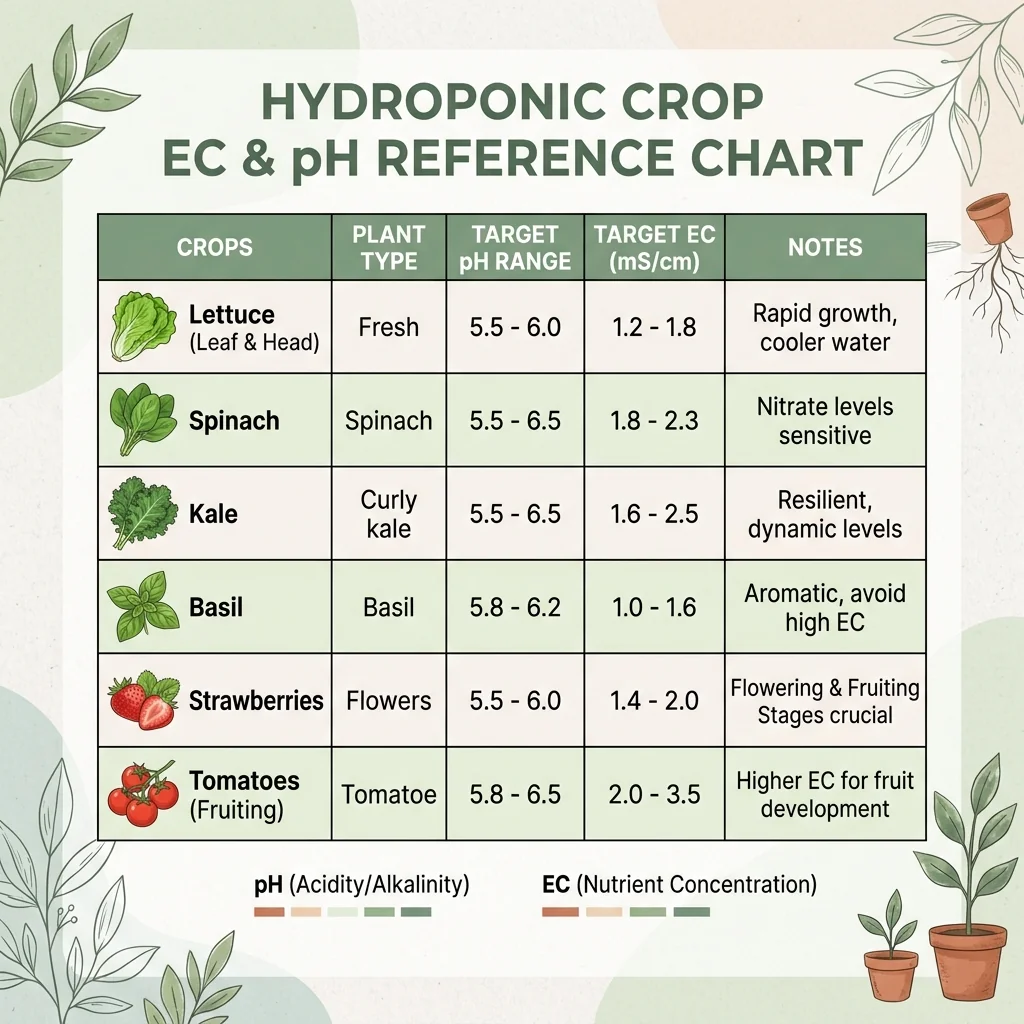
Hydroponic EC chart by crop (not just lettuce)
One reference chart for the EC and pH targets of common hydroponic crops, from leafy greens and herbs to fruiting plants, plus how to use the numbers safely.
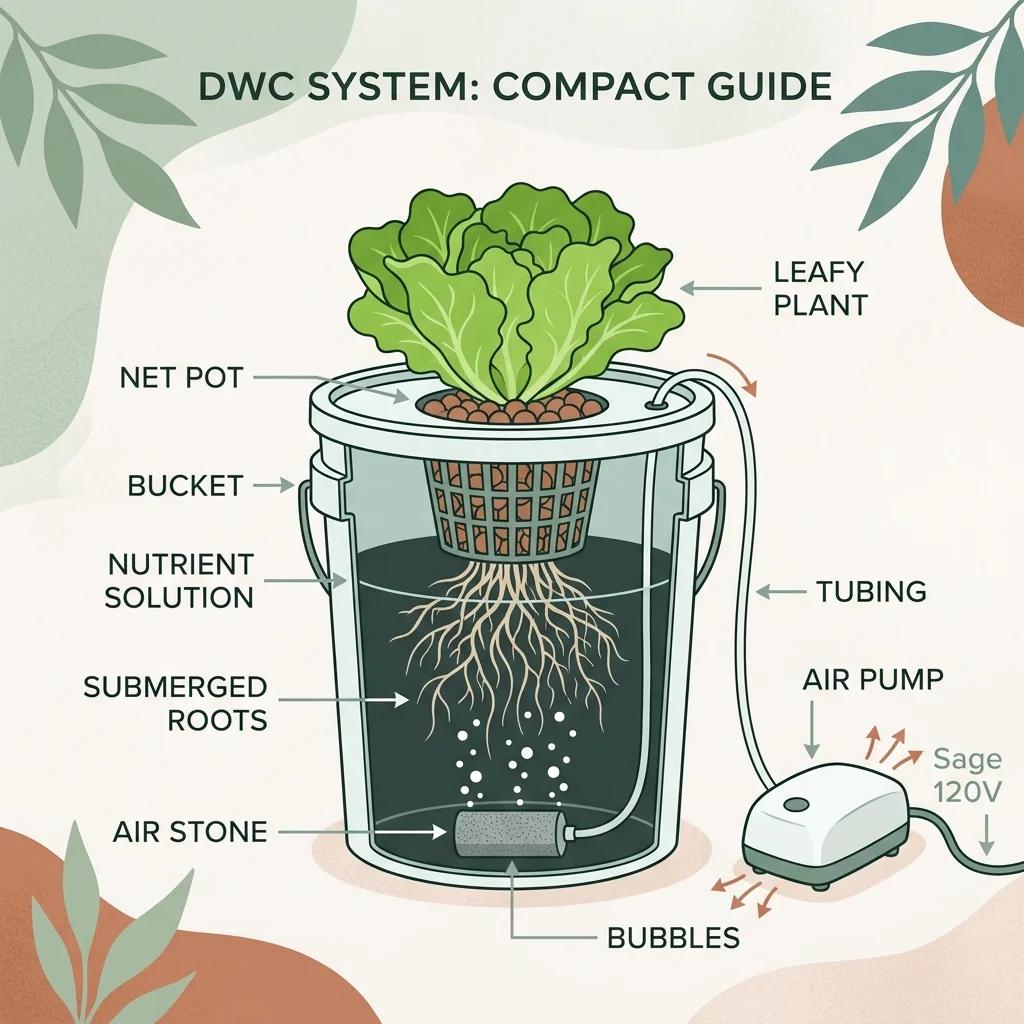
What is DWC? Deep water culture for small spaces
DWC suspends roots in aerated nutrient solution for fast growth. It is one of the best active systems for a small space, as long as you manage oxygen and heat.
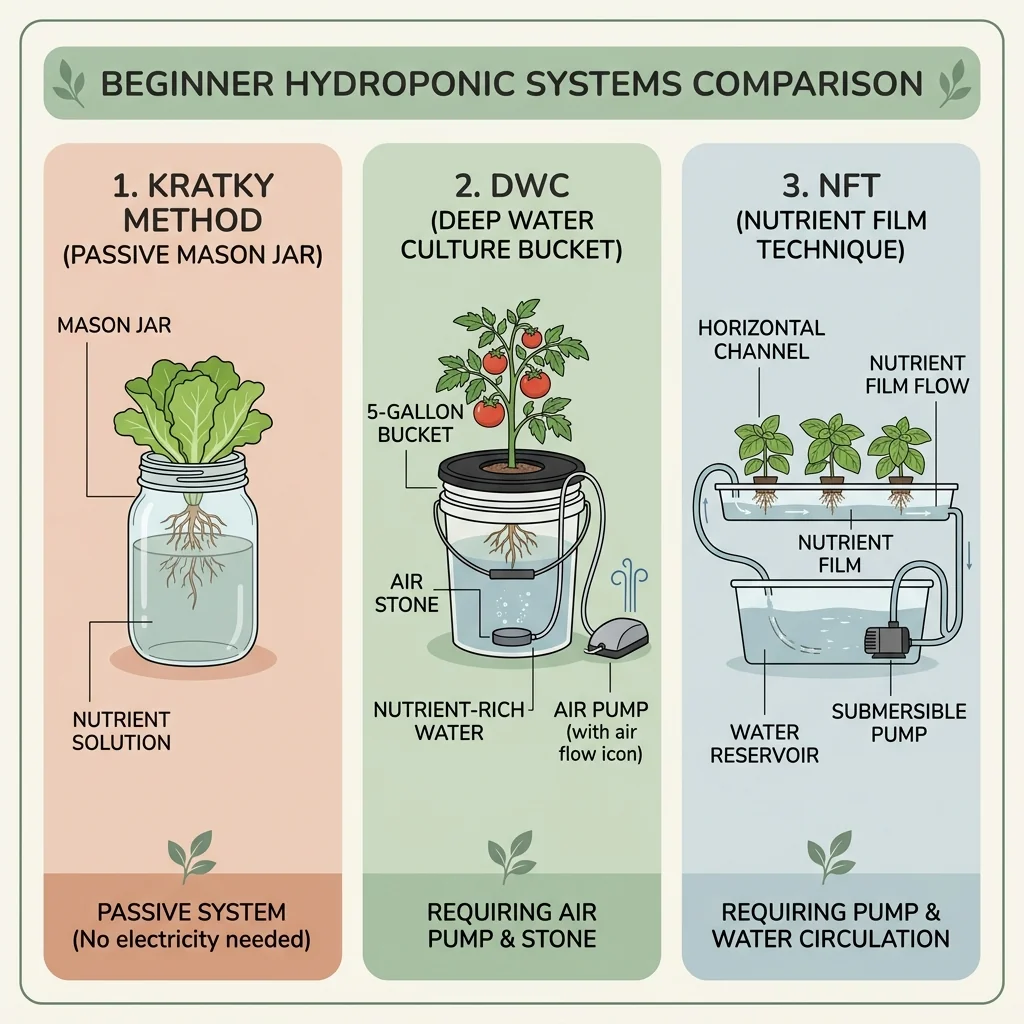
NFT vs DWC vs Kratky: which should a beginner pick?
Three systems dominate small-space hydroponics: Kratky, DWC, and NFT. This comparison shows how they differ and which one a beginner should actually start with.