
Same watts, different real output (efficacy figures are round numbers chosen to show the arithmetic, not measurements of any real fixture)
| Input watts | Published efficacy | Real photon output (PPF) |
|---|---|---|
| 40 W | 1.5 µmol/J | 60 µmol/s |
| 40 W | 2.6 µmol/J | 104 µmol/s |
| 65 W | 1.5 µmol/J | 97.5 µmol/s |
| 65 W | 2.6 µmol/J | 169 µmol/s |
A grow light’s real wattage is its electrical draw — what it pulls from the wall, in watts. It says almost nothing about how much light reaches a plant, and an “equivalent wattage” claim says even less, because the seller picks which technology to compare against, and nothing on the listing says how. What predicts growth is the light itself, measured as PPFD and, run over a day, as daily light integral — not the number printed on the box.
Real watts still matter. They set your electricity bill and put a rough ceiling on how much light a fixture could produce. But the number a spec sheet states and the number a seller compares it to are two different kinds of claim, and only one of them is measurable.
Why “equivalent wattage” is marketing, not a measurement
An equivalent-wattage claim — “30 W, replaces a 150 W fixture” — is a comparison the seller picks. It depends on which older technology they choose to compare against, how they define “replaces,” and under what test conditions, none of which appears on the listing. An equivalent-wattage label just asserts a number; it skips the step where that number would need to be checked.
The same underlying problem shows up even inside a single, well-defined light-measurement unit. Purdue Extension converts a foot-candle meter reading into a photosynthetically useful figure by multiplying by 0.20 for sunlight and 0.13 for HPS lamps — a 35 percent difference from the exact same meter reading, depending only on which lamp is under it. If one physical reading needs a different multiplier for every light source, a marketing comparison between two different products needs one even more, and it does not carry one.
Treat “equivalent wattage” the way you would treat any other unverifiable advertising line: skip it, and go straight to what the fixture actually draws and actually outputs.
What real watts actually tell you
Real watts — a fixture’s measured wall draw, or its stated input power — are a genuine, checkable number. They set your electricity bill: grow light electricity cost turns watts, runtime hours, and your tariff into a monthly figure.
Watts also put a rough ceiling on potential output, because more electrical input generally allows more photon output. How much of that electrical input turns into usable light depends on the fixture’s design, and that is the part wattage alone cannot tell you.
The number wattage does not answer
Plants respond to photosynthetic photon flux density (PPFD) at the leaf, and to how many hours a day that PPFD runs — the daily light integral, or DLI. Michigan State University Extension puts a common target for leafy greens and herbs grown in a controlled environment at 12 mol·m⁻²·d⁻¹ or more, with a wider minimum band of 10 to 12 mol·m⁻²·d⁻¹ and quality measurably reduced once DLI drops below 10. Neither figure has a watts column next to it, because DLI depends on light actually arriving at the canopy, over whatever hours the fixture runs — not on what the fixture draws from the wall.
Different herbs also want different amounts of that light, and the amount shifts with growing temperature. DLI targets for herbs and leafy greens covers the per-species figures and what changes them; none of that detail moves because a fixture carries a higher wattage rating, only because more or less light actually reaches the leaf.
Measuring what arrives is a PPFD reading’s job, not a wattage rating’s — PPFD and DLI for indoor herbs covers the grid method for doing that at canopy height. A lux meter is not a shortcut around that measurement either: lux and foot-candles are weighted for the human eye rather than for photosynthesis, so a bright lux reading can sit over a dim canopy — lux to PPFD covers when that reading can be converted and when it cannot.
Estimate what a fixture is really putting out
There is one place watts and real light output connect directly: a fixture’s efficacy, usually published as photosynthetic photon efficacy in micromoles per joule (µmol/J). Multiply it by input watts and the result is an estimate of total photon output — PPF, in micromoles per second:
PPF (µmol/s) = input watts × efficacy (µmol/J)
Say a fixture draws 45 W and its spec sheet claims 2.6 µmol/J: 45 × 2.6 is about 117 µmol/s of real photon flux. That number has nothing to do with whatever wattage a listing claims to replace, and everything to do with two figures you can actually check: watts measured at the wall or stated on the spec sheet, and efficacy published by the manufacturer or measured independently.
Because efficacy varies with LED chip, driver quality, and thermal design, the same input wattage does not guarantee the same output. The table above works through four combinations with round, illustrative numbers: a 40 W fixture at an efficacy of 2.6 µmol/J puts out 104 µmol/s, more than a 65 W fixture at 1.5 µmol/J, which manages only 97.5 µmol/s. The fixture pulling 25 fewer watts is the one delivering more real light — the higher number stamped on the box is not the higher number reaching the plant.
Do that same arithmetic before comparing two fixtures on price or wattage alone. Ask for the published efficacy figure; if a listing does not carry one, a plug-in power meter plus a PPFD reading at a known distance gets you the same comparison from measurement rather than a spec sheet.
Running hours extend the estimate further: multiply PPF by 3,600 seconds per hour, by the hours the timer actually runs, then divide by 1,000,000 to get the total moles of photons the whole fixture emits in a day. That total describes the fixture’s whole output, not a per-area reading, so it is not the same thing as a per-square-metre DLI figure. Grow light coverage guide covers spreading that output across your actual footprint, and a direct PPFD reading at canopy height is still the number that predicts growth most reliably.
Wattage also fades before it fails
A fixture’s input watts generally hold close to steady for its working life; the light coming out of it does not. LEDs dim gradually rather than failing outright, and ENERGY STAR’s L70 benchmark sets a working design goal of at least 25,000 hours for an indoor luminaire before output falls to 70 percent of its day-one level. How long do LED grow lights actually last covers turning that hours figure into years for your own photoperiod. The consequence for a wattage question is straightforward: a three-year-old fixture still pulling its rated watts is not necessarily delivering the light it did on day one.
Choosing real watts for your space
Skip the equivalence chart and work from two checkable numbers instead: input watts, and a measured or published PPFD/efficacy figure. Start from what you are trying to light — best grow lights for herbs and best grow lights for apartments and windowsills go through fixture types and what to check before buying: decide what shelf or windowsill needs covering, then look for a fixture with a stated PPFD map or measured output at that footprint, and use its watts mainly to estimate running cost and heat.
If a listing gives you nothing but watts and an equivalent-wattage claim, that is a sign to look elsewhere for the spec, not to trust the claim because no better number is on the page.
Common wattage mistakes
- Treating “equivalent wattage” as a real measurement instead of a seller’s chosen comparison.
- Assuming a higher-wattage fixture beats a lower-wattage one on real output, when efficacy can reverse that ranking.
- Comparing two fixtures on wattage alone, without checking published efficacy or a measured PPFD map.
- Forgetting that watts stay roughly constant while a fixture’s real output fades with age.
- Using watts as a stand-in for coverage area, when coverage depends on optics and mounting height, not on wattage.
- Skipping a plug-in power meter and trusting a model name that includes a round wattage number instead.
Sources
Measure what a fixture actually delivers
Turn watts into a real light estimate, then check coverage, cost, and buying decisions.
Common questions
How many watts does a grow light need for herbs?
Wattage alone does not answer this, because a watt measures electrical draw, not light reaching the leaf. Multiply the fixture's input watts by its published efficacy in micromoles per joule to estimate real photon output, then measure PPFD at canopy height to see what a plant actually receives.
What does an equivalent-wattage claim on a grow light listing actually mean?
It is a comparison the seller chooses — which older technology to compare against and what counts as "replaces" — and it says nothing about the fixture's actual electrical draw or its real photon output. Check the input watts and, if published, the efficacy figure instead.
Is a higher-wattage grow light brighter for plants than a lower-wattage one?
Not necessarily. Photon output depends on efficacy as much as on watts, so a lower-wattage fixture with better efficacy can outperform a higher-wattage one with worse efficacy. Compare published efficacy or measured PPFD, not the wattage number alone.
How do I estimate a grow light's real photon output from its wattage?
Multiply the fixture's input watts by its published efficacy in micromoles per joule to estimate PPF, its total photon output in micromoles per second. Multiply that by 3,600 and by the hours it runs each day, then divide by 1,000,000, to see the total photons it emits across a full day.
Related guides

Lux to PPFD: what a light meter reading actually tells your plants
Lux measures what a human eye sees; PPFD measures what a plant can use. The gap between the two explains why a bright reading does not guarantee strong growth.

How long do LED grow lights actually last?
An LED that still turns on is not necessarily still doing its job. Here is the arithmetic behind L70, and how to catch a fixture that is quietly falling behind.
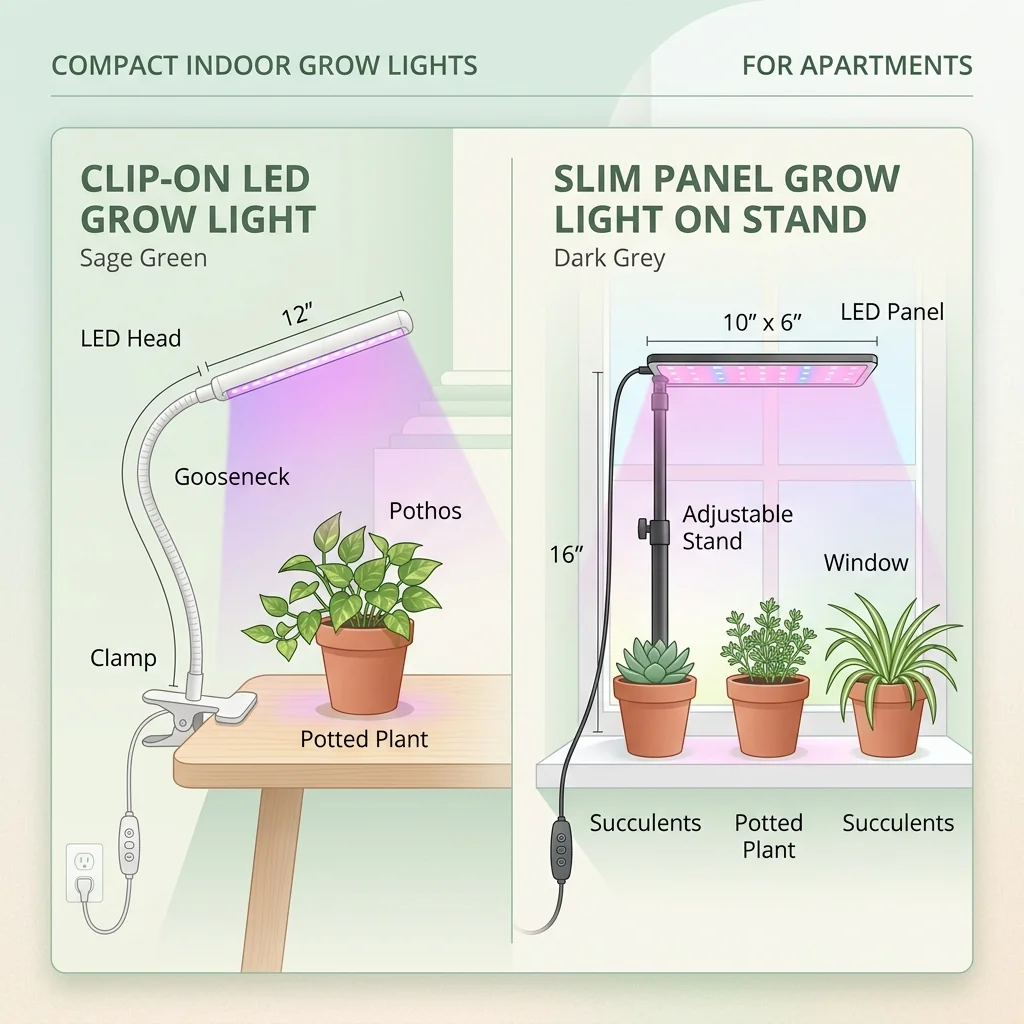
Best grow lights for apartments and windowsills
Apartments need grow lights that fit a small space and look acceptable in a living room. Here are the best compact LED types and what to check before buying.